IP reputation
Monitor your sending IP addresses, track reputation scores, and identify potential deliverability issues before they impact your email campaigns. View detailed IP health metrics.
To access IP reputation:
- Log in to your Infobip account.
- Go to Analyze → Email deliverability center → IP reputation.
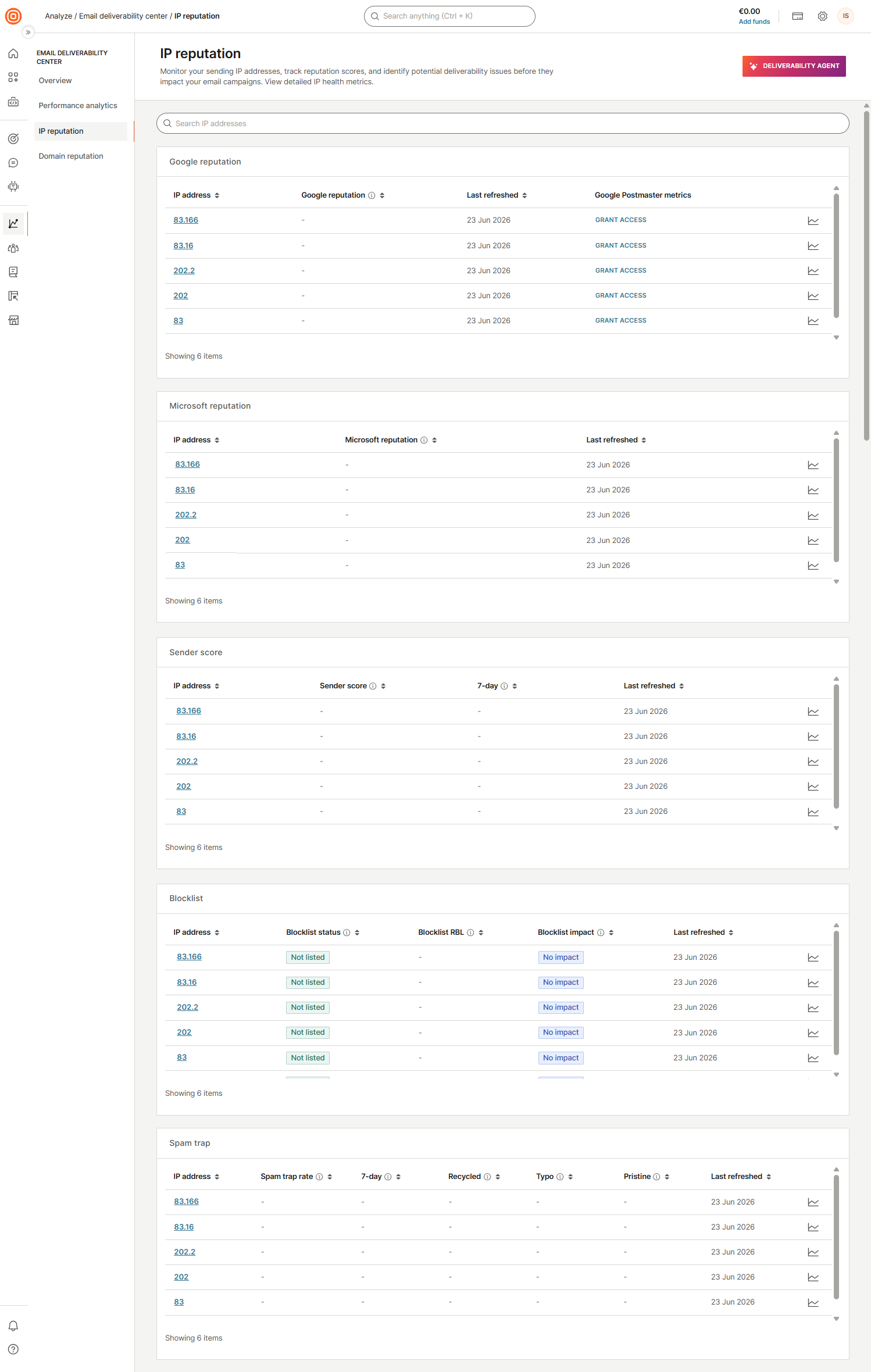
Use the Search IP addresses bar to find a specific IP. Select any IP address to open the IP address detail panel. Select the chart icon on any row to open Performance analytics filtered by that sending IP and grouped by provider.
Google reputation
The Google reputation table shows your IP reputation as reported by Google Postmaster Tools. This covers inbox placement signals from the Gmail ecosystem.
The table includes the following columns:
| Column | Description |
|---|---|
| IP address | The sending IP address. |
| Google reputation | The Gmail rating of your domain or IP based on user engagement and spam rates. High means inbox delivery, Low means the spam folder, and Unknown indicates insufficient sending history. If no data is shown, enable Infobip access in Google Postmaster Tools. |
| Last refreshed | The date the reputation data was last updated. |
| Google Postmaster metrics | Shows Grant access if Google Postmaster Tools is not yet connected for this IP. Select it to grant Infobip read-only access and start receiving reputation data. This is a one-time integration per IP. |
Grant Google Postmaster Tools access [#grant-google-postmaster-tools-access-google-reputation]
To receive Google reputation data in Infobip, you need to grant Infobip read-only access to your Google Postmaster Tools account.
Prerequisites
Before granting access, ensure you have the following:
- You must own or have administrative access to the sending domain.
- You need access to your domain's DNS settings for verification.
- A Google account with permission to manage Google Postmaster Tools.
Access Google Postmaster Tools
Go to Google Postmaster Tools ↗ and sign in with your Google account.
Add your sending domains
Select the + button and enter each of your sending domains.
Verify domain ownership
For each domain, Google provides a TXT record to verify ownership. Add this record to your domain's DNS settings:
- Copy the TXT record value provided by Google.
- Log in to your DNS provider (for example, Cloudflare, GoDaddy, or Route 53).
- Add a new TXT record with the host set to
@or your domain. - Paste the verification value and save.
- Return to Google Postmaster Tools and select Verify.
DNS changes may take up to 48 hours to propagate.
- In Google Postmaster Tools, select your verified domain.
- Select the three-dot menu and select Manage users.
- Select Add and enter:
[email protected] - Set the permission level to Reader or Viewer.
- Select Save.
What Infobip can monitor once connected
Once connected, Infobip will display the following:
- Domain reputation (Bad, Low, Medium, High)
- IP reputation for your sending infrastructure
- SPF, DKIM, and DMARC authentication rates
- Spam rate and user-reported spam
- Delivery errors and feedback loop data
Troubleshooting
- No data showing: Google requires sufficient email volume (typically 100+ emails per day to Gmail) before displaying metrics.
- Verification failing: Ensure the TXT record is correctly added and allow time for DNS propagation.
- Permission denied: Verify the service account email is entered exactly as shown above.
Microsoft reputation
The Microsoft reputation table shows your IP reputation based on spam data from the Outlook, Hotmail, and Live ecosystems.
The table includes the following columns:
| Column | Description |
|---|---|
| IP address | The sending IP address. |
| Microsoft reputation | The Microsoft rating of your IP based on spam data from Outlook, Hotmail, and Live users. High means reliable inbox delivery, Low means likely spam filtering. |
| Last refreshed | The date the reputation data was last updated. |
Sender score
The Sender score table shows the validity sender score for each of your sending IPs. Sender score is a 0 to 100 score reflecting overall IP reputation.
The table includes the following columns:
| Column | Description |
|---|---|
| IP address | The sending IP address. |
| Sender score | A 0-100 rating of IP trustworthiness based on spam traps, complaints, and provider data. Higher scores mean better inbox placement. |
| 7-day | The 7-day sender score trend. |
| Last refreshed | The date the score was last updated. |
Blocklist
The Blocklist table shows whether any of your sending IPs are listed on a real-time blocklist (RBL).
The table includes the following columns:
| Column | Description |
|---|---|
| IP address | The sending IP address. |
| Blocklist status | Whether your domain or IP is on email blocklists that block spam. Major impact means severely reduced deliverability; Minor impact has a limited effect. |
| Blocklist RBL | The blocklist provider where the IP or domain is listed. |
| Blocklist impact | The severity of blocklisting based on provider importance. |
| Last refreshed | The date the blocklist data was last updated. |
Spam trap
The Spam trap table shows spam trap hits for your sending IPs, broken down by trap type. Spam trap hits indicate list quality issues and can negatively affect your sender reputation. See Email lists and consent management and Suppression management for guidance on improving list hygiene.
The table includes the following columns:
| Column | Description |
|---|---|
| IP address | The sending IP address. |
| Spam trap % | The percentage of emails hitting spam trap addresses out of total traffic sent. Lower is better. |
| 7-day | The 7-day spam trap hit trend. |
| Recycled | Count of emails sent to abandoned addresses repurposed as spam traps. Indicates poor list hygiene from not removing inactive subscribers. |
| Typo | Count of emails sent to misspelled addresses (for example, @gmial.com). Indicates poor data collection from not validating emails at signup. |
| Pristine | Count of emails sent to addresses created solely to catch spammers. Indicates purchased or scraped lists and risks immediate blocklisting. |
| Last refreshed | The date the spam trap data was last updated. |
IP address detail panel
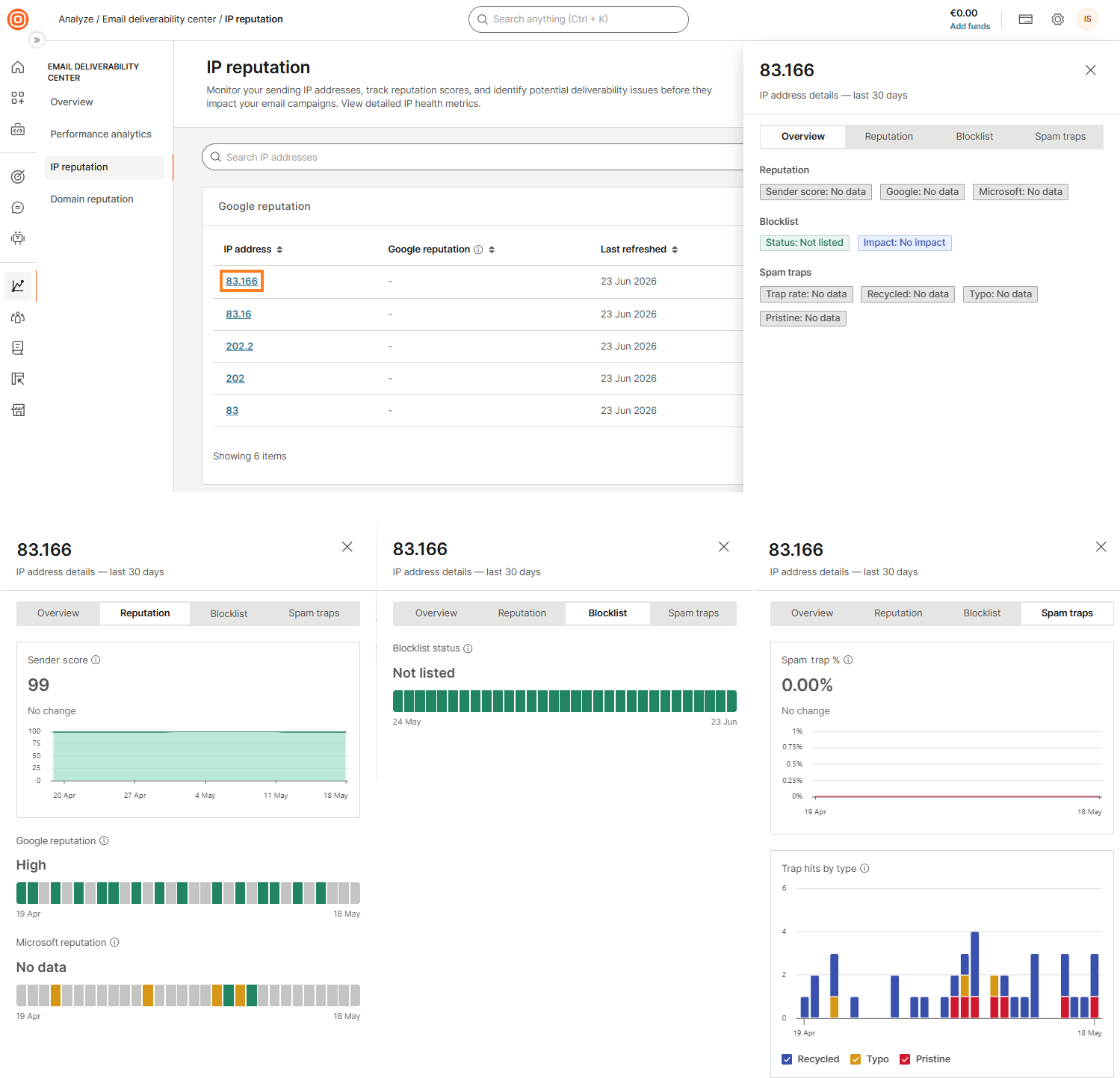
Select any IP address in any table to open the IP address detail panel. The panel shows a summary of IP health data for the last 30 days across four tabs:
- Overview: A snapshot of all health indicators, including reputation (sender score, Google, Microsoft), blocklist (status and impact), and spam traps (trap rate, recycled, typo, pristine).
- Reputation: Detailed reputation data for the IP across Google Postmaster Tools, Microsoft, and sender score.
- Blocklist: Detailed blocklist status and history for the IP.
- Spam traps: Detailed spam trap hit data broken down by trap type.
IP and domain warmup
How warming up IPs and domains affects your reputation scores.
Purchase and manage dedicated IPs
Add or change the sending IPs for your account.
Manage your IP and IP pool
Configure IP pool assignments for your sending domains.
Understand email deliverability
Core concepts behind deliverability, reputation, and inbox placement.