Email tracking types
Infobip supports several types of email tracking to help you measure delivery, engagement, and compliance.
Email opens
Open tracking shows how many recipients interact with your emails.
It works by logging an event when images in the email are automatically downloaded on the recipient’s side. If images are blocked, the open event cannot be tracked, so the data is not always 100% accurate. Because of this, treat open rates as indicative rather than absolute.
Open tracking still provides a useful signal for refining your email strategy and improving your sender reputation. Even if opens are not recorded, link clicks remain available as a reliable engagement metric, since opens and clicks are tracked separately.
URL clicks
URL click tracking is enabled by default when you add links in the Email editor.
Each time a recipient clicks a link, the request is routed through Infobip servers before reaching the final destination, and this action is logged as a click.
Using clicks, Infobip also tracks and obtains more data about the device the recipient was on when the URL was opened. This includes:
- Device type (desktop or mobile)
- Device name (for example, PC, Mac, Samsung, Huawei)
- Operating system (for example, Windows, macOS, Android, iOS)
Additionally, the recipient’s geographical location is tracked. The geolocation data includes:
- State
- City
- Longitude and latitude
This data helps marketers better understand their audience and tailor campaigns more effectively. Clicks from automated tools are reported separately. See Artificial clicks.
To generate a detailed click report:
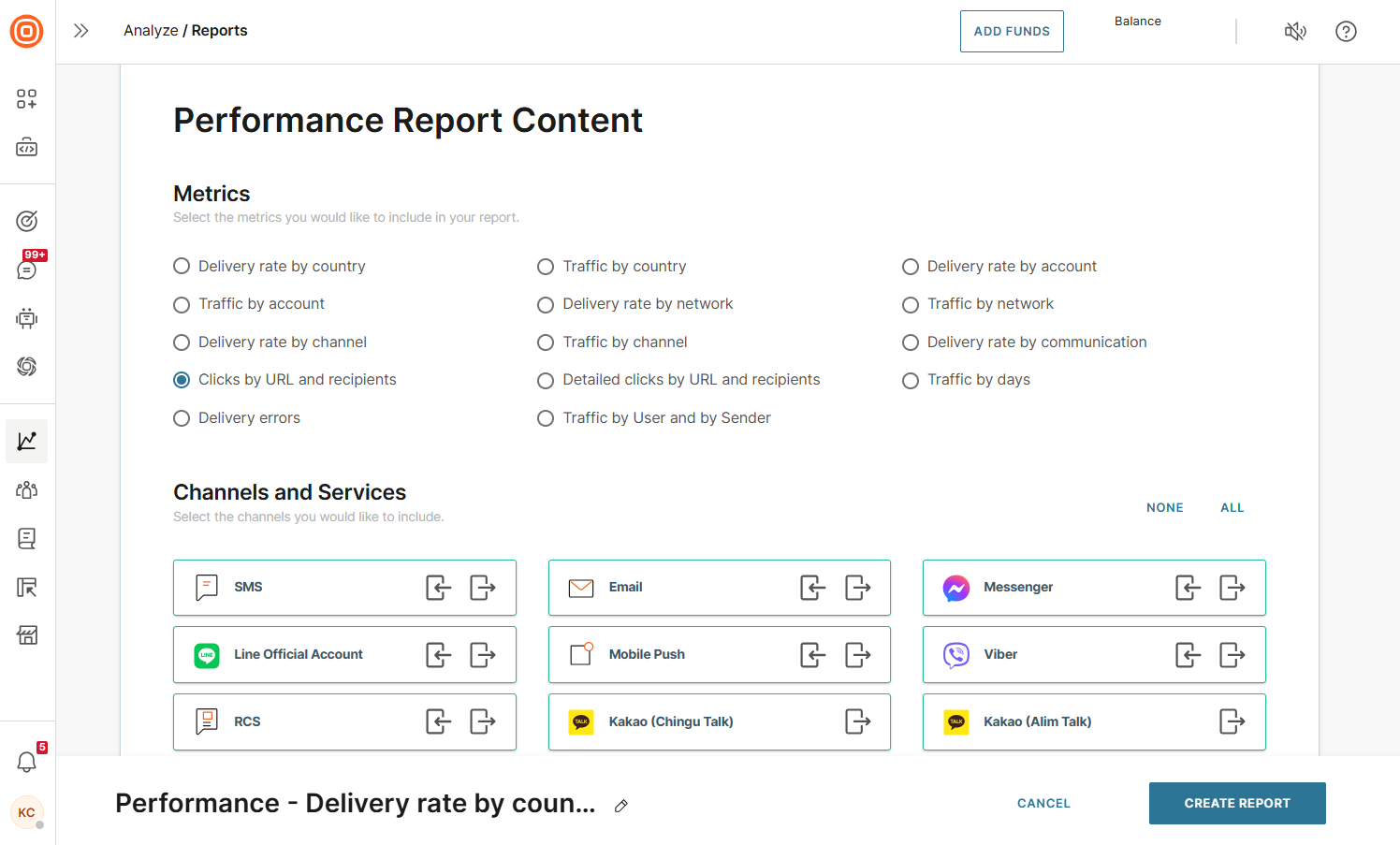
- Go to Analyze → Reports.
- Choose the Performance report type. You will see a list of metrics under the Performance Report Content section.
- Select Clicks by URL and recipients.
- Add any other necessary info.
- Select Create Report.
Disable click tracking on URLs [#disable-click-tracking-on-urls-url-clicks]
By default, Infobip tracks all URL clicks in HTML emails. If you want to keep click tracking enabled globally but exclude certain links, you can disable tracking at the link level. This option is available only when sending emails in HTML format.
To disable click tracking for a specific link, add the clicktracking=off attribute inside the <a> or <area> tag, before the href attribute.
For example, the following link will not be tracked:
Unsubscribes
Every email sent through Infobip includes an unsubscribe link. These links are automatically included in all email footers, even if you add them manually. For more details on how these links are integrated, see the Footer section.
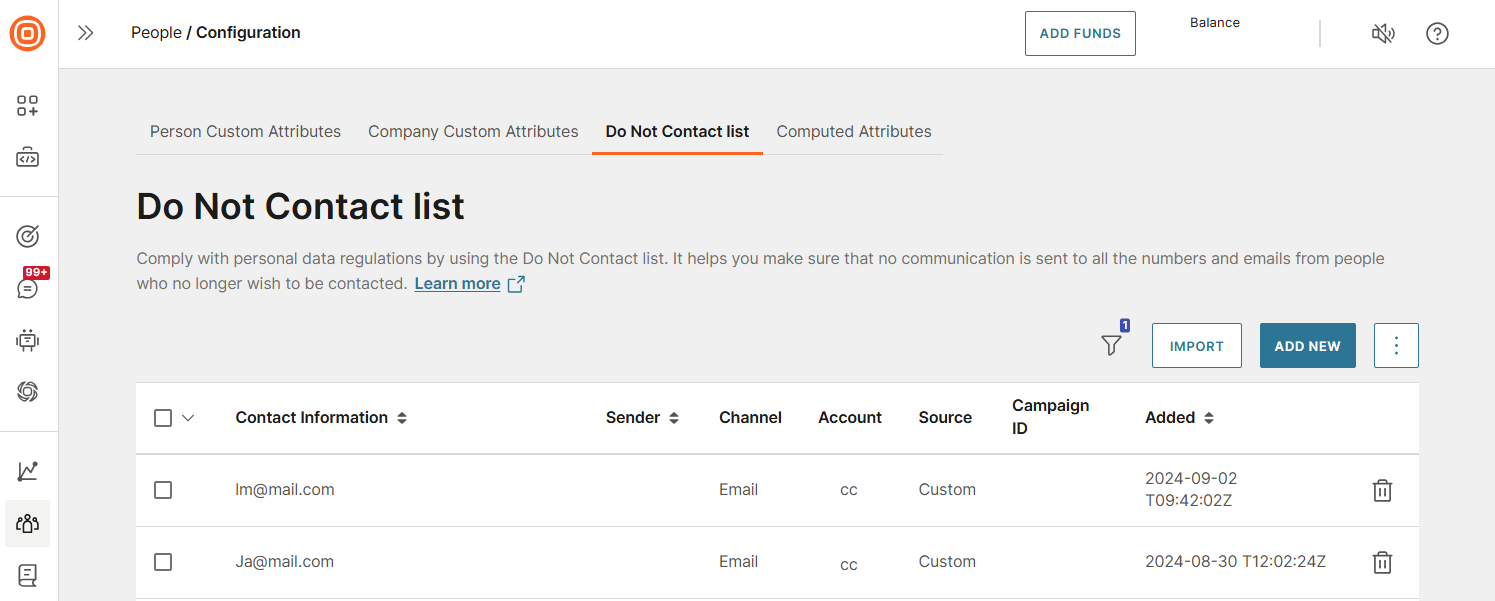
When recipients click this link, they are immediately removed from the sender list, and a record is inserted into the Do Not Contact filter.
You can view this list under People → Configuration → Do Not Contact list.
Unsubscribe functionality always applies at the sender level, not at the domain level.
For example, if a recipient unsubscribes from emails sent by [email protected], this does not block future campaigns sent from a different address at the same domain.
Complaints
A complaint is recorded when a recipient marks your email as spam. Mailbox providers report complaints to Infobip through feedback loops.
Infobip automatically adds these recipients to the suppression list to prevent further deliveries. High complaint rates damage your sender reputation and can lead to throttling or blocking by receiving servers.
To capture complaints, you can:
- Subscribe to the Complaint event in Subscriptions.
- Configure the Receive user events webhook with
"notificationType": "COMPLAINED".
Late bounces
Late bounces represent delivery failures that happen after the initial delivery attempt. For example, an email might be accepted by the recipient’s server but later rejected. These events are important for accurate delivery reporting and troubleshooting.
To capture late bounces, you can:
- Subscribe to the Late bounce event in Subscriptions.
- Configure the Receive user events webhook with
"notificationType": "LATE_BOUNCE".
Artificial clicks [#artificial-clicks]
Automated tools, such as email security gateways, antivirus and anti-spam scanners, and link-preview services, can follow tracking links within seconds of delivery, before the recipient sees the email. Counting this traffic as clicks inflates click-through and engagement metrics.
Infobip checks every tracked click against detection rules that identify non-human traffic:
- Clicks that pass the checks are reported as regular
CLICKEDevents. - Clicks that fail one or more checks are reported separately as artificial clicks (
ARTIFICIAL_CLICKED). - Requests that are not click attempts, such as a technical pre-check from a link-scanning tool, are not reported.
Detection applies only to link clicks, not to email opens. The rules are designed to minimize false positives, but some legitimate traffic can resemble automated traffic. For example, a recipient might use a VPN hosted on cloud infrastructure.
To receive artificial click events:
- Subscribe to the
ARTIFICIAL_CLICKEDevent using the Subscriptions API or Subscriptions Management in the web interface (Developer Tools → Subscriptions Management). For more information, see Available webhook events. - Configure the Receive user events webhook with
"notificationType": "ARTIFICIAL_CLICKED".
If you do not subscribe, Infobip drops artificial click reports, and you receive only regular click reports.