




How to improve customer satisfaction in a contact center
Effective ways to improve contact center customer satisfaction, from channel fit and AI agent containment to routing, handoffs and in-conversation feedback.

The nine levers, at a glance
- Put each query type on the channel that resolves it fastest
- Use asynchronous messaging to remove the queue instead of shortening it
- Scope AI agents to the queries where containment and satisfaction rise together
- Design the handoff so the customer never repeats themselves
- Route on intent, skill, and sentiment rather than queue order
- Treat wait time as a structural problem, not a staffing problem
- Collect feedback inside the conversation that just resolved the issue
- Use conversation analytics to find systemic causes, not just bad calls
- Give agents the context and tooling to be good at the hard half
Most attempts to improve customer satisfaction contact center go into handling customer interactions faster. More call center agents, tighter scripts, shorter average handle time. Those efforts help at the margin, and then they stop helping, because the largest available gains are not in how quickly a contact is handled. They are in whether the contact needed to happen at all, whether it resolved on the first call, and how much effort the customer spent getting there.
Three changes move the number more than anything else: putting each query on a channel that actually fits it, automating the routine call volume properly rather than partially, and making sure context survives every handoff. This article covers those three in depth, along with six further levers, the metrics that prove any of it worked, and the benchmark ranges to measure your own customer satisfaction score against.
What actually moves contact center CSAT
Customer satisfaction in a call center is not a single behaviour you can train for. It is the output of five underlying drivers, and each one fails differently.
- First contact resolution: Whether the issue was solved on the first call or first message is the strongest single predictor of the score. A fast service experience that resolves nothing produces a lower rating than a slower one that ends the problem.
- Total customer effort: Not how long the interaction took, but how much work the customer did: menus navigated, information repeated, channels switched, follow-ups chased. Effort predicts customer loyalty and customer retention more reliably than satisfaction does.
- Context continuity: Whether the business remembers the customer between interactions and across channels. Every request to repeat account details is a visible admission that it does not.
- Channel fit: Whether the customer could use the channel that suited their query, or was pushed onto one that suited the operation. Mismatched channels are a reliable source of customer frustration.
- Agent capability: Product knowledge, judgement and empathy on the customer interactions that reach a person, which after automation are the difficult ones by definition.
The classic three C’s of customer satisfaction map onto these neatly. Consistency means every customer gets the same answer regardless of channel or agent. Communication means the customer hears from you before they have to ask. Care means the interaction ends resolved rather than closed. Every tactic below is an attempt to make one of those three true at scale, and each one is designed to meet and exceed customer expectations on a specific part of the journey.
Nine ways to improve contact center customer satisfaction
Each of the nine below states what to change, why it moves the score, and which metric to watch. They are ordered by how much customer effort they remove, which is broadly the order of impact. The best customer service operations tend to work down this list rather than across it.
1. Put each query type on the channel that resolves it fastest
Offering more channels is not the same as offering the right ones. Most call centers now run voice, email, live chat and at least one messaging app, and then route by whatever the customer happened to pick rather than by what the query needs. The result is a delivery-status question occupying eight minutes of voice time, and a genuinely complex billing dispute being typed into a chat window one sentence at a time.
A workable mapping looks like this:
- Transactional and status queries: Order tracking, delivery windows, appointment changes, balance checks. These resolve in two or three messages on WhatsApp, RCS or SMS and should almost never reach voice.
- Identity-sensitive changes: Account updates, payment method changes, anything requiring verification. Live chat or messaging with authentication, so the customer is not reading card details aloud.
- Complex or emotionally loaded issues: Complaints, service failures, anything where the customer needs to be heard. Voice, with a real person, and ideally with the history already on screen.
Forcing a three-message query onto a voice call is an effort tax the customer pays and then rates you on. Getting the mapping right is usually the fastest available way to improve customer satisfaction in a call center, because it changes nothing about how well your service team works and everything about how much work the customer has to do. The Cloud Contact Center module within AgentOS handles voice, chat, email and messaging channels, including WhatsApp, Viber, RCS, and SMS in one agent interface, so the allocation is a call routing decision rather than a procurement one.
Metric to watch: customer effort score, and contacts per resolution.
2. Use asynchronous messaging to remove the queue instead of shortening it
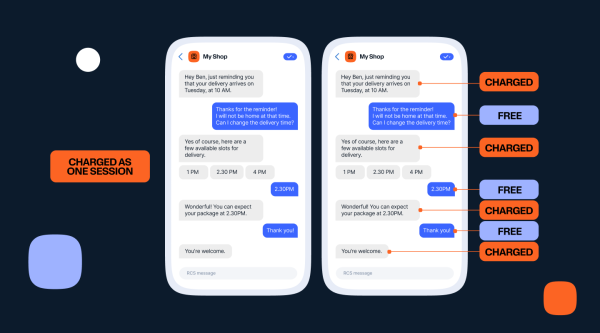
Every guide on this subject tells you to reduce wait times. Almost none point out that on an asynchronous channel there is no wait to reduce, because the customer is not waiting. They send a message, put the phone down, get on with their day, and come back when the reply arrives. The clock still runs on your side. It does not run on theirs.
That distinction changes the operational maths. A call center agent handling voice works one interaction at a time, and every minute of queue is a minute of visible frustration. An agent working asynchronous conversations handles several in parallel, and a four-minute response gap is not an experience the customer registers at all. Abandonment, the metric that governs so much voice-era staffing, largely stops being meaningful: nobody hangs up on a WhatsApp thread.
It also changes what peak season looks like. Floward, a flower and gifting retailer, handled 54,000 conversations on peak days and cut peak staffing requirements by 45% by moving volume onto messaging with automation behind it. Those are Valentine’s Day and Mother’s Day numbers, which is to say the days when contact centers usually break.
Metric to watch: abandonment rate, concurrent conversations per agent, and peak-period CSAT against baseline.
3. Scope AI agents to the queries where containment and satisfaction rise together
Plenty of teams have deployed a chatbot and watched their scores fall. That experience is real, and it is usually a scoping failure rather than a technology failure. A bot pointed at everything will fail at most of it, loudly, in front of the customers least equipped to tolerate it. Set against realistic customer expectations, though, automation is the single largest lever available on high call volume.
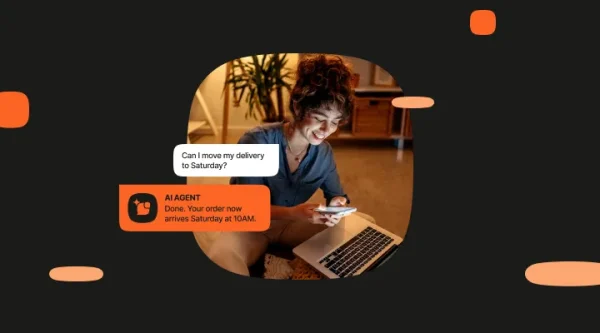
The scoping rule is narrow and boring, which is why it works. Automate queries that are high volume, low variance, and verifiable. Order status. Delivery windows. Balance inquiries. Appointment rescheduling. Password resets. These share a property: there is one correct answer, the system already holds it, and the customer can immediately tell whether they got it.
Framed that way, containment and satisfaction stop competing. A customer who gets a definitive answer at two in the morning rates that interaction higher than the same customer getting the same answer from a person at ten the next morning, because the second version involved waiting. Floward lifted its containment rate from 64% to 81% while reducing customer support costs by 15%, which is the shape you want: fewer contacts reaching customer service agents, and the ones that do arriving at a team with capacity.
AI Agents and the Chatbot Building Platform are modules within AgentOS, which means the AI layer and the human contact center share the same customer record rather than integrating across a vendor boundary. That matters for the next tactic more than this one.
Metric to watch: containment rate, and CSAT measured separately for contained and escalated conversations.
4. Design the handoff so the customer never repeats themselves
The handoff from automation to a person is where most contact centers quietly lose the satisfaction they gained. The chatbot fails, the customer is transferred, and the first thing the agent says is some version of “can I take your account number?”. Everything the customer just typed has evaporated. The interaction now feels worse than if there had been no automation at all.
Treat the handoff as a design problem with a specification. At minimum, five things transfer with the customer:
- The full conversation transcript, visible to the agent before they type their first word.
- Verified identity, so the agent doesn’t repeat authentication.
- The detected intent, so the agent knows what the customer was trying to do.
- Sentiment, so the agent knows how the conversation has been going.
- Any action already taken, so nothing is done twice and nothing is assumed undone.
The governing rule is simple to state and hard to implement: the customer should never be asked for information the business already holds. Implementing it requires the conversation data and the customer profile to live in the same place. The Conversational CDP within AgentOS builds profiles from conversational signals, intent, customer sentiment, and message history alongside the usual customer relationship management and transactional records, allowing context to cross the automation boundary intact rather than being reconstructed on the other side. It also makes genuinely personalized service possible at volume, because the personalization draws on customer data the business already has rather than what the customer just typed.
Metric to watch: repeat contact rate, and average handle time on escalated conversations.
5. Route on intent, skill, and sentiment rather than queue order
Sequential queueing treats every contact as equivalent and every agent as interchangeable. Neither is true. A customer with a technical configuration problem and a customer threatening to cancel need different people, and giving them whoever is free next produces two mediocre outcomes instead of two good ones.
Attribute-based call routing sends each conversation to the agent best equipped for it, using skill, language, availability, current workload, and account history. Sentiment-aware prioritization adds a second dimension: a conversation trending negative moves up the queue and toward a more experienced agent, before the relationship is the thing at stake rather than the query. On accounts with high customer lifetime value, that ordering is the difference between a recovered relationship and avoidable customer churn.
The upstream improvement matters as much as the routing logic. When routing draws on profile data rather than on what the customer selected from a menu, the customer stops doing the classification work. Smart routing and inbound IVR within the Cloud Contact Center can key off attributes the platform already holds instead of asking the customer to describe their own problem in four keypresses.
Metric to watch: first contact resolution and transfer rate.
6. Treat wait time as a structural problem, not a staffing problem
Long queues get read as a resourcing failure and answered with a hiring plan. Usually they are a demand problem wearing a resourcing costume. Most of the call volume arriving at a contact center was manufactured somewhere upstream: an invoice line nobody can interpret, a delivery that went quiet, a self-service flow that dead-ends two steps before it resolves anything. None of that is a service quality problem, and none of it is fixed by hiring.
Three interventions work better than headcount, in this order:
- Proactive notification: Anticipate customer needs and tell people what is happening before they have to ask. Shipment updates, delay notices, appointment reminders, payment confirmations. Every proactive message that lands is a contact that never arrives, and it arrives on a channel the customer already uses.
- Genuine self-service: Self-service counts only when it completes the task and resolves customer issues outright. A knowledge base article that explains a process the customer cannot then execute deflects the contact by about four minutes.
- Callback and virtual hold: For voice volume you cannot remove, stop making the customer hold the line for it.
The metric that matters here is not average speed of answer. It is contact volume per thousand customers. If that number is not falling, you are getting better at absorbing a problem rather than fixing it.
Metric to watch: contact volume per thousand customers, alongside average speed of answer.
7. Collect feedback inside the conversation that just resolved the issue
Post-interaction survey response rates have been falling for years, and the customers who still respond are disproportionately the delighted and the furious. The quiet middle, which is where most of your customers and most of your fixable problems live, goes unmeasured. Chasing the response rate with more reminder emails makes fatigue worse, and it leaves you acting on customer feedback that doesn’t represent the customer journey most people actually had.
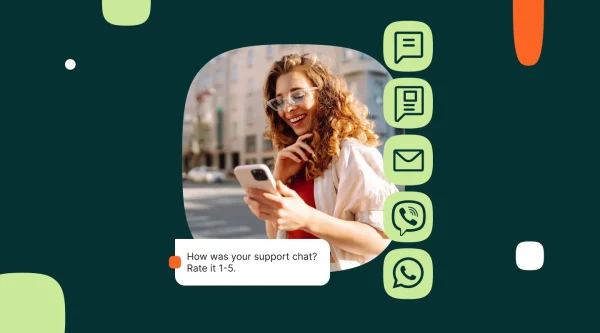
Asking inside the thread works better for an unglamorous reason: the customer is already there. The rating request arrives in the same WhatsApp or Viber conversation that just resolved the problem, seconds after resolution, while the interaction is still top of mind. No inbox, no click-through, no separate survey tool. Rich media is available if you want more than a number, and the response carries the full conversation context with it, so a low score comes attached to the transcript that caused it.
Higher response volume also makes the data usable enough to drive decisions, which is the difference between collecting feedback and acting on customer feedback. Queue-level and agent-level scores need enough responses to be meaningful, and survey-only measurement rarely produces them. Flamingo, a beauty retailer, increased its NPS score by 18% and lifted online sales conversion by 11% after moving customer conversations to messaging channels.
Metric to watch: survey response rate, and score coverage per agent and per queue.
8. Use conversation analytics to find systemic causes, not just bad calls
Quality assurance conventionally means sampling a handful of call recordings per agent per month and scoring them. It finds individual performance problems, which are real but rarely the reason scores move. When call center customer satisfaction drops across a queue, the cause is almost never that a group of agents simultaneously got worse. It is a policy change, a product defect, a pricing communication, or a process that started generating a new category of contact.
Automated scoring across every interaction rather than a sample changes what you can see. Intent and sentiment trending surfaces the new contact reason in the week it appears rather than the quarter after. Then the finding has to travel: if billing language is generating contacts, the fix belongs with the billing team, not with a coaching session for agents who are handling it correctly.
Insights and analytics within AgentOS covers live and historical dashboards across channels, with conversation transcripts and sentiment detection feeding the same view. The point is the routing of the finding, not the dashboard.
Metrics to watch: repeat contact reason volume, and time from cause emerging to cause identified.
9. Give agents the context and tooling to be good at the hard half
Once automation absorbs the routine volume, the interactions reaching a person are harder by definition. The easy ones stopped arriving. This is why the teams that automate most aggressively often need to invest more in call center agents, not less, and why treating automation as a headcount strategy tends to end badly. Exceptional customer service becomes the whole job, not a share of it.
Three things make a measurable difference:
- Context on arrival: A customer context card with purchase and customer history, prior interactions, segment, and current journey state, visible before the agent responds. An agent who has to ask what the customer bought starts the conversation already behind, and no amount of training turns that into excellent customer service.
- Assistive tooling: Agent Copilot surfaces responses from previously resolved cases, AI conversation summaries so a transferred agent reads three lines instead of forty, and writing assistance with rephrasing and translation for multilingual queues.
- Coaching on real transcripts: Reviewing conversations that actually happened, with the sentiment trace attached, beats generic soft-skills training. Empathy and active listening are trainable, but they are trainable against real examples, not role play.
Beam&Go doubled agent response time and cut cost by 30% after consolidating channels and adding automation, and Readmoo reported a 20% increase in team productivity. Both results come from removing friction around agents rather than adding pressure onto them.
Metric to watch: quality scores on escalated conversations, and agent attrition.
How to measure contact center customer satisfaction
None of the above is provable without measurement that can distinguish a real improvement in the customer experience from a quiet change in who is answering your surveys.
CSAT, NPS, and CES, and what each one tells you
The three standard metrics answer different questions, and using one where another belongs is a common source of confusion in reporting.
| Metric | What it measures | Blind spot |
|---|---|---|
| CSAT | Satisfaction with a single interaction, usually on a five-point scale immediately after resolution | Recency-biased and interaction-level. A customer can rate five interactions highly and still be preparing to leave. |
| NPS | Likelihood to recommend, which tracks the overall relationship rather than any one contact | Slow to move and influenced by product, price and brand, so it rarely isolates contact center performance. |
| CES | How much effort the customer spent getting their issue resolved | Less familiar to executives, which makes it harder to report upward despite predicting loyalty better than satisfaction for service interactions. |
CSAT is calculated as the number of satisfied responses, meaning ratings of 4 and 5 on a five-point scale, divided by the total number of responses, multiplied by 100. Eighty satisfied responses out of 100 total gives a CSAT of 80%.
What a good contact center CSAT score looks like
Benchmarks vary by industry and channel, but the operating bands are reasonably stable.
| CSAT band | What it means operationally |
|---|---|
| Below 75% | Something structural is wrong. Look for a resolution problem or a channel mismatch before looking at agent performance. Coaching will not close a gap of this size. |
| 75 to 84% | The common operating range for most contact centers. Improvements here come from first contact resolution and effort reduction rather than from tone or courtesy. |
| 85% and above | World class. Sustaining it depends more on preventing contacts than on handling them well, because the handling is already good. |
Two caveats worth reporting alongside any of these numbers. Channel changes the baseline: messaging and self-service resolutions typically score differently from voice, so a CSAT movement that follows a channel shift may be measuring the shift rather than an improvement. And the trend line matters more than the absolute. A contact center moving from 76 to 81% is doing something right, whatever the industry average happens to be.
Why survey-only measurement understates the problem
Survey scores tell you what the people who answered thought. They do not tell you how the customer feels when they never respond at all, and the people who did not answer are the majority. Combine the survey data with behavioural signals that do not require the customer to participate: repeat contact rate within seven days, abandonment, escalation rate, and sentiment measured across all conversations rather than a sampled few. When the survey score is flat and the repeat contact rate is climbing, trust the repeat contact rate.
What gets in the way
Four obstacles account for most stalled CSAT programmes, and none of them is a motivation problem.
- Customer data split across systems: When the CRM, the ecommerce platform, the chatbot and the call center each hold a partial record, no interaction starts informed and every handoff loses something. The fix is a unified profile, not a better integration backlog.
- Channels bolted on separately: Messaging added as a standalone tool, live chat from a second vendor, voice from a third. Each boundary is a place context dies, and customers experience the boundaries even though they cannot see them.
- Measurement that samples too little to diagnose anything: Reviewing 2% of interactions tells you about 2% of interactions. Root causes appear in aggregate patterns, which a sample of that size cannot show.
- Agent attrition resetting capability: High turnover means a continuously re-learning team, and the quality of judgement on difficult conversations never compounds. Reducing the volume of unnecessary contact is usually a better retention lever than a retention programme, and it protects customer retention at the same time.
Where Infobip fits
Most call centers assemble these capabilities from several vendors: a messaging provider, a chatbot tool, a contact center platform, an analytics product. Each integration is a boundary, and customer context degrades a little at every one. That degradation is what the customer experiences as being asked to repeat themselves.
AgentOS is Infobip’s agentic AI platform, and the capabilities behind the nine tactics above are modules within it rather than separate products. The Cloud Contact Center brings voice, chat, email, social and messaging into one agent interface with smart routing, inbound IVR, Agent Copilot and AI conversation summaries. AI Agents and the Chatbot Building Platform handle the automation layer. The Conversational CDP builds unified profiles that include conversational signals alongside CRM and transactional data. The Customer Engagement Platform handles proactive outbound messaging. Insights and analytics covers the measurement layer.
Because these are modules of one platform, a conversation that starts as a WhatsApp message to an AI agent and ends with a human agent on voice never crosses a vendor boundary. The transcript, the verified identity, the detected intent and the sentiment travel with it. Infobip also operates its own messaging infrastructure, with approximately 800 direct operator connections across more than 190 countries, which means the delivery of every notification, verification and outbound update sits on the same platform as the conversations they generate.
The results referenced through this article come from that architecture: Floward reducing customer service costs by 15% while lifting containment from 64 to 81%, Beam&Go cutting cost by 30% and doubling agent response time, Readmoo lifting team productivity by 20%, and Flamingo raising NPS by 18%. In each case the improvement in customer experience came from removing steps rather than from adding them.
Where to start with contact center customer satisfaction
Do not attempt nine changes at once. The sequence below produces measurable movement inside a quarter, and each step makes the next one easier.
- Establish a real baseline: Measure your customer satisfaction score alongside repeat contact rate and effort, not CSAT alone, so you can tell improvement from sampling noise.
- Identify your three highest-volume contact reasons: In most call centers these account for a disproportionate share of total volume and almost none of the strategic value.
- Move the most automatable of the three to an asynchronous channel with an AI agent behind it: One reason, one channel, measured against the baseline.
- Instrument the handoff before you scale the automation: Transcript, identity, intent, sentiment and actions taken all transfer, or the automation will cost you more than it returns.
- Only then extend to the next contact reason.
The order matters. Teams that scale automation before fixing the handoff usually improve containment and lose satisfaction, then conclude that automation does not work. It does. The handoff was the problem. Work through the sequence in order and you will increase customer satisfaction on a measurable, defensible basis rather than on a hunch, and you will deliver a better customer experience while doing it.
Frequently asked questions
Focus on four levers before anything else: resolve each query on the channel that suits it, automate the high-volume routine contacts, design handoffs so the customer never repeats information, and route on intent rather than queue order. Together, these reduce customer effort, which is the strongest driver of satisfaction in service interactions. Measure with CSAT alongside repeat contact rate so improvements are provable rather than assumed.
Five apply in almost any service context:
- Reduce the effort the customer spends, not just the time you spend.
- Resolve on first contact, even when that takes longer.
- Personalise using context you already hold rather than asking again.
- Act on feedback visibly, so customers see that responding changed something.
- Fix the upstream causes generating contacts instead of absorbing them.
Consistency, communication and care. Consistency means the customer gets the same answer regardless of channel, agent or time of day. Communication means keeping them informed before they have to ask, through proactive updates on issues, orders and delays. Care means treating resolution as the goal rather than case closure. In a contact center, consistency usually fails first, because it depends on every channel and system sharing the same customer record.
It is the long-standing service level convention of answering 80 percent of incoming contacts within 20 seconds. It remains a useful staffing target for voice queues, but it is worth treating carefully. It measures speed of answer and says nothing about whether the issue was resolved, and it does not translate to asynchronous channels where the customer is not holding a line. A contact center hitting 80/20 on voice while customers call back twice is not performing well.
Below 75 percent indicates a structural problem in resolution or channel fit. Between 75 and 84 percent is the range most contact centers operate in. Eighty-five percent and above is generally considered world class. Industry and channel both shift the baseline, so compare against your own trend line before comparing against a published average.
Divide the number of satisfied responses, meaning ratings of 4 and 5 on a five-point scale, by the total number of responses, then multiply by 100. Eighty satisfied responses out of 100 gives a CSAT of 80 percent. The figure is only as reliable as the response rate behind it: low response rates skew heavily toward customers at the extremes of the experience.
Badly scoped ones do. Well scoped ones raise it. The rule is to automate queries that are high volume, low variance and verifiable, such as order status, delivery windows and appointment changes, where there is one correct answer the system already holds. A customer who gets a definitive answer at two in the morning rates that higher than the same answer from a person the following day. The handoff to a human matters as much as the bot: if context does not transfer, the automation costs more satisfaction than it creates.
Channel and automation changes typically show up within one or two survey cycles, because they change the interaction itself rather than how well it is handled. Routing and coaching changes compound over a quarter. Fixing the upstream causes of contact volume takes longest and produces the largest, most durable movement, because it removes interactions rather than improving them.