





Voice use cases
Apply Voice to your customer journey to offer amplified experiences. Infobip’s Voice API use cases include notifications, interactive voice response (IVR) and call routing, one-time passcode (OTP) authentication, number masking and AI voice agents (Early Access). All of them run on one programmable voice platform.
Sign up and try our platform today. See Voice pricing.




195 countries for outbound calls, 68 for inbound calls
77 languages or dialects for text-to-speech voice messages
100 billion+ minutes processed annually
What is a Voice API, and what can you build with it?
A Voice API is a programmable interface that lets your application place and answer phone calls through a cloud platform instead of a traditional phone system. Your code sends a request, Infobip’s platform connects the call, and you decide what happens next: play a text-to-speech or pre-recorded message, collect keypad input, route the call to an agent or record the call.
Because the building blocks are the same for every scenario, one Voice API supports a wide range of use cases. The sections below group them by what the call is for, then show which API or low-code tool implements each one.
Core capabilities behind every use case
- Outbound calls in 195 countries and inbound calls in 68 countries
- Text-to-speech in 77 languages or dialects with 960 voices, plus speech-to-text in 143 languages or dialects across 74 base languages for voice bots and advanced IVR
- Interactive voice response (IVR) menus, keypad (DTMF) input and call routing
- Call recording, answering machine detection and conferencing
- Real-time media streaming to external systems for speech analytics or natural language processing
- SIP trunking, which links your existing phone system (PBX) or contact center to Infobip’s network, including Authenticated SIP for external AI providers
Many of these use cases can be launched without code using Flows, and developers can go deeper through the APIs when they need to.
Voice API use cases for notifications, automated support and insights


Voice authentication and OTP
Mitigate security threats from fraudsters by sending authentication messages over Voice.
Account recovery and identity verification
Verify user identity over Voice to recover accounts. Customers receive an automated call from a security prompt and can enter a pin via their keypad or get an audible pin which they use on another application to log into their account.
New user registration
During onboarding or registration, use Voice calls to authenticate user identity and ensure smoother conversions and secure account setup.
Voice two-factor authentication
As an alternative to 2FA through SMS, send one-time pins or passwords over Voice and ensure end-users get their security messages faster in urgent situations.
Number Masking
Ensure two-way calls are anonymized and user data stays private with Number Masking. Connect individuals over a Voice call and safeguard their personal numbers with our Number Masking API, Click-to-Call API or through the Calls API.

Infobip is a great partner because of their ability to keep up with our global growth and provide the type of service we need to meet our users’ demands.
Yoon Jung
Procurement Manager, Uber
AI voice agents and voice bots for inbound and outbound calls
Voice AI Agents, currently in Early Access, bring conversational AI to phone calls. An agent answers the call, understands what the caller wants through speech recognition, looks up the answer in your CRM or order system, and resolves the request or hands off to a human agent with a full summary. The aim is to resolve routine calls faster and leave live agents free for complex ones. Voice AI Agents build on IVR and run on the same voice network as the rest of this page. Authenticated SIP Trunking, SIP secured with TLS and SRTP encryption, connects your existing phone system or an external AI provider, so you can keep your current AI stack. It is distinct from standard SIP trunking, which links a PBX to Infobip’s network.
Where voice agents extend IVR with natural conversation
Status lookups
Verifies the customer, queries the backend and answers in one conversation
Appointment booking
Checks availability, offers slots and confirms the booking by voice
FAQ and support
Answers grounded in your knowledge base, so routine inquiries can be handled without a human
Outbound reminders and collections
Payment reminders, ID verification and repayment conversations at scale
Because Voice AI Agents are part of AgentOS, they work with the AgentOS customer data platform and journey orchestration. The agent knows who is calling before it speaks and can trigger SMS, WhatsApp or email follow-ups after the call ends.
Orchestrate engaging Voice interactions without coding
Connect with customers anywhere in the world. Use local numbers, offer convenience and seamless experiences to quickly build Voice scenarios without any coding experience.
Cloud contact center
Offer customers human-to-human interactions with Voice. Live agents can have a full view of past interactions and offer better customer support over Voice.
Customer engagement solution
Create event or behavior triggered workflows with Voice and keep your customers up-to-date on security alerts or messages.
Voice API use cases by industry
The same APIs solve different problems in each sector. These are the use cases Infobip customers run most often. For more by sector, browse the Voice use case library.
Financial services
Voice OTP and two-factor authentication, fraud alerts that need an immediate answer, and payment reminders delivered as a call when a text goes unread.
Retail and eCommerce
Order and delivery notifications, click-to-call support from the app, and number masking between couriers and customers.
Healthcare
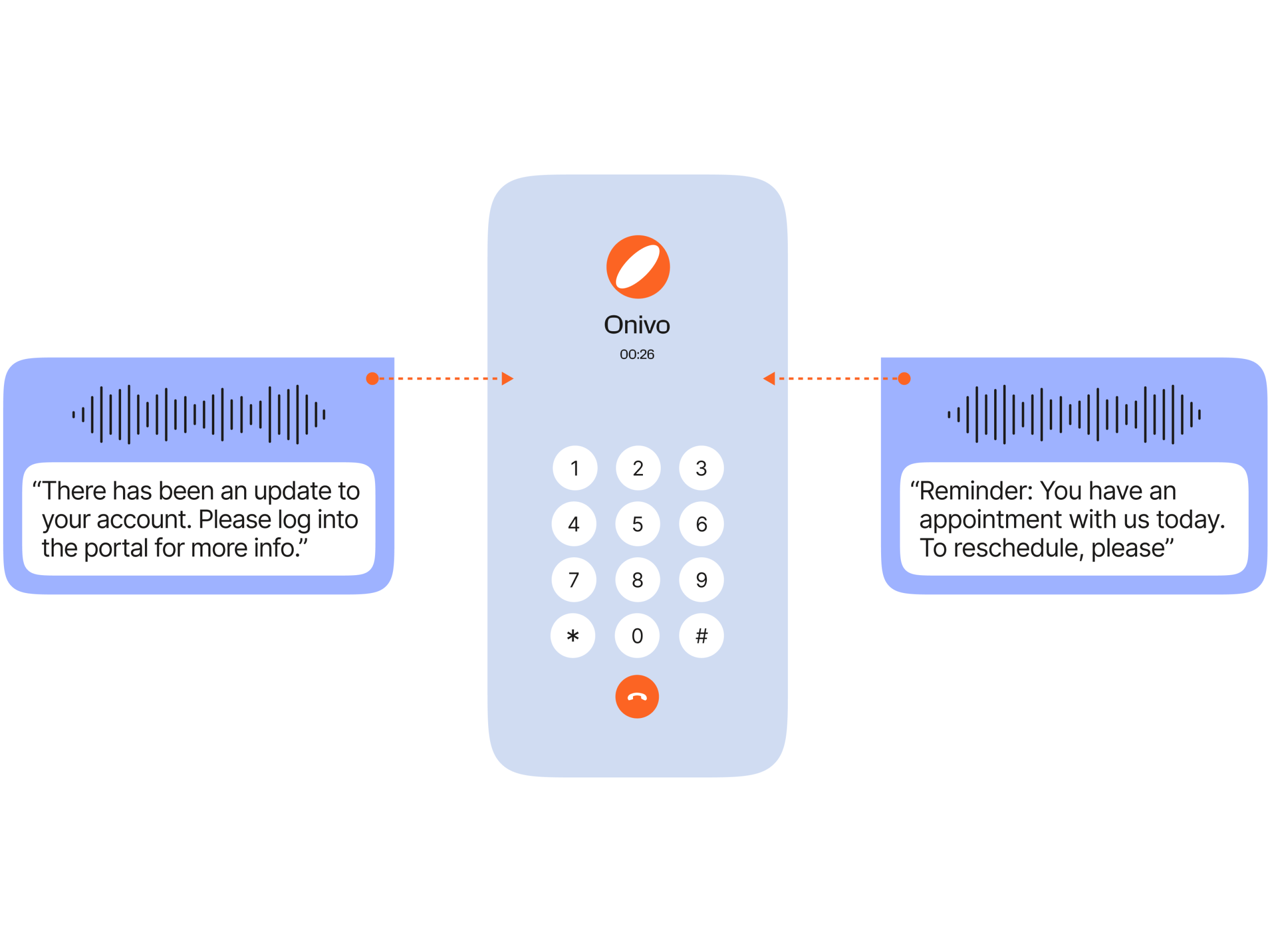
Appointment reminder calls with confirm-or-reschedule keypad input, results-ready notifications and patient callbacks that never expose a clinician’s number.
Transportation and logistics
Masked calls between drivers and passengers or recipients, arrival alerts and dispatch calls for every delivery.
Telecoms
Network status alerts, IVR self-service for account queries and SIP trunking for connectivity between mobile network operators (MNOs) and virtual operators (MVNOs).
Contact centers
Voice AI Agents (Early Access) for routine inquiries and a cloud contact center for everything else, with recordings and reports on each call.
Build your first Voice API use case today
Create a free account and send your first voice message before you commit to any volume.
Try for freeWhich Voice API fits each use case?
Infobip’s Voice APIs are modular. Pick the endpoint or low-code tool that matches the job, or combine them in one workflow.
| Use case | Recommended API or tool | Key features |
|---|---|---|
| Notifications, alerts and reminders | Voice Messages, Broadcast | Text-to-speech or pre-recorded audio, 77 text-to-speech languages or dialects, scheduling and retry policies, answering machine detection |
| Self-service menus and call routing | IVR, Flows | Keypad (DTMF) and speech input, call routing, call recording, no-code design with Flows |
| Authentication and OTP | Voice Messages | Spoken one-time pins, keypad (DTMF) collection |
| Private two-way calls | Number Masking, Click-to-Call, Calls API | Virtual numbers, call anonymization, call recording |
| In-app and browser calling | Calls API, WebRTC SDK | Calls from apps and browsers |
| Automated conversations on calls | Voice AI Agents (Early Access), Calls API with media streaming | Natural-language conversations, human handoff with context, media streaming for custom builds |
| Contact center connectivity | SIP trunking, Authenticated SIP Trunking | Connects your existing PBX or SBC, trunk management via API, integrations with Freshworks, Genesys PureCloud, Cisco Webex and OpenAI Realtime |
| Surveys and feedback | Flows | Keypad scoring, recorded verbal feedback, NPS workflows |
Integrate Voice APIs with a few lines of code
Send a voice message or reminder, start a call flow or bridge a call with the same REST conventions used across Infobip’s channels. Documentation, SDKs and Postman resources are available for developers, and the same account works for SMS, WhatsApp and every other channel.
- 60+ granular APIs and 60+ call events for full control over calls
- SDKs for popular programming languages
- Webhooks and delivery reports for real-time call status
- 24/7 support
Voice pricing: pay as you go, by destination
Voice usage is priced per destination on a pay-as-you-go basis, so you can start with one scenario and scale as it proves itself. Use the calculator on the Voice pricing page to estimate monthly cost from expected call volume, or contact us for a custom plan as your call volume grows.
Pay-as-you-go
Top up your account as you need with a flexible, pay-as-you-go model.
Custom plans
Running high call volumes? Contact us for a custom plan for large-scale Voice traffic.
See what our customers achieved with Voice
Discover how businesses use Infobip Voice APIs to protect privacy and reach customers in the moments that matter.
Uber
Number masking keeps calls between riders and drivers private across markets, without exposing personal phone numbers.

Wiraya
Payment reminders and debt collection run as voice-led journeys, so customers understand what happened, what they need to do and how to complete it.
How to choose a Voice API for your use case
Voice APIs look alike on a feature list. These are the factors that separate them once calls are in production.
Check how many countries the provider covers and how calls are routed. Infobip offers outbound calling in 195 countries and inbound calling in 68, with direct connectivity where available, 40+ data centers and redundant routing.
Ask about network architecture. A low-latency, redundant network matters most for two-way calls, browser calling (WebRTC) and voice agents, where a delay of even a second breaks the user experience.
Look for call recording compliance and data residency controls. Infobip holds SOC 2 Type 2 and ISO 27001 certifications company-wide, and these apply to the shared platform Voice runs on. Its privacy program addresses GDPR. In the US, Branded Calling ID (BCID) shows your verified business name, logo and call reason before the call is answered. Infobip’s BCID is CTIA-verified.
Text-to-speech and speech-to-text languages, call recording, answering machine detection, conferencing and media streaming decide which use cases you can build without a second vendor.
If voice agents are on your roadmap, choose a platform where the voice bot, customer data and human contact center share one system, so a call hands off with context. Infobip’s Voice AI Agents are in Early Access, and Authenticated SIP lets you keep an external AI stack.
Clear documentation, SDKs, a free account to test with and 24/7 support shorten the time from first API call to production.
Pay-as-you-go pricing with a public calculator lets you test a scenario before committing, and a custom plan should be available when your volume grows.
A voice provider recognized by analysts and trusted by global brands
The industry analysts have spoken. The platform behind every Voice use case is recognized worldwide for driving results for customers.


CPaaS Established Leader
Juniper Leaderboard 2025

Infobip is named as No. 1 CPaas provider
MetriRank CPaaS Report 2024

Infobip is named a Leader
CPaaS Universe Report 2025

Infobip is named a Leader in worldwide CPaaS
IDC MarketScape 2025
Frequently asked questions about Voice API use cases
A Voice API is a programmable interface that lets applications make, receive and control phone calls through a cloud platform instead of a traditional phone system. Developers use it to add calling, interactive voice response (IVR), spoken messages, recording and routing to their own software.
Notifications and reminders, self-service menus and call routing, voice OTP and two-factor authentication, number masking for private two-way calls, click-to-call, customer surveys, and Voice AI Agents (Early Access) that handle routine calls.
Voice over IP (VoIP) is the technology that carries calls over the internet. SIP trunking connects your existing phone system (PBX) or contact center to the phone network, so you can modernize without replacing it. A Voice API adds programmable control: your application decides when to call, what to play, how to route and what to record.
Yes. Voice AI Agents, currently in Early Access, run on Infobip’s voice network. To keep your own AI stack, connect it through Authenticated SIP Trunking, the preferred route for external voice AI providers. For custom builds, the Calls API supports media streaming.
Text-to-speech is available in 77 languages or dialects across 52 base languages, with 960 voices, and you can also play pre-recorded audio files. Speech-to-text supports 143 languages or dialects across 74 base languages.
Voice usage is priced per destination on a pay-as-you-go basis. For high call volumes, contact us for a custom plan. The Voice pricing page has a calculator for estimating monthly costs.
Calls run on 40+ data centers with redundant routing and built-in retry logic. Number masking and call anonymization protect customer privacy on the call, and in the US, Branded Calling ID is CTIA-verified. Infobip holds SOC 2 Type 2 and ISO 27001 certifications company-wide, which apply to the shared platform Voice runs on, and its privacy program addresses GDPR.
It reaches customers on a high-attention channel, can cut wait times with self-service and voice agents, and, with AgentOS, carries context from earlier interactions into the call so customers repeat themselves less.
Start building your unique Voice solution today
Create voice assistant use cases with customizable APIs. Sign up today and try it for free. No credit card required.
