





Built to reinvent: Infobip’s approach to innovation after 20 years
Infobip’s Chief Innovation Officer and Chief Product Officer on 20 years of customer-driven innovation, from SMS infrastructure to AI-powered agent experiences.



Infobip’s Kreso Zmak and Adrian Benic on what innovation actually looks like inside a company that has reinvented itself at every stage of growth.
When our founders reflected on 20 years of building the company, they returned to a phrase that has followed them since the beginning: “We are just starting.”
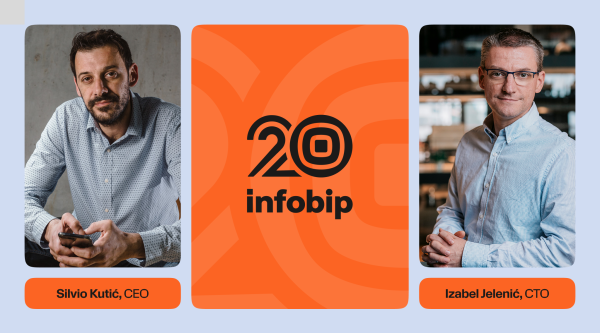
But a mindset alone doesn’t explain how a company goes from sending SMS messages in a small Istrian town to processing 1.2 billion transactions a day across 40+ data centers. That takes method and people who carry it forward as the company grows.
Kreso Zmak, Chief Innovation Officer at Infobip, and Adrian Benic, Chief Product Officer, are two of those people. In separate conversations marking the company’s 20th anniversary, both arrived at the same conclusion: Infobip’s advantage was never a single breakthrough. It was the habit of reinvention, applied consistently to products, teams, and the way the company operates.
There are no apples falling from trees
Innovation carries a myth that Kreso is quick to challenge. The image of a sudden flash of insight, an apple falling or a light bulb switching on, obscures what actually makes innovation work.
Innovation is often perceived as the example of Newton sitting below the tree and the apple falls and you get an idea. Innovation is much more than that. It requires very hard work. It requires preparation, deep research. And above all, a lot of conversations with customers, because innovation must be linked to their pain points, their ideas, the problems they encounter.

Kreso Zmak
Chief Innovation Officer, Infobip
Adrian Benic, Chief Product Officer, frames it differently but reaches the same place. “Innovation at Infobip isn’t a single product moment, it’s a series of compounding bets,” he says. “We tend to commit to the next layer while the current one is still working. Looking back, the progression seems obvious. At the time, each move meant redirecting energy from something that was growing.”
Innovation isn’t a flash of inspiration. Think of it like sport, you don’t become Luka Modric overnight. It takes choosing the right area to focus on, putting your best people there, and working at it long enough that you become the best at that thing. It’s pain, persistence, and time.

Adrian Benic
Chief Product Officer, Infobip
From SMS to channels to platform to intelligence
Adrian describes our product evolution in four stages, each building on the last.
The company started by building its own messaging infrastructure, the enabler that lets businesses send SMS at global scale. The strategy was straightforward. Be the most reliable way to deliver a message, anywhere.
Then channels multiplied. WhatsApp, Viber, RCS, Apple Messages. Every year brought another channel, and every channel brought another integration burden. So, the team built a single API endpoint spanning 15+ channels. One integration instead of fifteen.
The third shift moved from infrastructure to outcomes. Sending messages had become standard and expected. What mattered was whether the message meant something to the person receiving it. That drove the SaaS layer. Journey orchestration, cloud contact center, chatbots, a customer data platform.
Now comes the fourth. From orchestration to intelligence.
The arc is: SMS to channels to platform to intelligence. Each layer built on top of the last. We didn’t throw anything away. We kept adding capability while making the underlying infrastructure invisible.
Adrian Benic
Chief Product Officer, Infobip
That last point is worth focusing on. Infobip didn’t pivot away from infrastructure when it built software. It didn’t abandon messaging when it built orchestration. The product strategy stacked. The ability to stack, rather than start over, came from a decision made early, to own the infrastructure. 40+ data centers, 800+ engineers across 100+ self-managed teams, processing 1.2 billion transactions daily.
The decision to own infrastructure is also a decision to own quality. You can only guarantee outcomes at every layer when you control the foundation beneath them.
“We believe operating your own infrastructure is key to controlling customer outcomes,” Adrian explains. “When something goes wrong at 3 AM, we’re not filing a ticket with someone else’s platform team. We own the experience end to end.”
Small teams, startup speed
Infobip structures its teams into cross-functional business units that bring together engineering, product, support, go-to-market, and sales into a single group. Each unit operates with the autonomy of a small startup, defining its own value proposition, shaping its product roadmap, and executing its own go-to-market strategy.
The model follows a pattern Kreso has applied repeatedly over two decades. Start narrow, validate with a small set of customers, identify scalable patterns, then roll out globally.
We always start small. A small team based in HQ with a selected number of customers. Once we identify a scalable product feature or go-to-market model, we roll it out globally, across all regions and our entire customer base.
Kreso Zmak
Chief Innovation Officer, Infobip
That cycle applied to SMS. It applied to every channel expansion that followed. It’s applying now to AI and agentic experiences.
But the organizational design carries a deeper purpose. It keeps innovation tied to real problems. Kreso is unambiguous on this. “Any innovation not related to real-world problems or not solving a customer’s pain point is a waste of time and resources,” he says.
Adrian echoes this through the lens of co-creation. “The most important decision in co-creation isn’t how you build, it’s who you build with,” he says. “We deliberately seek out innovators. Customers who are ahead of their peers and willing to push into unproven territory. What they need today, their industry needs tomorrow.”
The structure creates the conditions for innovation to happen. The discipline of tying every initiative to a real customer need ensures it matters.
AI is the next layer, not the last word
Built on the foundations of our global infrastructure and 15+ channel integrations, we created AgentOS, an AI-native platform that brings together customer journey orchestration and AI agents in one intelligent layer. It lets businesses automate tasks, personalize at scale, and manage customer experience with far less manual work. Humans and AI work side by side, across every channel.
Our AI strategy extends well beyond products. Internally, we are building AI literacy across the entire organization. Every employee, regardless of role, needs to understand AI well enough to create an agent or automate part of their work. AI is also reshaping the operational layer around products, from onboarding and troubleshooting to monitoring. The parts of CPaaS (Communications Platform as a Service) that are often most painful for customers are getting faster and simpler.
What Kreso resists is the idea that AI alone is the answer.
The biggest misconception is that AI will solve everything, that you can create a prompt and it will handle it all. AI augments existing knowledge. It speeds up research, development, and deployment. But you need domain expertise. You need structured data. Without that, you just generate more garbage.
Kreso Zmak
Chief Innovation Officer, Infobip
Data has become the fault line. Brands that haven’t invested in structured, well-labeled data won’t be rescued by AI. They’ll scale their problems faster. Getting the foundation right is the hard, unglamorous work that determines whether AI creates value or noise.
All of that matters because what a communication platform needs to be is changing.
A communication platform used to be judged on whether the message got there. In the next decade, it gets judged on whether it understood the conversation.
Adrian Benic
Chief Product Officer, Infobip
Context, held across businesses, people, and AI agents, becomes what separates reactive communication from anticipatory experience. The infrastructure evolves into what Adrian calls “a nervous system spanning ecosystems, channels, and devices, carrying context wherever the conversation goes. Done right, it becomes like electricity. Essential, everywhere, and invisible.”
The method continues
What twenty years of building produced is hard to see as one breakthrough. The technology changed at every stage, but the discipline didn’t.
As Adrian puts it:
Bet on what’s next before you’re forced to, build alongside customers who are ahead of their peers, and control enough of the stack that you own the outcome, not just the delivery.
Adrian Benic
Chief Product Officer, Infobip
That’s the approach that took a small messaging company to a global communications platform. The same approach now applies to AI, to agentic experiences, and to whatever comes after that.