



We are just starting: A journey of faith, failure, and the future
As we celebrate 20 years of Infobip, we reflect on the people, culture, and constant reinvention that brought us here, and the belief that our journey is only beginning.



Twenty years into any journey, it’s natural to look back. To measure progress in milestones, scale, or distance travelled. But when you pause long enough, you realize that what carried you forward was never certainty. It was belief. It was people. It was the willingness to move even when nothing felt under control.
For us, that belief has always been captured in a simple idea: “We are just starting.”
Not as a slogan, but as a way of working. A mindset built on resilience, shaped by the understanding that progress is rarely straight, and that beginnings often repeat themselves.
As Silvio Kutić, CEO and co-founder, explains: “It doesn’t mean that we are just starting today, but it means that we need to always reinvent ourselves, to be open to the new things.”
Because from the very beginning, this journey was never linear.
Looking back on the early years, Silvio, describes a story shaped by iteration, restarts, and persistence rather than instant success.
When we decided to start Infobip, we first failed five times. We started Infobip version 1 in 2003, then version 2, then version 3, the company we know today, founded in 2006.

Silvio Kutic
CEO, Infobip
Those early failures didn’t stop the journey. They set its direction. Each restart carried new learning. Each setback demanded adaptability. Progress came not from avoiding failure, but from refusing to stop.
To continue learning through failures, to continue moving, to never give up.
Silvio Kutic
CEO, Infobip
That mindset still defines how we move today. Not waiting for certainty. Not chasing a final destination. But choosing, again and again, to take the next step and to believe that forward motion itself is progress.
A culture you cannot copy
When reflecting on what stands out most after two decades, Silvio doesn’t point first to products, scale, or global reach. He points to how people work together.
What makes that culture distinctive is not how much it changed, but how much it held steady.
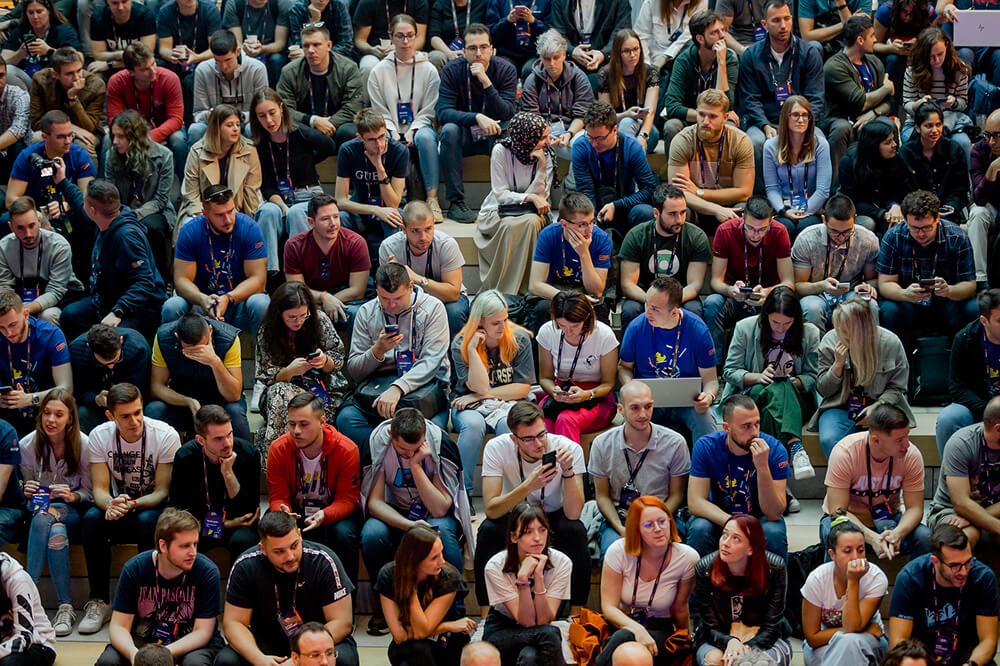
In these 20 years, the most interesting thing here at Infobip is the culture that we have built. And that culture hasn’t changed from day one. It’s a very collaborative team player culture. Humble, open, innovative. We are building new things together.
Silvio Kutic
CEO, Infobip
Over time, that mindset became an advantage. As the company scaled, complexity followed: more teams, more systems, more moving parts. But it also brought a risk: losing sight of purpose.
The people we have are our strongest point. We invest a lot of our efforts to create an organization where people can feel empowered, responsible, and can see the whole context end to end.

Izabel Jelenic
CTO, Infobip
Because culture, when done right, doesn’t slow innovation. It enables it. It gives people the confidence to experiment, the safety to fail, and the trust to move forward together, even when the path ahead is unclear.
Innovation is a habit
When a company spans two decades of change, it’s tempting to search for the one defining moment that made everything click.
But that’s not how this story unfolded. “If in all those 20 years, if we did only one big technology or business-wise breakthrough, it sure wouldn’t be enough,” Izabel says. What carried the company forward instead was something more demanding and far more sustainable.
We were reinventing everything every few years. If in all those 20 years, if we did only one big technology or business-wise breakthrough, it sure wouldn’t be enough.
Izabel Jelenic
CTO, Infobip
From the earliest days of building global messaging infrastructure, to expanding into omnichannel communication, to embracing AI-driven experiences, the pattern remained the same: learn, adapt, rebuild.
“The technology that we had at the start and the technology we have today are completely different beasts — in terms of number of people, scale, and the whole industry,” Izabel reflects. “What I’m really proud of is that many people from those early days are still here, not just keeping pace, but helping lead and set new industry trends.”
For Silvio, the evolution went beyond technology and into how Infobip supports its customers as communication itself changes.
We changed from providing the infrastructure to becoming a partner for digital transformation through rich communication channels, AI, and now with Agentic AI.
Silvio Kutic
CEO, Infobip
What began as helping businesses reliably send messages evolved into enabling entire conversations, across channels, in real time, and increasingly through intelligent, agent-driven systems. For customers, that means fewer disconnected tools and more intentional, meaningful interactions with the people they serve.
This didn’t happen all at once. It emerged through continuous learning, close collaboration, and a willingness to rethink what the platform was built to do, again and again.
For the businesses and partners building alongside us, this offered something steady amid constant change, a foundation designed to adapt, so they can focus on what matters most, serving their customers, even as the tools and expectations continue to evolve.
Still a startup, even at scale
Growth changes everything. It introduces complexity, layers, and new expectations. But it doesn’t have to change how a company thinks or how it moves.
Even today, after decades of expansion, Silvio still describes Infobip in startup terms. Not because of its size, but because of its mindset. For him, being a startup has always meant operating in uncertainty, where failure is possible, even likely, and choosing to act anyway.
Instead of centralizing decision-making or slowing down to protect what already worked, we leaned into autonomy. Teams were designed to operate like small startups within a larger system, each with clear ownership, responsibility, and the freedom to innovate.
Staying a startup, even at scale, was never about holding onto the past. It was about preserving the ability to move, to take responsibility, to experiment, and to keep going forward, even when the path ahead wasn’t fully defined.
Trust is not something you claim as you grow
From the early days, Infobip made a deliberate decision to build its core technology internally. It wasn’t the fastest route, and it often made short-term progress harder. At the same time it allowed for deep understanding of how the platform works and how it needs to evolve.
Growth didn’t just increase opportunity, it raised expectations.
The challenge became paradoxical: moving faster while making sure nothing breaks. With thousands of engineers changing production systems every day, reliability could not be an afterthought.
Izabel explains how this reshaped the engineering discipline.
We have more than one thousand engineers making changes every day. That means we must move fast, but also make sure nothing breaks. Testing, security, and quality have to be built in.
Izabel Jelenic
CTO, Infobip
Security, in particular, became the foundation. “At some point we realized if there is no security in place, we will just be gone. Today, it’s part of how every engineer thinks and builds,” says Izabel.
Today, reliability is not a constraint on innovation. It is what makes innovation usable, allowing customers to build with confidence, knowing that speed is matched by responsibility.
Trust, after all, is not something you claim as you grow. It’s something you earn every single day.
The first twenty and everything that comes next
Our first twenty years were about building foundations — technical, organizational, and human. About learning how to operate at scale without losing responsibility, how to innovate without breaking trust, and how to grow without forgetting why the work matters.
What comes next is less predictable.
As Silvio has said:
Nobody knows what will happen in the next 20 years, especially with AI. We’re focused on becoming an AI-first organization, bringing AI into our workforce and working together with agents, to have the agentic framework inside the organization.
Silvio Kutic
CEO, Infobip
The focus now is on building organizations that can adapt continuously, where humans and intelligent systems work together, where learning happens faster than disruption, and where responsibility scales alongside capability. It’s about enabling people to do more meaningful work. It’s about platforms that don’t just support communication but orchestrate intent.
For our customers and partners, it is a move toward systems that help make sense of complexity rather than add to it. Toward technology that augments people instead of replacing them. Toward collaboration models where businesses are not left reacting to every new wave, but are equipped to participate in shaping what comes next. Our aim is to help businesses stay connected to their customers even as interfaces disappear and interactions become more autonomous.
Today, we see business to agent communication, but it’s evolving into agent to agent. And in this agent-to-agent space, we want to find our position as the orchestrator of these intents, helping businesses participate in these technological shifts.
Silvio Kutic
CEO, Infobip
The first twenty years created the conditions for what’s ahead, and our spirit remains unchanged. “We are just starting.” And that is where hope lives.