





What CX maturity really tells you about your customer journeys (and what to do about it)
Learn about Infobip’s CX Maturity assessment that helps brands identify gaps, benchmark against industry peers, and plan actionable steps to improve CX automation and integration for better customer experiences.

Every conversation I have with senior leaders right now eventually lands on AI, but the conversation has shifted recently. A year ago, the question was:
“When should we start with AI?”
That question has largely been answered. Many organizations have already experimented with AI in some form, whether through copilots, automation, customer support, internal efficiency initiatives, or standalone pilots, and many are already seeing value, but mostly in isolated environments.
The question now is harder:
“We’ve invested. Why isn’t it scaling?”
Because moving from experimentation to enterprise-wide operational impact turns out to be much more complex than deploying a model. This is the stage where organizations start running into the realities of fragmented customer journeys, siloed data, disconnected channels, legacy systems, and operational complexity across teams and markets.
In other words, the challenge is no longer AI adoption but rather AI readiness; understanding what your organization is actually ready for, where AI can create value today, what foundations are missing, and how to scale intelligently from there.
That’s exactly what our CX maturity model measures. In this blog, we’ll walk you through what CX Maturity is and what it tells you about your CX infrastructure potential.
What CX maturity helps you understand about your organization
CX maturity assesses the infrastructure and capability behind customer interactions:
- Which parts of the journey are automated
- How advanced the use cases are
- Whether your systems can support what you’re trying to build
Our assessment evaluates those three variables like this:
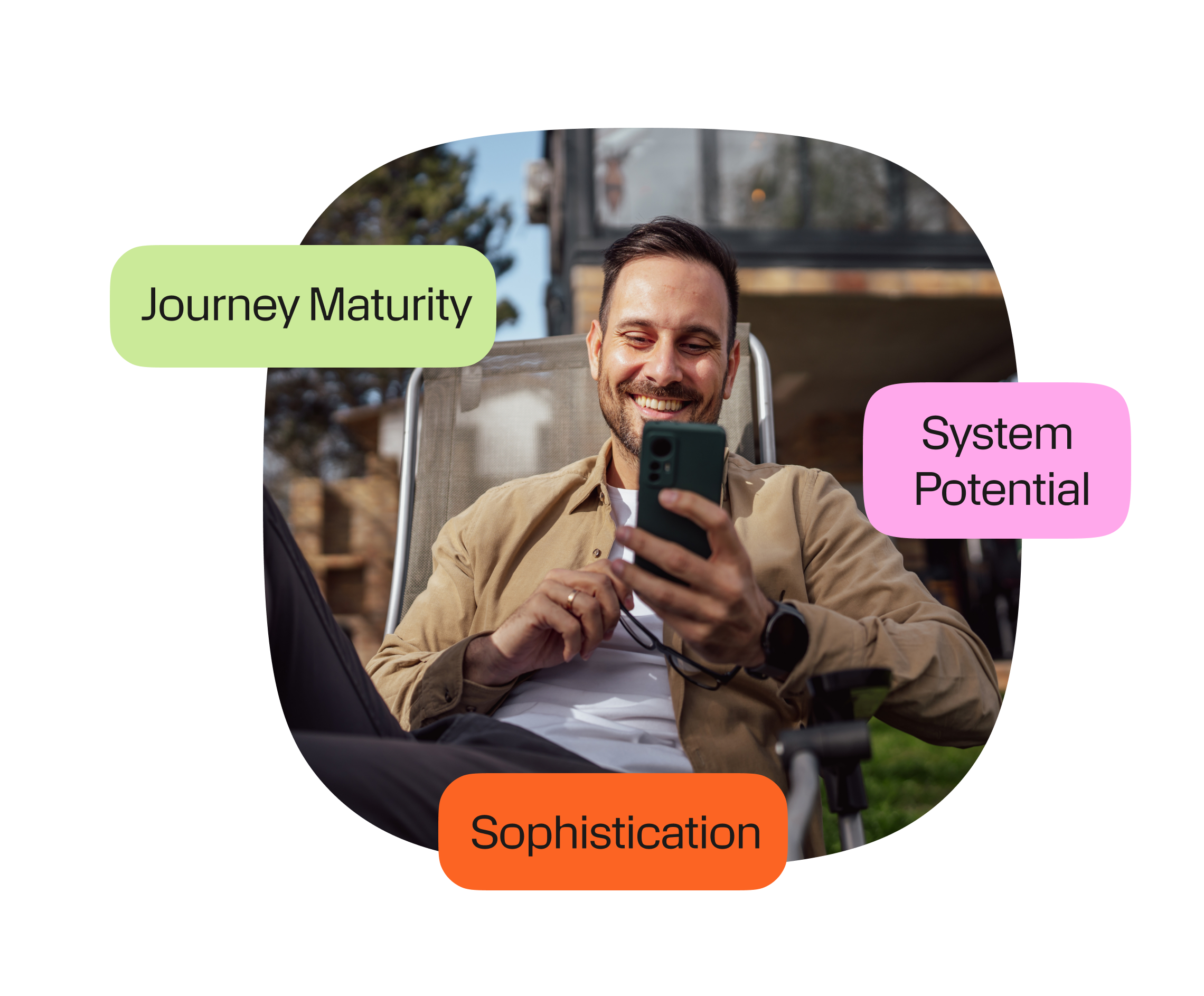
Journey maturity
Journey maturity looks at what parts of the customer journey you’re automating with communication and mobile solutions. This can include use cases from discovery to re-engagement. We aim to see how much of your CX journey is automated on messaging.
Sophistication
Sophistication examines how advanced your use cases are in practice. We look at what technology is powering each one, whether that’s simple rule-based features, smart automation, hybrid AI, or advanced agentic AI, and how deeply automated your use case is. For example, two brands could have “customer onboarding” automated, but brand A sends a link over SMS for onboarding information, while brand B has set up a complete conversational flow on WhatsApp to guide new customers. They are fundamentally different use cases.
System potential
System potential uncovers the key systems you have in place that are ready for API access (meaning you can connect various tools and channels to share and consolidate data). This gives us insight into which communication solutions, use cases, channels, and features can realistically be implemented to improve your overall CX journeys. It’s the dimension that answers a question most assessments skip entirely: not just what’s missing, but what’s actually achievable to build next based on your current tech stack.
The industry benchmarks
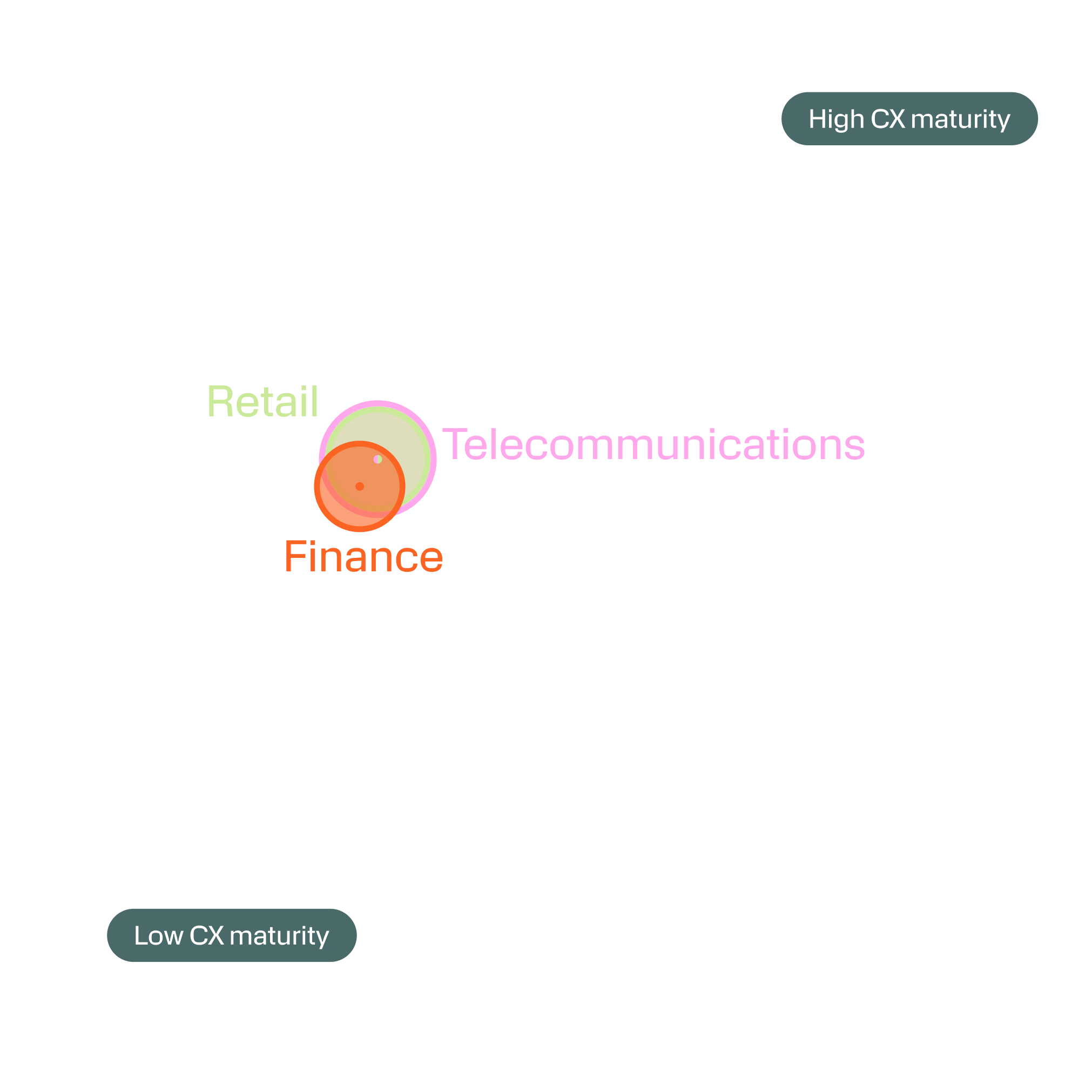
In our research and analysis, we’ve benchmarked where retail, banking, and telco enterprises are on our CX model. Retail and telcos have a very similar maturity, with telcos only slighty ahead in sophistication and banking behind both other industries in all three categories. This isn’t surprising considering the privacy and data concerns surrounding banking interactions:
Read our CX Maturity report for an in-depth analysis of each industry and a regional breakdown.
Why system potential is the dimension brands underestimate
When we run assessments, system potential is consistently where brands are most surprised by what the data shows.
In our CX Maturity report, we found that most brands do have fully centralized customer data (60%), but only 50% of brands are fully API ready and 58% have their channels fully integrated. That points to systems and tools that don’t talk to each other and becomes the biggest constraint on what AI and automation can achieve, because the intelligence layer that would make AI useful simply can’t function when data and tools aren’t connected.
But in system potential, the keyword is “potential”. We are looking specifically at what tools, systems, and data storage brands are already using, and what’s available for quick wins and advancements. There is usually a gap between what a tech stack can achieve, and what a brand is actually deploying in their CX journeys.
For example, if a brand scores low on journey or sophistication, meaning they probably focus on simple use cases and don’t have expanded journeys, but they have centralized data storage, are fully or partially API ready, and are using high-value systems, the potential for their CX is high. This means they can be doing a lot more to improve customer experiences with the tools and systems they already have in place.
From assessment to action: the Infobip Navigator
The most common frustration with maturity frameworks is that they tell you where you are without telling you what to do next. The Infobip Navigator program is built specifically to solve that.
Once the assessment is complete, our experts map the results across four phases: Vision, Value, Implementation, and Success.
- Vision benchmarks your maturity and identifies the gaps.
- Value links those gaps to specific use cases and business KPIs.
- Implementation prioritizes by feasibility, surfacing quick wins (use cases with no complex system integration required) separately from investments that need infrastructure groundwork first.
- Success tracks results and identifies the next growth opportunities as your maturity develops.
What surfaces is clarity for brands on what their capabilities are, and genuine quick wins focused on building on what you already have in your tech stack and journey.
Where to start
The most useful thing a brand can do before any AI or automation investment is made, is to understand exactly where they stand relative to real peers in their industry, with a clear view of what their current infrastructure actually supports.
That’s what the CX Maturity Assessment gives you: a benchmark built on data, across the three dimensions that determine what’s possible, and a prioritized path from where you are to where you need to be.
FAQ
CX maturity is a measure of how effectively a brand has built its customer experience infrastructure: which journeys are automated, how advanced those automations are, and whether the underlying systems can support continued improvement. It diagnoses capability gaps rather than measuring satisfaction or sentiment.
Customer satisfaction measures how a customer feels about a specific interaction. CX maturity measures the infrastructure that determines how consistently good those interactions can be. High satisfaction scores and low CX maturity can coexist, but low maturity puts a limit on how reliably the experience holds up at scale.
The assessment is available for banking, retail, and telecommunications organizations. It’s designed for senior leaders and teams responsible for digital CX, customer communications, and technology strategy.
The Navigator takes your assessment results and maps them into a prioritized roadmap: which use cases to build or deepen, in what order, based on value, feasibility, and what your current systems support. It distinguishes quick wins from investments that need infrastructure work first, so you know exactly where to start.
Version 2.0 adds system potential as a dedicated dimension, covering API readiness and integration depth. Sophistication is redefined to focus specifically on how advanced use cases are and on AI and automation technology types. The assessment now includes industry-specific benchmarks for banking, retail, and telco, backed by research across 200 respondents in six countries.
Discover more about CX Maturity
See how your CX infrastructure compares to your industry peers.