



Voice AI is so much more than automating conversations
Voice AI is commonly misunderstood as being just the final conversational interface between caller and machine. In reality, the final touchpoint is just one of four distinct layers that should be considered when evaluating Voice AI solutions. In this blog we look at findings from Omdia’s research to help businesses find the best solution for their unique requirements.

Ask a room of executives what ‘voice AI’ means and most will describe the same thing – a voice chatbot or AI agent that answers customer calls, understands what each caller wants, and either resolves the issue or hands off to a human agent.
That is the product that most vendors in the space lead with. However, the AI voice interface is only one part of a larger eco-system that creates value for the business – in reality there are three more layers that are just as important to get right if Voice AI is going to deliver on its potential to improve customer experience and reduce costs for the business.
The confusion is understandable given the recent history. For years ‘voice AI’ and ‘voice bot’ have been used interchangeably. From the start the use case has always been the same – to automate the resolution of issues that customers were calling about. However, early CX issues caused by rigid scripted experiences, customer data silos, and robotic sounding artificial voices led to business leaders becoming wary of both terms.
However, the underlying technology has now evolved and diversified to the point where the quality of the conversation at the final touchpoint between machine and human caller is just one piece of the puzzle.
In our joint white paper Omdia projects that the North American voice AI software market will reach $37 billion by the end of 2026, growing at a 13.3% annual rate. Some of that is spending on the actual voice agents, but a meaningful share of it is not.
In this blog we break down each of the four pillars of an effective Voice AI platform and explain the key role that each of them plays. Our goal is to help businesses looking to invest in a Voice AI solution to make an informed and future-proof buying decision based on sound research.
1. The voice agent: The part that gets the attention
Ten years ago, many industry analysts predicted that voice bots would handle most customer service calls within a few years. Early systems worked by mapping every imagined customer request to a set of keywords, so a caller who phrased a question differently than developers anticipated would get stuck in a loop, get asked to repeat themselves, or get transferred without resolution. The processing itself ran in stages:
- Speech converted to text
- Text analyzed for entities and intents
- An action decided
- Text converted back to speech.
Each stage added delay, making conversations feel closer to a walkie-talkie exchange than a natural human conversation. And the process was easily derailed – a caller who changed topics mid-sentence, or who asked a second question before the first was resolved, usually broke the system’s understanding of what they wanted.
Large language models fixed most of that. An AI agent built on one can pick out what a caller wants without a predefined script, hold a conversation across topic changes, and get interrupted mid-response without losing track of the request. Many modern AI voice platforms process audio directly which brings more fluidity and creates a more natural conversational experience.
Latency has also dropped enough, often to under half a second, that the exchange feels closer to talking with a person than talking to a machine. Some systems can even pick up on frustration or urgency in a caller’s voice and adjust their tone and pace in response, instead of working through a script at a fixed pace regardless of how the caller sounds.
AI voice agents built in this way have proven to be very successful. Take the example of a university in the US that connected a voice AI assistant to its student records system so that routine questions about registration and payment deadlines get answered immediately, using the student’s actual account data rather than generic information, while anything more complicated is handed to a staff member who can already see the student’s history instead of starting the conversation over. During enrollment and payment deadlines when call volume spike hardest, the AI assistant is now what keeps the support team from drowning.
The voice interface seems to be the hero in this scenario and is what most companies imagine when looking to adopt ‘voice AI’. But it’s just one piece of the puzzle – the rest of what ‘voice AI’ covers is just as important and is often agnostic of whatever vendor’s agent is running the calls.
2. Connectivity: The part that makes conversations happen
Most voice AI agent platforms available now are very good at holding a conversation. However, none of them run a phone network. Getting that conversation onto an actual call, reliably, at scale, in the countries your customers are in, is a separate problem. A growing number of companies solve it by keeping the AI platform they’ve chosen and connecting it to a voice carrier through SIP trunking or WebSocket streaming.
However, this approach can cause issues downstream. With the AI agent platform market evolving so rapidly, another vendor may turn out to be a better fit in the near future. For a company whose phone infrastructure is tied to a single AI vendor, they would have to rebuild that infrastructure every time they switch platforms. This mean new integrations, new testing, new failure points, often during the period when the switch was supposed to save time.
A company that keeps its telephony separate from its AI platform can test a new agent provider, compare it against the one it’s already running, and switch without touching the phone network at all. In a market where the leading model changes every few months, that separation is an insurance policy.
Connectivity also covers which channel a voice AI reaches customers through, not just which AI platform answers.
Take the example that Omdia refers to of a large European airport that built a voice AI agent into WhatsApp, so travelers can call in for flight updates, delays, and get directions from an app they already have open, through WhatsApp Business Calling rather than a traditional phone line.
That distinction matters more than it sounds – a solution that required a normal phone call would have put off any traveler wary of international roaming charges, which is most people at an international airport. The agent itself runs on standard cloud infrastructure; the reason the service holds up during peak travel periods, without falling over during a rush of arrivals, is that it was built on infrastructure designed to expand and contract according to demand rather than a fixed phone system that is sized for an average day.
The connectivity layer also handles use cases that have more to do with making voice services more accessible.
Whispp shows what connectivity looks like when there’s no conversational Voice AI involved at all. They built real-time audio-to-audio AI that turns a whispered voice into clear, natural speech instantly, giving people with stutters or conditions like vocal cord paralysis a way to speak on the phone with confidence. There’s no agent answering questions here; Whispp needed to intercept a live call and replace the caller’s own voice in real time, which is a connectivity problem, solved through WebSocket streaming into a carrier’s network.
3. CPaaS AI: The part that turns voice calls into data
Once a call is in progress, it doesn’t matter whose agent is running it but there is value in what happens to the audio itself once the call ends. A transcript can become an automatic summary, used for sentiment scoring, and used in compliance checks to ensure that a particular disclosure or script line was delivered correctly. This is critical in regulated industries like financial services or healthcare where there is a requirement to verify at scale that compliance requirements have been met.
Sentiment and topic data from call transcripts can be automatically aggregated across thousands of calls rather than the small sample a human quality team can manually review. This means that content centers can be measured constantly rather than audited occasionally, with real benefits for productivity and continuous improvement.
For outbound AI Voice calls, the CPaaS layer is also instrumental in the success of sales or collections campaigns by using machine detection to differentiate a real person from a voicemail system. This has got more difficult without the beeps previously associated with automated responses, and handsets that now have the capability to screen calls before a person answers. Getting that detection right is the difference between a campaign that pays for itself and one that spends its budget talking to voicemail boxes and screening systems.
None of this is free of risk, which is why security and privacy sit inside this layer rather than off to the side. Voice data includes both personal data and biometric data, and a transcript can contain the same sensitive information a written record would. Encryption, verified authentication, and compliance with rules like GDPR in Europe or HIPAA in US healthcare aren’t optional add-ons once a company starts extracting insight from every call instead of just recording it for occasional playback.
4. Infrastructure: The part nobody notices until it breaks
No matter how effectively the other three parts work – the actual call won’t be a positive experience if the audio itself is bad. AI agents, transcription engines, and sentiment models all perform worse on calls with noise, jitter, or a degraded line, and customers can hear the difference even when they can’t name it.
HD voice and real-time correction on calls that arrive over a poor connection, which happens often when a call is handed off between carriers before it ever reaches the AI system, fix the audio itself rather than asking everything downstream to compensate for it. Rating call quality the way a person actually experiences it, instead of jitter and latency numbers, catches problems those metrics miss. A call can score well on every network measurement and still sound bad to the person on it.
Providers that operate their own network have a real advantage here because they can build these corrections directly into the infrastructure instead of adding them as a layer on top after the fact. That includes predicting where traffic problems are likely before they cause a call to drop, shifting capacity automatically as call volume spikes, and recovering from a failure without a person needing to notice and intervene.
The same logic applies operationally, on the support side rather than the network side. When something breaks, the cause can be in the phone network, the AI platform, or the application logic, and finding it fast matters as much as building the system well in the first place. AI that can point a support or engineering team to the likely cause faster isn’t something a customer ever sees directly, but they feel its absence every time a fix takes longer than it should, or a routine problem turns into an afternoon of downtime because nobody could isolate it quickly.
This is also where a lot of voice AI investment underdelivers without an obvious cause. A company can buy an excellent agent and a solid connectivity layer and still get a mediocre result, because nobody checked whether the call quality underneath either one could actually support it.
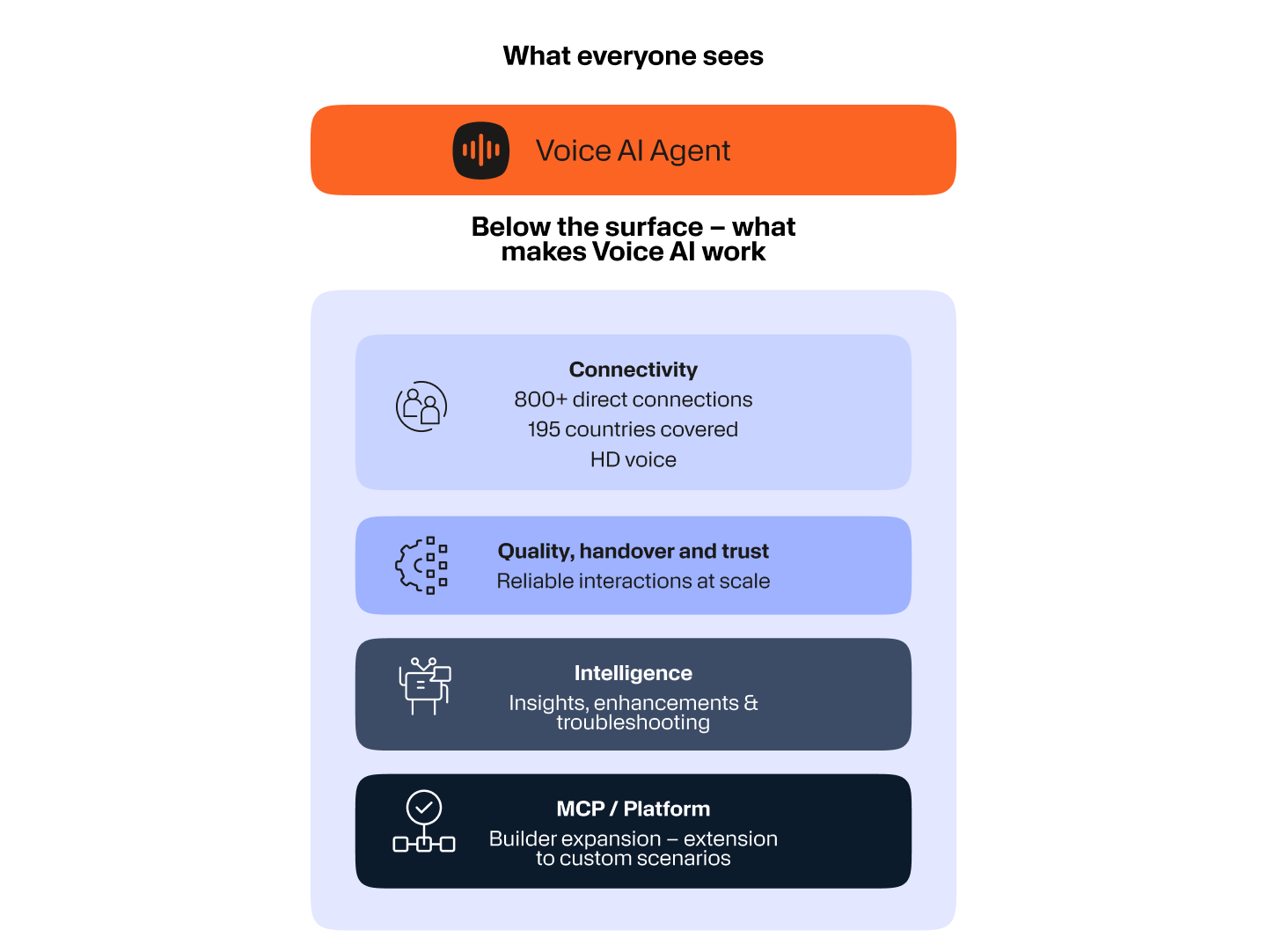
Four layers – one buying decision
Omdia’s survey of enterprise buyers asked what problems they run into most with their communication systems. Integration complexity topped the list, cited by 43% of respondents. Close behind: a lack of unified data and analytics (40%), the burden of managing multiple vendors (37%), and inconsistent customer experience across channels (37%). Cost inefficiencies followed at 35%, and compliance and security concerns at 32%.
Read as a list, those numbers look like six separate problems. Viewed together, they mostly describe the same problem showing up in different departments. A communications stack stitched together from too many vendors. A company that buys its agent from one vendor, its connectivity from a second, its transcription and analytics from a third, and its network from whichever carrier won a procurement cycle years ago. The result is they end up managing several integrations instead of one, several support relationships instead of one, and several places where customer data lives instead of one.
That’s the practical case for treating the agent, connectivity, CPaaS AI, and infrastructure as one decision instead of four separate purchases. Nobody has to buy all four from the same company on day one; most companies won’t. But assuming an agent vendor already has the other three covered, when it might not, is exactly how a project quickly runs into the integration problems that respondents in Omdia’s research flagged as their single biggest headache.
So where is the best place to start?
Most companies start with one piece, often the agent, and expand from there. This is a reasonable way to begin, but it is important to consider the other three layers from the start before choosing a technology partner. Making a decision based on a single problem that you have now may turn into a second integration project in the future when the connectivity or infrastructure gaps show up.
A useful test when evaluating a provider is whether they can support all four areas today, even if your business only plans to invest in one to start. A provider that can only sell the agent has no way to help once the conversation moves to connectivity, insights, or call quality. These should have been part of the evaluation criteria from the start.
Our new joint whitepaper with Omdia – Future-Proofing Your Investment in Voice AI, walks through all four areas in more depth, along with the market numbers and the full case studies referenced above.