







How to improve airline customer experience in 2026
Airline customers now expect fast, personalised answers to everything from simple questions to serious disruptions. The airlines that stand out communicate clearly, proactively, and on passengers’ preferred channels. This guide shows how omnichannel messaging and AI-powered automation improve every interaction, turn problems into loyalty moments, and make journeys smoother from first search to post‑flight follow‑up.

Airlines today operate in a world where passengers expect a seamless, digital-first experience from the moment they begin searching for a flight to the moment their luggage arrives – and beyond. Yet the stakes have never been higher: According to Deloitte, airlines could miss out on $1.4 billion in revenue annually without meaningful customer experience improvements.
The good news? Recent airline satisfaction research shows that passengers who rate their experience as ‘perfect’ are around 20 times more likely to fly with the same airline again than those with a ‘poor’ experience.
Improving airline customer experience in 2026 depends on combining omnichannel communication, AI-powered automation, and real-time messaging across every stage of the passenger journey.
This guide explores how airlines can raise the bar for customer experience through conversational engagement, intelligent automation, and connected messaging across channels like WhatsApp, RCS, SMS, email, and push notifications – backed by actual results from leading airlines.
Why airline customer experience management matters in 2026
Passenger volumes have rebounded to pre-Covid levels, and flight schedules are busier than ever. That said, tolerance for uncertainty is lower. Travelers expect clarity, speed, and digital convenience at every touchpoint. Tight connections, evolving border requirements, and crowded hubs make timely communication not just useful, but essential to delivering a strong airline digital customer experience.
Industry research reinforces the urgency. J.D. Power data shows that passengers who receive excellent service are significantly more likely to fly with the same airline again, underscoring customer experience as a key factor in airline choice. At the same time, personalization has become one of the strongest drivers of airline customer experience.
Recent analyses by McKinsey show that: 78% of consumers are more likely to make repeat purchases when content is personalized to them. In the airline sector, this can mean tailoring offers based on travel history, sending targeted upgrades to loyalty members, or adjusting messaging tone based on trip purpose.
Here’s what passengers expect today:
- Immediate responses through messaging channels, not phone queues
- Real-time flight updates delivered proactively
- Seamless experiences across devices and touchpoints
- Self-service options that reduce waiting and calling
- Personalized communication based on their preferences and travel history
The airline passenger experience increasingly mirrors other digital industries. Customers expect airlines to predict disruption and respond instantly and personalized across their preferred messaging channels. Meeting these expectations requires unifying data, channels, and operational systems so that communication becomes proactive rather than reactive.
Key channels for airline communication
Digital messaging channels have become the backbone of modern airline customer communication. Used together strategically, they enable airlines to maintain continuity across every journey stage – even when connectivity or circumstances change.
SMS: Reliable and universal
Best for: Time-sensitive alerts, check-in reminders, gate changes, boarding notifications SMS remains the most reliable channel for critical updates because it doesn’t require internet connectivity and reaches 100% mobile users.
WhatsApp Business Platform: Rich and interactive
Best for: Booking confirmations, baggage tracking, conversational support, post-trip feedback
WhatsApp combines reliability with rich media capabilities, enabling two-way conversations that feel personal and convenient.
RCS for Business: Visual and branded
Best for: Booking confirmations, interactive itineraries, upselling ancillaries, promotional campaigns RCS (Rich Communication Services) brings app-like experiences to native messaging, with carousels, buttons, images, and verified sender identity.
Email: Detailed and archivable
Best for: Booking receipts, itinerary details, policy updates, post-trip surveys Email is still essential for delivering comprehensive information passengers need to reference later.
Push notifications: Timely and contextual
Best for: Gate changes, boarding calls, geo-targeted airport navigation, last-minute deals
Mobile push notifications appear instantly on lock screens, making them ideal for urgent, location-based alerts.
Critical use cases for airlines
When disruptions happen, the difference between a terrible and a surprisingly smooth trip often comes down to how – and when – an airline communicates. The two scenarios below show how the same journey can feel completely different depending on whether communication is fragmented or connected, AI‑powered, and proactive.
CX Fail: When passengers are left in the dark
Sarah booked a 5-day vacation with her family.
She arrives at the airport only to discover her flight is delayed – she waits over five hours with no clear updates. When it is finally time to board, she rushes to the gate on her boarding pass, only to find it has changed due to the delay. She nearly misses her flight.
After landing, two of her checked bags are missing. The customer service desk tells her they will arrive “tomorrow,” but by day three of her 5‑day vacation, Sarah still has no idea where her luggage is or if it will ever arrive.
Result: Sarah’s says their lost baggage ruined their vacation, posts negative reviews, and vouches to never fly this carrier again.
CX Win: When messaging keeps passengers informed
Sarah booked a 5-day vacation with her family.
On the day of the flight, she receives an email alert that weather might cause delays. Closer to departure, an SMS confirms a two‑hour delay, so she stays home instead of waiting at the airport.
When she arrives, a WhatsApp message shares her updated boarding time and new gate number. She walks straight to the correct gate with confidence.
After landing, her luggage is missing, but she gets a WhatsApp opt‑in to track it. A follow‑up message confirms the bag has been found and shares the delivery day, time, and location.
Result: Sarah’s stress is minimized. She enjoys her vacation and stays loyal to the airline.
How to improve airline customer experience across the journey
The airline customer journey spans multiple stages, each presenting distinct opportunities to reduce friction and build trust. Designing messaging use cases around these stages allows airlines to create continuity from inspiration to loyalty.
Inspiration, research and booking
Passenger journeys often begin with comparing destinations, routes, baggage rules, and travel requirements across multiple platforms. Airlines that provide clear, conversational guidance during this phase are more likely to capture bookings.
The overwhelmed traveler
Anna wants to book a trip abroad but feels overwhelmed comparing destinations, flight options, baggage rules, and visa requirements across multiple sites, so an AI-powered chatbot on the airline’s website guides her to the right destination and flights, explains baggage allowances and visa details in a single conversation, and then helps her complete the booking, leading to faster decisions, higher conversion, and a stronger first impression.
Key capabilities
- Answering travel FAQs in chat
- Conversational booking via WhatsApp or RCS
- Personalized reminders for incomplete bookings
- Click-to-Chat ads that connect potential flyers directly from social ads to instant conversations
Pre-trip and pre-flight communication
Once a booking is confirmed, communication centers on preparation – check-in, seating, baggage coordination, and itinerary management. Proactive engagement at this stage reduces anxiety while lowering inbound support demand.
The forgotten check-in
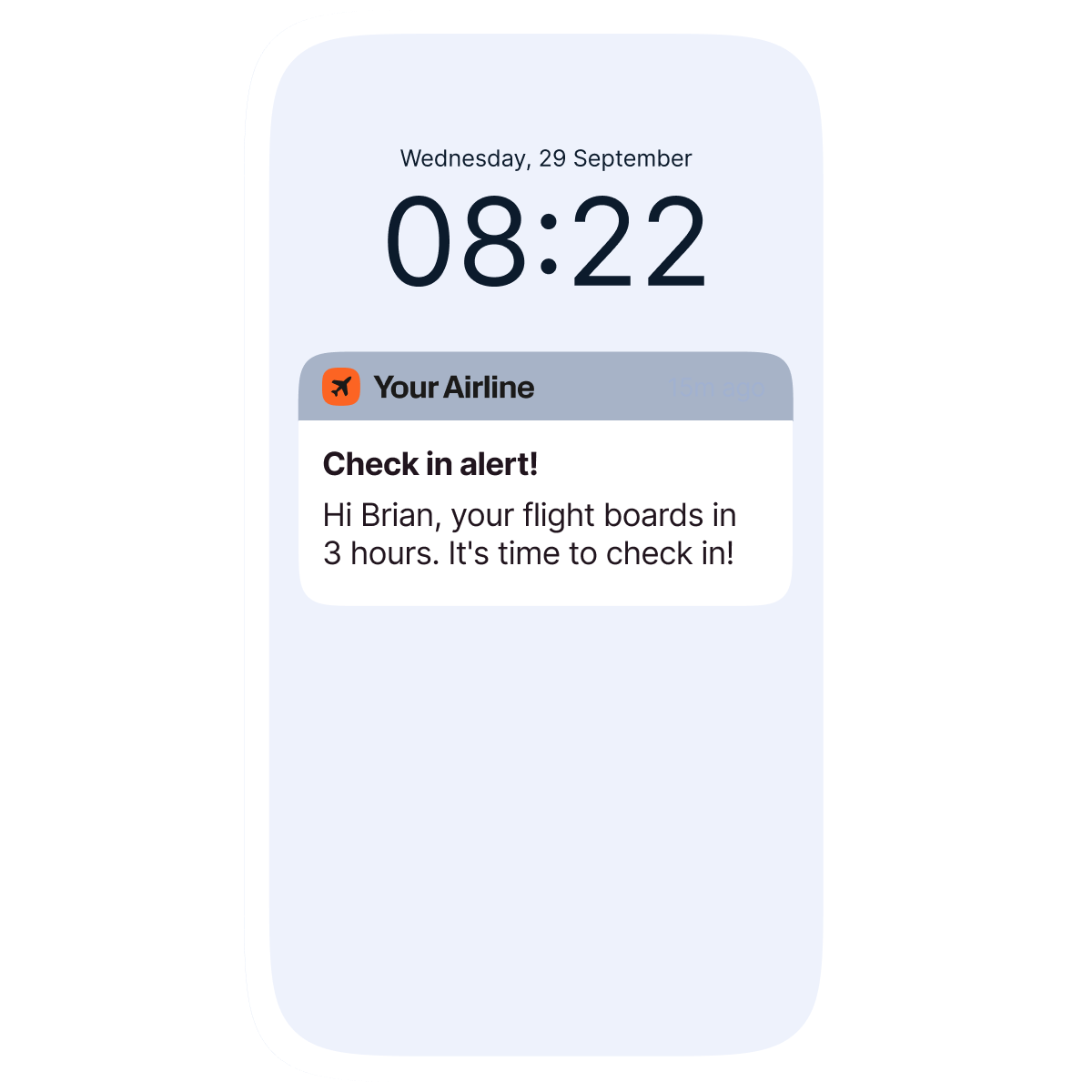
Brian is preparing for a business trip and forgets to check in online, but 3 hours before boarding he receives a push notification reminder, taps it, completes check-in in the airline app, and gets his mobile boarding pass on WhatsApp within minutes, resulting in a smoother airport experience, shorter lines at check-in, and better on-time performance.
Key capabilities:
- Booking confirmations across preferred channels
- Automated check-in reminders
- Upsell messages for extras from seats selection, check-in luggage, meals to lounge access.
- Itinerary builders and special service requests
Real-world impact:
Airlines using push notifications for check-in reminders see significantly higher online check-in rates, reducing airport congestion and improving operational efficiency
Day of travel and at the airport
The day of travel is often the most stressful stage – and where real-time messaging delivers the greatest impact. Passengers want information immediately and contextually, without needing to search.
Delayed flight uncertainty
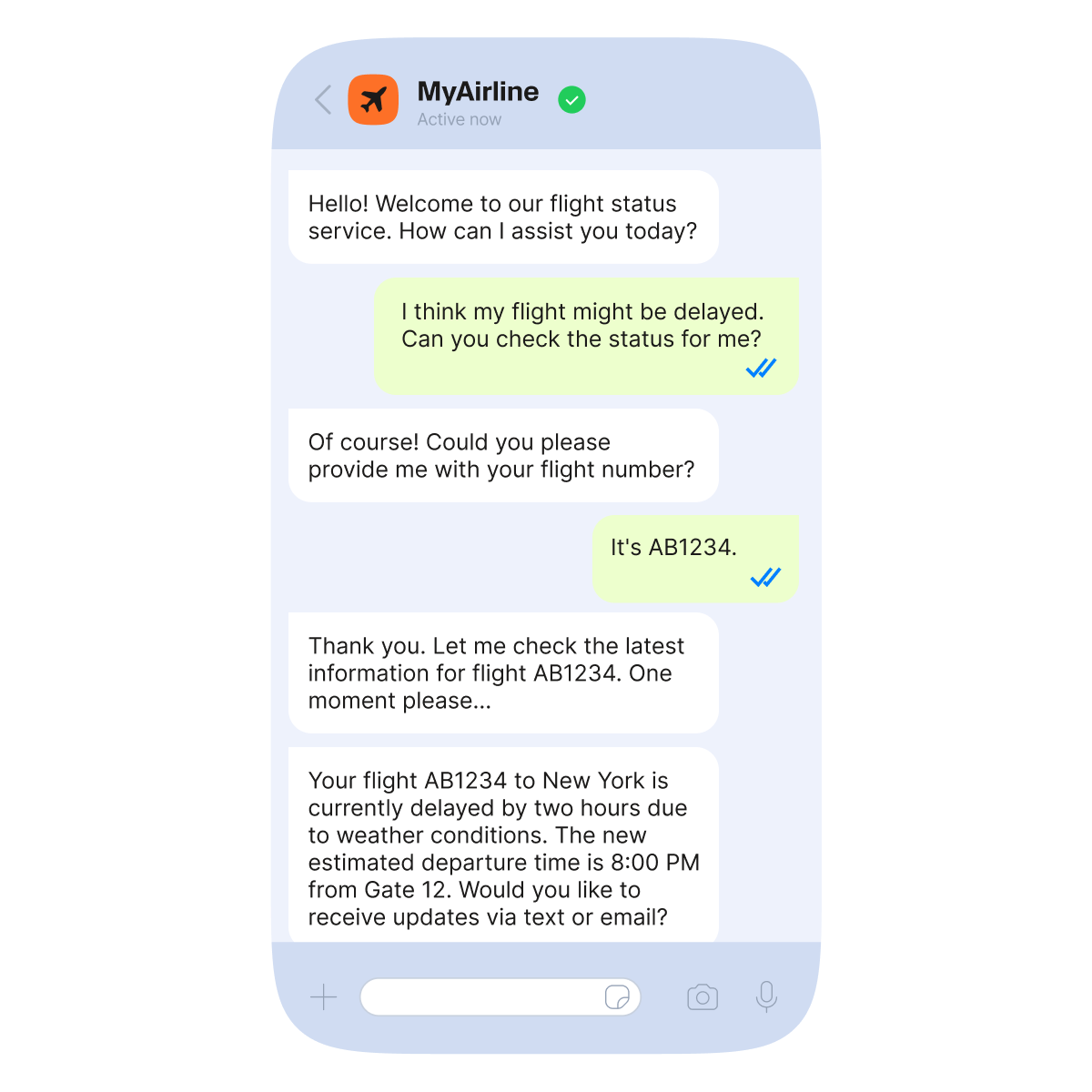
Joey suspects his flight to New York might be delayed but has no clear information from airport screens, so he opens the airline’s chat and asks for a status update; within the same conversation, the assistant confirms the delay, explains the reason, shares the new departure time and gate, and offers to keep him updated via his preferred channel, turning uncertainty into a calm, informed wait.
Key capabilities:
- Live flight and gate updates
- Geo-targeted navigation and boarding alerts
- Digital baggage reporting and tracking
- Rich messaging support during delays
- Real-time connection rebooking assistance
Post-travel surveys and loyalty
Post‑travel feedback is a powerful way to turn a one‑time flyer into a long‑term advocate. By asking the right questions while the journey is still fresh, airlines can uncover what delighted passengers, where friction crept in, and which improvements would have the biggest impact on loyalty.
The loyalty builder
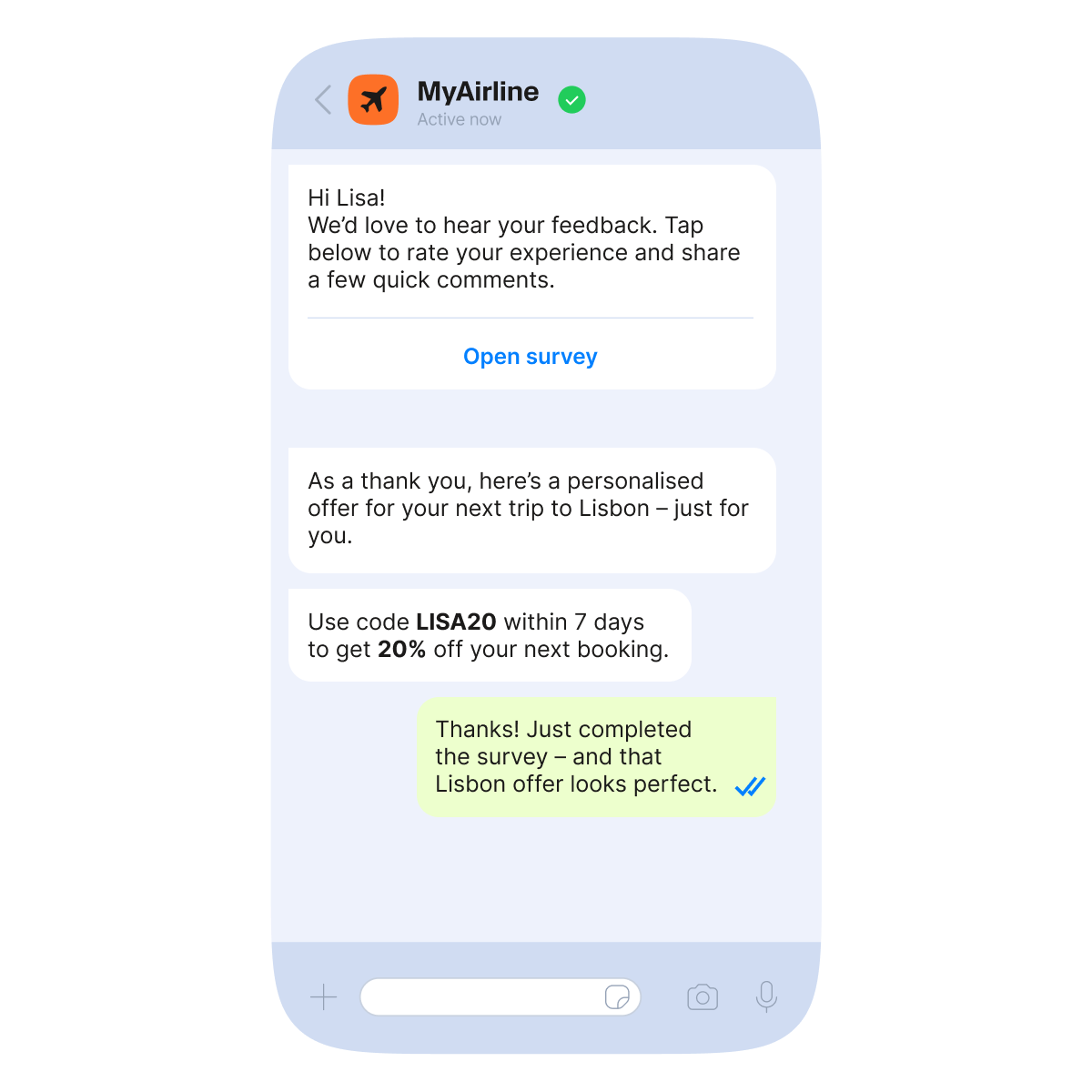
After a smooth trip, Lisa initially receives a generic “thank you” email that feels automated and easy to ignore, but when the airline instead sends a WhatsApp message that thanks her by name, invites her to share feedback through an interactive survey, and includes a personalised discount to a destination she’d previously searched for, she takes the survey, feels genuinely valued, and ends up booking her next trip within a week.
Key capabilities:
- Interactive messaging surveys tied to specific flights
- Loyalty offers based on travel history and preferences
- Handling post-trip complaints or missing baggage resolution
- Targeted remarketing campaigns
dsajfhlakdsjhfkljasdhklfh
AI and automation in airline customer service
According to SITA, 68% of airlines are planning investments in chatbot and AI-powered customer service capabilities. AI is rapidly redefining airline customer service by enabling proactive, autonomous support. Traditional service models often struggle under disruption or high demand, leading to delays and inconsistent information. Conversational AI agents running across messaging and voice channels provide scalable support without sacrificing continuity.
The rise of airline chatbots
AI is no longer experimental for travelers: recent reports suggest that around 48% of travelers have already used AI chatbots for travel assistance, and about 40% use AI tools for planning and booking. This growing comfort with AI is mirrored on the airline side, where chatbots now handle a significant share of customer service interactions.
Benefits of chatbots for airlines
Chatbots are most useful when they quietly take care of the simple stuff so agents can focus on the moments that really matter. For airlines, that often means fast answers, fewer calls, and passengers who feel supported even when things change at the last minute.
- Provide instant help for common questions and simple changes
- Send real-time updates about flight status, gate changes, and delays
- Reduce routine workload for contact centre teams
- Capture insights from every conversation to improve journeys and campaigns
- Offer always‑on support, no matter the time zone or time of day
Switching from reactive support to agentic AI
The next evolution goes beyond simple chatbots to agentic AI – autonomous assistants that can act on behalf of passengers, not just answer questions. In a single conversation, an AI assistant can detect a likely missed connection, search and present rebooking options, update the itinerary, and deliver revised boarding details.
When severe weather or technical issues affect hundreds of flights, these systems make it possible to scale service in a way humans alone cannot. AI can proactively notify affected passengers across SMS, WhatsApp, and email, automatically generate re-booking options based on preferences and availability, prioritize communications by connection risk and loyalty status, and deflect calls to self-service channels to reduce contact center overload.
By combining operational data with customer segmentation, airlines can dynamically prioritize assistance, offer faster rebooking for time-sensitive journeys or premium options for loyalty members, and guide passengers through largely autonomous journeys.
Over time, this moves airlines toward agent-to-agent interactions between their own systems and travelers’ personal AI assistants, while also driving tangible results such as higher online check-in adoption, reduced contact center demand, stronger engagement with promotions, improved ancillary revenue, and better NPS and satisfaction scores.
Building a conversational omnichannel strategy for airlines
Effective airline customer experience management requires coordination across marketing, operations, IT, and customer service teams. It also requires more than adding individual channels – it requires orchestration.
Here’s how to build an effective omnichannel strategy:
Choose the right channel mix
- Critical alerts: SMS, Push Notifications
- Rich interactions: WhatsApp, RCS
- Detailed information: Email
- Real-time support: WhatsApp, AI chatbot with live agent takeover
Set up reliable failover
Ensure message delivery even when passengers lose internet connectivity.
For example:
- Primary: WhatsApp
- Fallback: SMS
- Last resort: Email
Integrate with core systems
Connect your messaging platform with:
Personalize based on data
Use customer data to tailor communication
- Send check-in reminders based on time zone
- Offer lounge access to premium passengers
- Recommend destinations based on search history
- Adjust tone and content for business vs. leisure travelers
Measure and refine
Track performance across:
- Delivery rates by channel
- Engagement metrics (open rates, click-through rates)
- Conversion rates (check-in completion, ancillary purchases)
- Customer satisfaction scores (NPS, CSAT)
- Cost per interaction compared to phone support
Results airlines are achieving with digital CX

Cebu Pacific: Delivering a seamless customer-centric experience with Viber.
Tags:- Inspiration.
- Transportation & Logistics.
- Transportation & Logistics.
- SMS.
- Viber for Business.
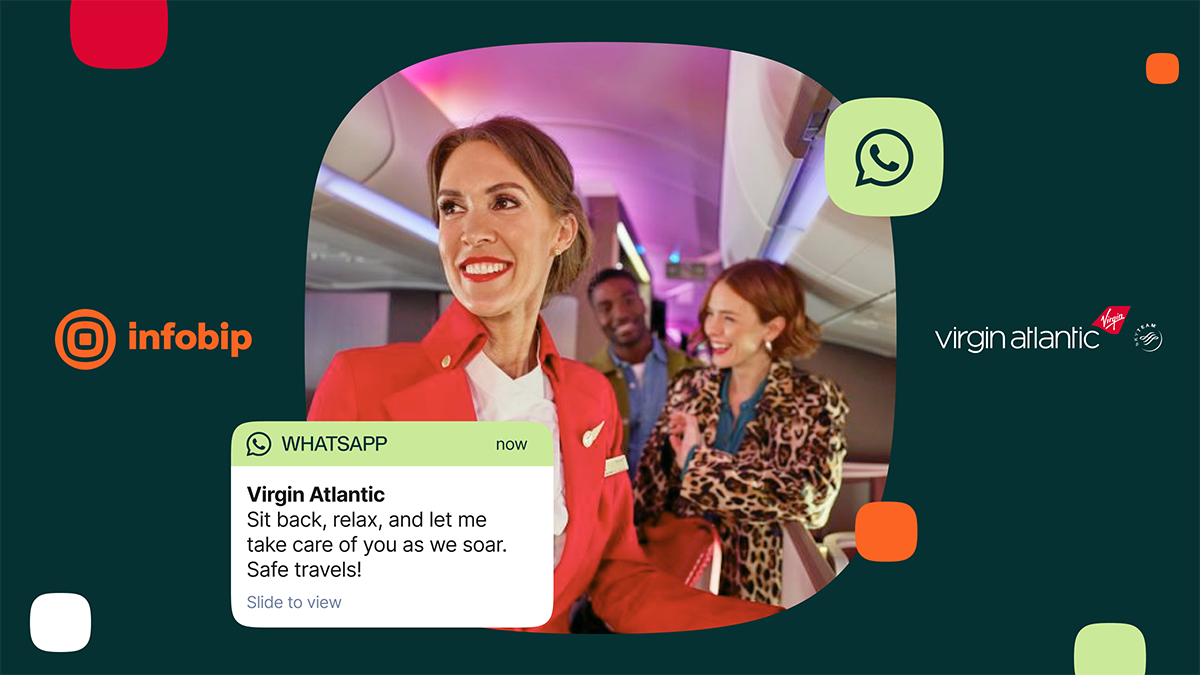
Infobip and Virgin Atlantic boost online check-ins Heathrow with WhatsApp.
Tags:- Global.

Airport AI: Elevating the passenger experience with WhatsApp Business.
Tags:- Inspiration.
- Transportation & Logistics.
- Customer Service.
- WhatsApp Business.

EaseMyTrip: Better conversion and customer experience with WhatsApp, RCS, and SMS.
Tags:- Inspiration.
- Transportation & Logistics.
- Marketing.
- RCS.

TTN: Real-time flight information for passengers worldwide.
Tags:- Inspiration.
- Transportation & Logistics.
- Customer Service.
- SMS.
{{title}}.
Tags:- {{term.name}}.
Successful airline CX starts with a unified platform
Delivering modern airline customer experience requires more than adding individual channels – it requires orchestration. An effective customer engagement platform unifies SMS, WhatsApp, RCS, email, voice, push notifications, chatbots, AI, contact center capabilities, and customer data into a single engagement environment.
With Infobip, airlines can rapidly deploy scalable solutions that improve service quality, operational efficiency, and long-term passenger loyalty – driving reactive support into proactive journey management.