






The channel explosion problem: Why adding RCS shouldn’t take six months
Your customers want RCS yesterday. Your roadmap says Q3.

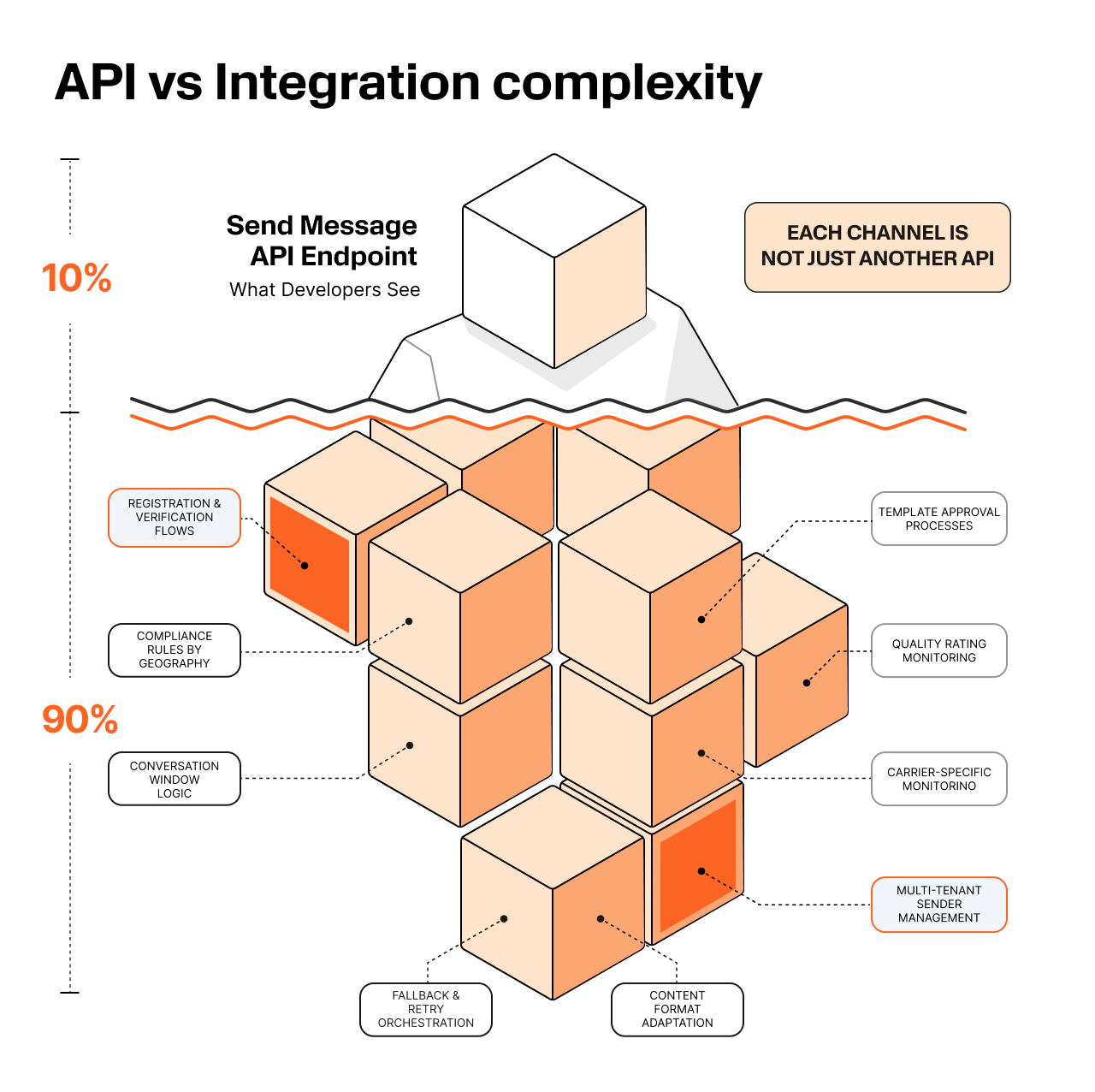
This gap is not a planning failure. It is a symptom of a deeper problem that platform teams discover the moment they try to expand beyond their first messaging channel: each new channel is not just “another API”. It is a new compliance regime, a new registration workflow, a new set of message semantics, and often a new logical model for how conversations work.
In my previous piece on MCP and integration overhead, I focused on the operational layer: provisioning workflows, admin tooling, and the infrastructure that platforms build around CPaaS APIs. That problem is real, and MCP helps solve it.
But there is a second layer of complexity: channel-specific integration overhead. For platforms, trying to meet customer demand across SMS, WhatsApp, RCS, and beyond is where roadmaps go to die.
The n+1 channel problem
When you integrate your first channel, you build the integration architecture. Message sending, delivery reports, webhook handling, and status tracking, plus the related reporting, billing and operational workflows. That investment pays off.
When you integrate your second channel, you expect to reuse most of that work. Sometimes you can. By the third or fourth channel, reality sets in.
Each channel has its own:
- Registration and verification flows. WhatsApp requires Meta business verification and WABA setup. RCS needs agent registration with carrier-specific approval processes. Apple Messages for Business has its own verification requirements.
- Compliance and content rules. US RCS prohibits some use cases like political messaging and sweepstakes at present. WhatsApp enforces template approval with quality ratings that can pause your campaigns. SMS in China requires signatures in Unicode brackets and pre-registered templates.
- Conversation semantics. WhatsApp has a 24-hour session window; outside that window, you can only send pre-approved templates. RCS has native fallback to SMS when the device does not support it. Apple Messages has payment integration via Apple Pay.
- Message types and capabilities. Carousels work on RCS, Instagram, and Messenger but not WhatsApp. WhatsApp Flows and Payments offer app-like experiences that do not exist elsewhere. Voice calling semantics differ between WhatsApp Business Calling and traditional voice.
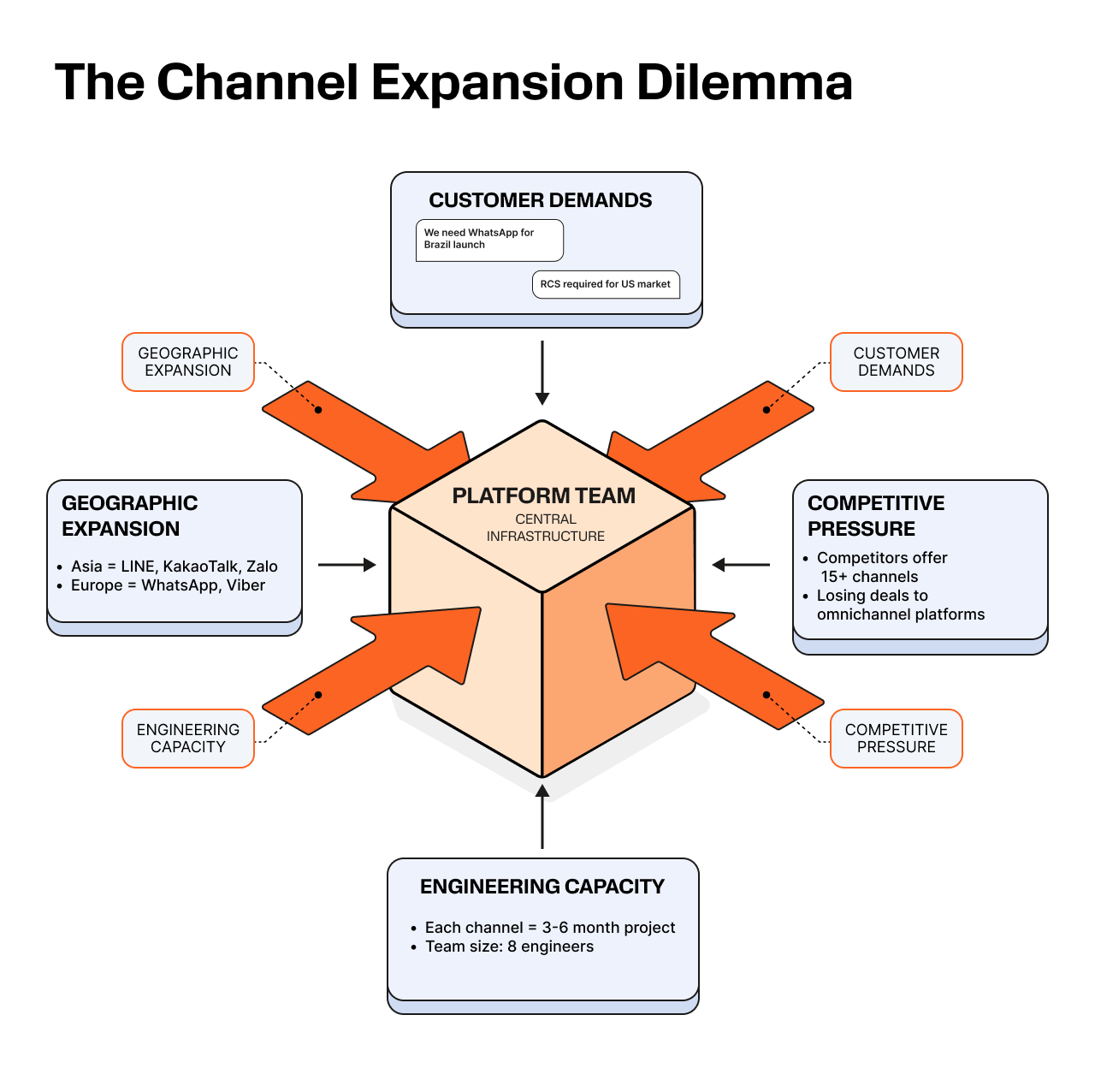
What initially looks like a simple channel addition becomes a 3–6 month project. Your team builds custom handlers for each channel’s quirks, maintains branched code for registration, and writes channel-specific logic for message formatting and delivery semantics.
Here’s a top-level overview of what each channel integration entails in various regions:
| Channel | Registration | Time to launch | Content restrictions |
|---|---|---|---|
| SMS 10DLC (US only) | Brand + Campaign via TCR | 1-2 weeks (moderate burden) | High – prohibited verticals |
| SMS Short Code (US only) | Carrier-by-carrier | 2-8 weeks (low burden) | Very high |
| SMS Toll-Free (US/Canada) | Verification required | 1-2 weeks (low burden) | Moderate |
| SMS (Europe – High Geographic variance) | Country-by-country | 1 day – 4 weeks(high burden) | Varies per country |
| WhatsApp (Global) | Meta Business Verification | 1-3 days to 2 weeks (High burden, quality monitoring) | Moderate |
| RCS (Carrier/geographical variation) | Brand + carrier approval | 2-8 weeks (Moderate burden) | Varies by carrier |
| Viber (Low geographical variance) | Business account | 1-2 weeks (low burden) | Moderate |
| Apple Messages for Business (Global) | Apple Business Register | 2-4 weeks (low burden) | Moderate |
This is the n+1 channel problem. Every new channel adds more than linear complexity, because the differences compound.
The geography and consumer problem
Your platform does not get to choose which channels matter. Your customers’ end users do. And those preferences are shaped by geography, demographics, and device ecosystems in ways that can shift faster than enterprise roadmaps.
WhatsApp dominates in Brazil, India, and most of Europe. LINE is essential in Japan and Thailand. KakaoTalk is table stakes in South Korea. Viber has strong presence in Eastern Europe and parts of Asia. RCS is rolling out globally, but adoption varies by carrier and device. Apple Messages for Business only reaches iOS users, but that is 50%+ of the US market.
When a customer asks for WhatsApp support because they are expanding into Latin America, or RCS because their US customers want richer experiences, you are not making a strategic channel decision. You are reacting to market reality.
If every channel addition is a 3-6 month project, you cannot keep up with those requests. Your customers either wait, or they look for platforms that already support what they need.
The case for Messages API
And then there’s the content mess. You can’t send the same message across channels and hope for the best, RCS supports rich cards with images and buttons, SMS is stuck with plain text, WhatsApp has its own template format. So your team writes channel-specific formatting code, maintains separate content versions, and debugs why the message that looks great on one channel breaks on another. It’s grunt work that scales linearly with every channel you add.
The natural response is to abstract. Build a unified messaging layer that hides channel differences behind a consistent interface.
This works, but it requires an honest trade-off: your first integration takes longer, but every subsequent channel becomes dramatically faster.
Messages API, as we have built at Infobip, lets you integrate once against a single endpoint and then add channels by configuration rather than code. The API handles several layers of complexity:
Content adaptation
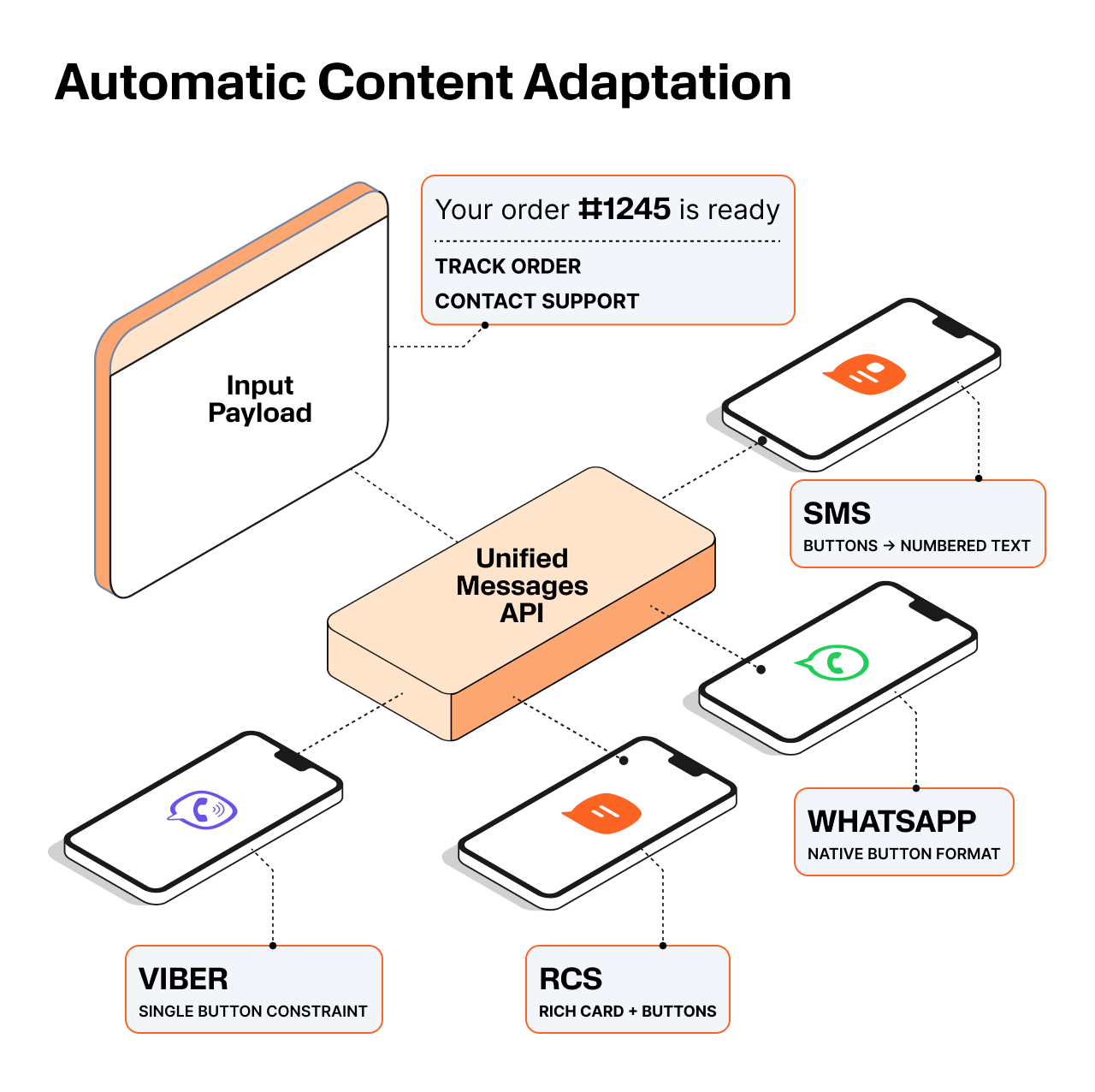
You send a message with text, an image, and action buttons. The API knows that SMS cannot render buttons, that Viber only supports single buttons, that WhatsApp has specific button formatting rules. Instead of building channel-specific formatting logic, the API adapts your content automatically. Buttons become numbered text options on SMS. Rich cards gracefully degrade when a channel does not support them. You define the message once; the API figures out how best to deliver it over each channel.
Failover logic
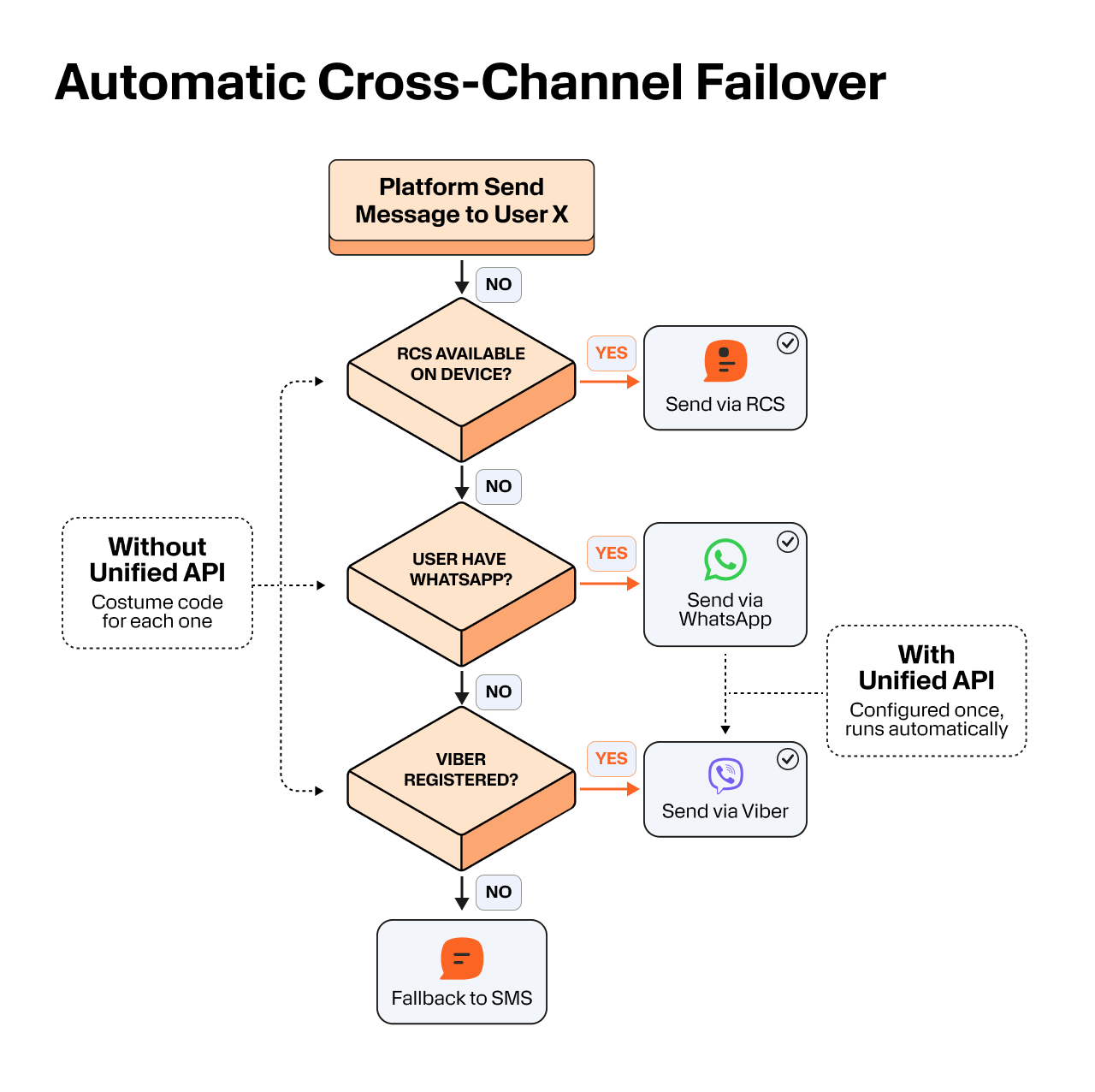
When RCS is not available on a device, the message falls back to SMS or MMS automatically. When WhatsApp delivery fails, sending to Viber or SMS kicks in based on your configuration. This is not just routing logic; it is cross-channel orchestration that would otherwise require custom code for every channel combination.
Unified delivery reporting
Instead of normalizing delivery reports from ten different channel APIs, each with their own status codes and webhook formats, you get a consistent reporting interface. One integration for status tracking across all channels.
Validation before send
The API validates your message payload against each channel’s requirements before sending. You catch any problems, and the reason for failure, immediately on submission to the API not when the message fails on delivery to the user.
Here’s the honest trade-off: getting started with a unified API takes more work upfront than plugging into a simple SMS API. You’re investing in a more robust integration now because it’s built to solve problems you’ll run into as you add more channels.
But the investment delivers returns. Your second channel is not a new integration project. It is a configuration change and some testing. Your third channel is the same. When a customer needs Viber for Eastern Europe or LINE for Japan, you are not looking at months of work, you are looking at days.
What abstraction can and cannot do
Even with a unified API, you cannot fully abstract away channel semantics. And you should not try.
- WhatsApp’s 24-hour session window is not a quirk to be hidden. It is a fundamental constraint that shapes how your customers design their messaging flows. If you abstract it away, your customers build experiences that break when the window expires.
- RCS fallback to SMS is not just a delivery mechanism. It affects content strategy, because what works in an RCS rich card does not translate to 160 characters of plain text.
- Apple’s business verification is not a registration step. It is a gate that determines whether your customers can use the channel at all.
However, everything that can be unified, should be. All Infobip features, delivery reports, analytics, conversation tracking, content templates, compliance tools, are available identically across every channel. Your customers learn one API, one set of concepts, and one integration pattern. The differences they encounter are only the ones that genuinely matter: the channel-specific constraints that shape user experience.
The goal is not to pretend channels are identical. It is to reduce the integration work for the parts that can be unified, while making the parts that differ explicit and manageable.
A well-designed unified API does both. It handles the commodity work of automatic message routing, content adaptation, and delivery tracking, while exposing the channel-specific semantics that your customers need to understand and design for.
Where the leverage is
In practice, channel integration overhead breaks into two categories:
Commodity work that should be unified:
- Message sending across channels via a single endpoint
- Content adaptation for channel-specific formats and limitations
- Delivery reports and status tracking
- Failover and retry logic across channels
- Webhook handling with consistent payloads
- Multi-tenant sender management
Channel-specific work that needs explicit handling:
- Rich features unique to each channel (Flows, payments, fallback configuration)
- Registration and verification workflows
- Template management and approval processes
- Conversation window logic and re-engagement rules
- Compliance requirements by country and carrier
The first category is where Messages API pays off. Integrate once, send to ten channels. That alone can make channel adoption significantly faster. The second category is where operational APIs and managed workflows matter. If our CPaaS provider exposes registration as a consumable workflow rather than a manual process, you can automate customer onboarding. If template management is API-driven with status webhooks, you can build approval flows into your platform. If compliance requirements are documented and enforceable at the API level, you catch problems before they become carrier blocks.
The practical trade-off
When evaluating how to approach channel expansion, platform teams should be honest about the trade-off:
If you integrate channel-by-channel, each integration is smaller and more contained. You learn the channel deeply. But you are building bespoke code for every channel, and the fourth integration is just as expensive as the first.
If you integrate a unified API, your first integration is larger and more complex. You are building against an abstraction designed for channels you do not use yet. But your second, third, and tenth channels are incremental. You gain channel velocity.
The break-even point depends on how many channels you expect to support. If you are certain you will only ever need SMS, a single-channel integration is fine. But if your customers operate globally, if they serve consumers across different demographics and device ecosystems, if channel preferences shift based on geography, you will need more channels than you can predict today.
And that includes channels that do not exist yet. Consumer messaging evolves faster than enterprise roadmaps. New platforms emerge, regulatory changes force adoption of certain channels in specific markets, and customer expectations shift. When that happens, a unified API provider absorbs the integration work. They add the new channel to their infrastructure, and you gain access through the same API you are already using. No new vendor contracts, no new technical integration, no disruption to your existing workflows.
In that world, the upfront investment in a unified API pays back quickly. And the alternative, rebuilding channel infrastructure every time the market moves, including for channels that didn’t exist when you started, becomes a drag on everything else you are trying to ship.
The shift
For years, adding a new channel meant accepting a fixed cost: weeks of integration work, custom code for registration, bespoke logic for that channel’s quirks. Platforms budgeted for it and moved on.
That model does not scale. When your customers expect omnichannel by default, and when channel preferences shift by geography and demographic faster than roadmaps can adapt, the fixed cost per channel becomes a compounding drag.
The alternative is to pay the cost once. Integrate a unified API that handles content adaptation, failover, and delivery tracking across channels. Consume operational workflows for registration and compliance.
Accept that some channel semantics cannot be abstracted away. But make sure those are the only things your team has to build channel-specific logic for.
RCS should not take six months. With the right architecture, it can be significantly faster. The question for platform teams is whether you are optimizing for the next channel, or for the next ten.