




The ultimate guide to agentic RAG for 2026
Agentic RAG and rag agents enhance conversational AI with accurate, business-specific answers. In this blog, we explain how agentic RAG pipelines deliver trust, boost efficiency, and transform customer interactions.


Agentic RAG is retrieval augmented generation with an agent layer on top. It lets AI route to the right source, rewrite vague queries, validate the retrieved context, and try again when the answer is not good enough.
That matters when the question depends on a policy that changed last week, a contract signed this morning, or a product detail buried in a knowledge base. Instead of guessing from memory, the system checks business knowledge before it answers.
In this guide you’ll learn everything about Agentic RAG: what is it, what makes it agentic, how it works under the hood, where it delivers real business value, and what to look for when choosing a platform to run it. Whether you’re making the business case, evaluating architecture, or building a deployment plan, it’s all here.
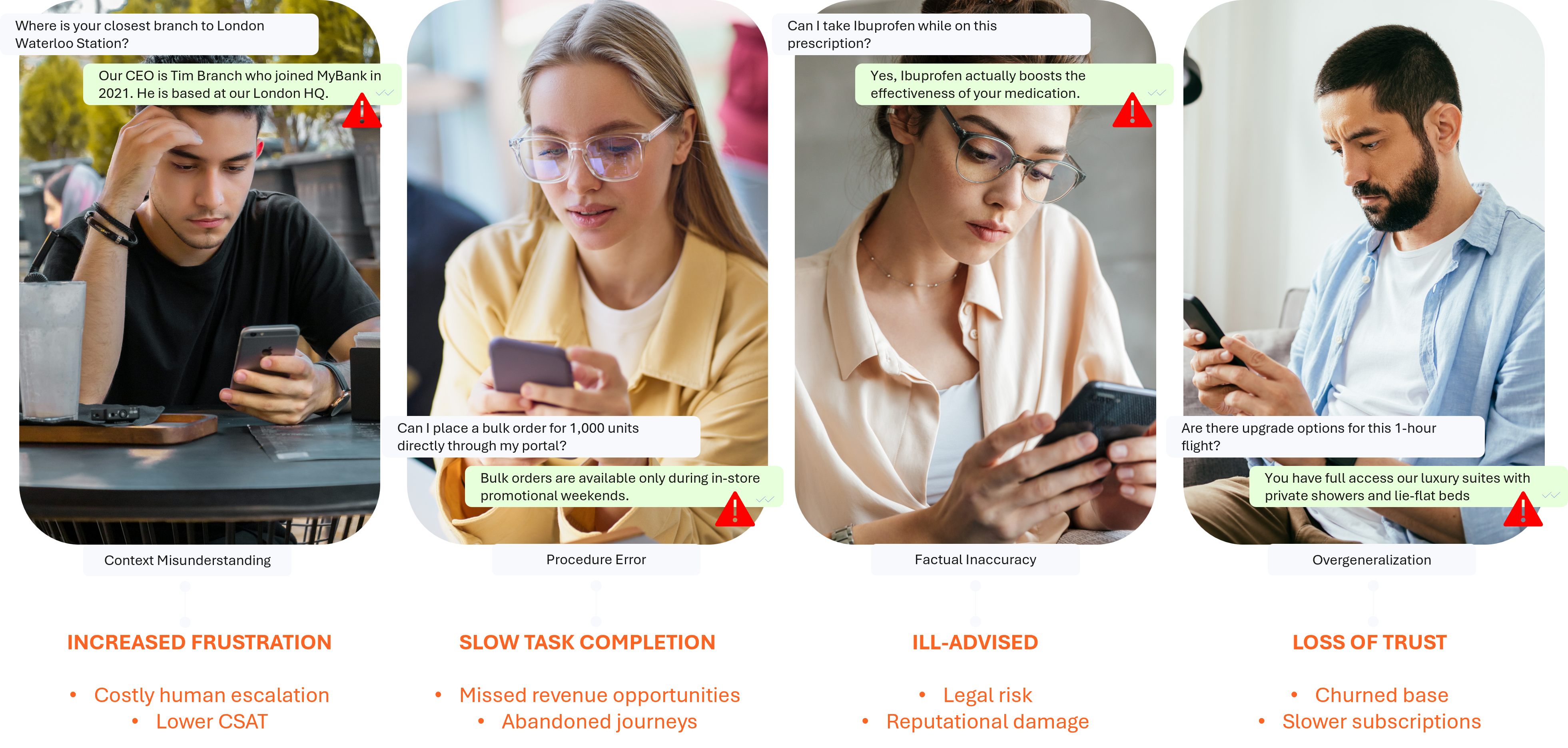
What is Agentic RAG?
Agentic RAG refers to the integration of AI agents into retrieval-augmented generation (RAG) systems. By adding AI agents to the RAG pipeline, these systems become more adaptable and accurate.
Unlike traditional RAG systems, agentic RAG connects a generative AI model with an external knowledge base that enables large language models (LLMs) to retrieve information from multiple sources and manage more complex tasks and workflows.
The result? Customers and employees get trustworthy, business-specific answers delivered by smart RAG AI agents.
What is a RAG agent?
A RAG agent is an intelligent AI assistant designed to retrieve, understand, and synthesize the most relevant information from a wealth of data resources.
A good RAG agent can:
- Decide whether retrieval is needed
- Choose the right source or tool
- Rewrite a vague query into something more precise
- Compare results from more than one source
- Check whether the retrieved context is complete
- Retry when the answer looks weak or conflicting
That makes the system more reliable on questions that are messy, dynamic, or spread across multiple systems.
Why agentic RAG matters
The gap between training data and current business knowledge is where most AI failures happen. A model may know the general idea of a policy, a product, or a regulation. It may still miss the latest version, the exception clause, or the exact wording that matters in a customer conversation. Agentic RAG connects the model to live or updated knowledge sources, so answers are grounded in current information instead of memory alone. That matters for accuracy and trust.
Cost and context windows
Without retrieval, teams often try to work around missing knowledge by loading entire documents into the prompt. A 100 page policy document can quickly add up to roughly 60,000 tokens, which drives cost up and makes it harder for the model to stay focused. With RAG, the system retrieves only the relevant sections, so the same document might contribute closer to 2,000 tokens instead.
| Approach | Context window cost | Model focus quality | Scalability |
|---|---|---|---|
| Without RAG | High | Drops as context grows | Harder to scale |
| With RAG | Lower | Stays sharper | Easier to scale |
RAG also removes the need to retrain the model every time policies change. You update the source document, and the system can use the new information right away.
Traditional RAG vs agentic RAG
The difference is easier to see side by side.
| Aspect | Traditional RAG | Agentic RAG |
|---|---|---|
| Retrieval flow | One pass | Multi-step loop |
| Query handling | Uses the user query as is | Can rewrite and refine the query |
| Source selection | Usually one source at a time | Can route across sources and tools |
| Validation | Limited or none | Can evaluate whether the result is good enough |
| Complex questions | Often weaker | Better at multi-part or ambiguous questions |
| Latency | Usually lower | Usually higher |
| Cost | Usually lower | Usually higher |
| Best fit | Simple, stable knowledge | Dynamic, multi-source, higher-stakes knowledge |
Traditional RAG keeps retrieval simple. It pulls a small set of relevant chunks and sends them to the model. Agentic RAG adds a decision layer. It can rewrite the query, route to the right source, and check whether the retrieved context is good enough before it answers.
The table below shows how that changes what the model sees, how much it costs, and how well it performs on harder questions.
| Approach | What the model sees | Cost profile | Response quality |
|---|---|---|---|
| No retrieval | Large blocks of text or full documents | Higher | Can drift when context gets noisy |
| Traditional RAG | A few relevant chunks | Lower | Good for direct questions |
| Agentic RAG | The most relevant context after routing and validation | Higher than traditional RAG, but often more accurate on hard questions | Strongest on complex or dynamic queries |
How to decide between standard RAG and agentic RAG
If you are deciding between standard RAG and agentic RAG, use this test.
- Choose standard RAG when the question is direct and the source is stable.
- Choose agentic RAG when the question is complex, the sources are multiple, or the knowledge changes often.
- Avoid either one when a human answer is faster, safer, or more accurate.
How does Agentic RAG work?
The power of agentic RAG comes from a robust, multi-step process that transforms messy enterprise documentation into instant, actionable answers:
- Ingestion: The system securely ingests all your business documentation PDFs, knowledge bases, and manuals.
- Preprocessing and chunking: Content is cleaned and split into manageable, context-rich chunks to optimize search.
- Embedding and indexing: Each chunk is turned into a searchable vector format, ready for rapid retrieval by the RAG agent.
- Retrieval: When a user asks a question, the rag agent quickly identifies and pulls the most relevant content chunks.
- Generation: The Agentic RAG system then generates an answer rooted in this retrieved data, ensuring every response is accurate and relevant.
- Action optional: In advanced applications, RAG agents do not just answer, they might trigger workflows, delegate requests, or connect to other business tools, acting with real-world purpose.
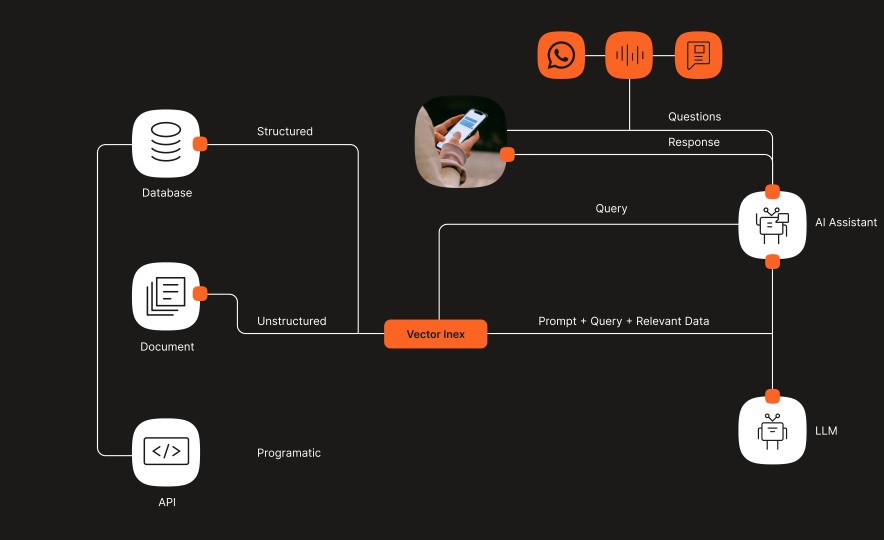
The core building blocks of Agentic RAG
Most agentic RAG systems use the same core pieces, even if the implementation changes.
The language model
The LLM writes the answer, but it also helps with reasoning, query rewriting, and tool selection.
The retrieval layer
This is the part that finds relevant context in a vector database, search index, document store, or API.
The agent layer
The agent decides what to retrieve, when to stop, and whether to try again.
The knowledge sources
These can include policies, manuals, product documentation, tickets, CRM data, internal wikis, or approved external sources.
The evaluation step
This is where the system checks whether the retrieved context is relevant, complete, and aligned with the question.
The memory and tool layer
Some systems keep short term or long term memory. Others use tools to call APIs, search the web, query structured data, or take action in another system.
Common architecture patterns
Agentic RAG is not one fixed design. A few patterns show up often.
Single agent router
One agent decides which source to query. This is a good starting point when you have a small number of sources and clear routing rules.
ReAct style agent
The agent reasons, acts, observes the result, and repeats. This pattern works well when the system needs to inspect what it found before moving on.
Plan and execute
One part of the system plans the steps. Another part executes them. This helps with more structured tasks that need multiple retrieval steps.
Multi-agent orchestration
Different agents specialize in different sources or tasks. One might handle internal knowledge. Another might handle external search. Another might validate the final output. The more complex the workflow, the more useful orchestration becomes. The tradeoff is that complexity also increases, so control and observability matter more.
Benefits and tradeoffs of Agentic RAG
Benefits
- Better grounding in current information
- Stronger handling of ambiguous questions
- More flexible routing across sources
- Lower hallucination risk when the evaluation loop works well
- More reliable responses for complex workflows
Tradeoffs
- More latency because the system may loop more than once
- Higher token and infrastructure cost
- Harder debugging because decisions happen in steps
- More dependence on evaluator quality
- More governance work around tools, sources, and permissions
If you worry that RAG depends on stale sources, struggles with vague questions, and adds latency when the answer needs more than one retrieval pass. That concern is fair. However, RAG works best when it is treated as a live knowledge system, not a one-shot search layer. With current sources, strong metadata, and an agent layer that can rewrite the query, route to the right source, validate the result, and try again when needed, RAG becomes more reliable than memory alone. So these limits do not weaken the case for RAG. They show why retrieval needs structure, freshness, and control.
Agentic RAG use cases that matter to both sales and technical teams
Agentic RAG and rag agents can transform enterprise workflows across multiple industries and channels. Here are a few use case examples to say the least:
Customer support
Support teams need answers that are current, consistent, and grounded in approved content. Agentic RAG can help answer product, policy, shipping, refund, and troubleshooting questions with less guesswork.
Sales enablement
Sales teams need fast access to the latest approved information. Agentic RAG can help surface product details, pricing context, and policy constraints without forcing reps to search across multiple systems.
Internal help desks
Employees ask the same kinds of questions every day. Benefits, onboarding, procurement, security, and HR policies are all strong candidates for agentic RAG when the sources change often.
Banking and regulated industries
When compliance matters, the system needs to be more than fluent. It needs to be grounded in the current version of the approved source and able to validate what it finds.
Retail and eCommerce
Returns, shipping, promotions, and stock questions change quickly. A system that can route to the right source and check freshness is much more useful than a static answer bot.
Omnichannel service
Agentic RAG is useful when the same knowledge needs to work across WhatsApp, RCS, live chat, web chat, or another customer touchpoint. The answer still needs to be consistent, even when the channel changes.
Implementation considerations of Agentic RAG
Keep source content current
The system can only be as accurate as the source material behind it. Stale documents create stale answers.
Chunk with meaning in mind
Chunking should preserve context. Bad chunking can split important details apart and make retrieval less reliable.
Use metadata well
Version, owner, date, channel, language, and permission metadata all help the system choose the right source and avoid the wrong one.
Add routing and fallback rules
Not every query should trigger the same path. Some should go straight to retrieval. Others should route to multiple sources or escalate to a human.
Make evaluation visible
You need to know why the system answered, what it retrieved, and when it retried. Without that visibility, debugging gets painful fast.
Test with real questions
Synthetic examples are useful, but real customer and employee questions will expose the edge cases much faster.
How Infobip mitigates Agentic RAG implementation gaps
Missing context
Some answers sound complete but are missing important details. That is a sign the system retrieved something relevant, but not enough.
How Infobip helps: Knowledge Agent Analytics tags partially answered responses, so teams can spot context gaps faster and improve the knowledge base with real production insight.
No production visibility
Without analytics, it is hard to tell which questions are answered well, which topics need better documentation, or where hallucination risk is starting to rise.
How Infobip helps: Analytics shows retrieved documents, response patterns, and knowledge gaps, so teams can improve the agent based on actual usage.
Policy compliance risk
Sometimes retrieved content can override intended instructions and pull the answer away from approved messaging or internal rules.
How Infobip helps: Agent level controls help keep responses within defined behavioral boundaries, so the system stays safer and more consistent in production.
What makes Infobip’s Agentic RAG pipeline unique?
We knew early on that RAG was our best bet for delivering contextual, accurate AI responses in real time. But to make that work at scale across WhatsApp, RCS, Messenger, Live Chat, and more, we had to build RAG into the fabric of our stack. Building an effective Agentic RAG system isn’t easy. Many organizations underestimate the engineering and data management required. That’s why we have developed an enterprise-class agentic RAG pipeline built from the ground up for accuracy, scale, and ease of use:
- Document-first indexing: Handles all types of unstructured documentation, regardless of format or “hygiene”.
- Custom chunk reordering: Prioritizes contextually relevant data, minimizing unnecessary back-and-forth.
- Multi-retriever architecture: Combines keyword, vector, and hybrid search so RAG agents always surface the best sources.
- Query rewriting: Refines ambiguous user questions, ensuring RAG agents fetch better responses.
- Response scoring & hallucination management: Every answer is checked for factual accuracy, and non-critical queries are cleverly handled.
- Seamless content updates: Upload new documents and the underlying AI knowledge base auto-updates, ensuring answers keep pace with changing policies or information.
- Modular deployment: Scale from targeted, single-channel deployments to full omnichannel agentic RAG orchestration.
Getting started with Agentic RAG and RAG AI agents
Deploying an agentic RAG system is smoother than you think. With Infobip’s managed platform, you don’t need to hire extra engineers or worry about infrastructure. Simply provide your documentation and some basic structure, and we’ll handle ingestion, tuning, and ongoing monitoring.
Choose the deployment tier that suits your business, higher-accuracy agentic RAG for complex, compliance-heavy domains, or lightweight RAG agents for lower-stakes use cases. Either way, you’ll see faster go-live, less manual effort, and more reliable results than traditional approaches.
FAQs
Agentic RAG is RAG with an agent layer that can decide what to retrieve, check whether the result is good enough, and try again if needed.
Traditional RAG retrieves context once and generates an answer. Agentic RAG can route, evaluate, refine, and loop before it answers.
No. It is better for complex or dynamic questions, but standard RAG is often enough for simple lookups and low latency use cases.
The main risks are latency, cost, debugging complexity, and poor evaluator quality. If the validation step is weak, the system can still make bad decisions.
However, RAG works best when it is treated as a live knowledge system, not a one-shot search layer. With current sources, strong metadata, and an agent layer that can rewrite the query, route to the right source, validate the result, and try again when needed, RAG becomes more reliable than memory alone. So these limits do not weaken the case for RAG. They show why retrieval needs structure, freshness, and control.
Not always. A single agent can do a lot. Multi-agent systems are useful when different sources or tasks need specialized handling.