




What is Model Context Protocol (MCP)?
Your AI assistant knows a lot. Model Context Protocol defines how it safely uses your tools and data to do something useful.
Model Context Protocol, often shortened to MCP, is an open source standard that defines how AI assistants connect to tools, data, and systems in a consistent way.
It was created to solve a growing problem in AI development. As models become more capable, they need access to real information and real systems to deliver value. Without a shared approach, those connections quickly become complex and fragile.
MCP provides a structured way to connect AI to the outside world. Instead of building one-off integrations for every tool or data source, teams can rely on a common protocol that both the AI and the system understand. This makes it easier to build AI applications that work reliably across different environments.
At its core, MCP helps AI assistants move beyond conversation and into action.
How Model Context Protocol works
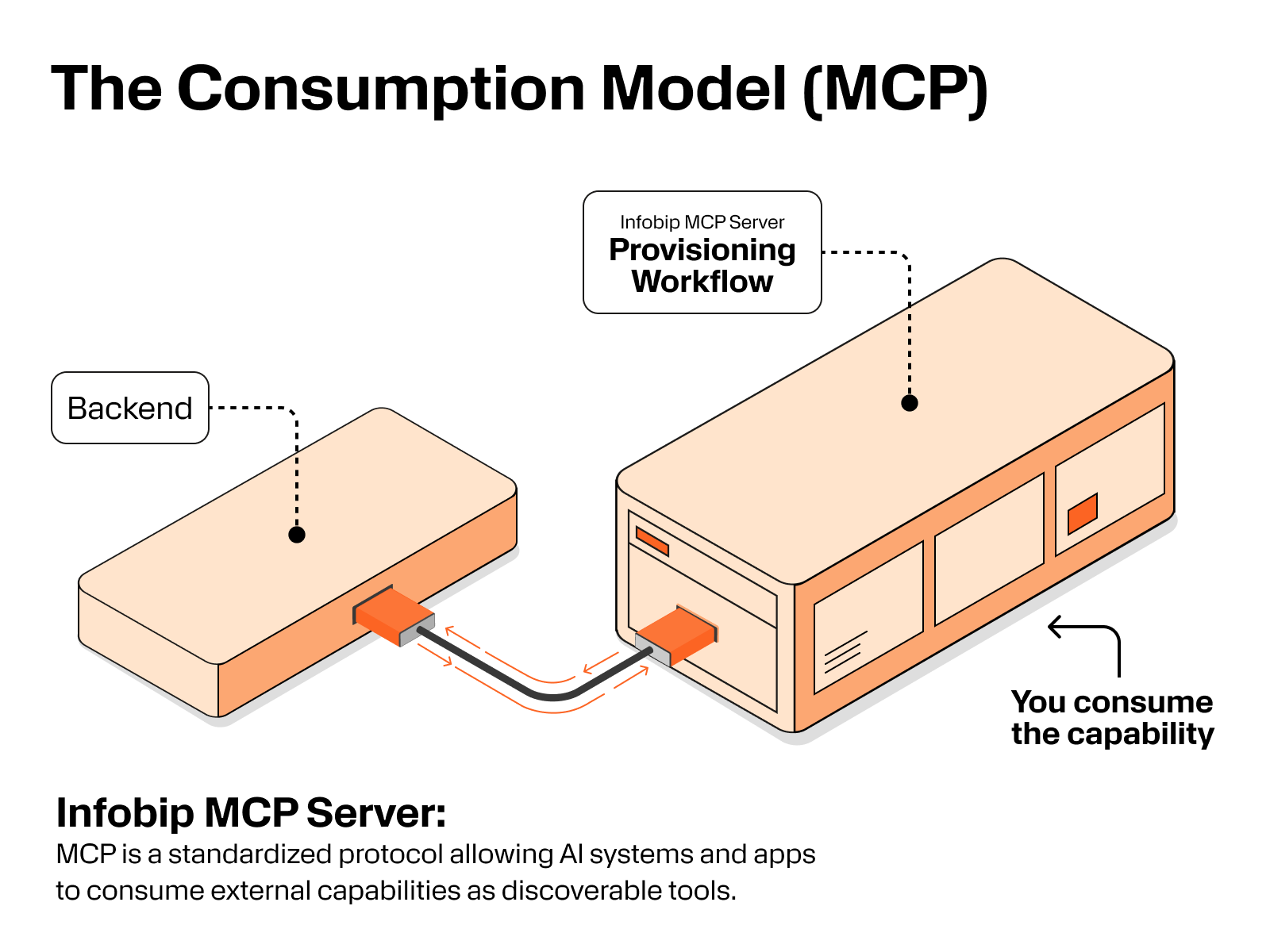
The AI assistant focuses on understanding intent, reasoning through problems, and deciding what should happen next. When it needs to access data or perform a task, it sends a structured request through an MCP client. That request is received by an MCP server, which owns the data or action being requested.
This approach keeps responsibilities clear. The model does not need direct access to databases, APIs, or automation tools. Instead, MCP defines how information and actions are requested, validated, and returned. This makes AI workflows easier to manage and safer to scale.
As AI applications evolve, models move beyond answering questions and begin performing tasks such as retrieving information, analyzing data, and triggering automated workflows. MCP supports this shift by providing a predictable way to connect AI to systems that already exist inside an organization.
This design is especially important for agentic AI. In agentic workflows, models plan steps, reason through outcomes, and act across multiple systems as part of a larger AI workflow. MCP provides the structure that allows these steps to happen without tight coupling between systems.
What are MCP servers?
MCP servers expose capabilities that AI assistants can use.
An MCP server might provide access to a knowledge base, analytics data, or customer records. Another server might handle actions such as updating records, sending messages, or triggering automated workflows inside a business process. Each server clearly defines what it offers and what an AI assistant is allowed to do.
Because each MCP server defines its own boundaries, organizations can connect AI to sensitive systems without giving it full access. This reduces risk while still enabling meaningful automation. It also makes it easier to reuse servers across multiple AI applications.
Understanding what MCP servers are is key for teams building agents that need to operate across complex workflows. Rather than hardcoding logic into the model, MCP servers act as controlled gateways to data and actions.
MCP clients and AI assistants
An MCP client is the interface that initiates requests on behalf of the AI.
This client can be a chatbot, an internal copilot, or part of an AI agent builder used for building agents that complete tasks on their own. The client decides when to request data or take action, while MCP defines how those requests are handled.
From the user’s perspective, MCP is invisible. An AI assistant can answer questions, pull relevant information, analyze data, and complete actions without the user switching tools or repeating context. MCP is the layer that makes connecting AI to real systems possible.
This separation also allows teams to customize AI behavior without changing underlying systems. New use cases can be added by adjusting how the client interacts with MCP servers rather than rebuilding integrations from scratch.
Model Context Protocol use cases
Model Context Protocol use cases focus on enabling AI to do more than respond.
Common MCP use cases include customer support assistants that retrieve answers from a knowledge base, AI applications that analyze data and generate insights, and agentic workflows where AI coordinates multiple steps across tools. These use cases rely on MCP to manage context, permissions, and tool calling in a consistent way.
In customer support, MCP allows AI assistants to access help articles, ticket histories, and customer profiles while keeping sensitive data protected. In data analysis, MCP enables models to request reports, run queries, and return structured results. In automation scenarios, MCP supports triggering workflows that span multiple systems.
As organizations explore how to build AI agents that can operate independently, MCP provides a practical way to connect those agents to real systems without fragile integrations.
MCP and agentic AI
Agentic AI depends on the ability to act.
In an agentic workflow, an AI assistant may plan a sequence of steps, call tools, evaluate results, and continue until a goal is reached. This requires reliable access to tools and data at each step. MCP supports this by defining a shared way for agents to interact with systems across the workflow.
Without MCP, teams often rely on custom integrations that are hard to maintain and difficult to scale. MCP reduces this friction by providing a standard way to connect AI, trigger actions, and manage context across an AI workflow.
This makes it easier to build custom AI agents that can adapt to new requirements over time. It also supports agentic process automation, where AI handles multi-step processes that previously required manual effort.
Benefits of using Model Context Protocol
One of the main benefits of MCP is consistency.
By standardizing how AI assistants connect to tools and data, MCP reduces duplication and simplifies system design. Teams can add new automation tools or data sources without redesigning their AI applications. Existing integrations can be reused across multiple workflows.
MCP also improves visibility. Because interactions flow through defined servers, organizations can better understand how AI uses data and tools. This supports monitoring, auditing, and optimization over time.
Another benefit is flexibility. MCP makes it easier to customize AI behavior and experiment with new use cases. Teams can focus on building agents and improving problem solving rather than managing integrations.
Security considerations
Model Context Protocol improves safety, but security still depends on careful implementation.
Each MCP server must define what data can be accessed and what actions are allowed. This is especially important when AI assistants interact with customer support systems, internal business processes, or sensitive information. Poorly designed servers can still expose too much functionality.
When implemented correctly, MCP can reduce risk by limiting exposure and improving visibility into how AI applications use tools and data. Logging, monitoring, and permission management remain essential parts of any MCP setup.
MCP and AI workflow design
MCP plays a central role in modern AI workflow design.
As teams invest in AI agent builders, agentic workflow design, and agentic process automation, the need for a shared integration standard becomes unavoidable. MCP supports this shift by making it easier to connect AI to tools, customize AI behavior, and scale automation across the organization.
This is especially valuable in complex workflows where multiple systems must work together. MCP allows AI to move between systems without losing context or breaking processes.
The future of Model Context Protocol
Model Context Protocol is becoming a foundational layer for AI applications that need to operate in the real world.
As AI assistants evolve, expectations continue to rise. Users expect systems that can understand intent, analyze data, and take action across tools. MCP helps meet those expectations by providing a reliable way to connect AI to the systems that power everyday work.
Over time, MCP will continue to support new use cases in automation, customer support, and business operations. Its open source nature also encourages adoption and collaboration across the AI ecosystem.
In this sense, Model Context Protocol is not just a technical standard. It is an enabler for practical, scalable, and trustworthy AI.
FAQs about MCP
Model Context Protocol is an open source standard that defines how AI assistants connect to tools, data, and systems so they can perform tasks as part of real workflows.
MCP servers expose data or actions that AI systems can use, such as accessing a knowledge base, analyzing data, or triggering automated workflows.
An MCP client is the interface used by an AI assistant to request data or actions from MCP servers.
MCP use cases include customer support automation, data analysis, agentic AI workflows, and building agents that operate across multiple systems.
MCP provides a structured way to connect AI agents to tools and data, making it easier to build, scale, and customize AI agents without fragile integrations.
MCP is not required, but it simplifies how to build AI agents that need to operate across complex workflows and real business processes.