

Omnichannel customer data: The complete guide to unified profiles and real-time activation
Most omnichannel data strategies draw from the same sources and miss the richest behavioral signals your customers generate. This guide covers how to unify and activate all six data types, including conversational data from chatbots, AI agents, and messaging channels, with Infobip AgentOS Conversational CDP.

Most enterprises think their omnichannel customer data strategy is working. They’ve connected the CRM, web analytics, email platform, and transaction history into something that looks like a unified view. What’s missing is what their customers are actually saying.
Every chatbot session, WhatsApp exchange, AI agent interaction, and contact center call generates real-time behavioral signals that most platforms log as support tickets, but they’re your richest source of customer intent. A customer who types “what’s the status of my claim?” into a chatbot tells you more about their current situation than ten web sessions combined.
Enterprises bringing conversational data into their omnichannel customer data strategy see the difference in results. Bolt achieved a 40% conversion rate increase by activating unified profiles across WhatsApp. Farm Superstores reduced operational costs by 60% through profile-driven chatbot personalization. Four in five organizations see positive ROI from CDP investment within 12 months, according to CDP Institute research.
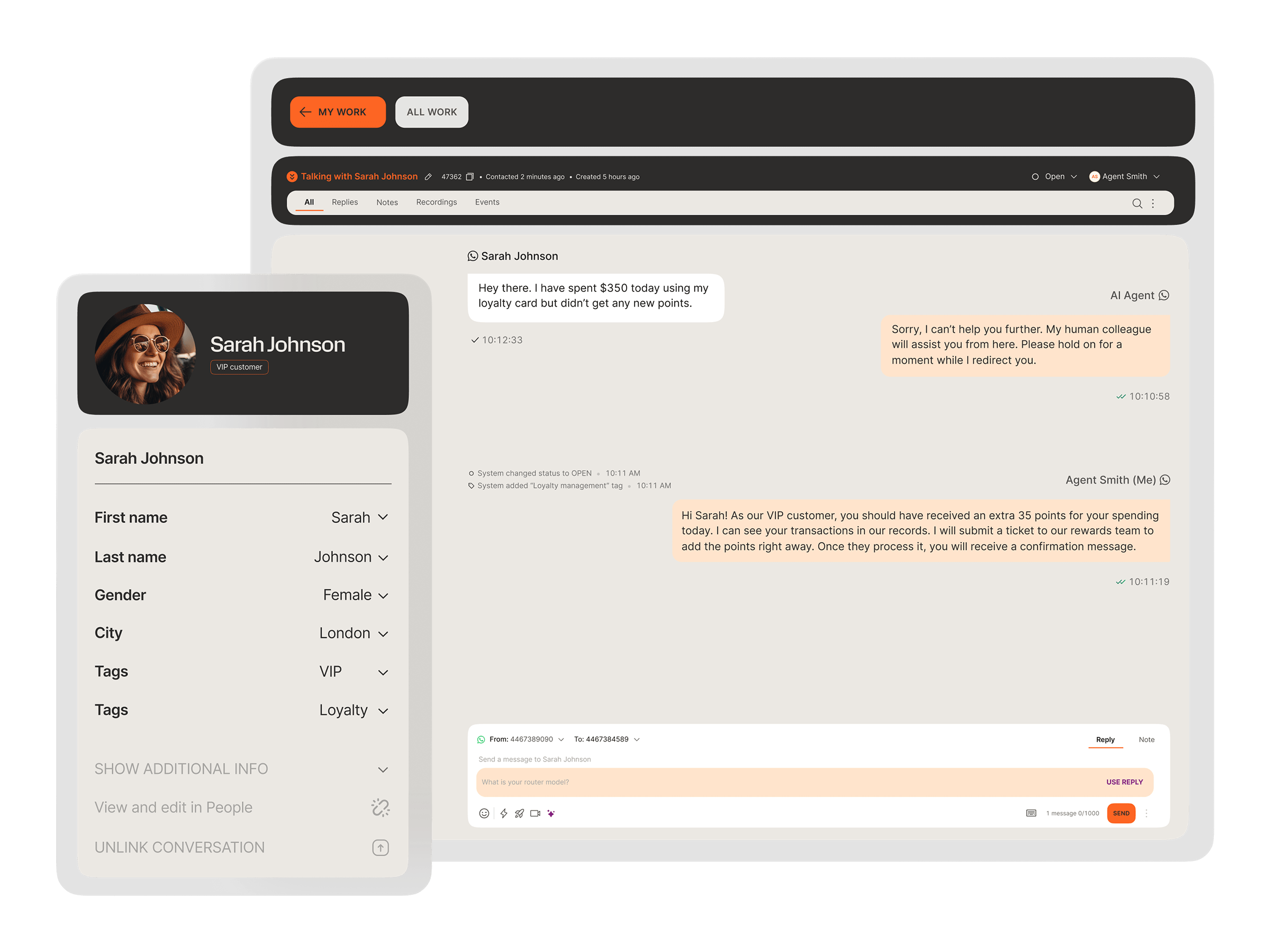
AgentOS Cloud Contact Center interface with CDP integration for context rich conversations.
This guide covers what a complete omnichannel data strategy looks like, including the conversational layer most platforms miss, and how the Infobip AgentOS Conversational CDP is built to close that gap.
What is omnichannel customer data and why most strategies leave money on the table
Omnichannel customer data is the complete record of every behavioral, transactional, and interaction signal a customer generates across every touchpoint where they engage with your brand. That includes:
- web and mobile activity
- email responses
- purchase transactions
- in-store visits
- all conversations across messaging channels, chatbots, AI agents, and contact centers.
Most organizations unify only three or four data types, typically CRM records, web analytics, email, and purchase history, while missing the richest behavioral signals entirely. That gap shows up in customer experience through repeated questions across channels, irrelevant offers that ignore what the customer already told you, poorly timed outreach, and wasted budget on campaigns built from incomplete profiles.
The 6 types of omnichannel customer data every enterprise needs
A complete omnichannel data strategy captures across six distinct categories.
Behavioral data covers how customers navigate your digital properties from page visits, app sessions, content interactions, to search queries, and click patterns. It reveals interest and intent before a purchase decision is made.
Transactional data records what customers actually buy, that includes purchase history, order values, returns, subscription renewals, and payment behavior. It’s the foundation of any customer lifetime value model or cross-sell strategy.
CRM and relational data brings in the account-level context: company records, sales history, service ticket history, and relationship tenure. For B2B enterprises, this is often the most mature data layer and also the most siloed.
Channel preference data captures how and when each customer wants to be reached, which channels they respond on, their preferred language, their typical engagement times, and their sensitivity to message frequency. Without this, personalization at scale is guesswork.
Conversational data is where most CDP platforms fall short. Every chatbot session, every WhatsApp exchange, every AI agent interaction, and every contact center call generates behavioral signals that reveal intent in a way no form fill or page visit can replicate. A customer who asks, “when does my policy renew?” is telling you something a web analytics system will never log. The Conversational CDP within AgentOS treats this as a first-class profile input, not a support ticket.
Consent and compliance data governs what you’re permitted to do with everything else. including opt-in records, channel-level preferences, GDPR consent timestamps, and CCPA compliance status. In a unified data environment, this has to propagate in real time across every channel and every activation decision.
Why conversational data is the missing layer in most omnichannel strategies
A customer who asks, “how do I cancel?” reveals churn risk at the exact moment intervention is still possible, something no CRM field would surface on its own. A customer who escalates from chatbot to voice is exhibiting frustration that should be flagged in their profile before the next interaction, not discovered during it. A WhatsApp exchange about loan products signals purchase intent that a browsing session can only approximate.
Infobip AgentOS Conversational CDP ingests this data as core profile intelligence across 15+ messaging channels. Chatbot sessions, AI agent interactions, and contact center calls all enrich the unified customer profile with intent signals, sentiment context, and behavioral data in real time. By the time a customer’s next interaction begins, their profile already reflects what they told you in the last one.
Understanding what omnichannel data is and why conversational data belongs in it is the foundation. The harder question is how you unify it.
Building an omnichannel customer profile: From fragmented data to unified intelligence
Most enterprise CX failures trace back to a familiar root cause. A customer who already told you what they need but was treated as a stranger the next time they reached out. Fragmented data produces disconnected profiles, siloed channels, repeated questions, and irrelevant offers. The unified omnichannel customer profile is the operational fix, and it needs to work across every channel simultaneously, including the ones where most CDPs can’t reach.
Identity resolution across every channel and device
The first challenge in building a unified omnichannel customer profile is identity. Your customers interact with your brand across dozens of touchpoints, from anonymous web sessions, authenticated mobile app usage, email clicks, to in-store transactions, phone calls, and WhatsApp messages from a mobile number. Each touchpoint generates a signal that belongs to one person. Connecting them is identity resolution.
Deterministic matching uses hard identifiers: email address, phone number, customer ID. When a customer logs into your app with the same email they use for WhatsApp, the system connects those sessions with certainty. Probabilistic matching handles the ambiguous cases, two devices sharing behavioral patterns, a browsing session converting two hours later under a different session ID, using device fingerprinting and behavioral signals to infer the connection.
The Conversational CDP within AgentOS resolves identity across 15+ channels simultaneously, including messaging channels where identity signals differ fundamentally from web interactions. A WhatsApp ID, phone number, and customer account number can all resolve to the same persistent profile. This is where most CDP vendors reach their limit. Infobip extends identity resolution into the conversational touchpoints they can’t access.
Real-time profile enrichment, not batch updates
Knowing who your customer is matters less if you’re working from a profile that’s 24 hours out of date. Most CDPs process profile updates in batch cycles, hours or overnight, which means the profile your agents and automation systems see never reflects what the customer just did.
Infobip AgentOS Conversational CDP enriches profiles in real time as events occur. A WhatsApp message triggers an instant profile update. A chatbot session’s intent signals are added to the profile before the conversation ends. When a customer signals churn risk in a chatbot at 2pm and the CDP only updates profiles overnight, the re-engagement window has closed before it opened. Real-time enrichment means the activation layer always works from current data.
This matters most at the moments that count, a customer mid-escalation, a prospect in a live chat session, a cardholder disputing a transaction. The profile needs to reflect their current situation, not yesterday’s snapshot. Send-time optimization and channel recommendation, two downstream capabilities within AgentOS, both depend on live profile data to make accurate decisions.
The conversational golden record: What sets it apart
The traditional concept of a golden record, a single persistent customer identifier consolidating all known interactions, was built around web and CRM data (purchase history, email engagement, account tenure, support ticket volume). These are valuable, but incomplete.
The conversational golden record adds the layer that traditional CDPs can’t build. It includes the customer’s preferred messaging channel, their sentiment trend across interactions, unresolved service issues, the products they’ve expressed interest in through AI agent conversations, chatbot containment history, contact center escalation log, and the last intent signal they generated in any conversation across any channel.
Most platforms hand customer data off at some point, and every handoff is where context gets lost or delayed. Infobip AgentOS keeps every module on the same platform, so the profile stays complete and current, never fragmented across systems that don’t share it.
Building a complete profile is the foundation. What you do with it determines whether the investment pays off.
How to activate omnichannel customer data: From profile to personalized experience
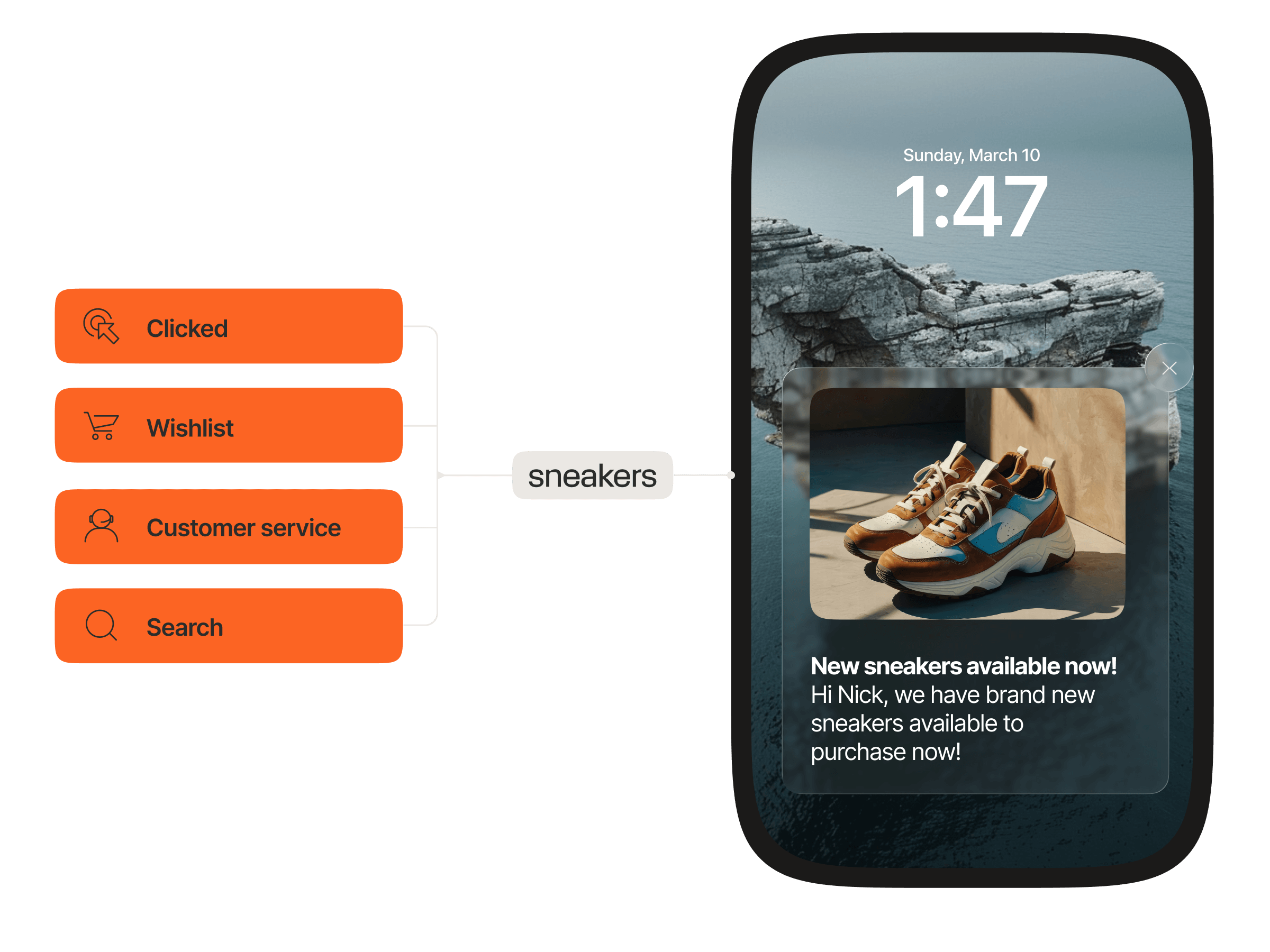
Segment once, activate everywhere – 15+ channels, no middleware
Traditional CDP activation requires exporting audience segments to separate tools. An email service provider for email campaigns, a platform for push notifications, a third-party API for WhatsApp. Every export introduces latency, data loss risk, consent complexity, and another vendor relationship to manage.
Infobip Conversational CDP builds segments and activates them directly across WhatsApp, SMS, RCS, Viber, Telegram, Apple Messages for Business, Facebook Messenger, email, voice, and more, all from the same platform, working from the same customer profile.
A banking customer reaching a 90-day inactivity threshold triggers a re-engagement message in their preferred language, referencing their last product interaction, sent via the channel they responded on most recently. No export, no third-party API call, no data transformation, no delay. The profile condition is met, and the message fires within seconds through Infobip’s own delivery network.
AI agents and chatbots that know your customer before the conversation starts
Infobip AgentOS AI agents and chatbots read Conversational CDP profiles before a conversation begins. When a customer opens a WhatsApp chatbot, the bot already knows their product holdings, recent service history, preferred language, and the outcome of their last interaction with the brand. It greets them by name, skips the authentication loop, and addresses their most likely need rather than starting from a blank context.
That’s not a product specification. That’s how LAQO Insurance resolved 30% of all customer queries through an AI chatbot, with 90% of those conversations completing within three to five interactions. The profile context meant the chatbot didn’t ask questions it already had answers to.
Contact center agents armed with complete customer context
When a conversation escalates from chatbot to human agent, the data handoff is where most platforms break. The agent gets a ticket ID. The customer gets asked to repeat everything they’ve already explained.
Infobip’s Cloud Contact Center within AgentOS has the full Conversational CDP profile integrated. So every escalation has the complete interaction history across all channels, product holdings, sentiment trend from prior conversations, journey context, and AI-recommended next best actions. Agents don’t start from scratch. They pick up exactly where the conversation left off, with a measurable impact on the metrics that matter most to service operations, such as reduced average handle time, higher first contact resolution rates, and better CSAT scores.
This is the omnichannel data loop closing in practice. Customer data powers the chatbot, the chatbot generates new data, and the escalation carries all of it to the human agent. Every agent interaction then enriches the profile further, so the next time the customer reaches out through any channel, that complete context is already there.
Send-time optimization and channel recommendation from unified profile data
Send-time optimization uses each customer’s historical engagement patterns to determine when they’re most likely to open and respond. Channel recommendation ranks available channels by each customer’s predicted response probability, based on past behavior, device usage patterns, message type preferences, and time-of-day engagement signals. Destination scoring takes this further, ranking all available channels by predicted response probability for each individual so that every campaign leads with the channel most likely to convert. Together, these capabilities mean the right message reaches each customer at the right time on the right channel, because the profile tells you what works for each individual.
This is what Bolt used. A profile-driven channel selection and timing model, combined with a WhatsApp-first sign-up journey, delivered a 40% conversion rate increase. The customers most responsive to WhatsApp got WhatsApp. The ones who engaged in the morning got their messages in the morning. Unified profile data made that level of granularity possible at scale.
Activating across that many channels only works when governance is front and center.
Omnichannel data and privacy compliance: Centralized governance at enterprise scale
The more channels you engage across, the more exposure points you create, and the more critical it becomes that consent, data residency, and governance rules propagate uniformly across all of them.
Consent management across every channel
In a fragmented data environment, consent is fragmented too. A customer who opts out of email still receives a WhatsApp campaign, because the marketing tool and the messaging platform don’t share a consent record. That’s a compliance and CX failure simultaneously.
Infobip Conversational CDP centralizes consent preferences across all 15+ channels within AgentOS. A customer who opts out of WhatsApp marketing is opted out everywhere at the profile level, affecting all downstream campaign logic immediately. Consent propagates in real time across the entire platform, with no sync delay and no edge case where a campaign fires on a channel the customer has already closed.
This approach is built for GDPR, CCPA, and the broader global direction of data privacy regulation. Every profile in the Conversational CDP is built on consented, first-party interactions, not third-party cookie data.
Enterprise security and data residency
Enterprise data governance requirements go beyond consent management. They include encryption standards, data residency options, access controls, audit logging, and certification compliance across multiple jurisdictions. Infobip is SOC 2 Type II and ISO 27001 certified, with AES-256 encryption and 43 data centers across global regions, allowing enterprises to specify where their customer data is stored and processed. CDP-triggered communications are delivered through Infobip’s own network, meaning customer data doesn’t pass through third-party delivery APIs that introduce additional compliance complexity and data exposure risk. It’s a level of data control that SaaS-only CDP vendors can’t offer.
The compliance foundation matters because the business case is compelling, and it needs to hold up to scrutiny.
Measuring the business impact of unified omnichannel customer data
Justifying CDP investment to leadership means more than citing industry benchmarks. It means pointing to enterprises that have already done it and showing what they achieved.
Real enterprise results from Conversational CDP activation
Bolt needed to improve conversion rates on its driver sign-up journey. Using Conversational CDP data to identify channel preferences and optimize send timing, combined with a WhatsApp-first activation approach, the company achieved a 40% increase in conversion rates.
Farm Superstores faced high contact center volumes and rising operational costs. A WhatsApp chatbot powered by Conversational CDP profile context, allowing it to address customer needs without asking questions it already had the answers to, delivered a 60% reduction in operational costs.
LAQO Insurance deployed an AI chatbot with access to full customer profiles across their insurance product portfolio. The result was 30% of all customer queries resolved entirely through the chatbot, with 90% of those conversations completing within three to five interactions.
Mukuru scaled a WhatsApp-based financial services operation across 10 languages, using multilingual profile data to route conversations and personalize content for customers across multiple African markets.
These outcomes come from connecting unified profile data directly to conversational channels and AI-powered resolution, without the middleware that introduces latency and data loss elsewhere.
The business case for unified omnichannel data: Industry research
According to McKinsey, personalization drives up to 40% more revenue for organizations that get it right. The global CDP market is projected to grow from $9.7 billion in 2025 to $37 billion by 2030, a 30.7% CAGR according to MarketsandMarkets. Omnichannel strategies drive 10–15% revenue growth and 20–30% improvement in customer satisfaction scores, while organizations with strong omnichannel practices reduce cost per contact by 7.5% year-over-year.
The platform-level differentiator is whether your CDP stops at unification or also owns the activation layer across the channels where your customers actually want to be reached. For more on how CDP investment integrates with your broader omnichannel marketing strategy, see this guide to omnichannel marketing automation with a customer data platform.
All of those outcomes depend on something CDP vendors rarely discuss, and that is the infrastructure behind the data.
The infrastructure behind omnichannel data:Why carrier-grade delivery changes everything
Every benefit described in this guide depends on what happens after the CDP triggers a message. Most CDP vendors hand off to third-party delivery APIs at that point, we don’t.
Infobip owns and operates its messaging delivery network: 850+ carrier connections, 43 data centers across 190+ countries, a 99.95% uptime SLA, and support for 130+ languages with automatic detection. When a Conversational CDP segment triggers a WhatsApp re-engagement campaign, that message travels through Infobip’s own infrastructure from origin to delivery. No third-party API, no additional compliance layer, no delivery uncertainty.
Analytics tools, standalone CDPs, and marketing clouds unify data and hand it off. AgentOS unifies data and delivers on it. Gartner has recognized Infobip as a Leader in the CPaaS Magic Quadrant for its infrastructure and delivery capabilities.
Omnichannel customer data is only as powerful as the platform that can unify and act on it. The enterprises seeing the strongest results aren’t just building better profiles, they’re activating them in real time, across the channels their customers prefer, without losing context at any point in the journey. That’s what the Infobip AgentOS Conversational CDP is built to deliver.
Frequently asked questions
Omnichannel customer data is the unified collection of behavioral, transactional, and interaction signals generated by a customer across every touchpoint they share with your brand. That includes web and mobile activity, CRM records, email engagement, in-store transactions, and conversational data from chatbots, messaging channels, AI agents, and contact center interactions. Most platforms unify only three or four of those data types and miss the conversational layer entirely. Infobip Conversational CDP within AgentOS captures all six natively, including the conversational signals that traditional CDPs can’t access.
An omnichannel customer profile is the single, unified record of a customer that consolidates all their interactions across every channel into one persistent identity, the golden record. Unlike siloed CRM records or channel-specific logs, a unified profile reflects the complete relationship. The Infobip conversational golden record extends the traditional concept by adding chatbot session history, WhatsApp exchanges, AI agent interaction logs, and contact center transcripts alongside transactional and behavioral data.
Unifying customer data across channels requires three capabilities: data ingestion from all sources via APIs, SDKs, and pre-built connectors; identity resolution that stitches multiple touchpoints to a single persistent customer ID using deterministic and probabilistic matching; and real-time profile enrichment as new events occur across any channel. Infobip Conversational CDP handles all three natively, ingesting data from 15+ messaging channels alongside CRM, web, and transactional sources without middleware. That means conversational interactions, typically absent from unified profiles, are included as first-class data inputs from day one.
Multichannel data is collected from multiple channels but remains siloed. Each system holds its own version of the customer, and those versions don’t communicate with each other. Omnichannel data is unified around a single persistent customer identity, so every touchpoint connects to one profile and every interaction carries the full context of the relationship. In practice, a multichannel customer repeats themselves every time they switch channels. An omnichannel customer doesn’t, because every channel they interact on works from the same complete profile. Infobip AgentOS is built around the second model, not the first.
A customer data platform provides the operational layer that makes omnichannel data actionable. It collects from all sources, resolves identity, enriches profiles in real time, enables dynamic segmentation, and activates to downstream channels. Most CDPs stop at segmentation and route segments to separate activation tools. Infobip Conversational CDP activates unified profiles directly across 15+ messaging channels within AgentOS without data export, third-party APIs, or the latency that comes with them. The time between a profile condition being met and a message being delivered is measured in seconds, not hours.
Conversational data is the behavioral and intent signal generated during chatbot sessions, AI agent interactions, messaging exchanges, and contact center calls. It captures customer intent in a way that passive web sessions and CRM records can’t. A customer who types “I want to cancel my subscription” into a WhatsApp chatbot has told you something a browsing session would never reveal. Most omnichannel data strategies collect web, email, and POS data while ignoring the billions of intent signals generated in conversations every day. Infobip Conversational CDP within AgentOS captures conversational data as core profile data, not a support log.
AI agents need complete customer context to make personalized autonomous decisions. Without unified profiles, they start every conversation from zero, asking for account numbers, repeating verification steps, and offering options that ignore what the customer has already shared. With Infobip AgentOS, AI agents access Conversational CDP profiles before the conversation begins. They know the customer’s product holdings, service history, preferred language, and the outcome of their most recent interaction. That’s what enabled LAQO Insurance to resolve 30% of all customer queries through an AI chatbot, with 90% of those conversations completing within three to five interactions.
ROI from omnichannel data unification flows through three dimensions. Revenue impact includes conversion rate improvement, CLV growth, and cross-sell or upsell lift from more relevant personalization. Cost reduction comes from improved chatbot containment, lower average handle time in the contact center, and fewer repeat contact interactions. Retention improves through better-timed re-engagement and more relevant outreach across the customer lifecycle. Infobip’s named outcomes include Bolt’s 40% conversion rate increase, Farm Superstores’ 60% operational cost reduction, and LAQO Insurance’s 30% AI resolution rate. CDP Institute research finds that four in five organizations see positive ROI from CDP investment within 12 months.
Unified omnichannel data creates a compliance obligation that matches the scale of the data strategy. Consent granted on one channel must propagate to all channels, and data residency requirements must be enforced at the profile level, not just at individual data stores. Infobip Conversational CDP centralizes consent management across all 15+ channels within AgentOS, so a customer who opts out of WhatsApp marketing is opted out everywhere immediately. CDP-triggered communications travel through Infobip’s own 43 data centers, meaning customer data doesn’t pass through third-party delivery infrastructure that introduces additional compliance exposure. Infobip is SOC 2 Type II and ISO 27001 certified, with data residency options across multiple global regions.
A complete omnichannel data unification stack needs five capabilities: a CDP for data ingestion and profile management, identity resolution for deterministic and probabilistic matching, real-time event streaming infrastructure, an activation layer for channel delivery, and consent management with data governance controls. Infobip AgentOS provides all five in one platform, combining the Conversational CDP with AI chatbot builder, AI agents, journey orchestration, cloud contact center, and insights and analytics on carrier-grade infrastructure with 850+ carrier connections across 43 data centers. No separate activation tools are needed for messaging channel delivery.
Ready to close the gap between your data and your customer experience?