



Fan engagement in 2026: the moment brands and teams keep wasting
Our new study of 500 brand leaders, read alongside our 2025/26 survey of 1,500 fans, shows where fan engagement breaks down and the moment almost everyone wastes.

The whistle goes and everyone reaches for their phone. Winners hunting down the highlight, losers looking for someone to commiserate with, both scrolling the same replays and reactions, both arguing about the same substitution. Millions of people, still completely invested, hours after the pitch has emptied.
That window is one of the most engaged audiences going, and in fan engagement terms it is still almost entirely unclaimed. Which is a rare and rather cheerful thing to find in a piece of research.
We went looking at all of this twice. Once with 500 senior decision-makers who run sports campaigns for brands in retail, food and beverage, banking, telecoms, and travel. Once with 1,500 supporters of football, American football, baseball, and cricket clubs.
The two groups don’t have much in common. They gave us the same answer anyway: fandom runs all year, and there is far more of it on offer than anyone is currently turning up for.
What fan engagement actually means
Fan engagement covers the full relationship between a fan and a club or brand, not just the ninety minutes in the middle of it.
Some of that relationship is transactional. Tickets, shirts, subscriptions, the things with a price attached. Most of it isn’t. Most of it is the arguing and the sharing and the group chat at 11pm, and that unpaid, unglamorous part is what makes anyone willing to buy a shirt in the first place.
It helps to picture the whole arc. Fans start building anticipation days out. They’re locked in during the game. And then they stay emotionally involved long after the whistle, replaying what happened and already thinking about next time.
Almost every fan engagement strategy we looked at is built for the middle bit. That turns out to be an expensive habit, and we’ll come back to why.
Part one: fan engagement for brands and sponsors
Everyone wants what sport has
Sports sponsorship stopped being the preserve of the obvious brands a while ago. Telcos, banks, airlines, and food companies are all buying in now, hoping some of sport’s loyalty rubs off on them. Which is fair enough. No other category has customers who’ll defend it through a decade of disappointing results.
Nearly three quarters of the brands we surveyed expect their sports investment to grow over the next twelve months, and they are already putting an average of 13% of marketing budget behind it. Their goals are sensible enough: awareness first, then engagement, then loyalty. Which makes what comes next a bit awkward.
The sports sponsorship ROI problem
Most of the money going into sports marketing is going somewhere nobody can properly account for. That works fine until the year it doesn’t, and then somebody in finance starts asking questions that are very hard to answer with a photo of a pitchside banner.
The frustrating part is that brands already know what would fix it.
87%
say AI is critical to the future of sports fan engagement
22%
have journey orchestration in place
58%
still can’t personalize at scale
47%
say data integration is the blocker
57%
find it difficult to prove ROI
The tools are all there. So are the channels. So is the fan data, sitting in six different systems that have never been introduced to each other.
What happens without a layer joining them up is quite specific, and you’ve probably experienced it as a customer. You start a conversation on one channel. You pick it up somewhere else a day later. The second channel has no idea who you are or what you already said, so you explain yourself again, slightly more irritated this time. The brand has lost the thread of a conversation it started.
Orchestration solves that by keeping the context with the fan instead of the channel. It’s the least exciting item on this page and the one holding up everything else.
The post-match window nobody uses
Remember the twenty minutes after the whistle. Here’s what’s happening in them:
- 44% of brands engage in the hours after an event
- 11% say that’s where their peak engagement happens
- 32% peak live and in-play instead
Brands are already there. They’re just not doing anything with it. They’ve turned up to the after-party and spent the whole time standing near the door.
That’s a strange thing to find in research, because it’s the cheapest fix available. Nobody needs to buy more sponsorship to close that gap. Fans are still awake, still emotional, still talking to each other, and the inbox is basically empty.
What a full fan journey looks like
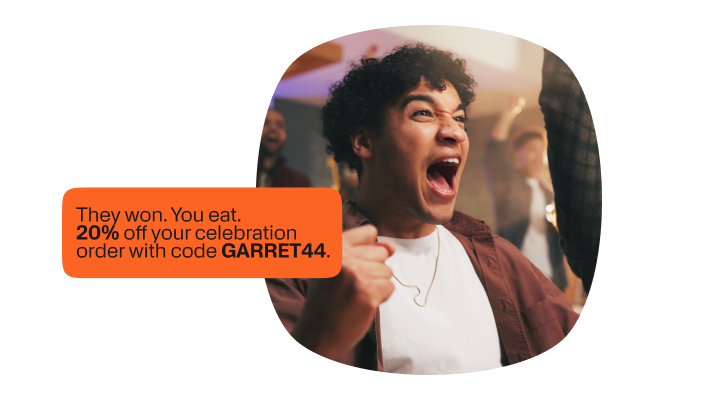
Take a food and beverage brand as the example. The same three moments apply whatever you sell.
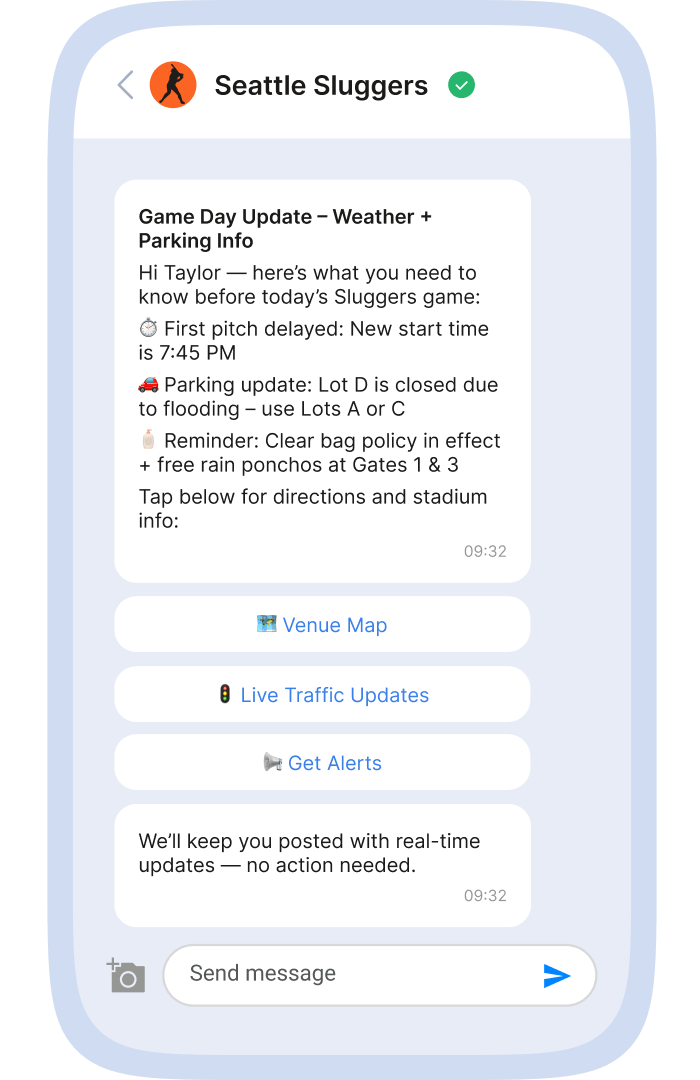
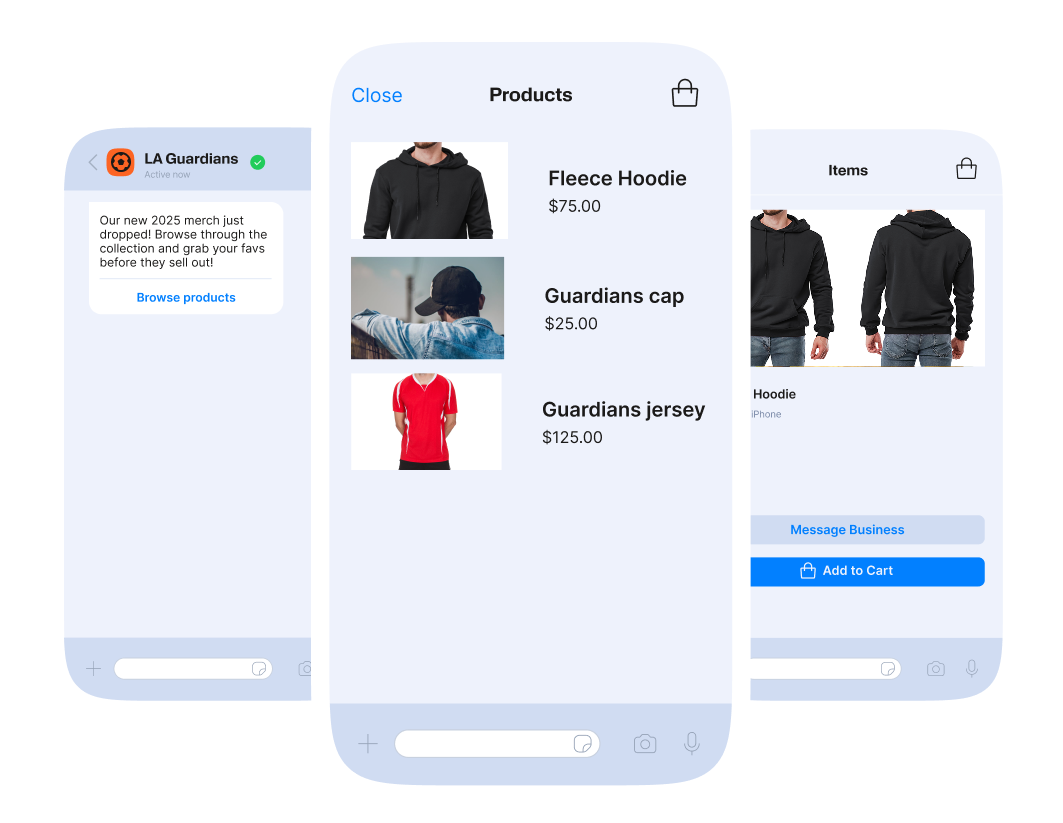
Build for participation, not reception
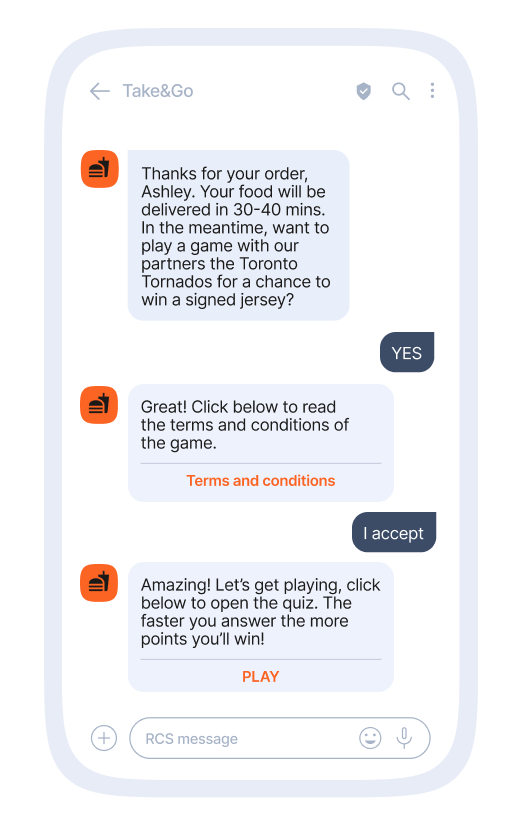
Two-way formats earn their keep twice over. They hold attention in the moment, and they quietly collect the first-party data that makes every later message better. Adoption is crowded at the top of the list and wide open at the bottom:
- 39% run trivia and quizzes
- 34% run loyalty points and rewards
- 33% run match predictions or fantasy games
- 31% run personalized offers
- 17% run real-time AI-powered interactions
Real-time AI play, the kind that reacts to what’s actually happening on the pitch rather than following a script somebody approved three weeks earlier, is where the room is.
Fan engagement in action: How TGR Haas F1 Team turned scrollers into regulars

A fan clicks an Instagram ad offering signed driver gloves. Instead of hitting a form they’ll abandon halfway through, they land in a WhatsApp conversation. Five quick trivia questions about the team’s history, a quiet opt-in, and a casual scroller now has a name, a profile, and a reason to come back next race weekend.
That happened at Monza. By the time the season reached Singapore and Austin, the same fans were predicting tyre choices and unlocking exclusive videos from the team principal.
- 74% quiz completion rate
- 76% engagement rate
- 80% lower cost per ad conversion than the previous single-channel approach
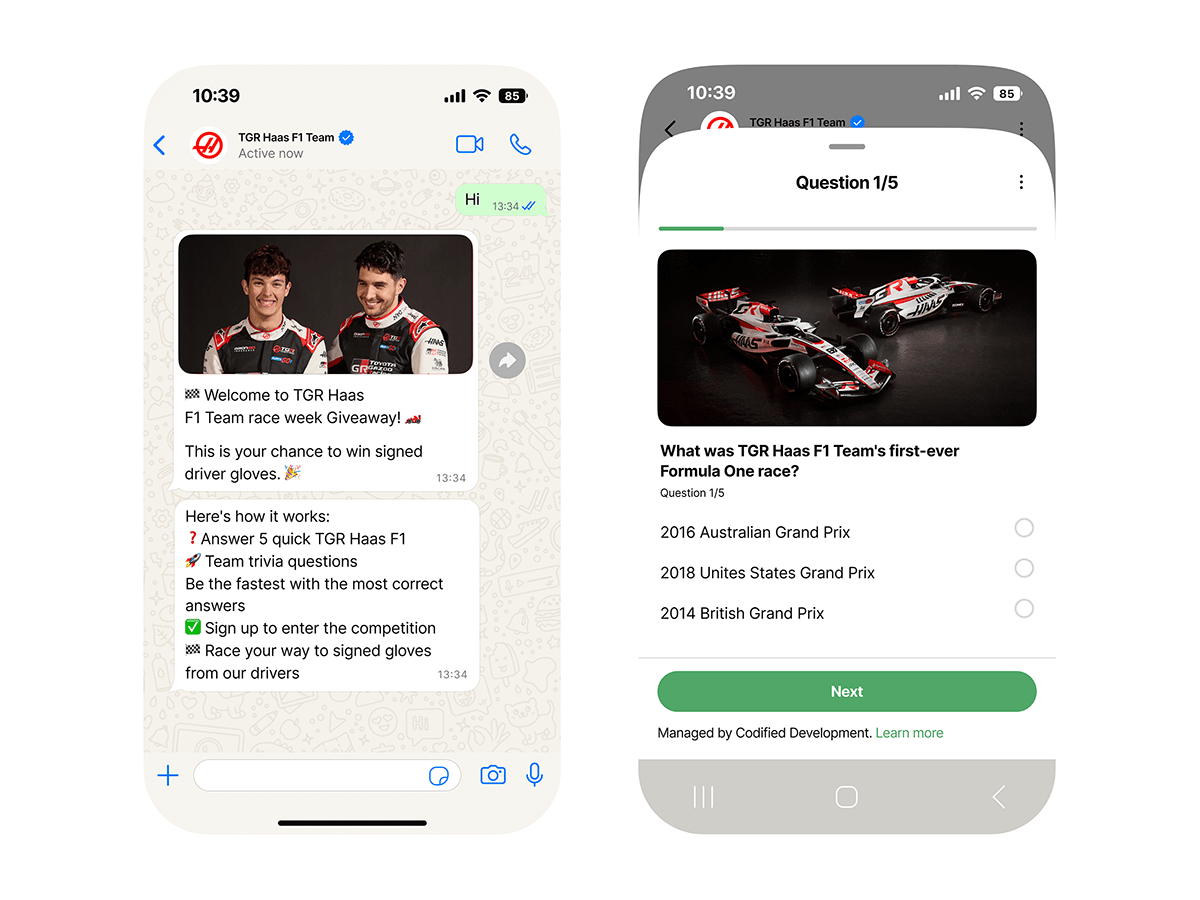
Here’s the useful bit for everyone who doesn’t sponsor a Formula One team. None of it depended on the racing. It worked because it was a conversation rather than a broadcast. Swap the checkered flag for a loyalty card or a boarding pass and a bank, a telco, or a pizza chain gets the same result, because people everywhere would rather be talked with than talked at.
The same fan journey works in any industry
Telecom
Matchday bonus data and loyalty rewards over rich messaging, picking up upsell and retention between billing cycles.
Food and beverage
Limited-time matchday promotions built around prediction games and instant-win mechanics that drive repeat orders.
Travel and hospitality
Live travel updates, event reminders, and contextual add-ons folded into one journey around the fixture.
Banking and finance
Cashback and card rewards tied to key tournament moments, so the offer arrives when spending is already happening.
Once you understand the fan journey, your category matters a lot less than you’d think. The behaviour underneath stays exactly the same.
Part two: fan engagement for sports teams
Why sports fans feel like strangers to their own clubs
The fan research is harder reading, so brace yourself a little.
- 69% haven’t been asked their opinion on anything for at least two seasons
- 66% are disappointed with their team’s attempts to engage them
- 55% feel let down by a lack of relevant content
- 49% often feel like a number rather than a valued supporter
- 30% feel treated like a customer rather than part of a community
When fans describe what they do receive, the words that come up are transactional, infrequent, and generic. Plenty of them said the board talks at them and never with them, which is a painful thing to hear from people who own four versions of your shirt.
Then there’s the cost of all this devotion. Six in ten fans feel they’ve been priced out of the game they love, whether that’s the subscription needed to watch from their own sofa, the tickets, or the merchandise.
We also asked the standard Net Promoter Score question about the digital fan experience. Cricket came out at 34. American football managed 7. Football landed on exactly zero. Baseball scored minus 8, which takes some doing when your respondents have already told you they love the sport.
What fans are actually asking for
Very little, as it turns out. They’d like to be included and kept in the loop, and that’s roughly the whole list.
- 82% want to feel more connected to their team, rising to 96% of fans under 35
- 73% find personal player stories inspiring
- 70% say regular access to players and behind-the-scenes content would deepen their connection
- 66% would join a digital fan community, rising to 81% of under-35s
- 8 in 10 would like, or might like, more say in team decisions
Nobody’s asking them. Not about jersey designs, not about what’s sold at the ground, not about anything.
And they’re not measuring you against the club down the road. They’re measuring you against every consumer brand that remembers their name, asks their opinion once in a while, and puts them in a room with other customers. Those brands have set the bar, and fans have noticed that following a football club feels less personal than ordering a coffee.
What teams get back for showing up
We asked fans what they’d do differently if their club made them feel more valued. Worth remembering these are the same people who just told us they’ve been priced out. A third would be more emotionally invested and would watch more games. Roughly a quarter would attend more matches, buy more merchandise, or pay for a membership, and almost a third would bring new fans in.
They’re offering you more money and more love than they currently give you, and the price is a bit of attention.
Fan engagement strategies that start with messaging
Fans are unusually clear about what they want on the channels they already use all day:
78%
Real-time updates and exclusive content
77%
Exclusive offers and discounts
74%
Enter contests & win prizes and early access to tickets and merch
66%
Voting or giving feedback on team decisions
52%
Team-related questions answered by a 24/7 chatbot
Four places to start:
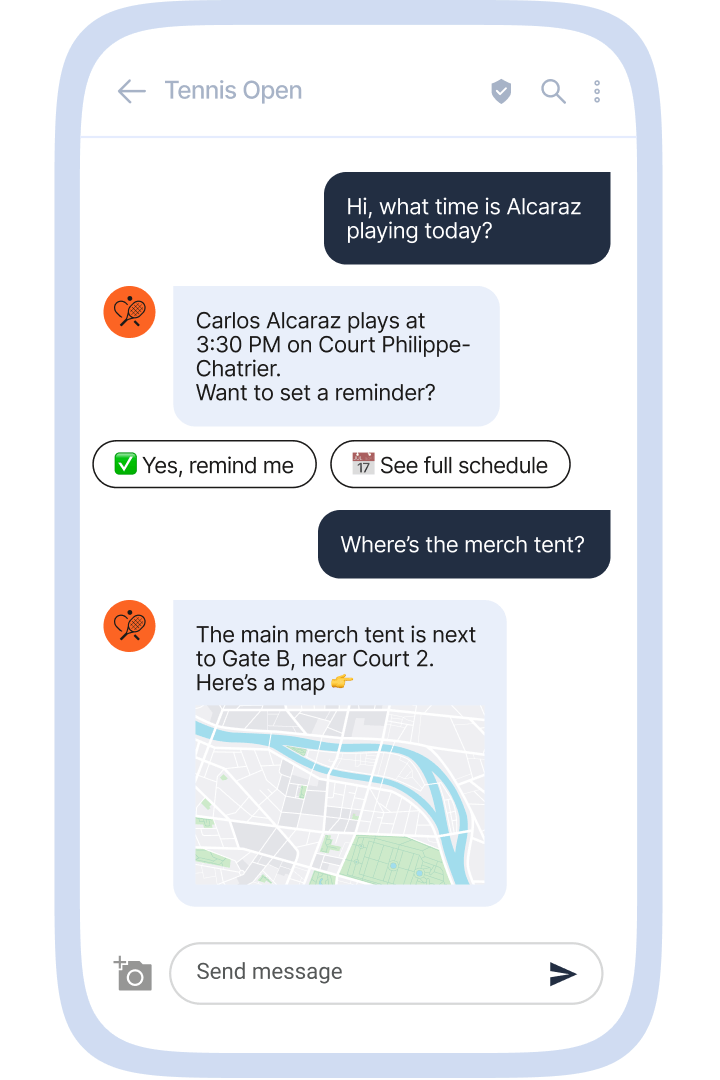
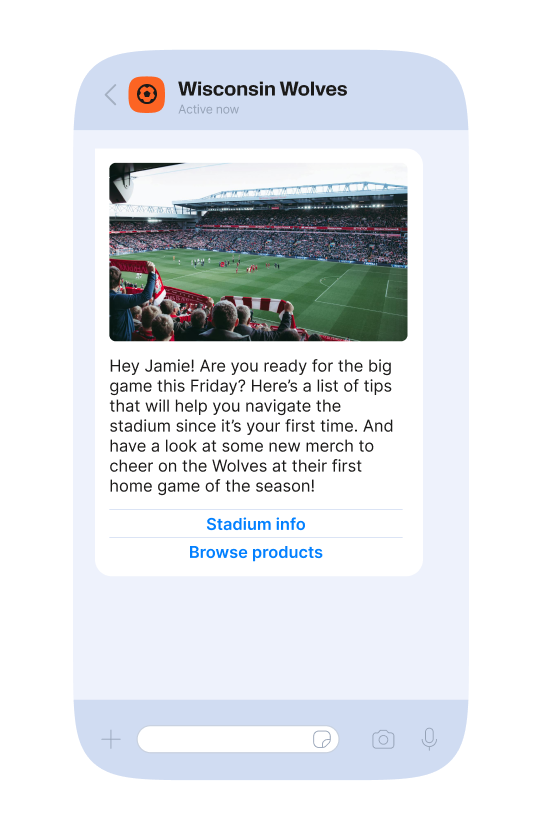
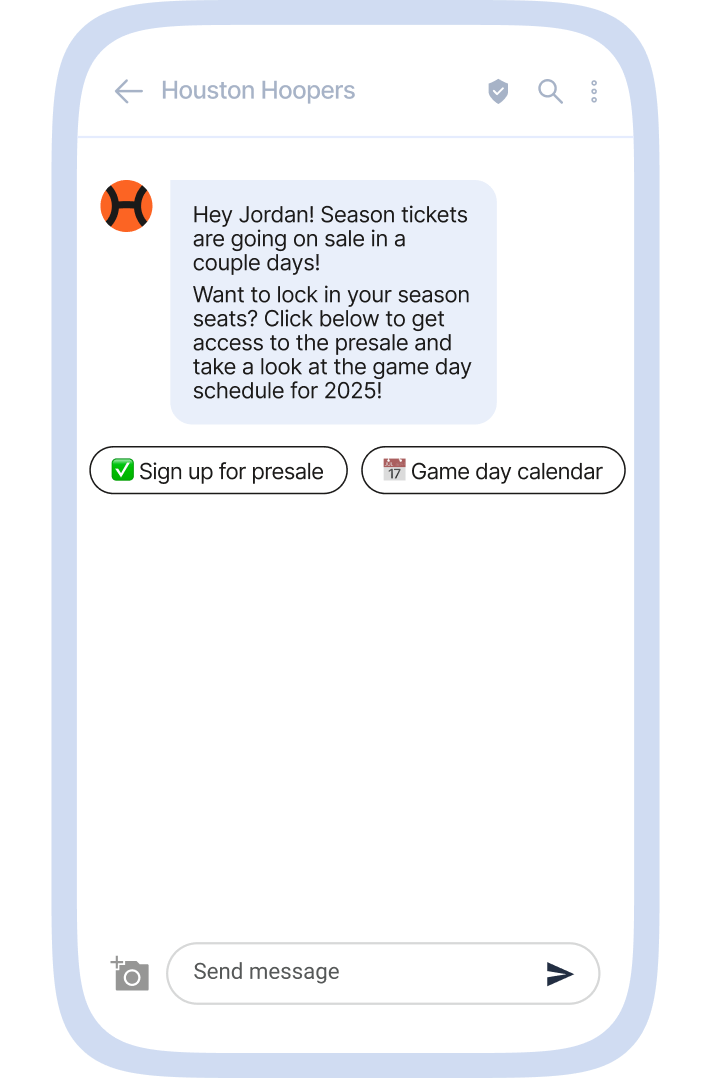
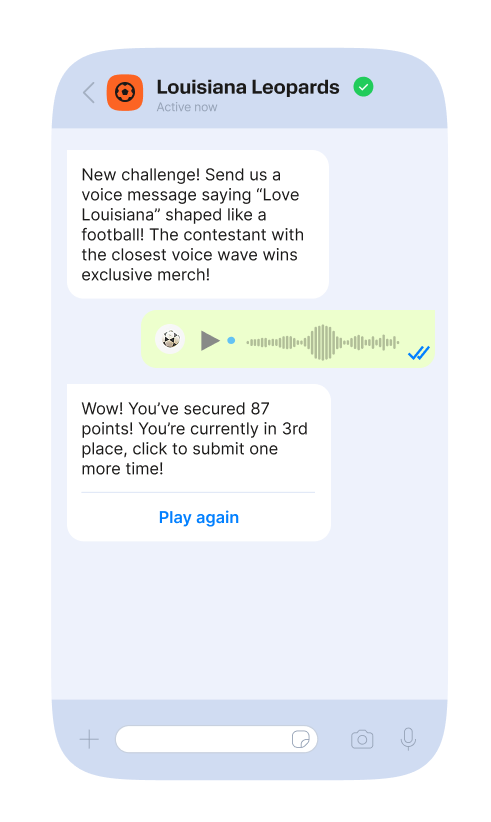
Fan engagement in action: How Claro Sports keeps fans talking during live events
Claro Sports reaches Mexican sports fans over RCS and several messaging platforms during live events, using a chatbot built with Infobip. Fans get real-time scores, interactive experiences, and updates on the athletes they follow, all inside the apps they were already using to talk about the game.
The fan engagement technology underneath both halves
Orchestration. AgentOS joins up customer data, channels, AI, and campaign tooling into one journey, so a fan’s context follows them around instead of getting stuck in whichever app they opened first. This is what answers the data integration blocker and the personalization-at-scale problem.
Conversational AI. Personalized conversation at scale across WhatsApp, RCS, and Messenger, handling ticketing, questions, feedback, and campaigns without anyone waiting in a queue.
Gamification you don’t have to build
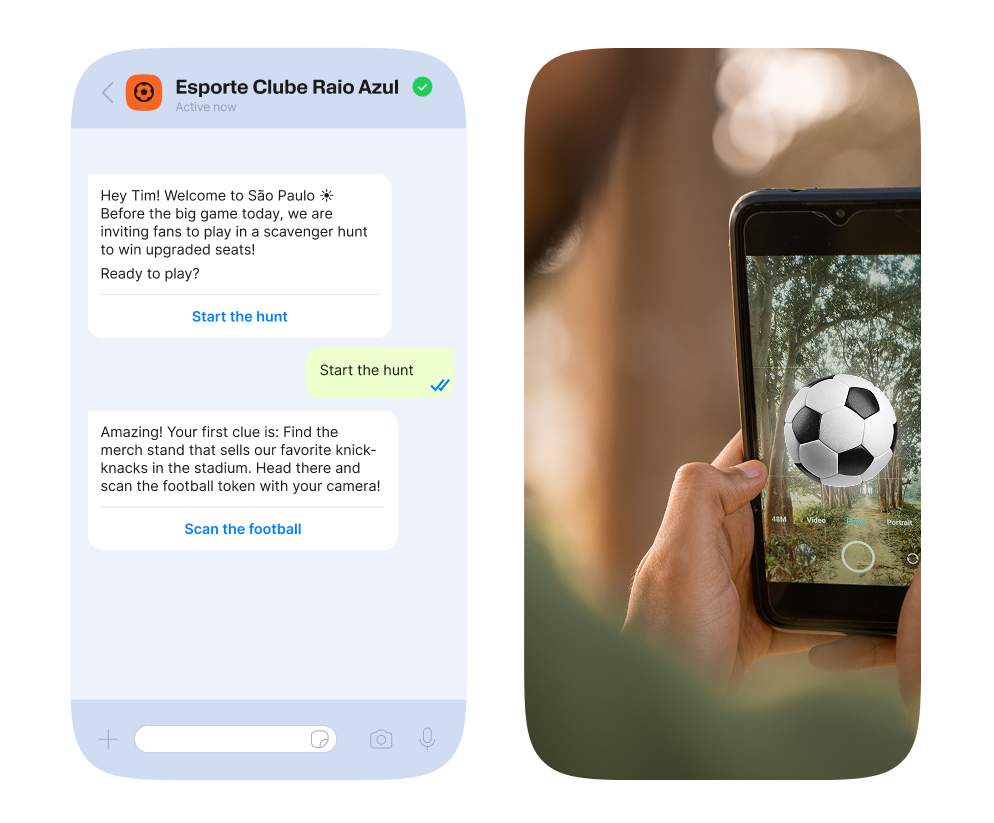
Quizzes, prediction games, AR scavenger hunts, virtual try-on, and voice-powered play with tools like Infobip Vocalize. Built from scratch, these need pipelines, model tuning, and channel integrations most marketing teams don’t have, and the tournament usually finishes before the project does.

AI and data analytics
Reading fan behaviour, predicting what they’ll respond to, and making sure every activation leaves something behind in a fan profile instead of evaporating when the campaign ends.
Four fan engagement challenges that will trip you up
- Digital fatigue. Send fewer and better. Volume isn’t engagement, and fans will let you know by muting you.
- Privacy. Handle fan data transparently and within the rules. Trust is the entire asset here.
- Spam. The line between helpful and annoying moves depending on the moment. Timing does as much work as wording.
- Standing still. Attention is zero sum. A fan who engaged with your pre-match content and then heard nothing afterwards belongs to somebody else by the next tournament. Whoever finishes the conversation gets to keep the relationship.
What all of it comes down to
Fans hand sport a kind of loyalty most organisations will never earn on their own, and they’ll share it with whoever turns up as a participant instead of a billboard.
The mechanics are simple enough. Access, recognition, rewards, and being useful at the moments people actually care about.
Fans stay loyal through every high and every low. Show up with the same consistency and you get to be part of that.
Discover our fan engagement solution and deliver a buzzer beating experience every time

Fan engagement FAQs
Fan engagement is the whole relationship between a supporter and a club or brand, not only the time spent watching a match. It covers the anticipation before an event, the interaction during it, and everything that happens afterwards, across every channel a fan uses. Some of it is transactional, like tickets and merchandise. Most of it isn’t, and that part is what keeps people coming back.
Sport produces a level of loyalty and repeat attention that few other categories can match, and fans extend some of that goodwill to brands that show up usefully rather than just visibly. Nearly three quarters of the brands in our research expect their sports investment to grow in the next twelve months, and they now span telecoms, banking, travel, and food as much as the obvious sponsors.
There is no single best channel, because fans move between several during one event. Social builds pre-match reach, rich messaging like RCS and WhatsApp carries two-way interaction around the game, and SMS, email, and push handle reminders and utility. What matters more than the channel choice is whether context travels with the fan when they switch.
This is where most brands struggle: 57% say proving ROI is difficult and only 25% can tie activations to business outcomes. The fix is instrumentation rather than more spend. Capture first-party data at every interaction, connect it back to a customer profile, and keep engagement, retention, and revenue in the same view so a season’s activity can be read as one story instead of a dozen disconnected campaigns.
Live and in-play is where attention concentrates, but the hours after the final whistle are the most underused. 44% of brands are active in that window and only 11% see their peak engagement there, which means fans are still emotionally invested and almost nobody is saying anything worth their time.
Start by asking fans for their opinion, since 69% haven’t been asked for anything in at least two seasons and two thirds want a say. From there: share behind-the-scenes access, keep communicating through the off-season, and give supporters a way to find each other. All four are straightforward to run over messaging channels fans already use daily.