



Best chatbot builders in 2026
A complete guide on different types of chatbot builders available in 2026, including their features and use cases. Discover which chatbot builder is ideal for your business goals, and how you can use them.

The term ‘chatbot’ is nothing new and has been active for more than two decades, helping brands attend to their customers and reduce manual workloads. What began as simple, rule-based programs capable of answering predefined questions has evolved into AI-powered chatbots and AI agents providing better accuracy in responses, powerful insights, and ultimately better customer experience.
Although most businesses still use traditional intent-based and rule-based bots, developing and managing these requires mapping conversation trees, defining intents, and training datasets, a process that can be time-consuming and complex. In contrast, modern AI-powered chatbots and agents built from prompts and large language models (LLMs) can be created in minutes, without much manual effort.
In this blog, you will learn:
- What a chatbot builder platform is
- Types of chatbot builder platforms and how these are different from one another
- A comparison of leading chatbot platforms
- Key features to consider while choosing a chatbot building platform in 2026
What is a chatbot builder platform?
A chatbot builder platform allows businesses to design, train, and deploy conversational bots, starting from simple rule-based flows to advanced AI-driven assistants. Using these platforms, you can create different types of chatbots according to your business use cases and also customize them by adding a logo, color, and more.
How does it work?
Not all chatbot builders work in the same way, as these platforms differ in many functionalities. While some platforms have a drag-and-drop feature, others work on LLM-based natural language understanding.
If you are not a developer or do not have any kind of technical knowledge, you can use a drag-and-drop model to design your chatbot flows, whereas if you need an advanced chatbot, you can use an AI-powered platform to build NLP chatbots and GenAI bots to connect with AI agents. Instead of relying only on predefined rules, AI agents use language models to understand user input and generate appropriate responses.
They can also be connected to external data sources such as CRM or Customer Data Platform to perform tasks, retrieve information, and adapt to different user interactions.
AI chatbot builders
AI-chatbot builders are the new-age chatbot building platforms, which allow users to design and deploy rule-based or AI chatbots without writing code.
An AI chatbot builder comes with several functionalities and integration options with real-time data sources such as customer data platforms and CRM, which empower it to deliver personalized responses. You can add AI agents to your chatbots to handle complex requests without manual intervention.
Use case of the chatbot builder
It is a fact that chatbot builders are quite important today across several customer-facing industries such as retail & eCommerce, BFSI, real estate, travel, and more.
Here are some of the key use cases of a chatbot building platform:
Lead generation
Customers nowadays do not want to fill in lengthy forms anymore, so using a conversational chatbot, businesses can boost their lead generation process. For example, our customer Nissan Saudi Arabia saw a 138% increase in leads generated through a chatbot. A chatbot can help you generate leads by:
- Asking qualifying questions
- Recommending relevant products or services
- Capturing contact details
- Booking meetings directly into sales calendars
Customer support
Adding a chatbot, businesses can automate their customer support process and provide timely resolution of queries. AI-powered chatbots, which use Generative AI for customer service, can understand customer intent, provide accurate answers to FAQs, deliver real-time order updates, and guide users step-by-step through troubleshooting processes. The result:
- Reduced ticket volume for agents
- Improved customer satisfaction
- Lower contact center cost
Customer onboarding
The onboarding process in many companies is often lengthy and time-consuming, as it involves multiple steps and requirements. With chatbots, businesses can accelerate onboarding, reduce delays, and keep their teams focused on tasks that require human intervention.
Chatbots can design customized flows to guide users through:
- Account setup
- Document submission
- Product education
- Feature walkthroughs
Internal automation
Today, businesses work on continuous improvement of their internal processes to add efficiency and reduce manual workload. Businesses can build customized chatbots for their multiple departments, such as HR, finance, admin, and more, to automate their regular queries. For example, an HR chatbot can answer policy-related questions, and similarly, an IT support chatbot can help employees with password resets or other troubleshooting tasks.
Driving engagement
Beyond sales, chatbots help brands drive engagement throughout the customer journey by providing a rich conversational experience. A real example can be the TGR Haas F1 Team, which boosted engagement among fans at a much lower cost per ad conversion by implementing a chatbot on WhatsApp. They attained a 76% engagement rate and an 80% lower cost per ad conversion.
Top chatbot builders in 2026
Although there are multiple chatbot builder platforms available today, here are some popular names:
Infobip
Infobip is an AI-first cloud communications platform that enables businesses to build connected experiences across all stages of the customer journey. With 20 years of experience in service enterprise communication customers worldwide, Infobip helps businesses automate their customer support and reduce costs with a no-code virtual assistant.
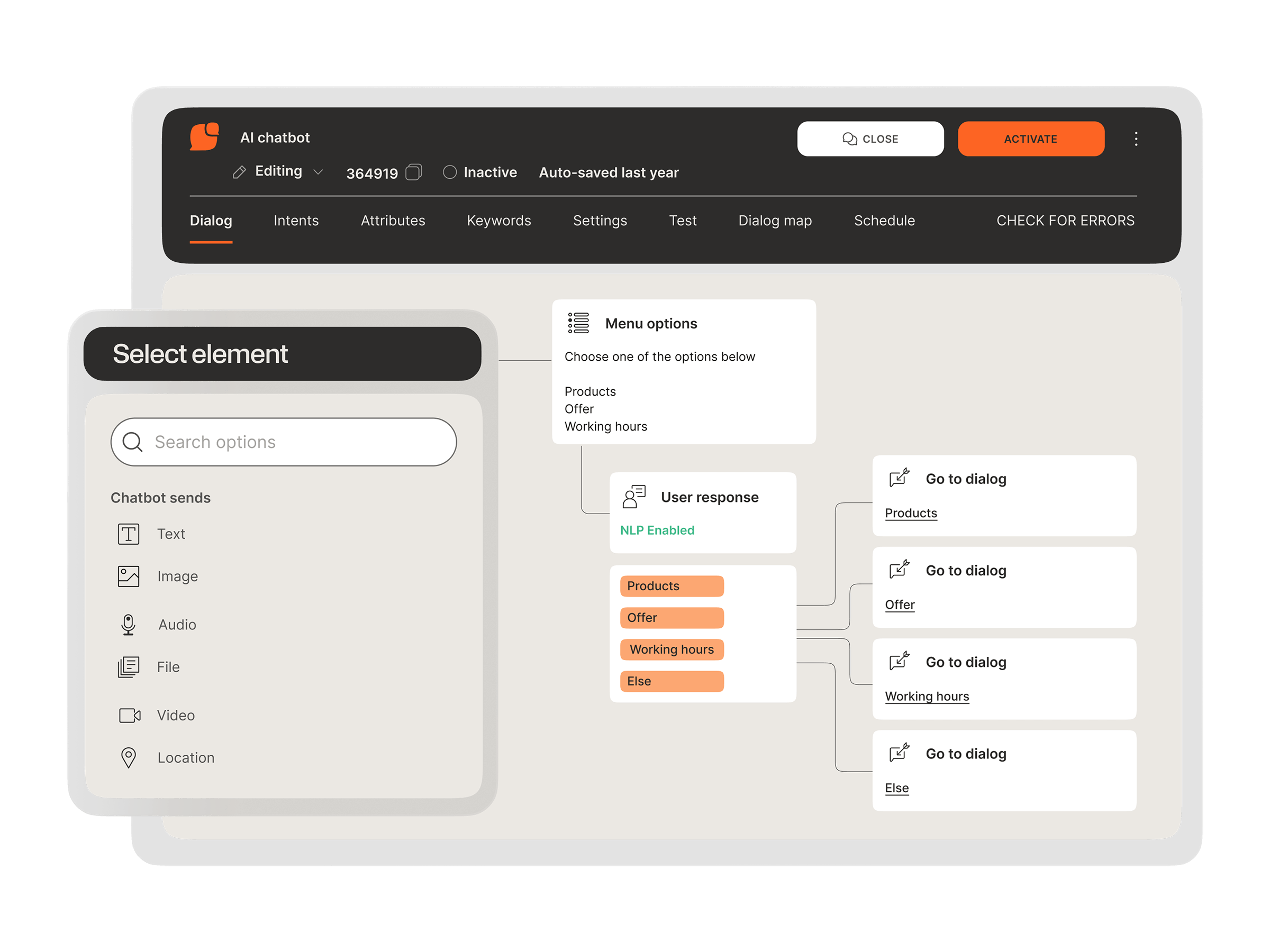
Features:
- 3100 chatbots built and delivered to clients
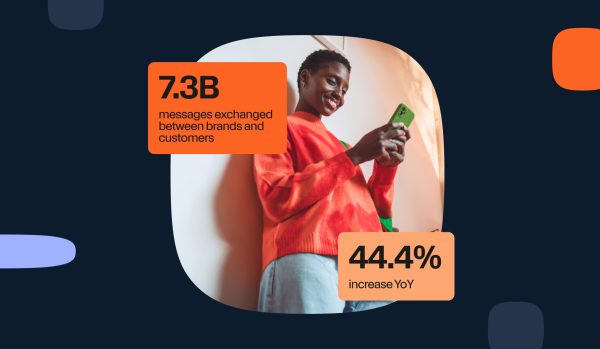
- 96 million active sessions and 1.3 billion messages exchanged
- Simple drag-and-drop elements or pre-defined templates to create your ideal conversation flow
- AI agent studio for building advanced chatbot flows from prompts
- Seamless transition from chatbot to live agent with access to the complete conversion history
- Personalization powered by CDP, integration capabilities, and coding elements
- Multi-lingual chatbot creation and deployment
- Omnichannel deployment to add chatbots to channels like WhatsApp, Live chat, RCS, Line, Viber, and more.
- Real-time dashboards and detailed reports from one single analytics hub
- Capability to add rich media such as images, GIFs, videos, PDFs, and other media
- Enterprise-grade security compliant with GDPR, ISO 27001, HIPAA, SOC2, CPI, and Cyber Essentials
Hubspot
HubSpot Inc. is a reputed US-based developer and marketer of software products for marketing, sales, and customer service. The HubSpot chatbot builder software allows businesses to easily create messenger bots.
Features:
- Zero coding chatbot creation
- Seamless integration with customer CRM
- Personalization of chatbot reply
- Capability to book meetings and qualify leads automatically from within the chatbot window
Zoho
Zoho provides chatbot builders Zobot software, which helps businesses build AI-powered chatbots.
Features:
- Codeless drag and drop chatbot builder
- Prebuilt chatbot templates for easy bot creation
- Multilingual chatbot building capability
- Flow report to track interaction trends and spot drop-offs
Yellow AI
Yellow AI allows building and deployment of AI agents with simple natural language prompts.
Features:
- No-code tools for building complex conversation flows
- Omni-channel orchestration
- Dynamic insights to improve AI agents’ performance
- Multiple CRM integration options
Zapier
Zapier helps businesses develop free chatbots using its chatbot builder. Although using the chatbot is free, businesses need to pay for custom branding integration and more.
Features:
- Integration with 8000+ apps
- AI orchestration
- Capability to add FAQs, docs, and public links
- Customizable conversation style to match brand tone
Landbot.io
Landbot provides different types of chatbot building options for businesses, such as AI agent chatbots, website chatbots, and WhatsApp chatbots.
Features:
- Visual drag and drop builder for seamless creation of the chatbot
- Bricks and templates to build complex chatbot flows
- Integration option with external data sources
Botpress
Botpress offers AI chatbot builders, which do not require any kind of coding expertise. Users can design AI agents visually with a drag-and-drop canvas.
Features:
- Conversation emulator to test and refine AI agents’ interaction before deployment
- Custom code addition option
- External API integration is possible
Key features to consider while choosing a chatbot builder
To select the best chatbot builder, you must define what business goal you want to achieve. Whether it is lead generation, customer service, or internal usage? For example, the features and functionalities of a lead generation chatbot will be very different from an internal communication chatbot. While a lead generation chatbot may need advanced integration with CRM systems, a chatbot built for the HR department can be a very basic one.
Once you are clear to use the chatbot, the next step is to evaluate the available platforms based on the following features.
Ease of use
A chatbot building platform must be user-friendly so that every team can use it seamlessly without the assistance of your IT department. Many platforms come with drag-and-drop dialog flow builders, which do not require any kind of coding expertise.
For more advanced use cases, AI agents can be built directly from prompts, enabling businesses to automate complex conversational flows without manual flow design.
Additionally, some channels offer additional AI features. For example, a WhatsApp AI flow builder allows creating a WhatsApp Flows in a few seconds just with the help of a few fonts.
AI capabilities
As AI plays an important role in business processes, you must ensure that the chatbot builder you are selecting has AI capabilities such as the ability to understand natural language, recognize user intent, maintain conversational context, and generate dynamic responses.
Chatbots with advanced AI capabilities, such as agentic AI, help businesses in proactive issue resolution, personalized retention, and multi-step troubleshooting.
Integrations
Identify a chatbot builder that integrates seamlessly with your existing tech stack, such as your CRM, helpdesk, e-commerce systems, email marketing software, and social platforms.
These integrations enable real-time data exchange and automate the entire workflow. For example, when integrated with a CRM, the chatbot can automatically capture lead information, assign leads to the sales team, and trigger follow-up campaigns.
Personalization
Your chatbot builder should allow you to personalize your customer interactions to drive higher engagement and conversion. By integrating with your Customer Data Platform, AI chatbots can analyze customer profiles and purchasing history, and deliver tailored responses.
Deployment options
A chatbot builder should be scalable, so that you can launch and manage a single chatbot across multiple senders. This feature will help you to deploy the same chatbot for multiple markets without creating new bots.
Additionally, it must support your omnichannel marketing initiatives so that you can deploy the application across multiple channels and platforms such as websites, landing pages, messaging apps, social media platforms, SMS, or even voice interfaces.
Analytics & optimization
Measuring a chatbot’s performance is important for businesses so that required optimization can be done at periodic intervals. A chatbot platform should be capable of providing detailed reporting on engagement metrics, goal completion rates, conversation outcomes, and user drop-offs.
With AI, you can even make this process more efficient. An AI-powered chatbot builder analyzes your chatbot’s performance and provides actionable insights into what is working and what is not, along with suggestions to improve.
Types of chatbot builders
Although there are various types of chatbot builders available, they broadly fall into three main categories: No-Code/Visual builders, Developer-friendly platforms, and Enterprise-Scale toolkits. Let’s understand how each type of platform differs from the other.
No-code/visual builders
As the name suggests, using these chatbot builders does not require you to be a developer. These platforms come with a drag-and-drop interface, pre-built templates, and guided workflows, which enable anyone to create a chatbot easily.
For small and mid-sized businesses that want to implement conversational features in their channels without heavy investment, they can go for these platforms. These builders are best suited for FAQ bots, lead capture bots, appointment scheduling, and simple support automation.
Key characteristics:
- Easy for beginners
- Quick deployment across websites and messaging platforms
- Cost-effective
Enterprise-scale toolkits
Enterprise-scale chatbot toolkits are advanced chatbot builders that fit large organizations, which have high traffic inflows and several interlinked departments. These platforms come with advanced AI capabilities, various deployment options, and deep system integrations.
Designed for large, complex conversational AI projects, these chatbot builders work best for automated contact centers and large-scale customer service operations.
Key characteristics:
- High scalability to handle large volumes of conversations
- Enterprise-grade security and compliance features
- Advanced integration with enterprise systems such as CRM and ERP
Creating your first chatbot
Now, as you are familiar with different types of chatbot builders and their functionalities, you can start creating your first chatbot. From creation to deployment, Infobip’s AI-powered chatbot builder will make the entire process seamless for you.
When you want to create a chatbot for your website or messaging channels like WhatsApp or RCS, you can do it in just a few steps. will make the entire process seamless for you. When you want to create a chatbot for your website or messaging channels like WhatsApp or RCS, you can do it in just a few steps.
- Get started with Infobip AI-powered chatbot builder
- Create your 1st chatbot with simple prompts
- Start with some basic workflows to test your bot
- Go for advanced flow building to implement multiple use cases
- Integrate with your tech stack for optimum performance
FAQs
An artificial intelligence (AI) chatbot uses machine learning and natural language processing (NLP) to simulate human-like conversations. You can use AI-chatbot builder platforms like Infobip to create and deploy a chatbot within a few seconds by using simple prompts.
No, you do not need coding skills to build a chatbot. Many chatbot builders offer drag-and-drop options that allow you to design and deploy a chatbot without any coding skills. However, if you want to create an advanced chatbot with deep customization, then you need at least basic to intermediate programming skills.
The time necessary to create and launch a chatbot depends on the complexity of the chatbot and the capability of the chatbot builder. While simple chatbots can be designed within a few hours, advanced chatbots with multiple workflows need a longer time, ranging from a few days to weeks. However, with an AI chatbot builder, you can create a chatbot instantly within a few seconds.
The cost of building a chatbot depends on many factors, such as complexity, features, integration, and more. Some basic drag-and-drop chatbot builders come for free, but for customization, you need to opt for a premium package. On the other hand, advanced chatbot builders with AI capabilities may cost a lot, but it is worth the money considering the long-term benefits like reducing manual operations and better output.