


WhatsApp news and updates: What’s new for businesses in 2025 and 2026
Every major WhatsApp feature launch from Q3 2025 through Q1 2026, explained clearly for businesses ready to put them to use.

If you have been watching WhatsApp closely over the past year, you will have noticed something shift. The platform has gone from a solid messaging channel to something that increasingly resembles a complete business communication environment, with voice calls, in-chat payments, scrollable rich content, AI-optimized marketing delivery, and, as of early 2026, the ability to run the WhatsApp Business App and the Cloud API on the same number simultaneously.
That is a lot of ground to cover.
This post works through every major WhatsApp update from Q3 2025 through Q1 2026, in chronological order, with clear explanations of what each feature actually does and what businesses need to know before using it.

Q3 2025: Voice, smarter templates, and more human conversations
Updates this quarter: WhatsApp Business Calling (GA) · Template Library · Reply-to · Typing indicators · Sentiment insight · WhatsApp Payments via Messages API
WhatsApp Business Calling
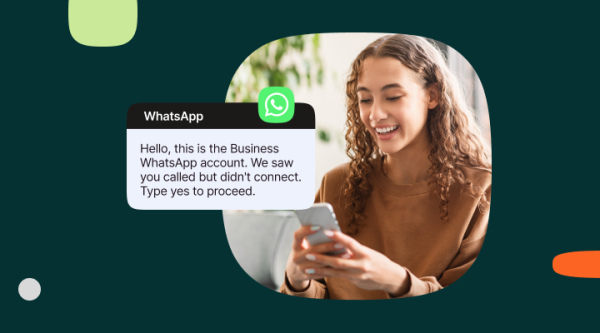
Businesses can now make and receive live voice calls inside WhatsApp, with the full conversation thread visible throughout the call.
Voice calling inside WhatsApp for businesses had been in beta for a while. On 1 July 2025, it became generally available, and it is worth understanding why this matters beyond the obvious novelty of placing a call through a chat app.
The real value is context. When a customer calls a business through WhatsApp, the agent answering already has the full conversation thread in front of them. There is no “can you give me your order number again.” The customer does not have to re-explain who they are or repeat what they already typed. The call and the chat share the same space.
Infobip was among the approved vendors in Meta’s beta programme across Brazil, Mexico, and India before the feature went live globally. There is one capability Infobip adds that the native API does not: call recording. For businesses in financial services, insurance, healthcare, or any sector where recorded calls are a compliance requirement, this is a meaningful distinction.
WhatsApp template library
A collection of pre-built, Meta-approved utility and authentication templates that businesses can select and send immediately, without building from scratch.
There is an under-discussed cost to building WhatsApp templates from scratch: time. Formatting decisions, approval waiting periods, and resubmissions after rejections add up to the cumulative delay. The Template Library removes most of that friction.
Rather than building from zero, businesses can now select from ready-made templates available directly through the Infobip API and Portal. Onboarding accelerates. Campaigns launch on schedule rather than waiting for custom approvals.
One caveat worth keeping in mind: Meta can re-categorize a template after submission. A template submitted as utility may be reclassified as marketing, which affects pricing and delivery rules. Always confirm the final category before building campaign logic around a specific template type.
Reply-to, typing indicators, and sentiment insight
Three features that close the gap between how WhatsApp feels in peer-to-peer use and how it has historically felt when messaging a business.
Reply-to lets agents and bots respond to a specific message in a thread, not the conversation in general. In a fast-moving exchange covering multiple topics, this one change prevents a surprising amount of confusion and unnecessary back-and-forth.
Typing indicators show customers when an agent or chatbot is actively preparing a response. Silence with no indication that anything is happening is a common source of frustration in business messaging. The indicator sets expectations and reduces follow-up messages like “hello, is anyone there?”
Sentiment insight analyzes incoming messages in real time, surfacing signals of frustration, urgency, or positive engagement. This can be used to trigger smarter routing, adjust automated responses, or give human agents early warning before a conversation escalates.
WhatsApp Payments via Messages API
Businesses in Brazil and India can now initiate and confirm payments inside a WhatsApp conversation, keeping the entire purchase journey in a single thread.
Q3 brought payment support into the Infobip Messages API for WhatsApp. Businesses can send order details and real-time status messages, and receive payment confirmations via delivery reports, all without redirecting the customer anywhere. A customer who can complete a purchase without leaving WhatsApp is more likely to complete it at all.
Q4 2025: Smarter marketing and in-chat browsing
Updates this quarter: Marketing Messages API for WhatsApp · WhatsApp Webviews
Marketing Messages API for WhatsApp
A dedicated API connection for WhatsApp marketing traffic that delivers higher deliverability, bypasses user-level caps, and adds exclusive campaign controls not available through standard connections.
Sending marketing messages on WhatsApp has become more complex. Meta’s user-level caps mean that high-volume campaigns can hit delivery ceilings with no obvious way around them if businesses are using standard API connections. The Marketing Messages API was launched in Q4 2025 specifically to address this.
Beyond higher deliverability for large-scale sends, the MM API brings capabilities unavailable through standard connections:
- Time-to-live (TTL) controls define how long a message remains valid for delivery, preventing stale promotions from landing days after they are relevant
- Performance benchmarks provide comparative context for campaign results, not just raw numbers
- Deep links direct customers from a WhatsApp message straight to a specific location inside an app, cutting several steps out of the journey from message to action
- User-level cap bypass for qualifying marketing traffic
Infobip’s Premium Meta Partner status put it among the first providers to offer the full MM API to clients. The results from early deployments are concrete: Grupo Baguer, a Colombian fashion group managing multiple brands and frequent promotional campaigns, achieved a 6 percentage point increase in marketing traffic delivery rates using the MM API. That delivery improvement translated into a 60% increase in ROI.
The MM API is now the recommended approach for any business running consistent WhatsApp marketing at volume. One geographic note: delivery to end users in the United States is not supported as of April 2025, though US-registered business numbers can use the API to reach customers in other countries.
WhatsApp Webviews
Anyone who has tried to complete a multi-step process through a messaging channel will recognize the problem Webviews solve. The customer is in a WhatsApp conversation. They click a link. A browser opens. They either complete the action there, losing the thread, or they close the browser and return to WhatsApp with no clear next step. Either way, the journey broke.
Webviews close that gap. When a customer taps a link in a WhatsApp chat, the destination opens inside the conversation window itself. When the action is complete, the conversation continues naturally in the same thread, with full context intact.
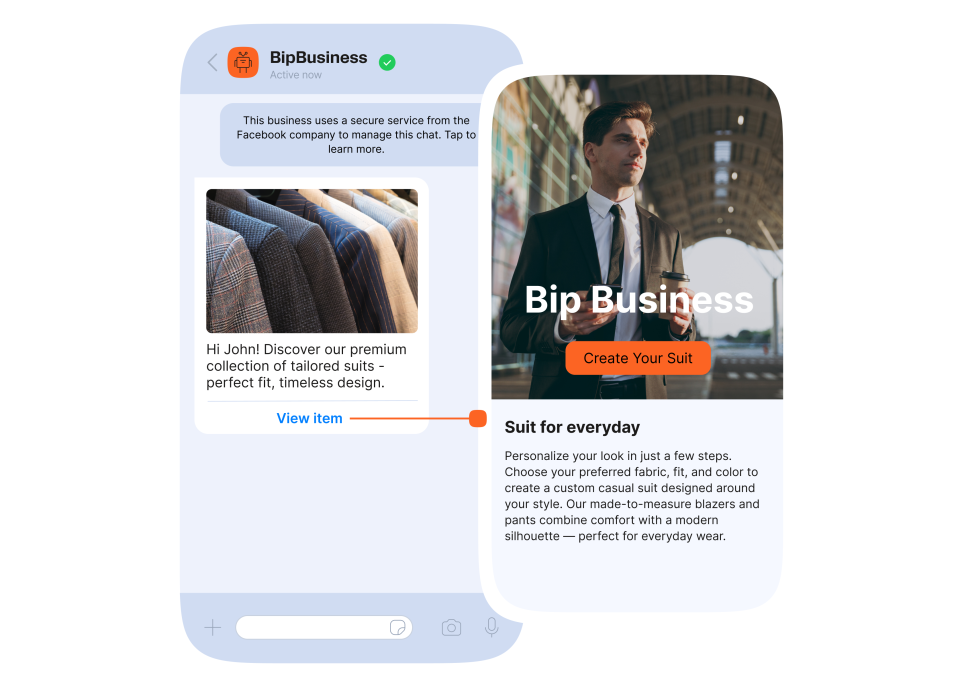
For businesses building complex customer workflows, this is a significant unlock. A single WhatsApp thread can now handle product discovery, checkout, post-purchase confirmation, and follow-up support without a single redirect to an external platform. Infobip supports Webviews as part of its WhatsApp integration, enabling businesses to build these continuous, in-conversation experiences at scale.
January 2026: The end of the app-versus-API dilemma
Updates this month: WhatsApp Business App co-existence
WhatsApp Business App co-existence
Businesses can now use the WhatsApp Business App and the Cloud API simultaneously on the same phone number, combining manual messaging in the app with automation and integrations through Infobip.
For a long time, one of the most frustrating decisions facing growing businesses on WhatsApp was this: the WhatsApp Business App is simple, familiar, and free for messaging, but it does not scale. The Cloud API scales and automates, but switching means giving up the app and the number recognition that comes with it. The January 2026 release removes that choice entirely.
What co-existence enables in practice:
- Continue using the WhatsApp Business App for manual, personal, or direct team conversations
- Use Infobip and the Cloud API for automated messaging, broadcasts, integrations, and programmatic use cases
- All messages sent and received are synchronized between the Cloud API and the app in real time
- Messages sent via the WhatsApp Business App remain free
- The app’s full feature set, including product catalog, orders, status, greeting messages, quick replies, labels, and voice and video calls, stays fully accessible
The feature is particularly relevant for small and growing businesses that built customer relationships through the app and now want to add automation or CRM integration without disrupting the conversations they already manage daily.
Important limitations before onboarding: During registration, users must select “Don’t share chats.” Chat history from the app is not transferred at the point of onboarding, and contact data is not automatically synchronized to the Infobip platform in this flow. Some app features remain exclusive to the app and are not accessible through the Cloud API. The feature is currently available for selected accounts only and requires contacting Infobip Support to enable.
On the roadmap: Up to 6 months of chat history and full contact synchronization are coming in a future update, which will make the transition significantly smoother for businesses with long-established customer relationships inside the app.
February 2026: Interactive carousels, new payment options, and richer templates
Updates this month: Interactive Media Carousels over API · WhatsApp Payment Links in Brazil · Rich media templates
Interactive Media Carousel messages
Businesses can now send horizontally scrollable cards via the WhatsApp API without needing a Meta product catalog, opening the format to any content type across any industry.
February 2026 brought Interactive Media Carousels to the WhatsApp API, and they are more flexible than the carousel formats that existed before. A carousel contains between 2 and 10 swipeable cards, each with:
- An image or video header
- Custom body text
- A call-to-action button (URL or quick reply)
Every card in a carousel can contain its own content and button configuration.
The one structural rule: all cards must use the same button type, either all URL or all quick reply, keeping the interaction pattern consistent as users swipe through.
Because there is no catalog requirement, the format works across a wide range of industries and use cases:
- Retail: Showcase multiple products, seasonal collections, or promotions in a single message
- Travel and hospitality: Present flight options, hotel rooms, or destinations side by side
- Financial services: Display loan products, account tiers, or insurance options for easy comparison
- Events: Highlight sessions, speakers, or lineup choices visually
- Customer service: Present resolution options or service tiers without walls of text
One timing constraint that matters for campaign planning: free-form media carousel messages can only be delivered within the 24-hour customer service window, meaning the recipient must have messaged the business within the previous 24 hours. For outbound sends outside that window, the template version of the carousel is required. Both formats are supported through the Infobip API.
WhatsApp Payment Links in Brazil
Payment Links are now available as part of the multi-payment experience in Brazil, joining Pix and Boleto as supported payment methods within WhatsApp.
While Payment Links were introduced earlier in 2025, the February release expands the Multipayment module, allowing businesses to include more than one payment method within a single message.
With this improvement, businesses can offer combinations such as Pix, Boleto, or Payment Links together in the same interaction, giving customers greater flexibility in how they choose to complete a transaction.
Payment Links remain especially useful in situations where a structured order message feels too formal or when a customer prefers to complete the payment later. A business can generate the link directly within the conversation, share it naturally, and receive a webhook status update once the payment is completed, followed by an order confirmation to close the loop.
WhatsApp Payments continues to be available in Brazil and India, with locally supported payment methods in each market.
Rich media templates
Agents in the AgentOS cloud contact center can now send WhatsApp templates containing images, videos, documents, quick replies, call buttons, and URL buttons, with customer data populated automatically.
A quieter but useful update: registered WhatsApp templates inside the AgentOS cloud contact center now support a much wider range of content types beyond plain text. Supported content now includes images, videos, documents, location, quick replies, call buttons, and click-to-URL buttons.
Agents can send rich WhatsApp messages directly from within a support conversation, with customer details like names and order numbers populated automatically from the customer’s profile. Templates are filtered by queue and availability window, so agents see only what is relevant to them at the right time.
How Infobip supports WhatsApp for business
All of the capabilities covered in this article are available through Infobip, either via the API or through AgentOS, the unified customer communications platform that connects WhatsApp alongside SMS, RCS, Voice, Email, Viber, and other channels.
As a Premium Meta Business Partner and long-standing WhatsApp Business Solution Provider, Infobip supports the full range of WhatsApp functionality, including co-existence onboarding, the Marketing Messages API, Business Calling with call recording, Interactive Media Carousels, Webviews, Payments, and the Template Library.
Businesses that need to orchestrate WhatsApp alongside CRM and marketing platforms can do so through Infobip’s integrations with Salesforce Marketing Cloud, HubSpot, Oracle Responsys, and Oracle Eloqua, each of which supports WhatsApp messaging directly within existing workflow builders.
What to know before you implement
WhatsApp Payments and Payment Links
are available in Brazil and India only
Messages API
does not deliver to US end users as of April 2025; US business numbers can still use it for international sends
Interactive Media Carousels
in free-form format require the recipient to have messaged the business within the past 24 hours; template carousels are needed for outbound sends
WhatsApp Business App co-existence
is in limited availability through Infobip; chat history transfer is not available at onboarding but is on the roadmap
WhatsApp Business Calling
is generally available as of July 2025 with expanding regional coverage
Webviews
open automatically when users tap links; per-URL control is not yet available and is managed at the Meta level
Template Library categories
can change after Meta review; confirm final classification before building campaign logic around a specific template
Conclusion
The WhatsApp updates across the past three quarters describe a platform evolving into something much closer to a full-service business communication channel. Voice, payments, in-chat browsing, carousels, optimized marketing delivery, and the removal of the app-versus-API constraint are not isolated feature releases. Together, they make it possible for a complete customer relationship, from first contact to purchase to ongoing support, to live inside a single WhatsApp thread.
For businesses that have been treating WhatsApp as a simple notification channel or a basic support inbox, these updates make a compelling case to look again at what the platform can actually do. Infobip provides the infrastructure to implement these capabilities through a single connection, with the expertise and partner status to support businesses at each step.
WhatsApp started as a messaging channel. Today – with voice, payments, webviews, and smarter delivery – it’s a platform where businesses can build complete customer journeys. That’s a fundamentally different product, and the companies embracing it have a real advantage.
Ivo Starešina
Product Marketing Manager at Infobip
FAQs
The headline updates include WhatsApp Business Calling (generally available from July 2025), the Marketing Messages API for large-scale campaign delivery, Webviews for completing in-chat actions without browser redirects, Interactive Media Carousels over the API, Payment Links in Brazil, and co-existence between the WhatsApp Business App and the Cloud API on the same number.
The Marketing Messages API is a dedicated connection built for marketing traffic on WhatsApp. It offers higher deliverability, the ability to bypass user-level caps, time-to-live controls, performance benchmarks, and deep links. Infobip, as a Premium Meta Partner, supports the full MM API and has delivered measurable results, including a 60% ROI increase for clients using it.
Co-existence allows a business to use the WhatsApp Business App and the WhatsApp Cloud API on the same phone number at the same time, available since January 2026 through Infobip. Manual messaging in the app and automated messaging via the API operate simultaneously, with messages synchronized in real time. Currently available for selected accounts through Infobip Support.
Media Carousels are horizontally scrollable messages with 2 to 10 cards, each containing a media header, body text, and a CTA button. They do not require a Meta product catalog, making them usable for any content type. Free-form carousels are limited to the 24-hour customer service window; template carousels can be used for outbound sends.
Webviews allow links tapped inside a WhatsApp conversation to open within the chat window rather than redirecting to an external browser. Customers can complete forms, payments, bookings, or uploads without leaving the conversation, reducing drop-off and keeping the journey in one place.
WhatsApp Payments through the Infobip API is available in Brazil and India. Brazil supports Pix, Boleto, and Payment Links (introduced in 2025), with the February 2026 update enabling multiple payment methods to be included within a single message.
The WhatsApp Business Calling API does not natively support call recording. Infobip’s integration adds this capability, which is relevant for businesses in regulated sectors such as financial services, insurance, and healthcare.
The Template Library provides pre-built, Meta-approved utility and authentication templates through the Infobip API and Portal, removing the need to build from scratch. Note that Meta can re-categorize templates after submission, so confirm final classification before launching campaigns.