




Best WhatsApp API providers for business in 2026
Big conversations need the right engine. In this guide, you will discover the top WhatsApp API providers for 2026, what sets them apart, and how to choose a platform that grows with you, not just for you.

It is good to have options. It is also the fastest way to feel overwhelmed.
When businesses start searching for the best WhatsApp API, they quickly realize how many choices exist. Every provider promises scale. Every platform claims reliability. Every sales page sounds confident.
So one big question appears very quickly.
Which WhatsApp API provider is actually the best?
The honest answer is simple. It depends.
It depends on your business goals, your region, your team size, and how you want to grow. A small ecommerce store has very different needs from a global brand running a 24 hour contact center.
This guide is here to help you sort through the options and choose with confidence.
Businesses searching for the best WhatsApp API provider or the best WhatsApp Business API provider are usually trying to solve the same problem. They want to scale WhatsApp communication without losing speed, visibility, or control.
In 2026, choosing the best WhatsApp Business API is not just about access. It is about features, automation, integrations, and long term fit. This guide compares the best WhatsApp Business API providers 2025 and 2026 businesses actually evaluate, including best WhatsApp Business API providers software used by small businesses and enterprises alike.
By the end, you will know what matters, what to ignore, and how to choose the right WhatsApp solution for your team.
Introduction: Why WhatsApp is a core business channel
WhatsApp is already where your customers spend time. They use it to talk to friends, family, colleagues, delivery drivers, and local businesses. It is part of everyday life.
So when a business shows up inside WhatsApp, it does not feel like marketing, it feels like a conversation. That difference matters more than most teams expect.
Answering a few chats manually might work when a business is small. Growth changes everything.
Messages increase. Team members overlap. Conversations get missed. Customers wait longer than they should. Leads go cold simply because no one saw the message in time.
This is especially true in WhatsApp first markets like India, Brazil, Indonesia, Kenya, and much of Africa and Latin America. In many of these regions, WhatsApp is the default communication channel.
It also matters for global brands that need reliable message delivery, strong security, and consistent performance across regions.
That is why more businesses are investing in the WhatsApp Business API.
What is the WhatsApp Business API?
The WhatsApp Business API, also known as the WhatsApp Business Platform, is the professional version of WhatsApp built for companies.
Instead of replying from a phone, businesses connect WhatsApp to a messaging platform.
That platform provides shared inboxes, automation features, reporting, and integrations with existing systems like CRM and eCommerce tools.
It turns WhatsApp into a real communications platform.
With the API, WhatsApp is no longer tied to one mobile app or one device. It becomes part of your operations.
This approach supports growth from the start.
It handles higher message volumes, multiple team members, and structured workflows without chaos.
Instead of one person replying when they can, you get:
- Multiple team members working together
- Access to the WhatsApp Business Platform
- CRM and contact center integrations
- Approved message templates for outbound communication
- Automated workflows for support and marketing
- Analytics for message delivery, reads, and conversions

Without a provider, WhatsApp is just a chat app.
With the right WhatsApp API provider, it becomes a system.
WhatsApp vs WhatsApp Business app vs WhatsApp Business API
Many teams hesitate before moving to the API. The differences become clear when you compare the options.
WhatsApp personal app
The personal WhatsApp app is designed for individual use. It works on one phone and one account.
It is perfect for personal conversations. It is not designed for business operations.
There is no shared access, no automation, no reporting, and no integrations.
WhatsApp Business mobile app
The WhatsApp Business mobile app adds basic tools for small businesses.
You get a business profile, labels, quick replies, and simple automation. It can work when message volume is low and one person handles most conversations.
The limitation appears quickly.
Only one primary device can manage chats. Automation is minimal. There is no real visibility into performance.
WhatsApp Business API
The WhatsApp Business API is the scalable option.
It supports multiple team members, advanced automation, integrations, and high volume messaging. It is designed for teams that treat WhatsApp as a core communication channel.
A simple rule helps here: If more than one person needs access, or if you want analytics and automation, you are ready for the API.
Many businesses only realize this after hitting the same pain points. Conversations get lost. No one knows who replied. There is no clear view of performance.
At that point, upgrading to the WhatsApp Business API feels less like an upgrade and more like a requirement.
Best WhatsApp API providers for 2026
Here are the providers businesses most often evaluate when comparing WhatsApp Business API platforms in 2026.
Best WhatsApp API providers for 2026
Here are the providers businesses most often evaluate when comparing WhatsApp Business API platforms in 2026.
Infobip
Infobip is widely regarded as one of the most complete WhatsApp Business API platforms available globally.
As an official Meta Business Partner and long-standing WhatsApp Business Solution Provider, Infobip combines feature-rich messaging, automation, analytics, and omnichannel orchestration within a single unified platform. Businesses can manage conversational marketing, transactional messaging, account verification, and customer support workflows without stitching together multiple tools.
One of Infobip’s strongest differentiators is its ability to support the full customer journey inside WhatsApp. From Click-to-WhatsApp ads and lead generation, to automated journeys, chatbots, agent handoff, payments, and post-purchase support, everything operates within a secure, enterprise-grade environment.
Infobip also offers:
- Advanced journey automation with real-time triggers
- AI-powered virtual assistants and smooth agent handoff
- Rich interactive messaging including carousels, lists, product catalogs, business calling and Flows
- Unified analytics covering delivery, seen, click, and conversion metrics
- Global infrastructure with operations in more than 70 countries
- 24/7 multilingual support
For enterprises, digital natives, and fast-scaling businesses that treat WhatsApp as a core growth channel, Infobip provides depth, reliability, and long-term scalability that few providers match.
Twilio
Twilio is a developer-first communications platform known for its flexible APIs and strong documentation.
It provides WhatsApp Business API access along with tools for SMS, voice, and email. Twilio works especially well for engineering-led teams that want to build highly customized workflows and integrate WhatsApp deeply into their backend systems.
The platform does not offer a fully packaged marketing interface out of the box. Instead, it gives developers the building blocks to create their own automation layers, dashboards, and routing logic. This flexibility makes Twilio powerful, but it also means businesses must invest internal technical resources to unlock its full potential.
Twilio is often a strong fit for companies with mature engineering teams that prioritize customization over ready-made automation modules.
Bird (ex. MessageBird)
Bird is an omnichannel messaging provider with a strong footprint in Europe.
It offers WhatsApp Business API access alongside SMS, email, and voice solutions. Businesses often evaluate Bird when they prioritize European data residency, compliance alignment, and regional support.
The platform supports marketing automation, customer support workflows, and integrations with CRM tools. While it offers solid capabilities, companies that require deeper automation layers or advanced journey orchestration sometimes look for platforms with broader ecosystem coverage.
Bird remains a credible option for businesses operating primarily in European markets that value local compliance and multichannel messaging.
Gupshup
Gupshup is widely used in India and other high-volume markets, particularly among e-commerce brands, startups, and digital-first businesses.
It provides WhatsApp Business API access with a focus on scalability and cost-efficiency in emerging markets. Gupshup supports conversational messaging, campaign management, and chatbot integrations, making it suitable for businesses that rely heavily on WhatsApp as a customer engagement channel.
Many organizations in India evaluate Gupshup due to its strong local presence and experience in high-volume messaging environments. It works well for businesses prioritizing reach and regional familiarity.
Companies with global expansion plans or more complex omnichannel requirements sometimes compare Gupshup with broader communications platforms that offer advanced analytics, journey orchestration, and cross-channel unification.
360dialog
360dialog focuses on direct WhatsApp Business API access with minimal platform layering.
It is often chosen by businesses that already have their own CRM, automation engines, or internal tooling and simply need stable WhatsApp API connectivity. By keeping the platform lightweight, 360dialog appeals to teams that prefer to manage workflows and reporting in external systems.
While it does not provide the same level of built-in automation or omnichannel orchestration as full communications platforms, it remains a practical option for technically capable teams seeking streamlined API access.
WATI
WATI is frequently selected by small and medium-sized businesses that want a user-friendly interface and quick onboarding.
It provides WhatsApp Business API access with basic automation features, shared inbox functionality, and template management. For businesses new to WhatsApp marketing, WATI can serve as an accessible starting point.
As organizations grow and require deeper integrations, advanced analytics, or omnichannel coordination, they may eventually look toward platforms built for larger-scale automation and cross-channel orchestration.
WATI works well for smaller teams focused primarily on WhatsApp conversations without complex workflow needs.
Why WhatsApp works so well for business communication
WhatsApp works because of behavior, not technology. People treat WhatsApp differently from other channels. Emails feel formal, SMS feels transactional, and phone calls feel intrusive, while WhatsApp feels natural. It feels like a space reserved for people and businesses you trust, and because of that, WhatsApp messages get attention.
A customer who ignores three emails may reply instantly on WhatsApp. A user who avoids long forms may happily send a short message. A hesitant buyer may ask one question and complete a purchase immediately. This is why WhatsApp communication often leads to faster resolutions and higher satisfaction.
When communication feels human, customers respond like humans.
What you can do with the WhatsApp Business API
Once WhatsApp is connected to a proper messaging platform, it becomes part of the full customer journey.
It supports marketing, operations, and support from one place.
Transactional messages
Businesses can send order confirmations, receipts, shipping updates, appointment reminders, and payment notifications automatically.
Customers stay informed without needing to ask.
Customer support and contact center use
The WhatsApp Business API is widely used in contact center environments.
Automation handles common questions instantly. More complex issues are routed to the right agent. Agents see conversation history and customer context in one place.
Response times drop. Resolution improves.
Marketing and engagement
With opt-in users and approved message templates, businesses can run campaigns that feel helpful rather than intrusive.
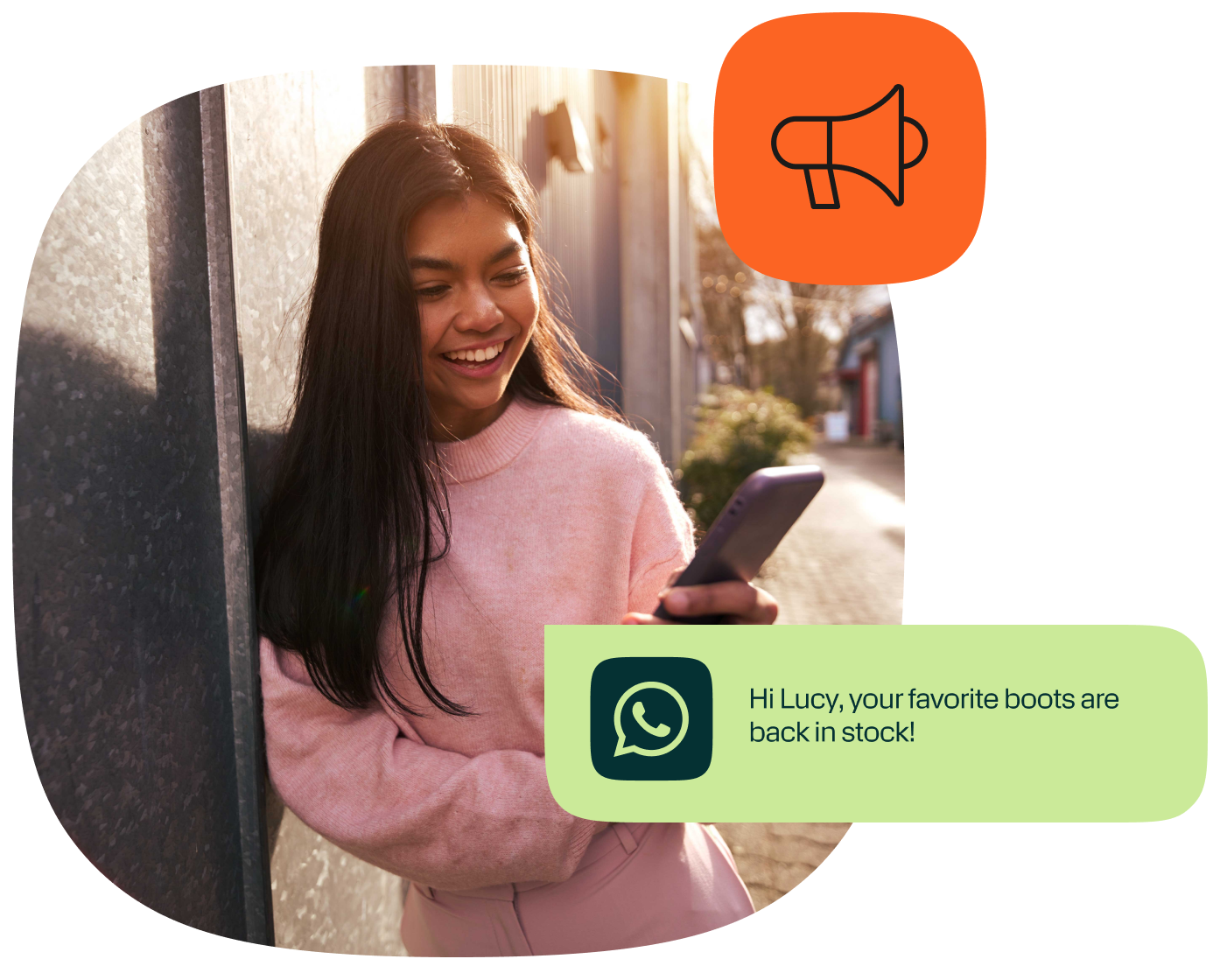
Examples include back-in-stock alerts, loyalty updates, and personalized offers.
Verification and authentication
WhatsApp is commonly used for one-time passwords and account verification. Messages arrive quickly and feel secure to users.
Rich messaging experience
WhatsApp supports images, videos, buttons, lists, and product cards.
These features reduce typing, guide users, and improve conversion. Small improvements compound quickly at scale.
How WhatsApp pricing works in 2026
WhatsApp uses a message-based pricing model. You pay per message, not per conversation.
A conversation starts when a business sends a template message to a customer and that message is delivered, or when a customer messages a business. WhatsApp template messages are categorized as marketing, utility, or authentication, while non-templated messages are considered free-form (typically sent by an agent or chatbot) and fall under service conversations.
Pricing varies by country and category.
How to set up the WhatsApp Business API
Most businesses work with a WhatsApp API provider to simplify setup.
The process usually includes:
- Creating or verifying a WhatsApp Business account
- Registering a phone number
- Connecting to the WhatsApp Business Platform
- Creating and submitting message templates
- Setting up automation features and integrations
There are rules to follow. Customers must opt-in. Message templates must be approved. There is a 24-hour service window for customer-initiated conversations.
A good provider guides you through these steps and handles compliance behind the scenes.
The goal is simple: Get live quickly and operate confidently.
What to look for in the best WhatsApp API provider
Not all WhatsApp API providers offer the same capabilities.
Some only provide access. Others offer a complete messaging platform.
When choosing the best WhatsApp API provider, think beyond day one.
- Reliability and message delivery: Message delivery must be fast and consistent across regions.
- Automation features: Automation features like bots, routing, and AI-driven workflows save time and improve response speed.
- Integrations and communication channels: WhatsApp should connect with other communication channels like SMS, email, and chat.
- Analytics and reporting: You should see delivery rates, read rates, response times, and conversions.
- Security and compliance: This is essential for regulated industries and enterprise teams.
- Support and onboarding: When WhatsApp becomes critical, support quality matters.
Key features that define the best WhatsApp Business API providers
The best WhatsApp Business API providers are more than gateways. They are full communications platforms.
Automated workflows and AI-driven automation
Automated workflows handle common requests and route conversations intelligently. AI-driven tools improve efficiency without removing the human touch.
Team members and shared inboxes
Multiple team members should work together without confusion. Shared inboxes and role based access are essential.
Contact center capabilities
For support teams, WhatsApp should integrate with contact center tools and ticketing systems.
Messaging platform and omnichannel support
WhatsApp works best when it is part of a broader messaging platform, not a standalone tool.
Why Infobip often becomes the long-term choice
When businesses first evaluate providers, they usually focus on setup speed or pricing. As they grow, those priorities shift toward scalability, compliance, deeper analytics, and unified orchestration across channels.
This is where Infobip consistently stands out.
Infobip was also one of the first three Business Solution Providers (chronologically) to enter Meta’s WhatsApp Business Solution Provider program, reinforcing its early commitment and long-standing partnership within the WhatsApp ecosystem.
It does not treat WhatsApp as a standalone messaging tool, but as part of a broader customer engagement ecosystem that connects WhatsApp with SMS, RCS, email, push, voice, and in-app messaging through one unified platform with shared automation and reporting. Instead of adding separate tools over time, businesses can orchestrate the entire customer journey within a single environment, maintaining consistent data, logic, and measurement across channels.
With more than 20 years of experience in global communications technology, Infobip brings proven infrastructure, operational expertise, and long-term customer partnerships that go far beyond API access. It supports onboarding, template optimization, automation, and continuous performance improvement at scale, helping teams evolve from basic messaging to advanced, data-driven engagement strategies. Many businesses choose Infobip for WhatsApp capabilities initially, but they stay for the reliability, insight, and global scalability that support sustained growth.
Infobip often becomes the platform that customers choose over and over again, and for more than 20 years it has set the standard for businesses that refuse to compromise on growth, reliability, and global reach.
Regional considerations when choosing a provider
Some providers have stronger regional footprints. In India, businesses often compare Gupshup and Infobip. In Kenya, local providers and Infobip appear frequently. In Europe, compliance standards and integrations often shape decisions. In North America, API flexibility and developer documentation tend to carry more weight.
Regional familiarity can be important, especially when navigating local regulations and customer expectations.
At the same time, businesses operating across multiple markets need more than regional coverage. With offices in more than 70 countries, Infobip supports customers globally while maintaining strong local presence. It does not simply operate in markets. It builds infrastructure, partnerships, and expertise within them.

This allows businesses to scale confidently, knowing their provider understands both global complexity and local nuance.
Choose a provider that aligns with where your customers are today and where you plan to grow tomorrow.
Automation vs human support on WhatsApp
A common concern is whether WhatsApp should be automated or handled by humans.
The best answer is both.
Automation handles repetitive tasks instantly. Humans handle nuance and complex situations.
The best WhatsApp experiences blend automation with human support seamlessly.
Customers get faster answers without feeling ignored.
Conclusion
Choosing the best WhatsApp API provider is not just a technical choice.
Fast replies feel respectful. Clear updates build trust. Helpful automation saves time for everyone involved.
The best WhatsApp Business API providers make life easier for teams while delivering the natural conversations customers expect.
When WhatsApp is treated as a core communication channel and supported by the right platform, it becomes one of the most effective ways to engage, support, and grow a business.
Once everything runs smoothly, it is hard to imagine working without it.

FAQs
Reliability, automation features, analytics, security, and integrations.
Start with your use cases, then compare platforms, not just access.
It is an official partner that provides access to the WhatsApp Business API.
With guided onboarding, many teams go live within days.
Yes. The WhatsApp Business API supports large scale messaging.
Yes. Shared access is a core feature.
Yes. It becomes valuable once automation or multiple users are needed.