






The compliance tax: How regulatory fragmentation is eating your roadmap
Why global messaging compliance has become a growing tax on product and engineering teams.

Five years ago, that sentence would have sounded strange. Compliance was something you handled once during setup, maybe revisited annually, and otherwise stayed out of engineering’s way.
Today, for platforms serving global customers across multiple messaging channels, regulatory requirements have become a continuous engineering workstream that competes directly with feature development.
In previous pieces, I’ve covered the operational layer, channel-specific integration overhead and the hidden costs that accumulate when platforms build infrastructure on top of CPaaS APIs.
This piece addresses a third layer: Regulatory overhead. And unlike the others, this one compounds in ways that are particularly hard to predict.
The fragmentation problem
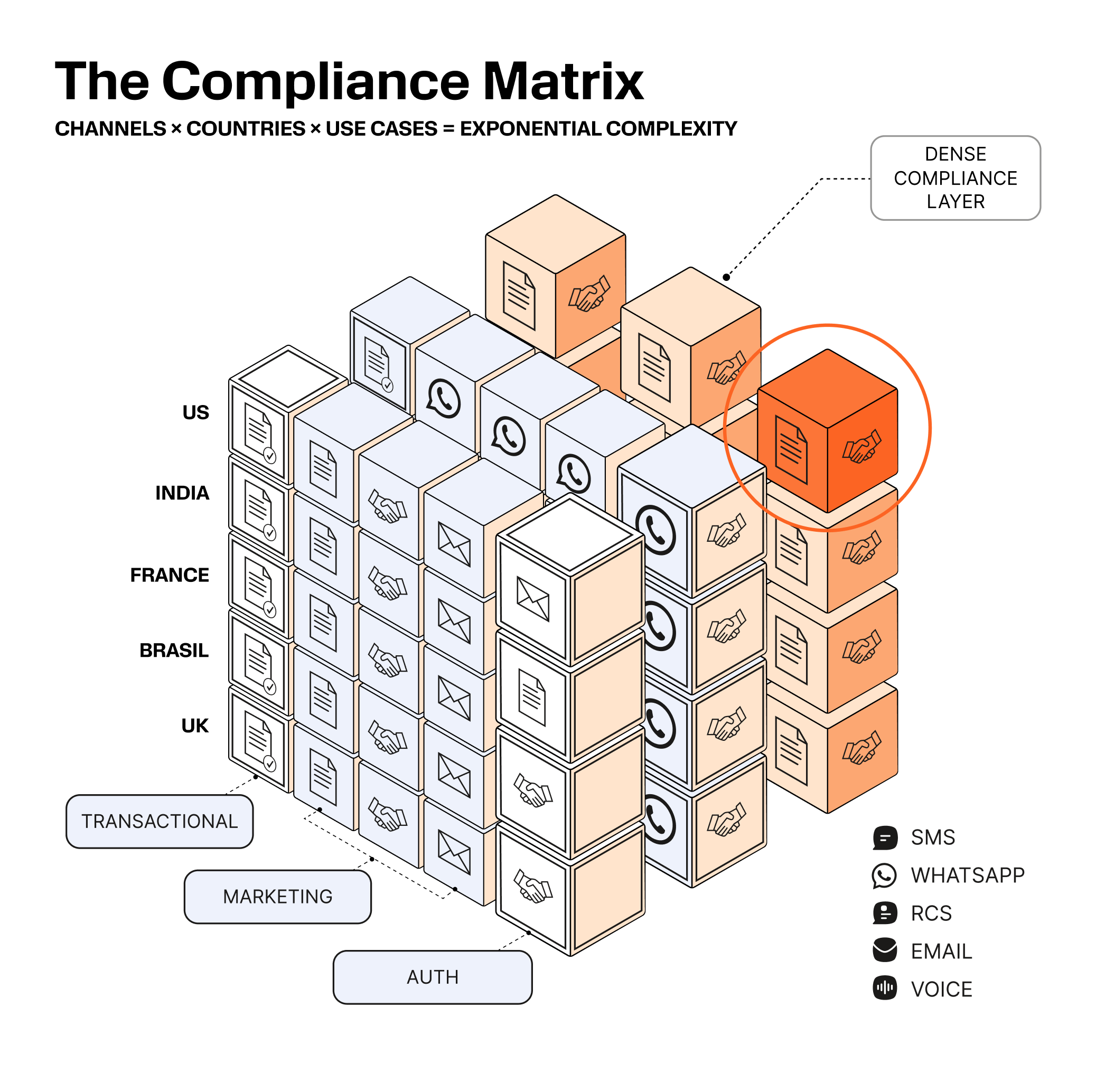
Compliance is not a checkbox. It is a matrix. Every combination of channel, country, industry and use case introduces its own registration requirements, content restrictions, and consent rules. The complexity does not add linearly, it multiplies.
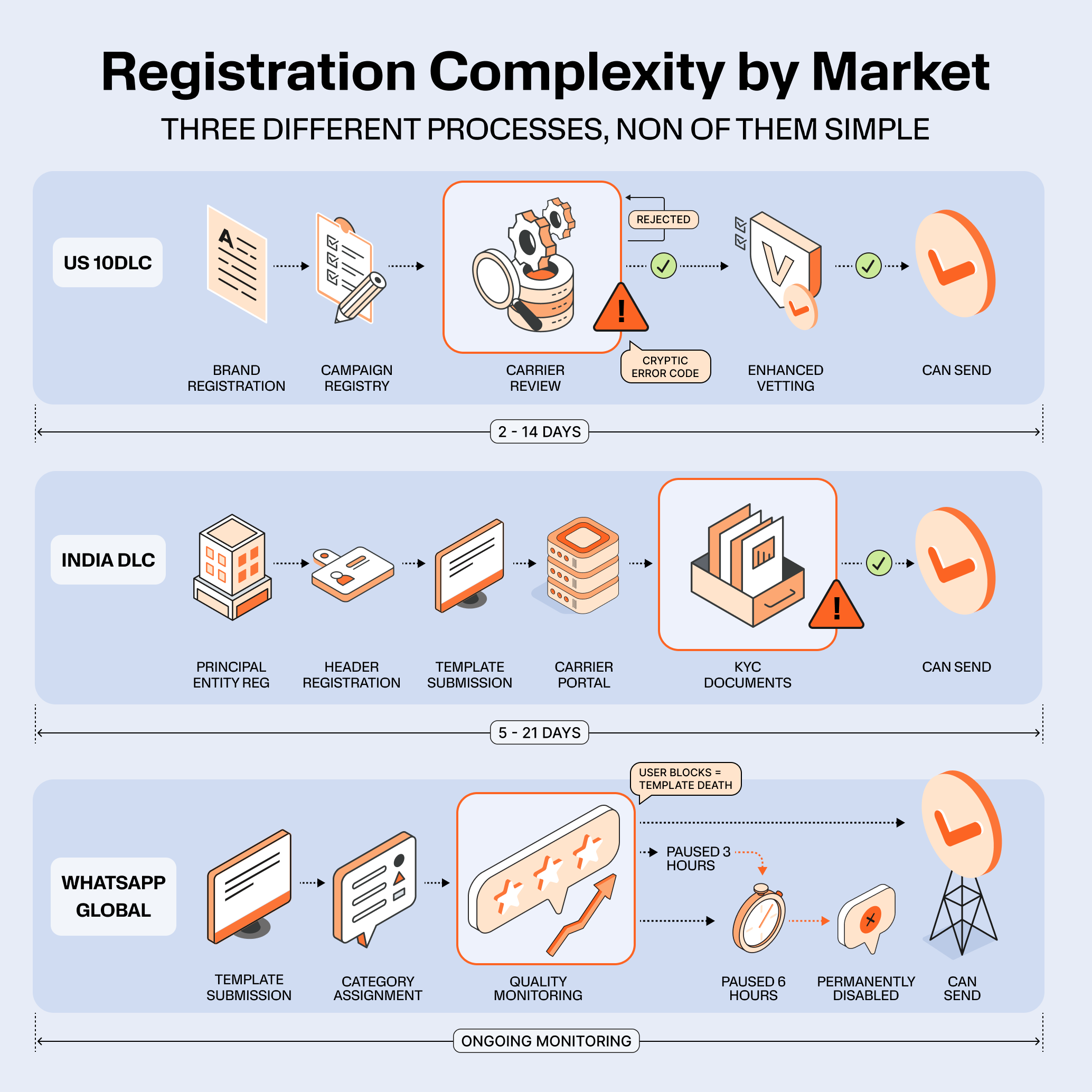
Consider what it takes to send business messages in just three scenarios:
United States: SMS via 10DLC
10DLC (10-digit long code) registration has become a must for many brands looking to use SMS as a channel to connect with customers in the US.
You must register your brand with The Campaign Registry, then register each campaign with a declared use case, opt-in method, and sample messages. If a campaign is rejected, you diagnose the issue using limited rejection codes, fix it, and resubmit.
Non-US brands require additional vetting. Certain verticals such as political messaging or debt collection face extra scrutiny or outright restrictions. Throughput limits depend on your vetting score, and even after approval, capacity may be throttled until enhanced verification is completed.
India: SMS via DLT
To send commercial SMS in India, businesses must register with telecom authorities or service providers using Distributed Ledger Technology (DLT).
Every sender must register as a Principal Entity on a Distributed Ledger Technology platform operated by telecom carriers. Sender IDs (Headers) must be approved, and every message template must be pre-registered and categorized as Transactional, Service Implicit, Service Explicit, or Promotional.
Templates must match exactly. Any deviation results in the message being blocked. International senders cannot use alphanumeric IDs and cannot send promotional traffic at all. There are registration fees, mandatory KYC requirements, and carrier-specific portals to manage.
Global markets: WhatsApp & SMS
WhatsApp requires all business-initiated messages sent outside the 24-hour messaging window to use pre-approved templates.
Templates are categorized as marketing, utility, or authentication, and Meta automatically reclassifies them if the content does not align with the declared category.
Templates are also assigned quality ratings based on user feedback. If users block or report messages, templates can be paused for increasing periods and eventually disabled. Repeated quality issues can reduce messaging limits or lead to the suspension of the entire WhatsApp Business Account.
Now multiply this complexity across different markets your customers operate in:
- Brazil: LGPD compliance combined with carrier-specific registration requirements.
- China: Mandatory pre-registered templates with signatures in Unicode brackets; as of late 2025, unregistered senders are fully blocked.
- UK, Germany, France: Different interpretations of GDPR, each affecting how consent must be captured, stored, and tracked.
- Singapore, Thailand, Vietnam, Indonesia: Market-specific Letter of Authorization (LOA) requirements and strict content controls.
This is the compliance matrix. For platforms enabling global messaging, it is not optional complexity. It is table stakes.
The hidden engineering cost
The most visible cost of compliance is registration work: forms, documentation, and approval timelines. That work is frustrating but generally manageable.
The larger cost appears afterward, in the ongoing operational burden of staying compliant as rules change, templates are rejected, and quality scores fluctuate.
Template rejection cycles
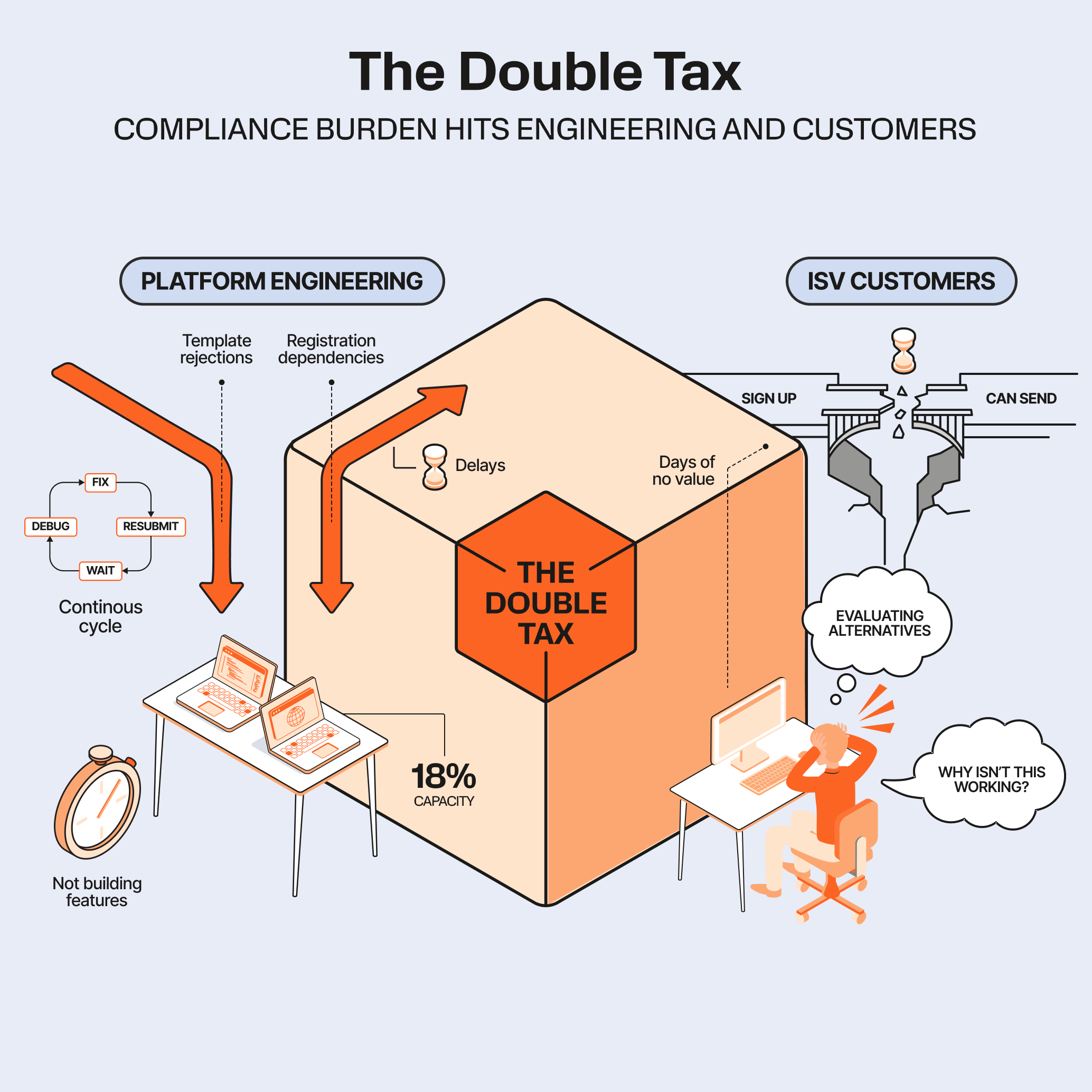
On channels like WhatsApp, a rejected template means a customer cannot launch a campaign. Diagnosing whether the issue is formatting, policy alignment, or categorization takes time. Fixing it takes more time. Waiting for re-approval takes even more.
For platforms supporting hundreds of customers running multiple campaigns, this becomes a continuous support load. And when customer templates underperform, the impact often extends beyond the individual sender to the platform’s overall reputation.
Registration dependencies
In the US, 10DLC traffic cannot be sent until brand and campaign registrations are approved. Depending on use case and vetting requirements, this can take days or weeks. For self-serve platforms, this creates a gap between customer sign-up and time-to-value. Every day in that gap is a day the customer may reassess their choice
Consent and preference management
Regulations such as GDPR, TCPA, and CCPA require not only collecting consent, but tracking it, enforcing opt-outs, and proving compliance when challenged. For platforms, this means building infrastructure to manage consent per end user, per channel, per use case and per customer. When regulations change, that infrastructure must change with them.
Country-specific routing logic
Certain content is prohibited in specific countries. Some sender types are restricted by use case. Some channels require mandatory disclaimers or formatting. Platforms either encode these rules into routing logic or expose customers to failed deliveries, blocked traffic, or regulatory risk.
This is where compliance stops being a legal concern and becomes an engineering one.
What compliance as a service looks like
The traditional approach is to treat compliance as a platform responsibility: hire specialists, build registration workflows, create internal tooling to track templates and consent, and maintain it all as regulations evolve. The alternative is to consume compliance capabilities from your CPaaS provider.
Pre-registration and approval workflows
Instead of integrating directly with The Campaign Registry, DLT platforms, or WhatsApp Business Manager, registration workflows are handled by the provider. Customers submit information through your platform, while the provider manages approvals, rejections, and lifecycle updates via APIs or webhooks.
Template lifecycle management
Templates are submitted programmatically. Status updates, quality ratings, pauses, and disablements are surfaced automatically. This enables proactive remediation before quality issues affect sender reputation.
Country and channel rule enforcement
The compliance matrix allowed content types, sender formats, and restricted use cases is maintained centrally. Your platform queries these rules during campaign creation or send time, preventing failures before they reach production.
Consent and opt-out handling
Opt-out keywords are handled automatically. Blocklists are enforced per sender. Consent status is tracked and honored across channels, without requiring each platform to build its own infrastructure. This does not eliminate responsibility.
Platforms still need to understand regulations and design compliant experiences. But the operational infrastructure, the workflows, tracking systems, and rule engines can be consumed rather than built.
The practical trade-off
Compliance-as-a-service is not free. You are depending on your provider to stay current with regulations, to maintain integrations with registration authorities, and to surface compliance status accurately. If they lag behind regulatory changes or provide poor visibility into registration status, you inherit those problems.
The question is whether the alternative is better: building and maintaining compliance infrastructure yourself, staffing a team to monitor regulatory changes across dozens of countries, and accepting that compliance work will compete with feature development indefinitely.
For platforms with global ambitions or customers with global ambitions, the math usually favors consumption. The compliance matrix is too large and too dynamic to maintain in-house without significant dedicated investment. And that investment does not differentiate your platform. It just keeps you from getting blocked.
The shift
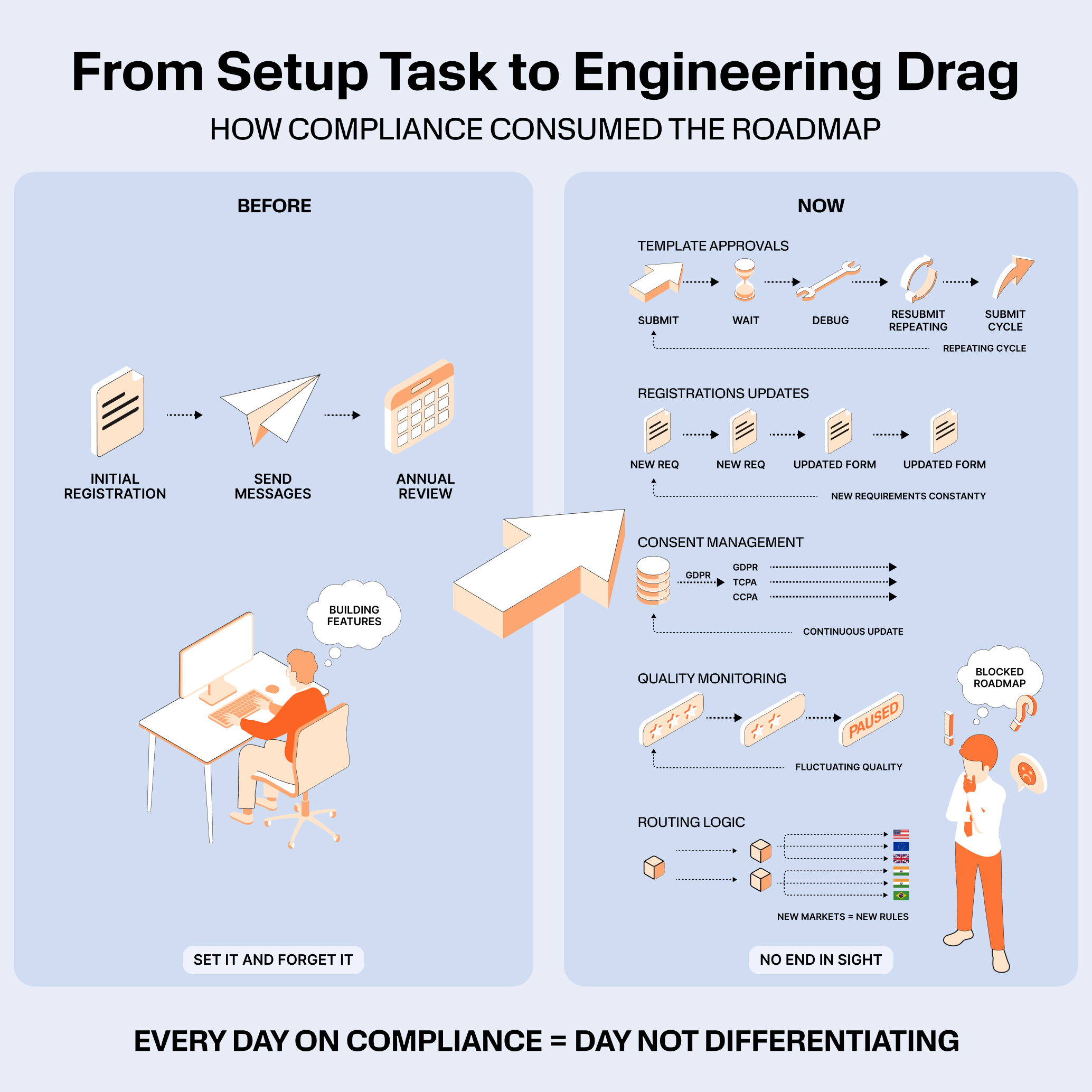
Compliance used to be a setup task. Today, it is a continuous operational layer spanning registration, content approval, quality monitoring, consent management, and country-specific routing. And this landscape is not getting simpler.
As brands compete harder for end-user attention, they continue to adopt more channels like SMS, WhatsApp, RCS, email, push, in-app, and whatever comes next. Each new channel introduces its own rules, approval models, quality signals, and enforcement mechanisms.
At the same time, existing channels are tightening controls. Carriers, platforms, and regulators are putting up more guardrails to protect their ecosystems from spam, abuse, and regulatory exposure.
The result is compounding complexity. Rules change more frequently. Approval processes become stricter. Quality thresholds rise. Enforcement becomes faster and less forgiving. What was once a manageable set of requirements now demands constant monitoring just to stay operational.
For platforms supporting global, multi-channel messaging, this means regulatory overhead will continue to grow. Every new channel added to your roadmap increases the surface area for compliance risk. Every rule change introduces new engineering work. Every tightening policy raises the cost of staying current.
This is where compliance becomes a structural drag on engineering capacity. Time spent tracking regulatory updates, debugging template rejections, or adapting to new approval requirements is time not spent on personalization, orchestration, analytics, or experience design the features that actually differentiate platforms.
The shift is recognizing that compliance infrastructure is not a competitive advantage, especially in a landscape that is becoming more fragmented and more restrictive over time. It is a cost of doing business that will only increase and one that can be consumed rather than built.
Your compliance team should inform product decisions. They should not be a blocker on your roadmap. The real question is whether you are preparing to manage an increasingly complex compliance landscape in-house or whether you are treating compliance as a service designed to scale with it.
Keep reading:
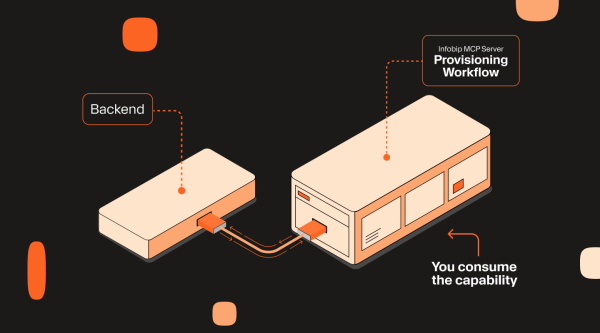
How MCP helps platforms reduce integration overhead.
Most platforms don’t slow down because of product ideas. They slow down because engineering time gets eaten by the operational glue around integrations. MCP changes where that work lives.

Best marketing automation platforms in 2026 .
Compare the best marketing automation platforms in 2026. Learn which solutions unify customer data from marketing, sales, and service, orchestrate seamless multi-channel campaigns across email, SMS, WhatsApp and more, and deliver AI-powered personalization at scale.

The channel explosion problem: Why adding RCS shouldn't take six months.
Messaging channels multiply faster than roadmaps can handle. Learn why channel-by-channel integrations don’t scale and how unified APIs unlock real channel velocity.