




Travel customer experience: How to deliver connected journeys across every channel and every border
Travel customer experience is defined when journeys break down. See what a customer experience platform for travel needs to keep every trip connected.

Travel customer experience matters most when a trip breaks. A traveler is stuck in a foreign airport at 11pm. Their connection has dropped. Their battery is low. The support line is closed in the brand’s home time zone.
That’s the moment that matters more than the smooth booking or trip that goes to plan. Travel CX is decided when the journey breaks, and the brand has to help fast.
Most travel brands still design for the easy version of the trip. They assume the customer is on a familiar network, in a familiar language, with time to wait. Travel doesn’t work that way. The journey crosses systems, channels, countries, and teams that don’t share one view of the traveler.
This guide explains what travel customer experience means, where it breaks, how AI changes the response, how it differs by type of travel business, how to choose the right platform, and how to measure whether it works.

Why travel customer experience is unlike any other industry
Travel has its own failure modes. It also has its own pressure. The real problem is reachability, timing, and fragmented systems.
Three things make travel different. The customer isn’t at home. The journey sits across systems no single team owns. Demand arrives in spikes, not in a smooth line.
Your customer isn’t at home
In most industries, a customer who needs help is on their usual device, on their usual network, in their usual time zone, and often in their usual language. Travel removes all of that at once.
A traveler may be roaming, offline, on weak airport Wi-Fi, or trying to save battery while standing in a queue. They may be in a market where the brand’s home channel isn’t the one they use or may need help while the support team is asleep.
That means a message that only works with local data, and a support model that only works during office hours isn’t enough.

The journey crosses systems no single team owns
A single traveler usually exists in several systems at once, and none of them tells the full story. A booking may live in a passenger service system or property management system. A reservation may live in a global distribution system or booking engine. The same person may also have a loyalty ID, marketing profile, and service ticket.
Each system holds part of the truth. The agent can’t see the booking. The booking system can’t see the complaint. The marketing tool doesn’t know the trip was disrupted. The traveler ends up repeating the same story to different teams at the worst possible moment.
That isn’t just frustrating, but also slows recovery, weakens trust, and makes personalization feel random.
Demand doesn’t arrive evenly; it arrives all at once
Travel support is event driven. A weather event, IT outage, baggage issue, strike, or air traffic restriction can push volume up within minutes. The pressure hits every channel at once.
That’s very different from a predictable support queue in retail or software. Staffing alone can’t flex fast enough for that shape of demand. You also need a way to reach travelers before they contact you, then route the right case to the right place.
Once you see travel this way, the next question is simple: what does travel customer experience actually mean?
What travel customer experience means today
Travel customer experience is the full set of interactions a traveler has with a brand from inspiration through post-trip, across owned channels, partners, and third parties, so the traveler can book, move, get help, and recover without repeating themselves.
It isn’t the same as guest satisfaction or customer service. It’s the operating system behind both.
The travel customer journey, stage by stage
The journey makes more sense when you break it into stages. Each stage uses different systems, channels, and failure modes, which is why one generic CX playbook doesn’t work.
| Stage | Core systems | Traveler channels | Common failure mode |
|---|---|---|---|
| Inspiration | Content, CRM, marketing automation | Social, email, web, app | Interest is captured, but not turned into an identifiable journey |
| Research and shopping | Search, fare, availability, booking engine | Web, app, chat, email | The traveler compares options but gets no timely support or reminder |
| Booking | GDS, booking engine, payment, loyalty | Web, app, email, SMS | Abandonment because the path is too long or trust is too low |
| Pre-trip | Reservation, service, ancillaries, notifications | SMS, WhatsApp, email, push | Important updates don’t reach the traveler in time |
| In-trip | PSS, PMS, departure control, service desk | WhatsApp, SMS, in-app, voice, live chat | Disruption is handled late and the traveler repeats information |
| Post-trip and loyalty | Survey, loyalty, service, CRM | email, app, SMS, messaging apps | Feedback is collected, but it doesn’t feed the next trip |
According to Travelport, a single accommodation purchase journey can involve around 45 touchpoints. This makes fragmentation easy to see, and the table shows why it happens. Each stage depends on a different system and a different way to reach the traveler, so travel CX breaks down fast.
Where travel customer experience breaks down
The trouble starts when the trip stops going to plan.
When the traveler hears first
The biggest failure in travel CX is the delay between the event and the first useful message. If the traveler sees the airport board before the brand contacts them, the brand has already lost ground.
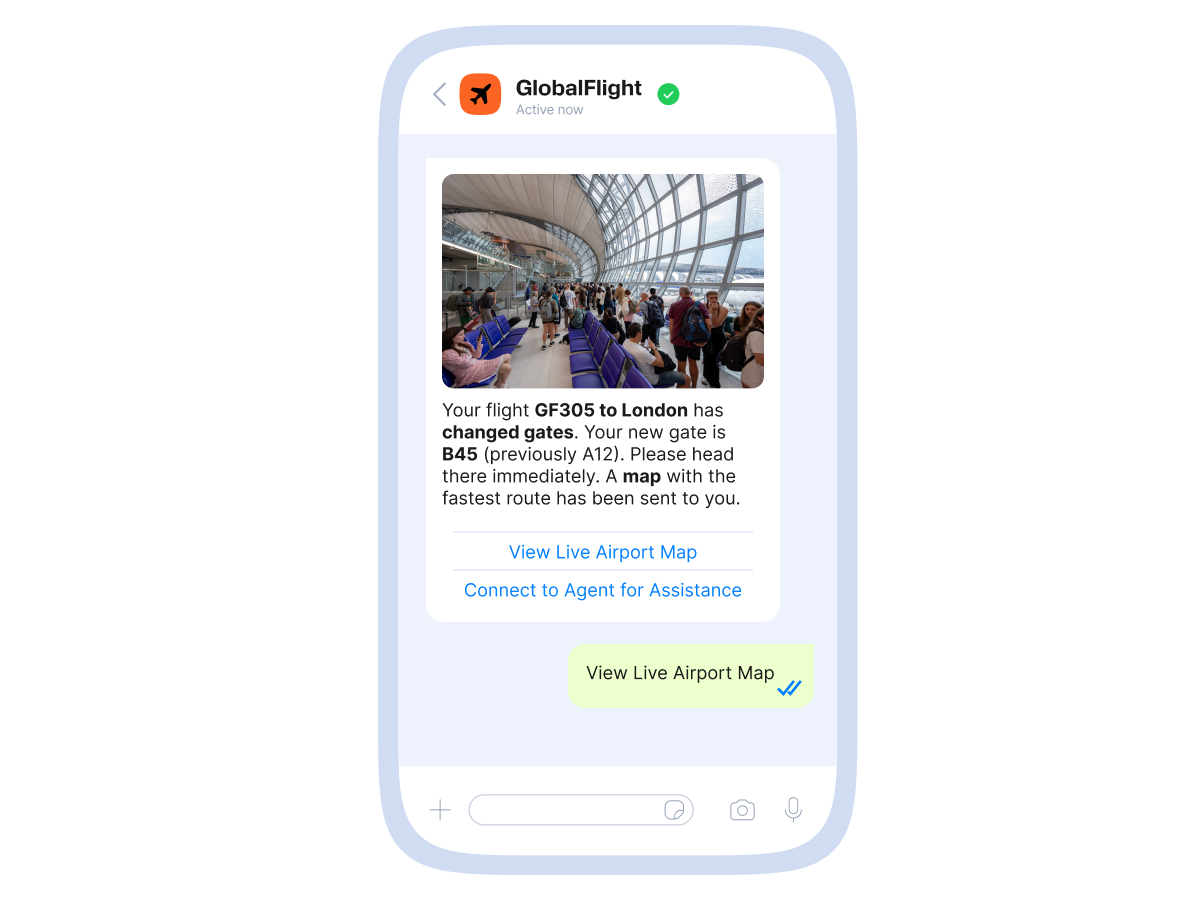
The best response is proactive and specific. It should tell the traveler what changed, what the options are, and what they can do next. A generic alert doesn’t help, but a resolution does.
According to Business Traveller, only 10% of passengers feel informed during flight disruptions, which shows how much communication shapes the experience.
Messages that never reach the traveler
A message on the wrong channel is the same as no message. If the traveler is offline, email is too slow. If the market relies on a messaging app, SMS may be the weaker choice. If the trip crosses borders, the brand’s home channel may not be the right one abroad.
The practical rule is to use the channel the traveler actually uses where they are, not the channel the brand prefers at home. It may mean LINE in Japan, KakaoTalk in Korea, Viber in Eastern Europe and the Philippines, Zalo in Vietnam, RCS across Android-heavy markets, WhatsApp in much of Europe, Latin America, and Asia, and SMS as the fallback that still works without data.
If the message doesn’t get through, the traveler is still on their own.

Fragmented traveler data
When the traveler is split across booking, loyalty, service, and marketing systems, personalization gets shallow fast. The agent can’t see the full context. The follow-up offer ignores the current trip. The upsell lands after the flight has already been canceled.
Most personalization failures are data-access failures. The system knows something, but not enough, and not in time.
Language and time zone gaps
Travel support often breaks at the same time as the trip. That means the traveler needs help at 2am local time, in a language the support team may not staff for, while the brand is expecting a daytime call in its home market.
The traditional answer is headcount. The better answer is first-line automation with real-time translation, then human escalation when the case is too sensitive or complex for self-service.
According to Enshored, a lack of multilingual support can cause brands to lose around a third of potential customers. In travel, that’s crucial because language gaps can show up right when the traveler needs the most help.
Measurement that records what happened but never why
Travel teams usually have plenty of numbers. They have NPS, CSAT, drop-off rates, and survey results. What they often lack is the reason behind the behavior.
According to Hotel Plus, hotel websites lose an average of 85% of visitors before booking completion. In travel, that kind of drop-off shows why teams need to understand where the booking breaks, not just how many people left. A metric without context tells you what happened, not why.
The next step goes beyond adding another dashboard and calls for a better response model.
How AI is changing customer experience delivery in travel
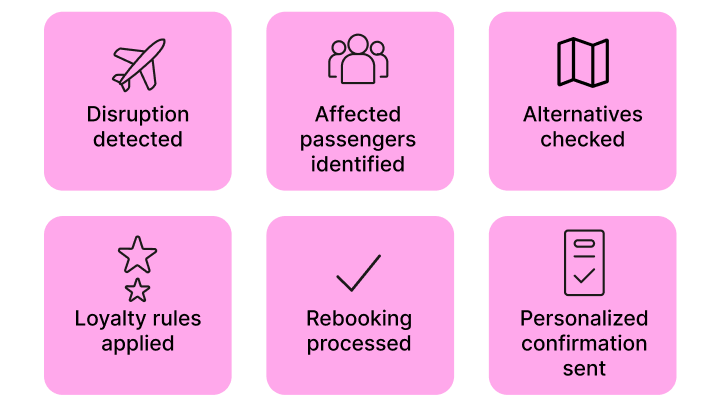
AI in travel changes the timing of the interaction. It lets brands act before the traveler asks, resolve more cases without a handoff, and personalize the response with live context instead of broad assumptions.
Proactive engagement before the traveler has to ask
The biggest shift is from reactive support to proactive action. Instead of waiting for the traveler to contact the brand after a delay or cancellation, the brand detects the event and sends the next best step first.
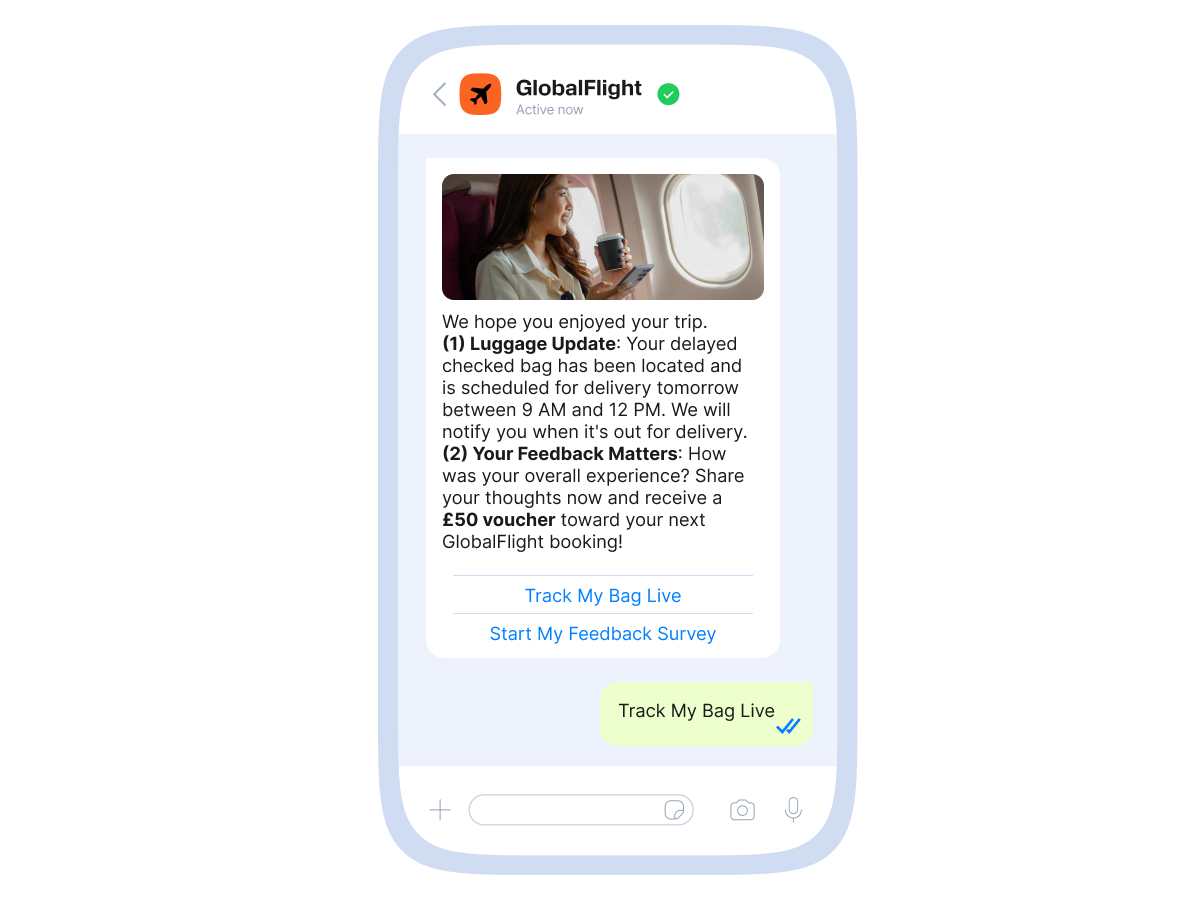
That might mean pushing rebooking options before the traveler reaches the desk, offering a late checkout after a delayed arrival, or confirming an itinerary change before the traveler starts searching for answers.
The value goes beyond the traveler feeling better served. The brand also cuts inbound volume by solving the problem earlier.

AI agents that resolve rather than deflect
A chatbot that answers a question is useful. An AI agent that can read the booking, apply the rules, and complete the change is much better.
The difference is system access. If the agent can only explain policy, it deflects. If it can rebook, refund, check baggage status, change seats, amend an itinerary, or process loyalty redemption, it resolves.
That said, not every case should stay automated. High-emotion, high-value, safety-related, or exception-heavy cases should move to a person.

Personalization built on unified traveler data
Useful personalization in travel is about context. What just happened. Where the traveler is in the journey. What they bought before. What they’re likely to need next.
A strong example is ancillary propensity, where past purchase behavior predicts which add-on a passenger is most likely to want, and the offer is delivered on the traveler’s preferred channel. Cebu Pacific uses that approach, connecting relevance to the live trip, not just to the customer profile.
Knowing when to hand over to a person
Enterprise readers know automation isn’t the answer to everything. The handoff needs to work when the case turns emotional, urgent, or regulated.
Good handover triggers include repeated failed resolution, declining sentiment, safety or medical issues, bereavement travel, high-tier or high-value customers, and compensation claims. The human agent should get the full conversation history and traveler context.
Once AI takes more of the load, the real differences show up by type of travel business. Travel isn’t one market.
Travel customer experience by type of travel business
Airlines, hotels, OTAs, cruise lines, rail operators, and tour companies all face different systems, channels, and failure points. A useful travel CX model has to reflect that.
| Sub-vertical | Journey shape | Dominant failure mode | Highest-value use case |
|---|---|---|---|
| Airlines | High-frequency, disruption-heavy, time critical | Delayed irregular operations communication | Proactive disruption updates and rebooking |
| Hotels and resorts | Stay shaped, property based, service heavy | Fragmented guest data across properties | Pre-arrival upsell and in-stay messaging |
| OTAs and marketplaces | Own the relationship, not the supplier | Booking abandonment and blame for supplier issues | Abandonment recovery and supplier delay alerts |
| Cruise lines | Long pre-departure window, limited onboard reach | Weak connectivity at sea | Pre-cruise nurture and itinerary change alerts |
| Rail and ground transport | Short windows, high frequency, low latency tolerance | Real-time service disruption | Service alerts and refund automation |
| Tour operators and travel agencies | Long consideration cycle, advisory led | Many suppliers, many handoffs | Conversational sales support and itinerary delivery |
Airlines
Airlines are the most disruption-led type of travel business. Their CX is shaped by delays, cancellations, gate changes, baggage issues, and rebooking pressure. The critical systems are the passenger service system and departure control.
The highest-value use case is proactive irregular operations communication. That means contacting the traveler before they start calling and giving them a route to action instead of a generic status update.

Hotels and resorts
Hotels and resorts are centered on the stay, not the whole trip. The experience starts before arrival, continues through check-in, in-stay service, checkout, and review.
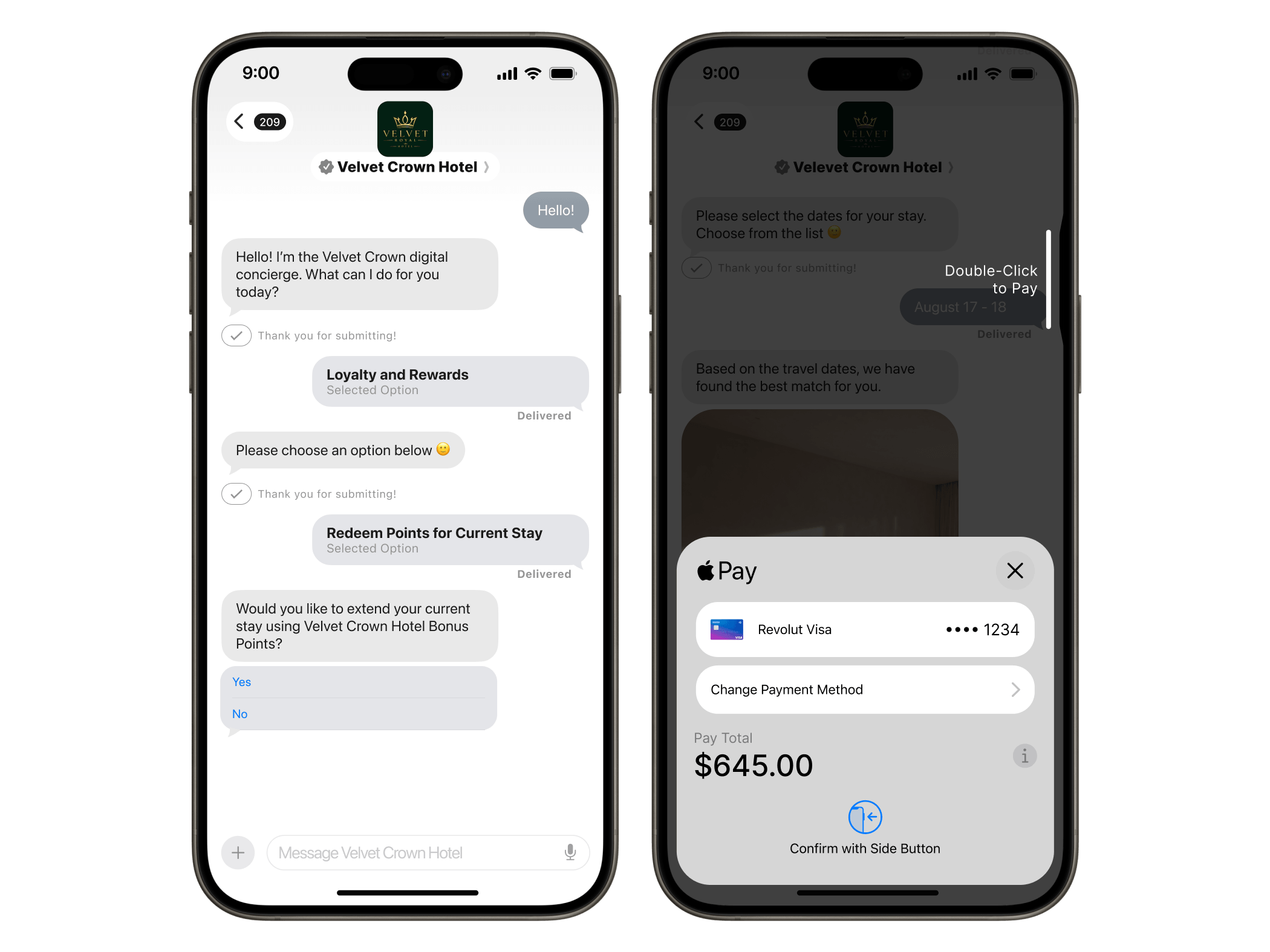
The property management system is usually the system of record, but it often sits at property level rather than brand level. That fragments the guest across a portfolio. The strongest use cases are pre-arrival upsell, in-stay messaging that replaces the front desk phone, and review follow-up.
OTAs and travel marketplaces
OTAs sit in the hardest position. They own the customer relationship, but they don’t control the full-service chain. When something fails, they absorb the blame even if the travel provider causes the problem.
Booking abandonment is a big commercial issue here, and the recovery window is short. Messaging-based abandonment recovery and disruption communication are the highest-value use cases because they can recover revenue before the traveler disappears.
Cruise lines
Cruise lines are different because the traveler is often hard to reach once the trip starts. Connectivity at sea can be limited or expensive, so the pre-departure phase matters the most.
The strongest use cases are the long nurture sequence before departure, onboard messaging over ship Wi-Fi, and notification of port or itinerary changes. In this type of travel business, timing and channel choice matter more than volume.
Rail and ground transport
Rail and ground transport combine high frequency with low per-transaction value. The challenge is speed. When a disruption happens, the traveler often needs an answer immediately.
Real-time service alerts, refund automation, and accessibility assistance are the highest-value use cases. This needs a fast answer because the traveler has only a few minutes to act.
Tour operators and travel agencies
Tour operators and travel agencies have the longest consideration window and the most advisory work. They also manage complex itineraries across multiple suppliers.
That makes conversational sales support, document and itinerary delivery, and in-destination assistance the most valuable use cases. The relationship is often personal, so speed and continuity matter more than volume reduction.
With the operating model clear, the next step is choosing the right platform.
How to choose a customer experience platform for travel
Choosing the right platform starts with a buyer checklist.
Channel coverage and global deliverability
The first question is whether the platform owns delivery across the markets that matter.
Ask which channels are native, which ones depend on third parties, what happens when delivery fails, and how the platform behaves when the traveler is abroad. A platform that only routes conversations isn’t the same as one that owns delivery to the handset.
Infobip owns the infrastructure layer, so it can deliver end to end instead of relying on a chain of third parties.
Traveler data unification
The second question is whether the platform can build one live traveler profile across booking, loyalty, service, and marketing systems.
That profile should update during the trip, not after it ends. It should also be available to automated and human agents. If a tool only serves marketing, it isn’t enough for service use cases.
Automation depth and AI agent capability
The third question is what automation can actually complete.
Can it only answer questions, or can it finish the transaction in the backend system? Can it handle refund status, itinerary changes, rebooking, or baggage queries without handing off too early? How does it handle hallucination risk when the answer affects fare rules or visa requirements?
Integration with travel systems
Travel buyers should also ask about integration depth. The platform should connect with passenger service systems, departure control, global distribution systems, property management systems, central reservation systems, loyalty platforms, CRM, and revenue management.
Pre-built connectors are important, but so is implementation time. A platform that looks strong in a demo but takes months to connect isn’t a fast path to value.
Compliance, consent and data residency
This matters because travel is cross-border by nature. A buyer should know how the platform handles per-channel opt-in, sender registration, regional data protection obligations, and data residency.
Infobip holds certifications including ISO 27001, ISO 27017, ISO 27018, and SOC 2 Type 2, which support opt-in, data residency, and other compliance requirements.
Build, buy or outsource
The last question is whether the brand should build, buy, or outsource parts of the experience.
Outsourcing can solve surge capacity and language coverage quickly, and for some organizations it’s the right answer. The honest tradeoff is that outsourced cost scales with volume, while automation does not. The strongest model usually combines automated first-line resolution with skilled human escalation.
That decision becomes clearer when the measurement model is right, so the next section looks at what to track.
How to measure travel customer experience
Travel teams usually measure a lot, but they don’t always measure the right things. A useful scorecard should separate experience, operations, and commercial impact.
Experience metrics
NPS, CSAT, and CES still matter, but they do different jobs.
NPS is useful for broad sentiment and loyalty signals. CSAT is better for specific interactions. CES shows whether the customer had to work too hard. In travel, these scores should never be lumped together, because a post-disruption CSAT and a post-booking CSAT aren’t measuring the same thing.
According to Calculator for NPS, travel NPS benchmarks often sit in a directional range around 0 to 35, though the exact number varies by carrier, market, and year.
Operational metrics
The operational layer tells you whether the system is doing its job.
Track first contact resolution, average response time, containment or automation rate, average handle time, and message delivery rate.
Commercial metrics
The last layer is revenue and retention.
Track booking conversion, abandonment recovery, ancillary attachment rate, repeat booking rate, loyalty enrolment, and cost to serve. Loyalty enrolment shows how well the experience turns interest into repeat business.
When the metrics are right, the pattern is easier to spot.
What good looks like
The clearest travel CX wins move work upstream, keep channels connected, and make offers fit the trip.
Virgin Atlantic
Virgin Atlantic‘s AI-led passenger engagement reportedly increased online check-in by 11% and cut customer care workload by up to 50%. More of the work happens before the traveler needs to call, so the service team can focus on the cases that still need a person.
AirAsia
AirAsia tied together airline, digital banking, and OTA communications in one setup, with public reporting pointing to delivery reliability above 90% on SMS and email. The traveler gets a consistent message, even when the business spans more than one service line.
Cebu Pacific
Cebu Pacific used historical purchase behavior to predict likely add-ons and deliver those offers through channels like Viber, SMS, and email. That makes the offer more relevant and better timed, which is exactly what travel CX should do.
These examples show the pattern clearly. The brands that win connect data, channels, and automation around the moment the journey breaks.
Building travel customer experience on AgentOS
AgentOS is the agentic AI platform that brings the pieces together. In this model, the modules below work together as one operating system.
Conversational CDP: One traveler profile across every system
The data fragmentation problem disappears only when the brand can see the traveler as one person across booking, loyalty, service, and marketing systems.
A Conversational CDP does that in a travel context. It builds a live traveler profile that updates during the journey and is available to automated agents and human teams alike. That makes recovery faster and personalization more relevant.
AI agents and the chatbot building platform: Resolution at first contact
Travel volume spikes are where automation matters most. AI Agents and the Chatbot Building Platform can handle rebooking, itinerary changes, refund status, baggage queries, and guided self-service in multiple languages.
The important part is the escalation design. Complex or sensitive cases should move to a person with the full history attached. Automation should reduce queue pressure, not trap the traveler in a dead end.
Customer engagement platform: Reaching travelers on the channel they actually use
Reachability is the root issue in travel CX.
A Customer Engagement Platform can orchestrate journeys across more than fifteen channels, including Viber, RCS, SMS, email, voice, push, and in-app messaging. It can also fall back to another channel when the first one fails. In travel, that’s crucial because the message only helps if the traveler gets it.
Cloud contact center: Escalation with full context
Cloud Contact Center handles the human side of the journey once automation is no longer the right answer.
The difference is that the agent should receive the full conversation history and the live traveler profile so they can pick up the case without asking the traveler to repeat themselves.
Final thoughts
If your travel CX breaks at the handoff between systems, channels, and teams, the next step is to map where the journey fails and fix the architecture first.
When the architecture works, the result is a travel journey that stays connected even when the trip doesn’t.
Frequently asked questions
Travel customer experience is the full set of interactions a traveler has with a brand from inspiration through post-trip, across owned channels, partners, and third parties. It’s about making the journey work across booking, service, recovery, and loyalty without forcing the traveler to repeat themselves.
It matters because travel is high stakes, emotional, and time sensitive. Good CX supports repeat booking, stronger peer recommendations, and lower recovery costs when something goes wrong. It also helps brands respond faster when disruption or service failure hits.
Travel is different because the customer is often abroad, on a foreign network, in another time zone, and sometimes in another language when they need help. The journey also crosses systems no single team owns, and demand arrives in spikes rather than a steady flow.
The main stages are inspiration, research and shopping, booking, pre-trip, in-trip, and post-trip, including loyalty. Each stage sits in a different system and usually reaches the traveler on a different channel, which is why one generic CX playbook doesn’t work.
They should detect the event early, contact the traveler before the traveler contacts them, and send the resolution instead of just the alert. The message should use a channel the traveler can receive without friction, and human agents should step in when automation isn’t enough.
The best platform is the one that combines native channel coverage, traveler data unification, AI agents that can complete transactions, integration with travel systems, and cross-border compliance. Those are the criteria that matter in the real world, and they are the right ones to judge any vendor by.
Use three layers of metrics. Experience metrics include NPS, CSAT, and CES. Operational metrics include first contact resolution, containment rate, response time, and message delivery rate. Commercial metrics include booking conversion, ancillary attachment, repeat booking, and loyalty enrolment.
Outsourcing can be the right answer for surge capacity and language coverage, especially when speed matters. Automation is better for scaling first-line resolution without adding cost linearly. The strongest model usually combines both.
AI is used to reach travelers before they ask, resolve common requests, personalize offers using live traveler data, and handle multilingual interactions in real time. It should also hand off high-risk or high-emotion cases to a person.
The best channel depends on the market and the traveler. WhatsApp is strong across Europe, Latin America, and Asia. LINE, KakaoTalk, Viber, Zalo, RCS, SMS, email, voice, push, and in-app messaging all have a role depending on where the traveler is and whether they’re online.