



Getting A2P 10DLC campaigns approved faster with Campaign Assistant and AI Reviewer
Reduce A2P 10DLC rejections and resubmissions. Build compliant campaigns from intent with Campaign Assistant and catch issues before review with AI Reviewer.

Any platform that sends A2P SMS to US phone numbers over 10-digit long codes has to register its customers’ brands and campaigns. The requirements change often and differ by use case, so even experienced platform teams submit campaigns that come back rejected for a missing disclosure, an unclear description, or a consent flow that doesn’t meet the bar. Each rejection costs money and pushes the launch back by another review cycle.
The most effective way to reduce that cost is to catch problems before a campaign is ever submitted. When platforms can check campaigns against A2P 10DLC requirements while they’re still being built, their customers get feedback early, fix issues in the platform, and submit campaigns that are much more likely to be approved on the first pass. Fewer rejections mean fewer repeat fees and less time spent waiting in the review queue.
In this blog we’ll cover how Infobip’s Campaign Assistant and AI Reviewer, now in Early Access, are built to help mitigate the risk of rejection and speed up the time to launch for compliant 10DLC campaigns in the US.
How a 10DLC campaign gets registered
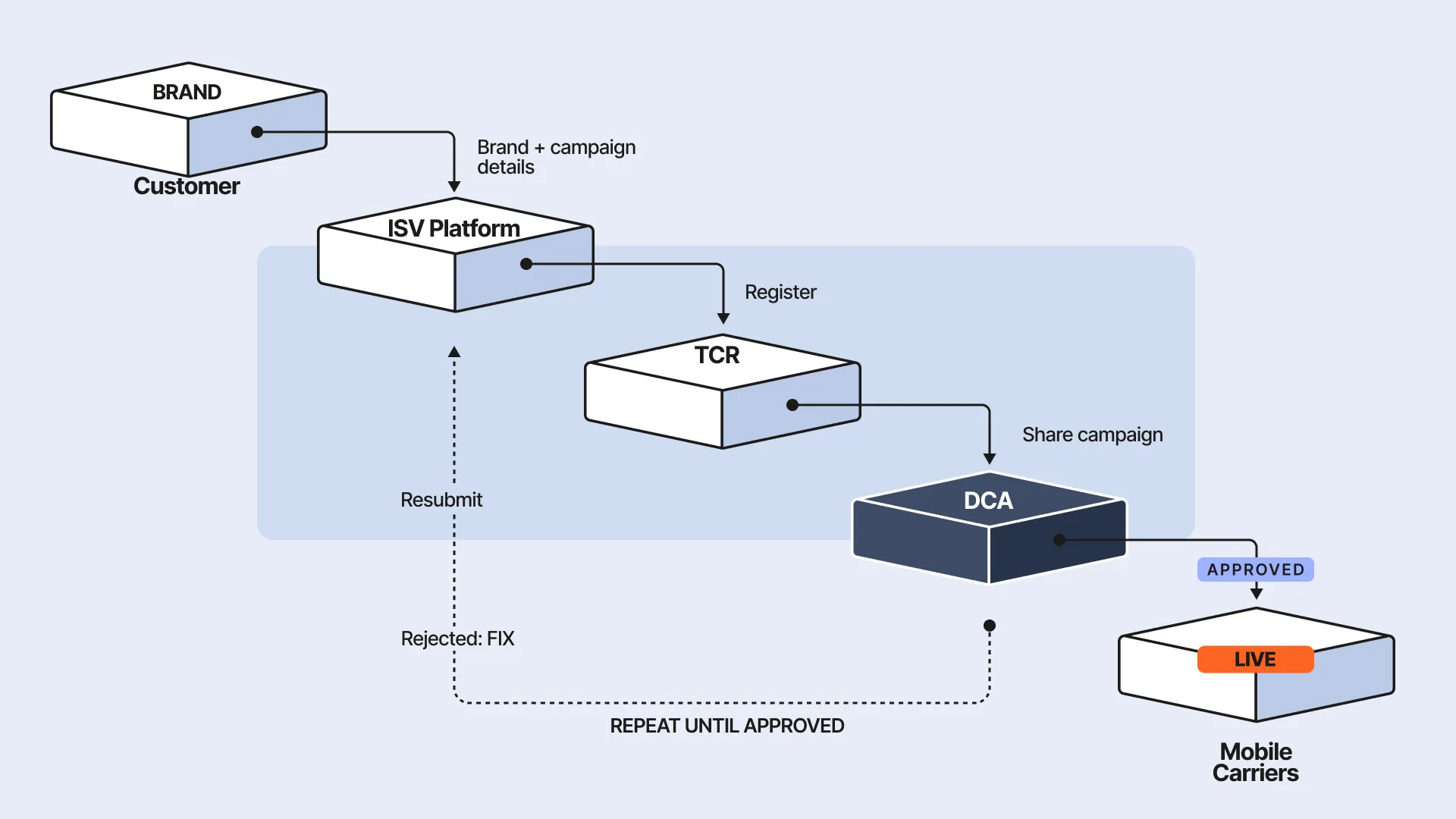
Many platforms that support US messaging act as a campaign service provider (CSP). They collect brand and campaign details from their customers and register them with The Campaign Registry (TCR). Each campaign is then passed to a direct connect aggregator (DCA), which acts as the intermediary between businesses and mobile carriers. The DCA reviews the campaign against CTIA and carrier guidelines and either approves or rejects it. Only approved campaigns go live.
Where the time and cost add up for campaign submissions
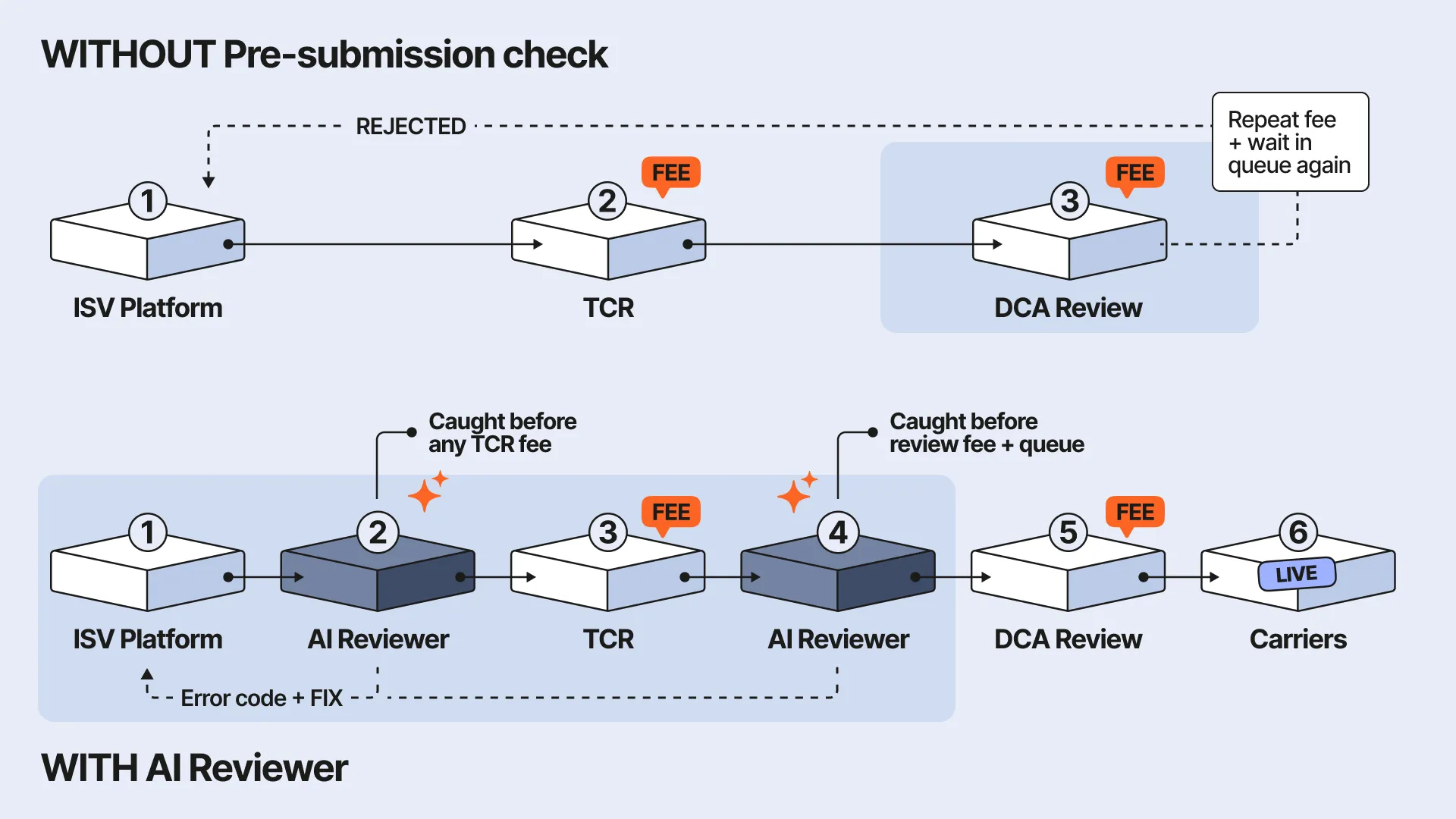
Fees apply at several points in that flow, with TCR registration and DCA checks. If the campaign is rejected, the customer has to fix it and resubmit, which means paying the review fee again and waiting in the review queue a second time.
For a single campaign, one rejection means a delay. For a platform registering 10DLC campaigns on behalf of hundreds of customers, rejections turn into a recurring cost and a steady stream of support tickets.
When guidance and validation for compliance sit inside the registration workflow, customers don’t need to learn 10DLC rules to get a campaign approved, and the platforms don’t need a compliance specialist checking every submission.
Two tools built to support campaign approval
Campaign Assistant and AI Reviewer approach the problem from opposite ends of the process. One helps build a compliant campaign from scratch, and the other checks a campaign that’s already been put together.
1. Campaign Assistant builds the campaign from intent
Much of 10DLC compliance comes down to specifics, such as the required HELP and STOP keywords, how sample messages are written, and the disclosures an opt-in flow needs to include.
Campaign Assistant was built to take care of those details by having the platform send the brand and a plain description of the campaign, for example “marketing messages for a retailer offering an early Black Friday deal,” and Campaign Assistant returns a 10DLC campaign built to meet the requirements. That includes sample messages, HELP and STOP responses, and recommendations for the terms and conditions and privacy policy the campaign needs.
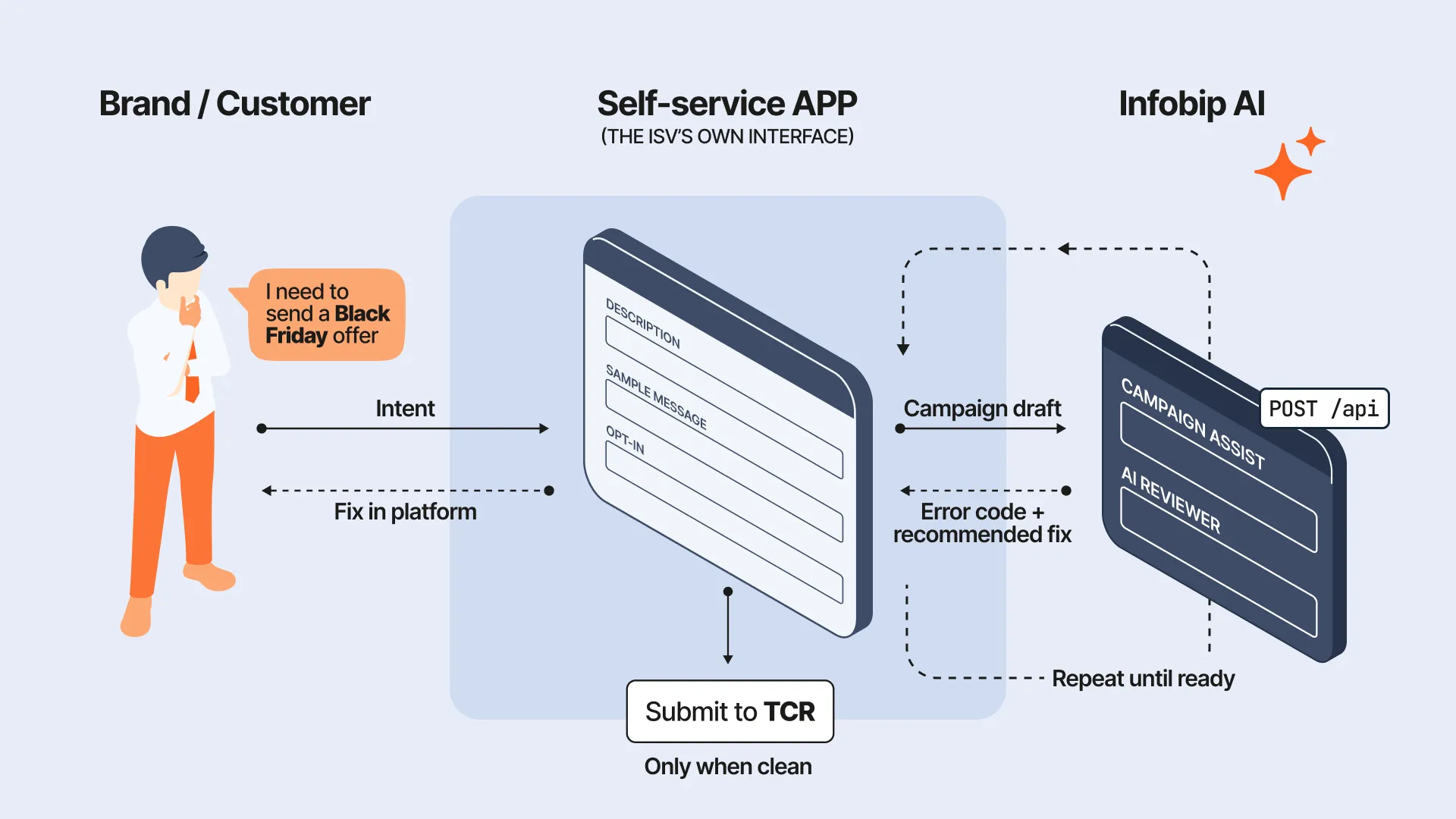
Campaign Assistant is a good fit for platforms that haven’t built their own tools for creating 10DLC campaigns, or whose customers have trouble putting together compliant campaigns. A platform only needs to collect a few inputs from its customers and call the API to get a complete campaign back that is ready for review.
2. AI Reviewer checks the campaign before it’s submitted
AI Reviewer is ideal for platforms that already create and register their own campaigns and want a sense check before submission. It reviews the campaign details, including the description, sample messages, call to action, and brand website, against 10DLC requirements. Each issue comes back with an error code, the reason it was flagged, and a recommended fix that can be adjusted before formal submission.
Here’s an example of some of the feedback AI Reviewer returns:
| Error code | What it flags | Recommended fix |
|---|---|---|
| 1003 | Brand website is inaccessible, doesn’t exist, or returns an error | Make sure the brand website is live and accessible |
| 2002 | Campaign description is unclear | Provide a clear, detailed description of the messaging program’s purpose |
| 3001A | Call to action doesn’t obtain sufficient consent | Add a consent mechanism that requires explicit affirmative action, such as a checkbox, button click, or keyword reply |
| 7002 | Brand or program includes disallowed content, such as lead generation or affiliate marketing | Remove the disallowed content type from the program |
The full list of codes is available in the campaign rejection reference.
Platforms can run AI Reviewer at two points in the registration flow. Running it before registering with TCR catches campaigns that would be rejected, including those with disallowed content, before any TCR fees are paid. Running it before sharing the campaign with the DCA catches issues before the review fee applies and before the campaign enters the review queue. Either way, an issue fixed early doesn’t incur a resubmission cost.
What this means for platforms and their customers
Because both tools are API-based, platforms can build them into the experience they already offer their customers while offloading the heavy lifting of compliance evaluation. The most resource-intensive part of 10DLC compliance is building and maintaining the logic to evaluate the campaign payload itself. When a DCA introduces a new nuance to what constitutes “disallowed content,” a platform’s engineering team does not have to write new regex, update keyword blocklists, or retrain models to catch it. AI Campaign Assistant absorbs that evaluation complexity centrally.
A customer setting up a campaign inside the platform can see the API’s returned error codes and recommended fixes in the platform’s own interface and correct the campaign before anything goes to TCR or a DCA. Because the API passes through actionable, human-readable recommendations, the feedback loop between the platform and its customers is shortened, all without requiring constant code updates from developers.
What’s next for AI Campaign Assistant
While 10DLC is a major focus for US messaging, guidance and checks are necessary across multiple sender types. AI Campaign Assistant is actively expanding its scope to support the broader CPaaS ecosystem:
- Campaign Assistant: The generation capability already provides draft suggestions and recommendations for 10DLC, Toll-Free Numbers (TFN), and Short Codes (SC). We are currently planning to extend this support to Rich Communication Services (RCS), providing platforms with actionable recommendations and compliant-aligned templates to help them build their submissions across all primary channels.
- AI Reviewer: Currently optimized for catching 10DLC issues before submission, this evaluation engine will expand its logic to validate requirements for TFN, Short Codes, and RCS. This will ensure campaigns are seamlessly checked against carrier guidelines regardless of the underlying route.
Get started with Early Access
Campaign Assistant and AI Reviewer are both available in Early Access through the API, with Infobip’s compliance experts involved where it matters most. Here’s how platforms can get started:
- Bring your campaign intent or existing campaign data: Start with a description of what a brand wants to send, a draft campaign, or campaigns you’ve already built.
- Pilot Campaign Assistant, AI Reviewer, or both: Test them against real campaigns from your customer base.
- Work through edge cases with the Early Access team: Partner directly with Infobip’s compliance experts on complex use cases and help refine the flow.
- Help shape the product: Your feedback guides how both tools develop.
If 10DLC rejections are adding cost and delay to your customers’ launches, the Early Access program is a good place to start.