



How RCS works: A deep dive into modern messaging
With Apple now supporting RCS on iOS 18 and Google and major carriers positioning it as the next standard for business messaging, it’s easy to see RCS as a brand‑new channel. In reality, what feels like a recent breakthrough is the result of years of evolution in mobile messaging technology, now finally reaching critical mass across devices and networks.

What is RCS and why it matters
Rich Communication Services (RCS) brings rich, interactive messaging into the phone’s native inbox – without requiring users to download another app. It supports high-resolution photos and videos, carousels, buttons, read receipts, typing indicators, and verified branded senders – all within the inbox users already trust.
An important part of the RCS experience – for business messaging in particular- is brand verification. Before a business is allowed to send RCS messages, its sender identity must be verified either by the mobile carrier or by an approved third‑party verification authority that checks legal identity, documentation, and compliance. This ensures users can clearly distinguish legitimate brands from fraud, building trust and protecting the channel from abuse. Verification also enables branded sender IDs, logos, and trust indicators that strengthen authenticity throughout the conversation.
Where RCS is not available – for example, if the device does not support RCS, the carrier has not enabled it, or there is no data connection – the business messaging platform can be configured to fall back to SMS or MMS, helping maintain consistent delivery across devices and cellular networks.
RCS matters more than ever in 2026 for two reasons:
- Apple’s roll‑out of RCS support on iOS 18 (2024): RCS support on Apple devices helps close the long‑standing gap between Android and iPhone, enabling richer messaging RCS experiences across a more unified ecosystem and making the channel more stable and scalable for brands and mobile carriers.
- Growing global adoption: More mobile carriers, original equipment manufacturers (OEMs), and enterprises now treat RCS as the next generation of business messaging, using it to run secure, interactive, and measurable customer conversations at scale instead of relying only on basic SMS.
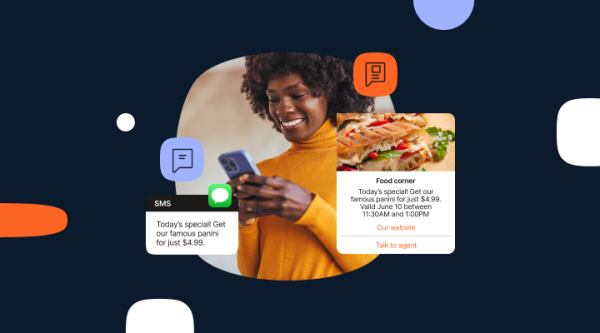
For businesses comparing RCS with traditional SMS, this difference is fundamental: RCS enables interactive, two-way journeys in the native inbox, rather than one-way text alerts. This means they can run interactive campaigns, support user-initiated conversations and design customer support and transactional journeys using a native channel that behaves more like a chat app than a basic text message – without needing customers to download anything new.
The RCS ecosystem: How it works
RCS isn’t a single product or platform – it’s an interconnected ecosystem of carriers, technology providers, platforms, and brands, each with a distinct role in enabling rich, interactive messaging. Whether for business‑to‑person marketing campaigns or user‑initiated support conversations, these players work together to deliver dynamic, verified interactions directly within the native mobile inbox.
Carriers / mobile network operators
Carriers own and govern the RCS for Business channel in their markets. In practice, this means two things:
Firstly, by working with chosen and approved aggregators to enable RCS messaging to their subscribers and ensure compliance with regulatory and anti‑fraud requirements, and secondly, by approving and onboarding verified brand senders before they are allowed to send RCS messages to their users.
While the core RCS network and technology layer is hosted and operated by platform providers such as Google in the vast majority of markets, carriers retain full control over access policies and maintain the authority to determine which verified businesses can message their subscribers.
Brand verification authorities
In many markets, carriers delegate the responsibility of authenticating and verifying businesses to approved third-party brand verification authorities. These authorities validate that a business is legitimate by checking legal identity, registration, documentation, and compliance with local regulations and anti-fraud standards.
Once verified, a business can register as an RCS agent and begin sending messages to consumers on the carrier’s network. This third-party model reduces the operational burden on carriers while maintaining security and trust across the RCS channel.
OEMs and platforms (Google and Apple)
Google and Apple implement RCS within their native messaging apps, but their roles differ significantly. Google manages the core RCS infrastructure globally and operates the Android RCS client through Google Messages, which is now the default messaging app on most Android devices.
Apple supports RCS at the OS and device level within the iOS Messages app, allowing iPhone users on iOS 18 and later to send and receive RCS messages – though iOS RCS support is currently available only on carriers and networks that have specifically enabled it for Apple devices, making it a subset of overall carrier RCS support.
Both platforms ensure that RCS messages are sent, received, and rendered correctly with rich media, buttons, and interactive cards, and they manage the user‑facing chat features and experience.
Brand and businesses
Brands and enterprises use RCS to send marketing, transactional, and support messages, building rich customer journeys with interactive flows, automation, and detailed engagement analytics. Many brands do not directly integrate with a CPaaS platform; instead, they work through their existing partners who provide them platforms for the marketing, CRM or customer support, which are themselves connected.
This partner-led, multi-layer model allows brands to use the marketing and customer data platforms they already know and trust while gaining access to the full capabilities of RCS without additional integration overhead.
A simple RCS message flow through the ecosystem
At a high level, this is how an RCS message moves through the ecosystem – independent of message content or use case:
- Message trigger: A brand initiates an RCS message through an ISV, a CPaaS platform, or directly through an aggregator API or campaign tool, specifying the recipient, content, media, and interactive elements.
- Validation and routing: The aggregator validates the brand’s credentials and registration, formats the message payload, and sends it to the RCS platform. In most markets, this is Google’s RCS platform; in rare cases where a carrier operates its own RCS infrastructure, the carrier’s platform still hands off delivery to Google’s system as part of end-to-end routing..
- Delivery capability check: The RCS platform checks whether the destination number and device support RCS based on the recipient’s carrier, device type, messaging client, and network configuration. If RCS is fully supported, the message is delivered as a rich interactive chat to the user’s native messaging app.
- Fallback (if RCS is unavailable): If RCS is not available – for example, because the device does not support it, the carrier has not enabled RCS, or there is no data connection – the message can be configured by the business platform to fall back to SMS or MMS, ensuring the message still reaches the recipient.
- Feedback and analytics: Once delivered, delivery confirmations, read receipts, typing indicators, and interaction events (such as button clicks or carousel scrolls) are sent back through the aggregator to the Google platform, providing full visibility into engagement and performance metrics.
Understanding RCS carrier support and coverage
RCS P2P between Android and iOS is enabled only in markets where carriers have worked with Apple to enable this functionality. As of early 2026, this includes markets such as the UK, US, and Germany, with more markets expected to follow as Apple continues its rollout.
RCS for Business support
Never skip this step. Consent builds trust and ensures legal SMS compliance.
- Use double opt-ins to confirm interest and reduce spam complaints.
- Offer SMS sign-up during email capture or account creation.
Android users:
RCS for Business is enabled across a growing number of markets and carriers globally. Coverage continues to expand as more carriers adopt the channel and onboard verified business senders, making RCS for Business one of the fastest-growing messaging channels for brand-to-consumer communication.
Apple users:
RCS for Business on iOS is supported on those carriers that have worked with Apple to enable it, which is currently a subset of – but not identical to – the carriers that support P2P RCS on iOS. While the overlap is significant, not all carriers that offer P2P RCS to Apple users have also enabled RCS for Business.
RCS coverage: What to expect by market
Typical RCS delivery rates vary by region and depend on factors such as carrier adoption, device penetration, network configuration, and user settings. In markets with strong RCS infrastructure – such as India, the US, Germany, and Brazil – coverage can reach 70-90%+ of mobile users for RCS for Business campaigns, though exact rates fluctuate based on local conditions.
Brands should work closely with their CPaaS provider to understand expected delivery rates and coverage in their target markets, and configure intelligent fallback strategies to maximize reach across both RCS and non-RCS audiences.
How RCS messaging works
The steps below outline the typical path of an RCS message – when a brand sends an RCS message to a consumer who has a compatible device, carrier support, and an active data connection. (For details on what happens when these conditions aren’t met, see “What affects RCS message delivery” below.)
Step 1: A message is created in an RCS-enabled app
This step differs depending on who initiates the message.
- Consumer-initiated (P2P):
A user opens an RCS-enabled messaging app – such as Google Messages on Android or the Messages app on iOS 18 – and initiates a conversation with a contact, types a message, attaches high resolution photo or video content, or taps a quick reply or suggested action. In the background, the app checks whether RCS chat features are enabled and whether there’s an internet connection available via Wi-Fi or mobile data.
(Note: For consumers to find and message a business proactively, they typically need a prior message from that brand, or discover it through external channels such as QR codes, paid media, or in-app search.)
- Business-initiated (A2P):
A marketing automation platform, chatbot, or backend system triggers an RCS message through a CPaaS API. The message payload includes the text content, high resolution photo or video URLs, suggested replies, interactive buttons, carousel elements, and metadata needed to deliver and track engagement.
- Consumer-to-business initiated (P2A):
A consumer discovers a brand or business through external entry points such as QR codes, paid media campaigns, in-app search, website links, or organic search results. They then open an RCS-enabled messaging app and initiate a conversation with that business by tapping a “Message us” button, scanning a QR code, or searching for the brand within the app. Once initiated, the conversation flows through the RCS channel with rich media, suggested replies, and interactive elements.
Step 2: The message is sent over IP (mobile data or Wi-Fi)
Unlike SMS, which relies on the operator’s signaling network and cellular networks for delivery, RCS messages are sent over Internet Protocol (IP).
If Wi-Fi is available, the device or business platform uses that connection to send and receive the message. If not, it uses mobile data.
Step 3: The RCS server routes the message
Once the message is sent over IP, it is routed through the RCS infrastructure. The CPaaS aggregator (such as Infobip) sends the message payload to the RCS platform – which, in most markets, is Google’s RCS platform. The RCS platform then performs routing checks: it verifies whether the recipient’s carrier supports RCS, confirms any necessary interconnection agreements if sender and recipient are on different networks, and checks whether the recipient’s device and RCS messaging client are compatible.
If all conditions are met (carrier support, interconnection, device compatibility), the message proceeds to delivery. (The next section or this article explains what happens when the RCS delivery is not possible.)
Step 4: The message is delivered to the user’s native messaging app
If all routing checks pass, the message is delivered as a rich RCS chat directly into the recipient’s native messaging app – Google Messages on Android or the Messages app on iOS. The message displays with all rich media (high resolution photos and videos), interactive buttons, carousels, and other dynamic elements intact.
Step 5: Delivery, read receipts, and interactions
One of the strongest advantages of RCS messaging is the feedback and engagement data it provides – capabilities not available with basic SMS.
Delivery confirmations show that an RCS message has reached the recipient’s device. Read receipts and typing indicators confirm when a message has been opened and viewed, and when the recipient is actively composing a reply.
Interaction tracking captures every tap, click, or engagement – whether on a button, link, suggested reply, carousel item, or rich card – and associates it with the recipient for behavioral insights.
All these signals are passed back through the RCS platform to the CPaaS aggregator (such as Infobip), and then forwarded to the brand’s messaging dashboard or analytics platform. There, they’re surfaced in real‑time analytics dashboards and performance reports, enabling A/B testing, audience segmentation, and continuous optimization – a level of insight that goes far beyond traditional SMS.
Fallback and alternatives when RCS is not available
The steps above describe the ideal RCS delivery path. When any required condition isn’t met – such as device support, carrier enablement, or data connectivity – RCS delivery isn’t possible, and the business messaging platform can route the message via an alternative channel.
When does fallback occur?
- The recipient’s device, messaging app, or carrier doesn’t support RCS
- RCS chat features are disabled in user settings
- There’s no active mobile data or Wi-Fi connection
- The sender and recipient are on networks without the required interconnection
What is the fallback behavior?
Fallback is handled by the business messaging platform (via the CPaaS provider or ISV), not by RCS itself. When configured, the platform automatically delivers the message via SMS or MMS instead, ensuring reach across mixed and non-RCS environments while adoption continues to grow.
What affects RCS message delivery
RCS offers a much richer messaging experience than SMS, but delivery isn’t guaranteed in every situation. A few technical and user-level factors determine whether a message arrives as a full RCS chat or falls back to SMS or MMS. Knowing what influences delivery helps teams design campaigns and journeys that work reliably across different markets and devices.
Device compatibility
RCS only works on supported devices and compatible messaging apps. Most modern Android phones support RCS through Google Messages, and iPhones gain RCS support with iOS 18 and later where the carrier has enabled it. Older smartphones and feature phones that lack RCS-capable clients will always receive messages via SMS or MMS instead, so brands should plan for a mix of RCS and non‑RCS experiences across their audiences.
User settings
User preferences also matter, although RCS chat features are typically enabled by default in supported messaging apps. Recipients need RCS chat turned on and an active internet connection; if RCS is explicitly switched off in settings or there is no Wi‑Fi or mobile data available, the business platform can be configured to deliver messages via SMS or MMS instead.
The future of RCS messaging
Growing adoption
The introduction of RCS support in iOS 18 significantly expands the addressable audience in markets where iPhones dominate, especially as more carriers enable RCS for both Android and Apple devices. At the same time, carriers are standardizing their RCS implementations and interconnections, which reduces fragmentation and improves reliability, making RCS the natural upgrade path from SMS for many brands rather than just another messaging channel to manage.
Emerging features
RCS capabilities continue to mature in ways that directly support richer customer experiences and unlock new use cases beyond what traditional SMS can handle. End-to-end encryption for one‑to‑one chats in Google Messages is being implemented in line with GSMA specifications and will see broader coverage across carriers and devices over time, while business messaging uses different security models tailored for telco and regulatory requirements.
Rich cards, carousels, suggested replies, and suggested actions are improving, and deeper integration with AI, chatbots, and automation platforms is expanding what brands can do with conversational messaging – from guided shopping flows to interactive support journeys.
Business impact
For brands, these developments translate into stronger performance and greater flexibility across both existing and entirely new messaging use cases. RCS delivers higher engagement and click-through rates than basic SMS or email, while providing richer analytics and event data for ongoing optimization.
It supports visually engaging use cases across marketing, onboarding, support, and transactional messaging, and helps reduce reliance on multiple standalone apps by bringing app-like experiences directly into the native inbox.
Remaining challenges
Adoption isn’t yet uniform across all regions and carriers, and mixed environments still require careful handling of fallbacks and routing logic to make sure every user receives the most appropriate message format.
There is also ongoing work to fully standardize advanced features – such as encryption and interactive components – across different clients and platforms. Even so, the direction is clear: RCS is positioning itself as the future‑proof evolution of SMS, combining richer experiences with the reach and simplicity of mobile messaging.
FAQs about how RCS messaging works
Yes. RCS messages are sent over IP and can use either Wi-Fi or mobile data, depending on what is available on the device at the time. If there is no internet connection, the business messaging platform can be configured to fall back to SMS or MMS so the message still reaches the recipient.
Yes. With RCS support in iOS 18 and later, messages flow compatible Android devices and iPhones using modern RCS features instead of basic SMS, when both devices are on carriers that have enabled RCS for those platforms.
For consumer person-to-person messaging, RCS supports end-to-end encryption for one-to-one chats in Google Messages, and this is being implemented more broadly in line with GSMA specifications across carriers and devices. RCS for Business is not end‑to‑end encrypted in the same way, but business traffic is still encrypted throughout its journey from brand to device, handled within secure, telco-grade infrastructure, and fully aligned with telecom and regulatory requirements. When combined with brand verification and strict sender approval, this makes RCS business messaging significantly safer and more trustworthy than traditional SMS.
If the recipient’s device or messaging client does not support RCS, their mobile carrier has not enabled it, or RCS chat is turned off in settings, the business messaging platform can be configured to send the message via SMS or MMS instead. This fallback behavior ensures that campaigns still reach users on non‑RCS devices while RCS adoption continues to grow.
For consumers, RCS chat is typically free to use, apart from standard mobile data charges or any Wi-Fi costs. For businesses, pricing depends on the CPaaS provider, carrier commercial models, and message volumes, and may be structured per message, per session, or as part of bundled enterprise agreements.
Use RCS through Infobip to reach everyone, everywhere
You have seen the history, now be part of the future. Discover how RCS is reshaping global communication by turning every native inbox into a rich engagement platform.