




History of RCS Messaging: When did RCS come out?
With the recent buzz around Apple adopting RCS as a standard and Google and telecoms position it as the future of business messaging, you might be asking yourself: when did RCS messaging come out? While it feels like a modern innovation, the technology actually traces its roots all the way back to 2007.

Rich Communication Services (RCS) is a carrier-based protocol designed to upgrade the SMS and MMS customer experience. It introduces features we now expect from chat apps, like high-quality media sharing, read receipts, and typing indicators directly into a native messaging app.
RCS release date: September 15, 2008
While the initiative began in 2007, the first official specification was published by the GSMA on September 15, 2008.
Though the industry initiative began in 2007, the project was formally taken over by the GSM Association (GSMA) in early 2008, with the first official specification released later that year. However, the path from those early blueprints to global adoption wasn’t a straight line.
Timeline of RCS development
Origins of RCS (2007–2010): Concept and early development
If you want to know when RCS was invented, you have to look back to a time when SMS was king, but the mobile internet was knocking on the door.
In 2007, a group of telecom industry promoters launched the Rich Communication Suite (RCS) initiative. Their goal was ambitious but clear. They wanted to use IMS (IP Multimedia Subsystem) technology to upgrade the humble text message into something richer. They envisioned a service that offered phonebook-based presence (seeing who is online), file sharing, and video sharing alongside standard text.
The industry quickly realized that for this to work, it needed a global standard.
GSMA takes the lead
The initiative gained formal structure in February 2008 when the GSMA officially took over the project. They established a dedicated steering committee to guide its development. This move signaled that RCS wasn’t just an experiment. It was the intended roadmap for the future of carrier messaging.
On September 15, 2008, the GSMA released the first official RCS specification. This document laid the technical groundwork for rich features to exist within a carrier network.
A fragmented start
Despite the official specification, the early years were slow. Deployments between 2008 and 2010 were mostly experimental. The technology faced significant hurdles:
- Fragmentation: Different carriers interpreted the specifications in different ways, making it hard for messages to travel across networks.
- Device support: Handsets did not support RCS natively. Users often had to download specific client apps, which defeated the purpose of a seamless SMS upgrade.
- Limited reach: Without a unified approach, RCS remained a niche engineering achievement rather than a consumer product.
Early carrier deployments and the Joyn initiative (2011–2014)
By 2011, the industry realized that specifications alone were not enough. During this period, apps like Facebook Messenger were rapidly training consumers to expect rich, app-like communication features that standard SMS simply couldn’t match.
Users were getting used to seeing when a friend was typing or knowing when a message had been read. To compete with these emerging OTT apps, including WhatsApp and BlackBerry Messenger (BBM), carriers needed a consumer-facing brand that users could recognize and trust.
Enter Joyn
In 2011, the GSMA unveiled “Joyn.” This brand was intended to be the consumer seal of approval for RCS. The idea was simple: if you saw the Joyn logo on your device, you knew it was capable of rich messaging, video calls, and file sharing right out of the box.
Major European operators, including Vodafone, Orange, Movistar, and Deutsche Telekom, rallied behind Joyn. They began rolling out services in 2012, particularly in markets like Spain. Across the Atlantic, MetroPCS (now part of T-Mobile) became one of the first U.S. carriers to support RCS services in late 2012.
Why Joyn struggled to take off
Despite the heavy marketing push, Joyn failed to gain widespread traction. The initiative faced several critical hurdles that stalled adoption:
- Inconsistency: Even with the Joyn branding, the underlying implementations often differed between carriers.
- The App problem: On many devices, Joyn wasn’t truly native.Users often had to download a specific carrier app instead of using their native messaging app to access the features.
- Limited device support: Apple’s iMessage (launched in 2011) offered a seamless, rich mobile messaging experience for iPhone users, leaving Joyn to fight a fragmented battle on Android.
The rise of the cloud hub
In 2014, Jibe Mobile launched a cloud-based RCS hub. Instead of every carrier building complex, custom connections to every other carrier, they could connect once to the Jibe hub to achieve global interoperability. This cloud-first approach would soon catch the eye of a major technology giant and change the trajectory of RCS forever.
Google acquisition and Universal Profile (2015–2016)
By 2015, the RCS ecosystem was at a crossroads. That changed in September 2015, when Google acquired Jibe Mobile.
This acquisition was a clear signal that Google intended to make RCS the standard messaging protocol for Android. By integrating Jibe’s cloud-based hub, Google could offer carriers a hosted solution. Instead of building their own complex RCS infrastructure from scratch, carriers could simply plug into Google’s Jibe platform to deploy the service.
The turning point: The Universal Profile
While Google provided the infrastructure, the industry still needed a common language. In November 2016, the GSMA released the Universal Profile (UP).
The Universal Profile was a single, globally agreed-upon set of specifications for Advanced Messaging. It defined exactly how features like group chat, high-res photo sharing, and read receipts should work across different networks and devices. This marked the moment RCS shifted from a fragmented experiment to a viable global product.
Growth era (2017–2021): Partnerships and carrier adoption
With the Universal Profile in place, the years following 2016 were defined by a race to scale.
Building the ecosystem
Momentum built quickly after the Mobile World Congress in 2016. Google began integrating RCS capabilities directly into Android Messages (now Google Messages), positioning it as the default messaging app for the Android ecosystem. This bypassed the need for users to download separate carrier apps.
By early 2020, RCS was available from 88 operators in 59 countries, creating a substantial base of RCS enabled users for the first time.
The U.S. carrier pivot
In the United States, the four major carriers (AT&T, Verizon, T-Mobile, and Sprint) briefly formed the Cross-Carrier Messaging Initiative (CCMI) in 2019 to build a unified RCS app. However, recognizing that Google’s solution was already scaling rapidly, the CCMI was dissolved in 2021. The carriers pivoted to adopting Google Messages as the default native messaging app on Android devices. This decision unified the U.S. market under a single, interoperable standard.
The birth of RCS for Business
As peer-to-peer adoption grew, the commercial potential emerged. The Universal Profile enabled RCS for Business, allowing brands to move beyond the 160-character limit of SMS. Between 2018 and 2021, early adopters started implementing RCS to leverage verified sender profiles, rich carousels, and suggested action buttons to drive engagement rates far higher than SMS.
RCS vs. SMS: The business upgrade
To understand why the industry fought so hard to standardize RCS, you have to look at the limitations of the technology it replaces. For decades, SMS has been the workhorse of mobile communication, but it is strictly limited to 160 characters of plain text. Implementing RCS upgrades this experience by removing those limits and adding rich interactivity.
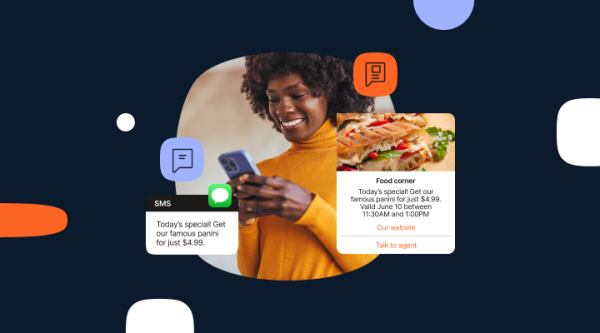
Here is how RCS upgrades the experience for businesses:
- Trust and verification: Every business sender must be verified. When a message arrives, it displays the brand’s official logo, name, and a verified checkmark.
- Customer experience: RCS supports sending rich media, such as high-resolution images, videos, and carousels (swipeable cards) directly in the chat, keeping users immersed without forcing them to open a browser.
- Interactivity: Instead of typing “YES” or “STOP,” users can tap “suggested actions” like “confirm appointment” or “view map.”
- Analytics: Unlike SMS, which only tracks delivery, RCS provides app-level analytics, including read receipts and button clicks.
Mainstream adoption and Apple’s entry (2022–2024)
If the previous years were about building infrastructure, 2022 to 2024 were about reaching critical mass.
By 2022, there were over one billion RCS users worldwide. Google Messages had firmly established itself as the primary texting app on most Android devices, and Samsung phased out its own messaging app in favor of Google’s, further unifying the Android ecosystem.
However, one major piece of the puzzle was missing: the iPhone.
The Apple announcement
For years, the “green bubble” vs. “blue bubble” divide meant that messaging between Android and iOS fell back to old-school SMS/MMS. That changed in November 2023, when Apple announced it would adopt the RCS Universal Profile.
iOS 18 launch
Apple officially released RCS support with iOS 18 in September 2024. This was a historic milestone. For the first time, iPhone users could exchange high-quality images, see typing indicators, and get read receipts when texting Android users.
Apple followed this up with the release of iOS 18.1, which introduced support for RCS for Business). This opened the door for brands to send rich, verified messages to iPhone users, effectively bridging the commercial divide between the two operating systems.
The impact of Apple’s support in Europe
France
According to af2m (the French Association for Multimedia Services), 85% of all smartphones in France are currently RCS compatible. High Android penetration had already given RCS a strong foundation, and Apple’s adoption further expands reach and accelerates enterprise usage of RCS for business messaging.
Germany
This market demonstrates the scale RCS can achieve as a native messaging channel. Research notes that RCS reach in Germany exceeds that of WhatsApp, highlighting the competitive advantage of a universal, telco-owned messaging service when it is available across device ecosystems.
RCS today and the future (2025 and beyond)
As we look to 2025, RCS is poised to become the default messaging standard for the planet.
Market growth projections
The market for rich messaging is just getting started. Research indicates massive acceleration, with total revenue expected to grow from 1.8 billion in 2024 to $8.7 billion by 2029, a staggering 370% market growth over the forecast period. This explosive growth is driven by brands shifting budget from traditional SMS to richer, interactive formats that drive higher engagement.
The Apple effect
Apple’s entry into the ecosystem is a massive catalyst. With RCS support rolling out on iOS 18 in September 2024, the update instantly expanded the ecosystem to include millions of new RCS enabled devices worldwide. This effectively doubles the addressable market in many regions, allowing brands to reach iPhone and Android users with a single, unified rich messaging strategy.
Security and technical evolution
The future of RCS is deeply focused on privacy. Google has already rolled out end-to-end encryption for RCS chats and group messages on its platform. The next frontier is ensuring this level of encryption works seamlessly across different carriers and platforms, including Apple’s implementation.
The future of customer experience is conversational commerce, and it lives in the native inbox. We are moving toward a world where customers can browse a catalog, select a seat on a flight, and pay for a purchase directly within their phone’s native messaging app. This seamless experience allows customers to complete complex transactions in their default inbox without ever needing to download or log in to a separate application.

The opportunity for brands
As adoption grows, RCS for Business is set to become the default standard for brand interactions, replacing the friction of apps and the insecurity of SMS.
- Native functionality: Customers will expect to browse catalogs, book appointments, and pay for purchases entirely within the messaging app, no third-party downloads required.
- Verified trust: With the Verified Sender feature ensuring authenticity, RBM will likely become the primary channel for high-value communications, replacing unsecured SMS for banking alerts and transaction confirmations.
FAQs about the history of RCS
RCS originated in 2007 as the Rich Communication Suite initiative led by telecom operators. It officially came under GSMA management in early 2008, with the first specification released on September 15, 2008.
The RCS Universal Profile, introduced in 2016, is a standardized framework by the GSMA that ensures all carriers and devices support the same set of RCS features.
Early RCS adoption was slowed by fragmented carrier implementations, lack of interoperability, and limited device support before the Universal Profile unified the standard.
Apple announced support for the RCS Universal Profile in November 2023 and officially rolled it out to iPhone users with the release of iOS 18 in September 2024.
RCS is designed to be the modern successor to SMS, offering richer features and better security. However, it is not an immediate replacement; SMS will continue to exist as a universal backup channel for devices or networks that do not yet support RCS.
If you use a provider like Infobip, you can set up a failover to SMS option. This ensures that if the RCS message fails to deliver, a standard SMS is sent instantly as a backup.
Use RCS through Infobip to reach everyone, everywhere
You have seen the history, now be part of the future. Discover how RCS is reshaping global communication by turning every native inbox into a rich engagement platform.