



Messaging Trends 2026
20 years of
business messaging
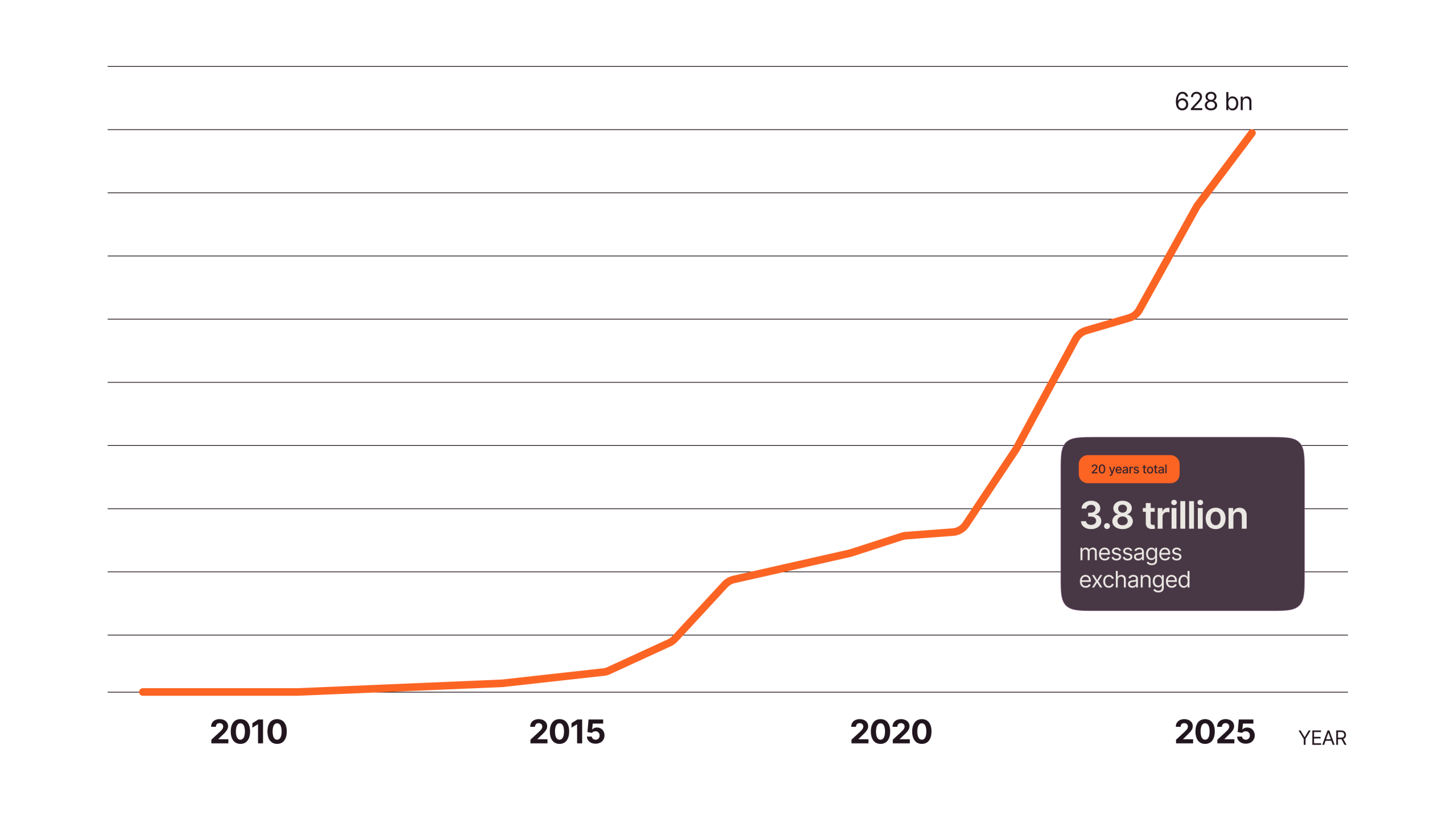
In the year that Infobip turns 20, we have decided to mark the occasion by exploring two decades of messaging trends based on real data from our platform. From one-way, low-sophistication messaging to conversational interactions orchestrated across multiple channels and supported by AI.
Learn about the long-term trends that have shaped how brands communicate with their customers, and what the next major step in B2C messaging will be.
20 years
3.8 trillion
messages exchanged

The early messaging boom
In the mid-to-late 2000s, mobile messaging was limited in scope. Businesses used it mainly for simple notifications or one-way alerts, treating it as a supplement to email and voice calls rather than a central communication method. Interaction volumes on our platform were measured in millions, not billions, and adoption was variable across industries and markets.
That changed as businesses discovered the benefits that a mobile-first messaging strategy could deliver:
- Direct reach
- Immediate delivery
- High engagement rates
As use cases expanded beyond basic notifications into transactional messaging, authentication, and service alerts, our platform data started to grow strongly and we saw the first signs of the trends that dominate B2C messaging today.
The pandemic-driven acceleration
Between 2020 and 2022, messaging increased exponentially, with annual interactions more than doubling on digital channels, including WhatsApp, Messenger, Apple Messages for Business, social media interactions, and AI-enabled conversations.
COVID-era digital transformation forced immediate adoption across industries that had previously relied on in-person or phone-based communication. Our healthcare customers shifted from paper reminders and manual calls to digital appointment notifications and test result updates. Remote work and eCommerce created massive increases in authentication requests, delivery alerts, and customer support interactions. Evolution that might have taken a decade under normal circumstances, happened in just months.
Total Infobip interactions
This period established lessons that still shape messaging strategy today:
- Delivery consistency builds trust
- Global reach requires strong routing infrastructure
- Reliability matters when customer experience is at stake

SMS shows resilience and long-term growth
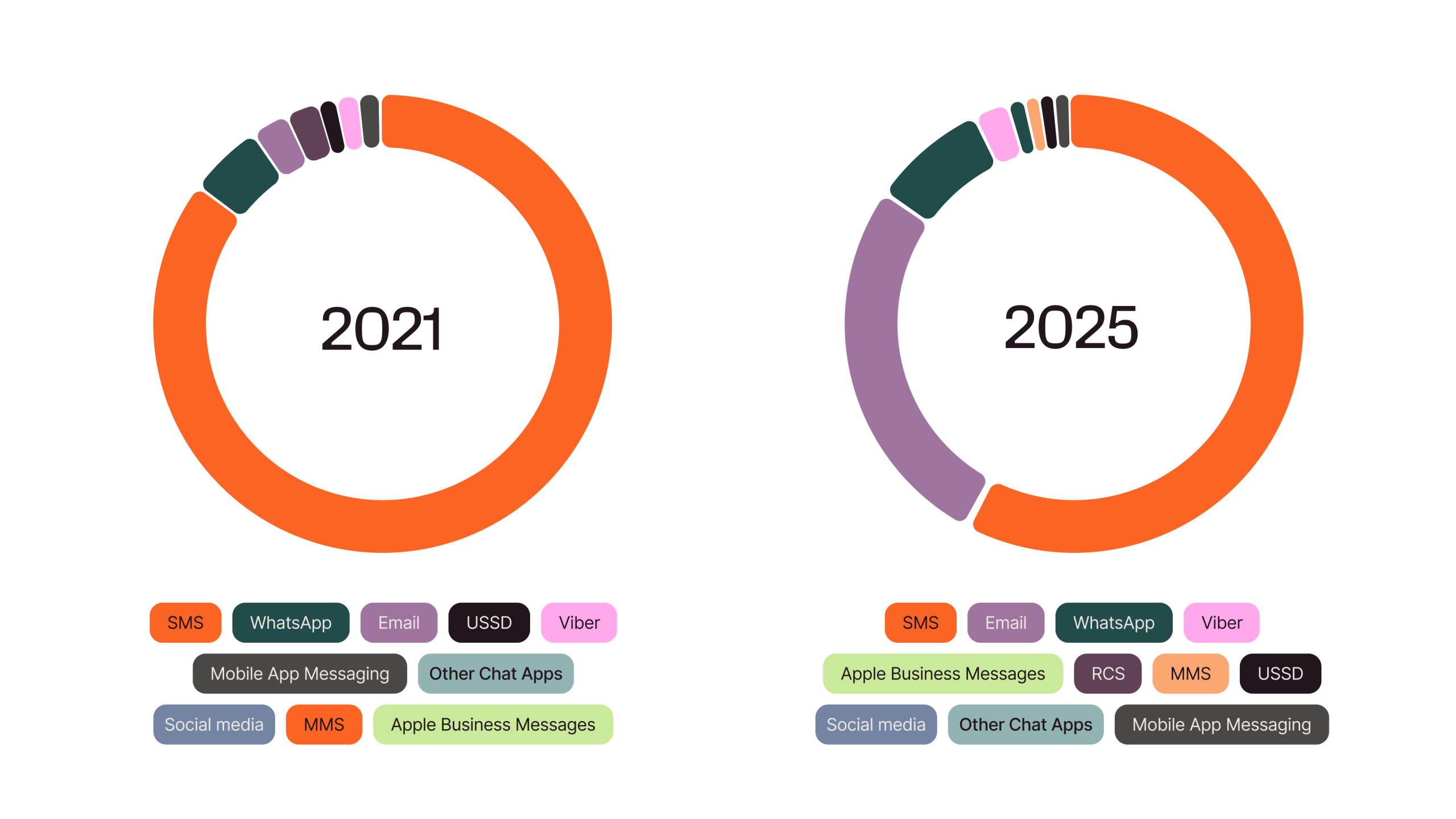
Ten years ago, SMS represented 99% of our platform traffic. Today, while it remains a key pillar channel for almost all of our customers, and message volumes continue to grow, SMS now accounts for 62% of the traffic on our platform.
Rather than signaling a decline in SMS as a B2C channel we are seeing it used alongside digital channels like WhatsApp, Viber and Messenger, and other messaging channels like RCS.
Global messaging interactions
The primary use cases for SMS reflect the channel’s strengths of reach, reliability, and trust. It is the chosen channel when brands need to deliver high‑priority information quickly and clearly; one‑time passcodes, urgent service alerts, delivery updates, and time‑sensitive updates.
When implemented as part of an omnichannel strategy alongside email, RCS, and digital channels – all augmented by AI, SMS will continue to play a key role for the foreseeable future.

Email refuses to fade – and scales instead
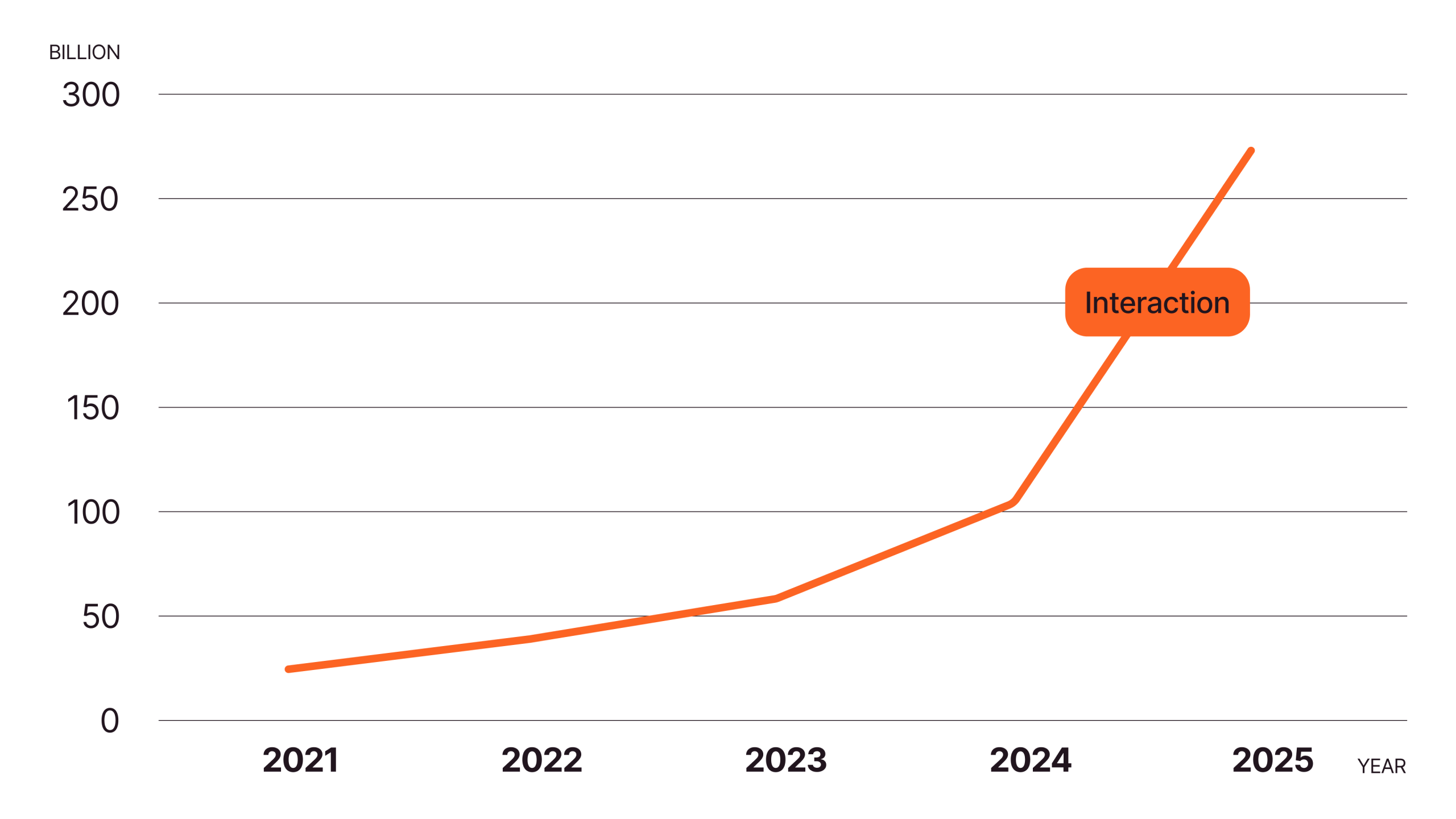
In the past decade email has experienced a transformation from under-measured technology to a highly effective, API-driven interaction channel. While email has been common in regulated industries, long-form communication, and B2B contexts for decades, its growth accelerated sharply after 2020 when it became fully API-driven, automated, and measurable.
We have seen the steepest acceleration between 2023 and 2025, when interactions increased nearly 5x as businesses integrated email into automated customer journeys, lifecycle messaging, and AI-driven personalization.
Financial services, insurance, and healthcare companies rely on email for compliance-driven messaging, detailed correspondence, and formal customer communication that requires permanence and structure – use cases where auditability, and content depth matter most.
Email growth
WhatsApp: The fastest-growing conversational channel
After WhatsApp Business launched in August 2018, we were quick to help our customers adopt the channel. Global volumes grew a staggering 8x from 2019 to 2020, then 2.7x between 2020 and 2021 as eCommerce use cases expanded during the pandemic, and businesses in regions where WhatsApp is popular used the app to facilitate more conversational interactions with customers. Any use case where two-way interactions and media sharing created better experiences was a sweet spot for the app.
Even today we are still seeing double digit growth, with a 15% increase during 2025, making it one of the fastest-scaling channels on our platform.
As a functionally rich messaging app it was also one of the key channels that businesses used to deploy chatbots, a trend that continues today.
Conversational AI WhatsApp interactions
| Conversational AI | |
|---|---|
| 2023 | Top channel WhatsApp 91% |
| 2024 | Top channel WhatsApp 91% |
| 2025 | Top channel WhatsApp 91% |
RCS: Closing the gap between SMS and app messaging
After Infobip launched its RCS service in 2018, the channel scaled steadily over the following years, with the strongest growth in India. Growth patterns fluctuated as infrastructure matured, until the key moment when Apple started to support RCS on its devices with the release of iOS 18 in 2024.
Following the rollout, global RCS traffic grew fivefold, with North America seeing message volumes rise by 14x in 2024 and a further 70x in 2025.
For RCS to grow in a region requires a high proportion of RCS-ready handsets and carriers to support the channel. This process has been slow to kick off in some countries, where SMS continues to dominate.
If you look at digital channels which support a conversational approach to B2C messaging, we can see how RCS has gained ground.
Global conversational channel share comparison
| Channel | 2023 share | 2025 share |
|---|---|---|
| 87.9% | 77.3% | |
| RCS | 1.0% | 13.1% |
| Viber | 10.2% | 8.7% |
| Social media | 0.2% | 0.1% |
| Other chat apps | 0.7% | 0.8% |
Voice and Video: The channels for human-to-human interactions
Voice and Video interactions generate lower volumes than text-based channels but deliver disproportionately high value per interaction. Telecom contact centers, healthcare providers, and enterprise support teams rely on voice and video for complex problem resolution, consultations, and scenarios requiring human judgment.
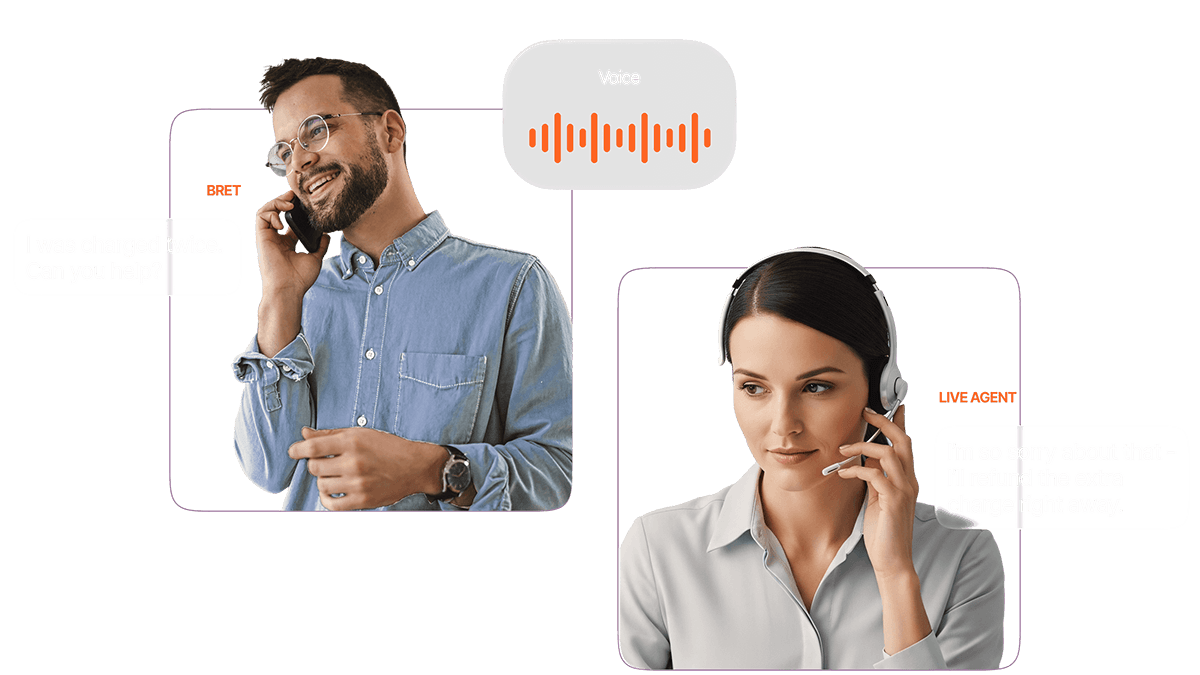
The pandemic revitalized Voice and Video as B2C channels with interactions growing 15x between 2021 to 2025, driven by remote work, virtual support needs, and telehealth. This wasn’t a temporary adoption. By the end of 2025, voice and video interactions had established real-time communication as a standard part of customer support and service delivery. These interactions are now initiated and orchestrated through messaging platforms rather than operating independently, making them a key part of integrated customer journeys.
From multichannel to true omnichannel
We define true omnichannel communication as using multiple channels to interact with customers in an orchestrated way so that they enjoy a consistent, seamless, and contextually relevant experience.
This requires all channels to be managed from a single platform, based on the same CDP (Customer data platform), with no data or channel silos.
This is difficult to do and, in the past, required significant investment and development work as each channel had a unique set of features and API.
With the release of our unified Messages API developers are now able to use one API and a single endpoint for all of the channels they want to incorporate, rather than a separate API for each one. Channels like SMS, email, and WhatsApp still support unique features, but the features that they share are now unified in a single API.
This makes it much easier to adopt true omnichannel communication, and the recent uptake from our customers has been significant.
Our data confirms that what started as ‘adding more channels’ evolved into strategic orchestration, where success came from coordinating channels intelligently rather than simply deploying more of them.
In the Omnichannel revolution section of the report we show how in a matter of years, the traffic on our platform has reflected this shift with 97.7% of traffic now sent by customers who use multiple channels,
and 4 channels being the most common number used in terms of traffic volumes.
There are still a large number of small and medium sized businesses that use one, two, or three channels with us, but the enterprise global brands that we work with have fully embraced omnichannel communication.

How is AI turning messaging into an engagement engine
Chatbot interactions increase 40x in 5 years
After the launch of our chatbot building platform in 2020, we have seen both volume of interactions and the sophistication of chatbots increase exponentially. In only five years we have moved from simple AI in the form of guided chatbot flows, to conversational and generative AI, and with the launch of our Agentic AI platform we are seeing the next phase of the evolution.
The four-phase evolution of AI-driven engagement
Phase 1: Early adoption (2020–2021)
AI-driven interactions on our platform grew over 7x from 2020 to 2021 as businesses moved quickly to handle digital demand. Early chatbots were basic, handling common questions via simple rule-based flows, but they proved that automation could handle volume while maintaining service quality.
Phase 2: Expansion (2022)
Interactions grew 2.5x from 2021 to 2022 as better natural language processing (NLP) and intent recognition made chatbots more capable. Businesses moved to handling order status, appointment scheduling, and billing inquiries. In this phase, chatbots became production-ready infrastructure, generating measurable ROI through reduced contact center costs.
Phase 3: Mainstreaming (2023)
Interactions grew 1.6x from 2022 to 2023 as chatbots began handling end-to-end flows including tracking, booking changes, and even payments. With global and multilingual deployments, enterprises began relying on chatbots for real transactions, proving automation could generate revenue in addition to saving costs.
Phase 4: Maturity in progress (2024–2025)
Growth moderated to 1.16x from 2023 to 2024 and 1.14x from 2024 to 2025. This signals market maturation: focus is moving from interaction volume to resolution efficiency, conversation quality, and intelligent escalation.
Industries focus
Industries with high-volume, repetitive interactions have benefited most from AI-driven conversations:
| Industry | Use cases | Impact |
|---|---|---|
| Finance | Balance inquiries, transaction alerts, fraud verification | 24/7 self-service reduced call center volume by handling high-frequency, low-complexity requests |
| Retail | Order tracking, return processing, product recommendations | Chatbots handled post-purchase anxiety (Where’s my order?) and enabled conversational commerce at scale |
| Telecom | Billing questions, plan changes, service troubleshooting | Automated the highest-volume support requests, freeing agents for retention and upsell conversations |
| Healthcare | Appointment scheduling, prescription refills, test result notifications, symptom triage | Reduced administrative burden on staff while improving patient access to care and reducing no-show rates |

Hrvatski Telekom: Leveraging partnership to build AI-powered conversational support solutions for telco customers.
20%
62%

Megi Health Platform: Optimizing patient care with an interactive chatbot built using Infobip Answers.
86%
65%
{{title}}.
{{meta.stats[0].number}}
{{meta.stats[1].number}}
{{meta.stats[2].number}}
What 20 years of messaging reveals about the next phase
Over the past decade we have seen businesses change their approach to use the channels that customers prefer. Every country has its preferred messaging apps and unique way of communicating. Global businesses must adapt.
The future of business messaging won’t be defined by channel replacement, but by smarter orchestration: selecting the right channel for each moment, maintaining continuity across touchpoints, and measuring what drives real outcomes rather than just what generates volume.
The businesses that s쳮d in the next decade won’t be those sending the most messages, they’ll be those driving conversations that customers want to be involved in, that drive real outcomes, and that build stronger relationships over time.
There is no doubt that agentic AI will play a key role in enabling this process on a scale and across all channels. Our AgentOS platform is designed to orchestrate AI-driven customer interactions across workflows. It turns messaging from high-volume outreach into a precision engagement system where every interaction is measurable, optimizable, and designed to create long-term customer value.
AgentOS represents where we are going as an AI-first organization. It will define not only the next 20 years of our business but how the entire messaging eco-system evolves.
We are just starting.
Shape the future of messaging with us
Our custom solutions help businesses like yours lead the way.