
A complete guide to Viber chatbots and how to build one in 2025

Join us for an introduction to Viber chatbots, including key features, what they can be used for, and most importantly – how to build one without needing to be a developer.

Skip to table of contents

Viber is a messaging app that in 2025 is used by over 1 billion people globally and is the most popular app in several significant markets including Philippines, Bulgaria, and Greece. Brands that operate in the regions where it is popular have recognized the value of incorporating the app into their business communication – and this includes deploying chatbots on the channel.

Viber bots are a great way for businesses to reduce the cost of customer service, boost engagement and retention with bold marketing campaigns, and automate a lot of transactional messages. They allow brands to offer around-the-clock service without the overhead of human staff. In this blog we cover everything you need to know to design and build a Viber chatbot, with step-by-step instructions that anyone can follow.

The types of Viber chatbot that you can build

There are two main types of chatbot, each with its unique strengths and features:

  • Rule-based Viber chatbots: These chatbots provide a pre-configured menu of options for users to select from. They are the quickest and easiest to set up but can be incredibly useful for answering day-to-day queries that customers would previously have called a contact center to answer. Anything from store opening hours, product availability, and account balances can be provided via a simple set of options.
  • Intent-based Viber chatbots: These are more sophisticated chatbots that can be designed to provide a more conversational experience for people interacting with them. They take longer to build as they use natural language processing (NLP) and need to be ‘trained’ to understand multiple words and phrases and user intents. However, they can be incredibly flexible and a real asset to any business that wants to showcase its creativity and market leadership.

Matching chatbot type with use case

To help you choose the best type of chatbot for your use case we have expanded on the types of chatbot and what they can be used for. This should help you choose the right tool for the job and avoid over-engineering the solution.

Static informational bots

You might consider these automated responses rather than chatbots as they don’t support what we would consider two-way chat. However, they can be very useful in providing information or directing customers to another channel when there isn’t a person available to reply to a message. For example “Thank you for your message. Our store is closed right now, but you can explore our website to find and purchase the products that you are interested….

Interactive Viber chatbots

These chatbots flex the strengths of rule-based chatbots to enable two-way communication with users using workflows that are simple to build, but also incredibly useful and flexible. The user chooses options via a guided set of menu options that can include buttons, and quick replies.

They can be used effectively for all sorts of use cases including providing answers and gathering information from the customer in a secure way, for example Gender, Number of dependents, Preferred check-in time and any data point that can be provided via a set of options or free text field.

Transactional Viber chatbots

By integrating your Viber bot into your operational systems means that you can use it for a host of transactional use cases. Enable users to complete actions like booking appointments, placing orders, or making even making payments via integrations with payment systems like Google Pay, Apple Pay, and other local alternatives.

Conversational AI Viber chatbots

Use NLP and machine learning to enable natural conversations over the Viber channel. These chatbots can really chat by understanding intent and provide contextual responses. They are most suitable for advanced customer support or conversational marketing use cases.

How to build a Viber chatbot in 6 simple steps

If you would like to try building your own Viber chatbot you can register for a free account on our website and request a demo by clicking the following option:

Screen shot from the self-service portal showing the option for requesting a demo

You can then request access to our chatbot building platform where you can follow these simple steps to create a working Viber chatbot in under half an hour.

Step 1 – Getting started

Once you have logged into your new account, select the Chatbots option from the menu on the left.
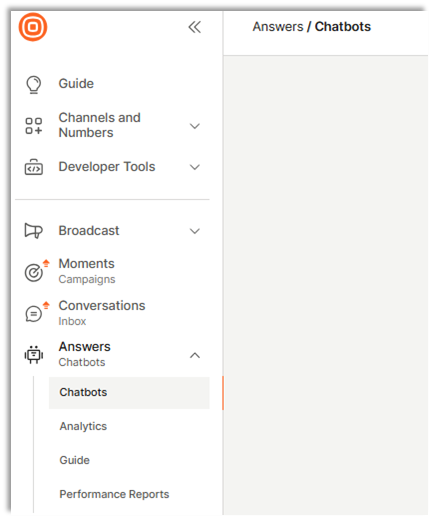
Screenshot from the portal interface showing how to select the build chatbot option

Click Create Chatbot and then Start from Scratch.

Give your chatbot a name and select Viber from the dropdown menu (depending on your region, you may need to ask your Infobip account representative to add Viber to your account).
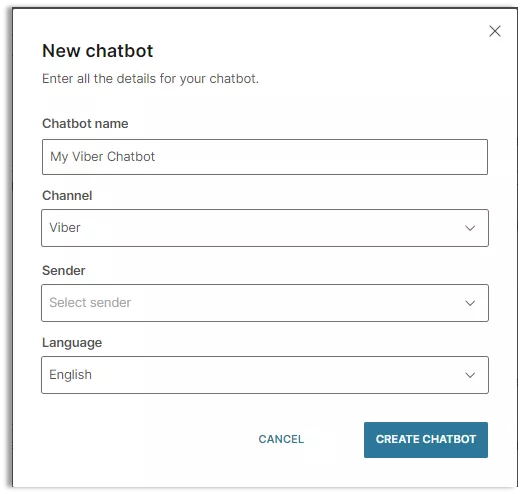
Screenshot from the portal interface showing how to name your chatbot and choose Viber as the channel.

This will open the main chatbot builder canvas.
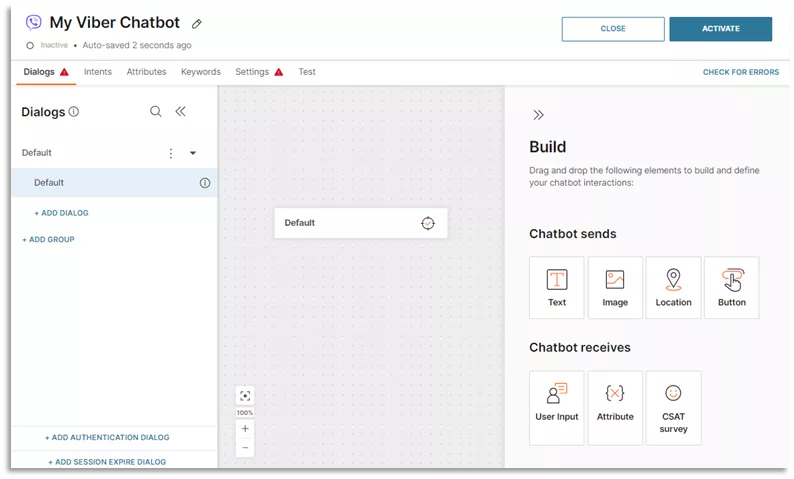
Screenshot from the portal interface showing the main chatbot building canvas

The Build section on the right of the screen has a set of tools that can be used by dragging and dropping them onto the workspace. You can use these to build up the structure and flow of your automated Viber chat.

The tools (called elements) are separated into three categories based on their function – but they all work in exactly the same way: Drag onto the workspace > Configure > Link to conversation flow.

You will get the hang of it really quickly once you start using them.

Step 2 – Add a welcome message

Every good conversation starts with a friendly greeting, right?

Drag and drop a Text element onto your workspace from the Chatbot sends menu.

You can then add some welcome text and maybe a question to kick off the engagement. Any answers that the person provides can be saved and used later in the chat, so they don’t have to keep repeating basic information like name, account number, or postcode.

Everyone is different and uses language in a slightly different way so there will always be times when the chatbot can’t quite understand what the person has asked, or maybe they have foreign characters on their keyboard. This is when the Repeat and Fallback options can be used to provide a more seamless experience.
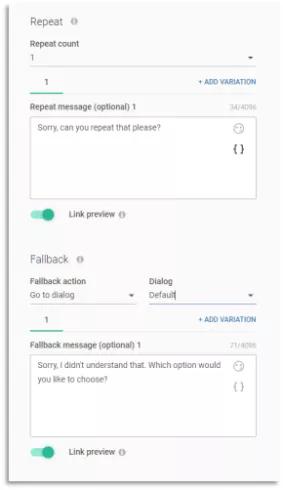
Screenshot from the portal interface showing how to set a fallback option

Step 3 – Display options for users to select

By providing a set of options for users to select from, the chatbot can answer increasingly complex queries with cascading sub-menus.

Our example will only have one set of options, but you can go as deep as you like by following the same process.

Add a Send Text dialogue that asks the person to make a selection from the list that we will configure in the next step.
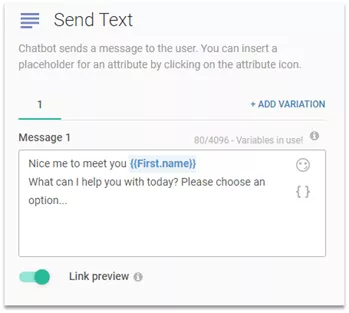
Screenshot from the portal interface showing how to configure the Send Text dialogue.

Next, you need to link the introductory text to the list of options by adding a Go To Dialog element and then a Text element to introduce the menu and specify the list of options it will contain.

It is a really good idea to use the Delay option to provide a bit of time for the person to read the text you are displaying and make a decision on what they would like to do. You’ll find it under Bot Actions.
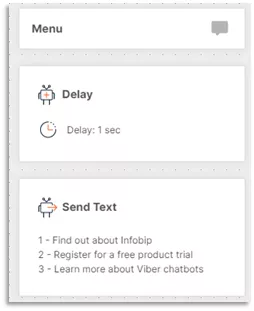
Screenshot from the portal interface showing how to configure a Delay.

The next step is to add a User Input element (you can find it under the Bot Receives menu). This will process the response that the person replies with. You can add Synonyms to handle multiple forms of response and make the chat more flexible.
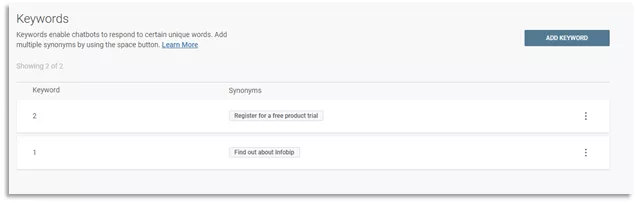
Screenshot from the portal interface showing how to configure keywords.

Step 4 – Link responses to actions

You will then need to create an Action for each of the options that the user might choose. This can be done by configuring a Go To Dialog for each option.

You can be extra creative when creating your actions by including rich media like image carousels and videos for added engagement possibilities.

  • If your customer requests the address of their nearest store send them the geolocation using the Location attribute.
  • If a user requests information about one of your products, why not send them a video.

To do this you just drag the relevant element onto the workspace and link or upload the media you are sharing.

Step 5 – Time to say goodbye

The final step in the build process is to configure a seamless exit path from the chat.

Once you have confirmed that the person has got what they came for you can sign off the chat or loop them back to the menu of options.

To close and reset the chatbot interaction add a final Close session attribute. This can also optionally delete any saved data – or it can be copied to your customer database to enrich future interactions with the person.
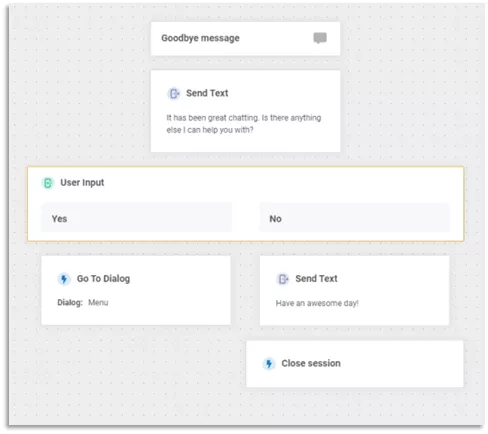
Screenshot from the portal interface showing how to configure a goodbye message to sign off from the chat.

Step 6 – Testing

It is always a good idea to make use of the Simulation option to thoroughly test your chatbot before you deploy it. Ask colleagues or friends to try it out too as fresh eyes often find issues or inconsistencies that the creator didn’t see.
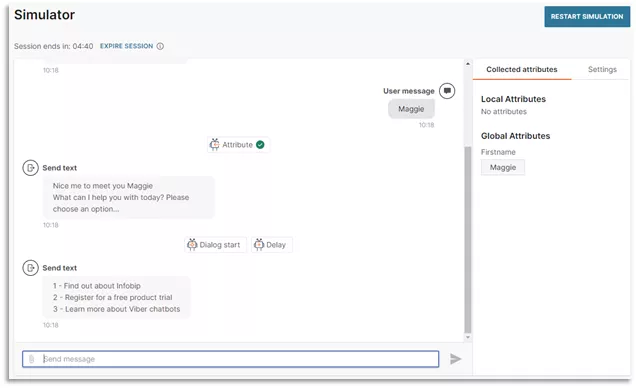
Screenshot from the portal interface showing how to test your Viber chatbot.

When it is time to deploy your chatbot, just click Activate and it will be live!

This is basic example of a rule-based chatbot. Using the same methodology, you can go on to create highly sophisticated Viber chatbots that use natural language processing to understand customer intent to facilitate more conversational chat interactions.

Check out the following video which shows how to incorporate elements of gamification into your Viber bot to boost engagement with your customers.

Viber chatbot integration options

For businesses to get the most value from the Viber channel it makes sense to integrate it into their existing communication stack so that it can work alongside other channels like SMS and email. With Infobip there are a number of integration options:

1. Add Viber chatbots to your cloud contact center

With a cloud contact center, you can ensure a connected and consistent experience
and provide the same level of service no matter how customers get in touch, including via your Viber chatbot. Backed with a customer data platform both agents and chatbots always have access to the customer history and context they need to resolve issues quickly.

2. Create a unified messaging platform

Our Messages API is the ideal solution for businesses that want to use Viber chatbots and Viber Business Messages, and other messaging channels with a single unified API. Since Viber Business Messages is based on the recipient’s phone number and Viber Bots is ID based, both audiences can be covered with a single integration.

3. Add Viber chatbots to your own communication stack

The Viber chatbot API enables businesses to integrate Viber Bots as a messaging channel into their own systems. With Infobip, they can continue to use the channel after the free message limit has been exceeded.

Viber chatbot pricing

We strongly recommend that you use the calculator on our Viber pricing page to work out precise costs for your region, volumes, and use cases.

The following are general guidelines and do not constitute a formal quote.

  • There is no charge from Viber for building and deploying a chatbot, but there is a monthly maintenance fee of about €100 under the new commercial terms.
  • Welcome Messages that you can automate when a person first initiates a chat with your app are.
  • After a person initiates a chat, subsequent session messages are free within a 24-hour window.
  • Chats that are initiated by a chatbot are paid when sent outside an active session.
  • Businesses get 10,000 free outbound messages per month, then pay per message based on the recipient’s country.

FAQ

Keep reading:

Get the latest insights and tips to elevate your business

By subscribing, you consent to receive email marketing communications from INFOBIP. You have the right to withdraw your consent at any time using the unsubscribe link provided in all INFOBIP’s email communications. For more information please read our Privacy Notice

A complete guide to Viber marketing for business growth

Discover how Viber marketing delivers engaging, personalized customer experiences through rich promotions, automated support, and secure notifications.

Razan Saleh Group Content Marketing Manager
Skip to table of contents

Viber continues to be one of the most influential messaging apps in 2025, especially across Eastern Europe, the Balkans, the Middle East, and parts of Asia where it remains a top communication channel.

With more than 1.2 billion registered users worldwide and incredibly high engagement where 90% of messages are opened in the first three minutes, Viber offers brands a powerful opportunity to reach customers with timely, personalized communication.

As customer expectations shift toward richer, conversational experiences, Viber marketing offers businesses a way to increase engagement, boost loyalty, reduce support workload, and ultimately drive measurable revenue

In this guide, we’ll walk through everything you need to know to build an effective Viber marketing strategy: how the channel works, who it’s best suited for, the message types available, practical setup steps, proven marketing tactics, and how to measure success.

Viber customer engagement header image

What is Viber marketing? 

Viber marketing refers to using Viber Business Messages to promote products or services, drive leads and communicate with customers through targeted, personalized, and often automated messages.

Features like chatbots, branded stickers, carousels, and list messages provide multiple opportunities for brands to engage with customers and enhance their experience. 

Unlike personal Viber chats, business messages come from a verified sender and support:

  • Rich media (images, buttons, video)
  • Transactional updates
  • Promotional campaigns
  • Conversational and chatbot-based communication
  • Advanced formats like list messages, carousels, and OTP messages

It’s a high-trust, opt-in channel designed to help brands deliver the right message at the right moment.

With such wide usage and versatility, Viber marketing can support many different industries. Let’s look at the benefits of using the channel.

Benefits of using Viber marketing

Globally, more than 8,500 brands are already using Viber Business Messages to engage with customers, and the list is growing. Viber’s strongest markets and rich feature set make it ideal for industries that rely on real-time, personalized communication.

Here’s why Viber stands out as a core messaging channel for banks, retailers, and enterprises looking to build meaningful customer relationships: 

  • Massive reach: Over 1 billion users globally, with a high penetration rate in key markets and demographics (63% of users are aged 25–50). 
  • Higher engagement: Messages land directly in customers’ personal chats, with higher open rates than traditional email or SMS. 
  • AI chatbots for smarter engagement: Harness the power of AI to automate responses, personalize recommendations, analyze customer behavior, and optimize campaigns in real time, driving better results with less manual effort. 
  • Rich experiences: Go beyond plain text. Use visuals, quick replies, lists, and carousels for two-way, interactive journeys. 
  • Viber calls: Enable customers to make free voice calls directly within the Viber app, providing seamless, real-time support without any cost to the end user. This enhances customer convenience and speeds up issue resolution. 
  • Security & trust: Viber is end-to-end encrypted, helping you build trust for sensitive interactions like banking and retail purchases. 
  • Cost-effective: Especially for OTPs and notifications, Viber’s pricing is often more favorable than SMS. 
  • Brand recognition: Verified business accounts, branded sender IDs, and customizable profiles reinforce your company’s identity. 

By making Viber an essential part of your customer engagement strategy, you meet your customers where they already are and, on their phones, in real time, with experiences they’ll remember. 

Once you know Viber is the right channel, the next step is understanding the message formats you can send and how each one works.

Types of Viber business messages 

Viber is all about helping brands keep up with customer expectations while delivering secure, convenient, and rich conversational interactions. Here are five different message types that you can use depending on your marketing goal:

1. Conversational messages

Conversational messages enable two-way communication between businesses and customers. They allow users to reply directly, ask questions, request assistance, or engage with a chatbot for guided support. This message type is ideal for customer care, booking changes, product inquiries, and personalized recommendations.

2. Promotional messages

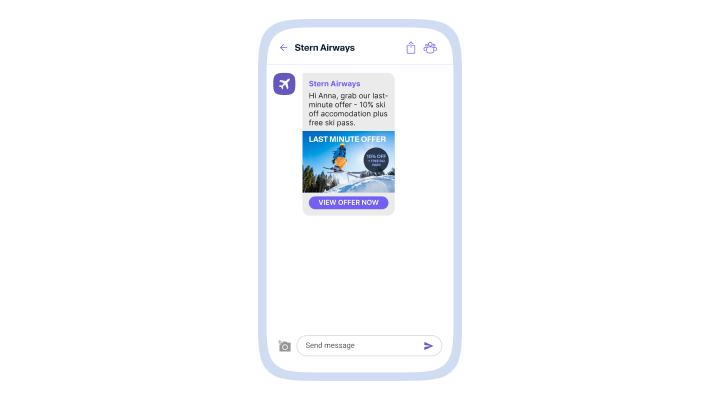
Promotional messages allow businesses to send targeted offers, announcements, and marketing campaigns directly to opted-in customers. These messages support images, emojis, buttons, and concise text, making them ideal for sharing flash sales, seasonal promotions, product launches, or loyalty rewards.

Chat screen from Stern Airways with a promo card: “Last minute offer—10% off ski accommodation plus free ski pass,” and a “View offer now” button.

3. Transactional messages

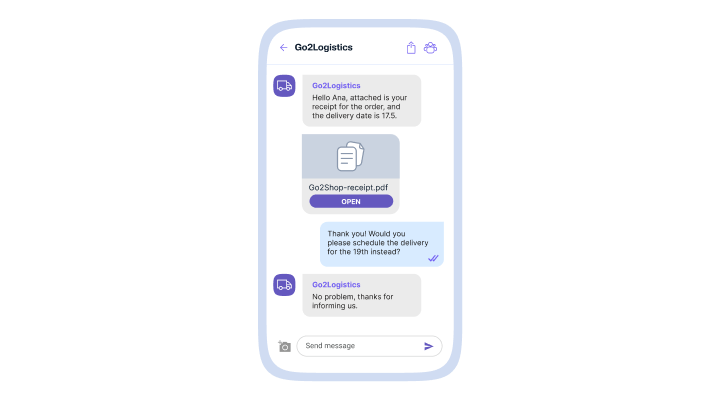
Transactional messages deliver important, time-sensitive information customers expect to receive. This includes order confirmations, delivery updates, appointment reminders, payment alerts, and account notifications. Because they’re highly relevant and anticipated, transactional messages typically achieve exceptionally high open and engagement rates. 

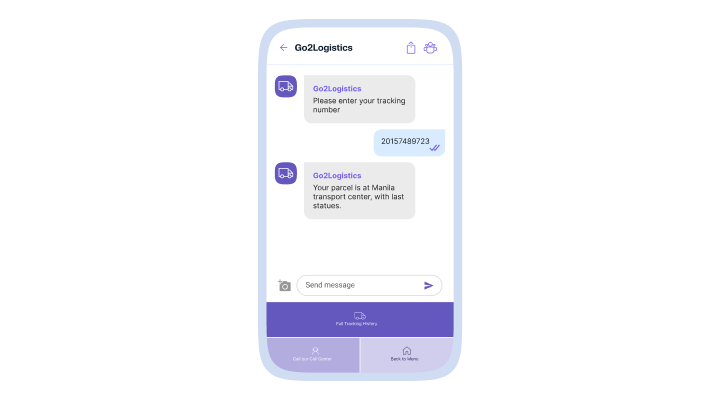
Go2Logistics chat asks for a tracking number; user enters 20157489723; reply says the parcel is at the Manila transport center, with status. Bottom bar shows Full Tracking History, Call and Contact Center, and Back to Main Menu.

4. List messages

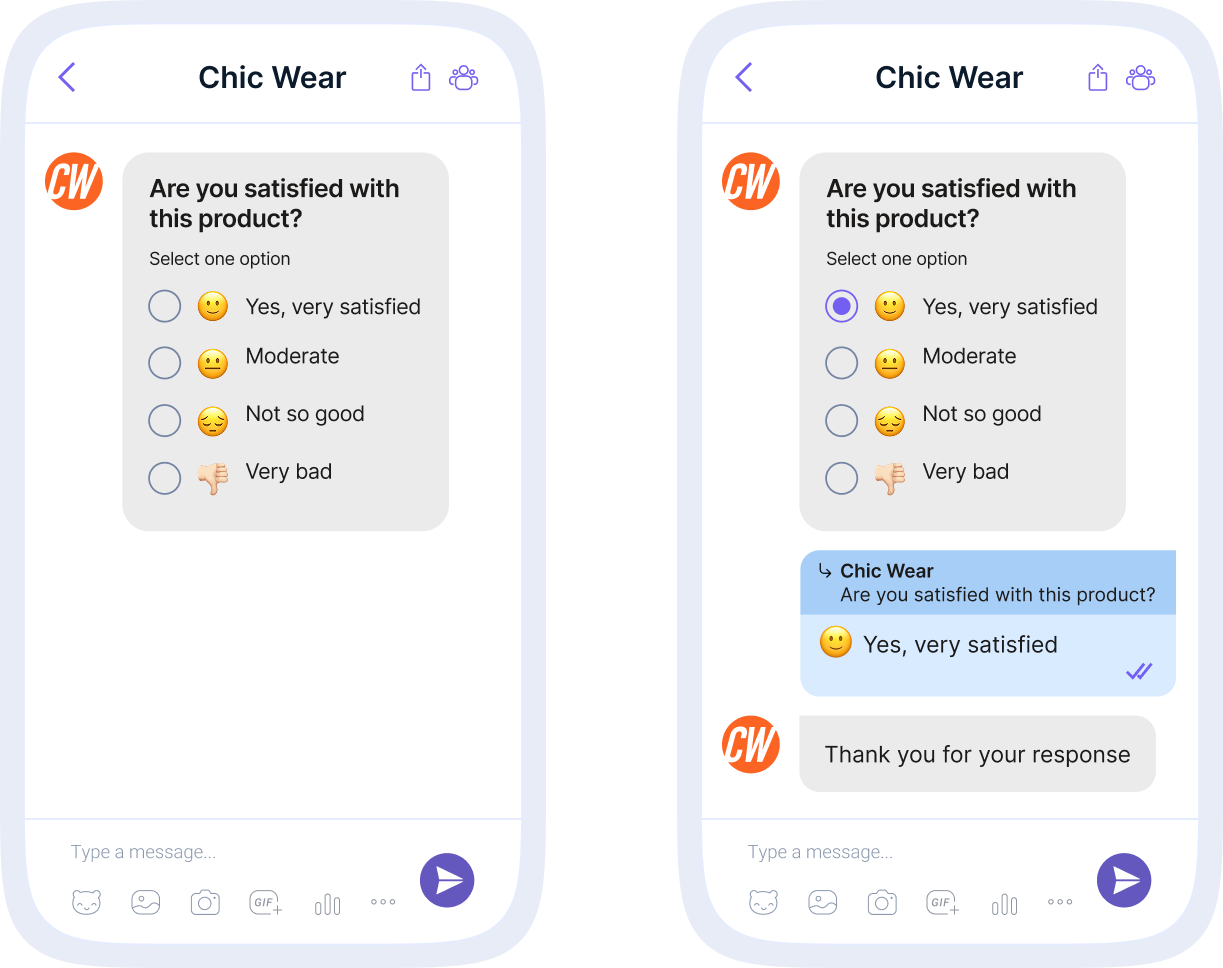
List messages offer users up to five predefined choices they can simply tap for quick responses, perfect for actions like confirming bookings, scheduling deliveries, or collecting feedback. When a user makes a selection, their choice is sent as a message, enabling businesses to reply automatically. 

Viber list messages

5. Carousel messages

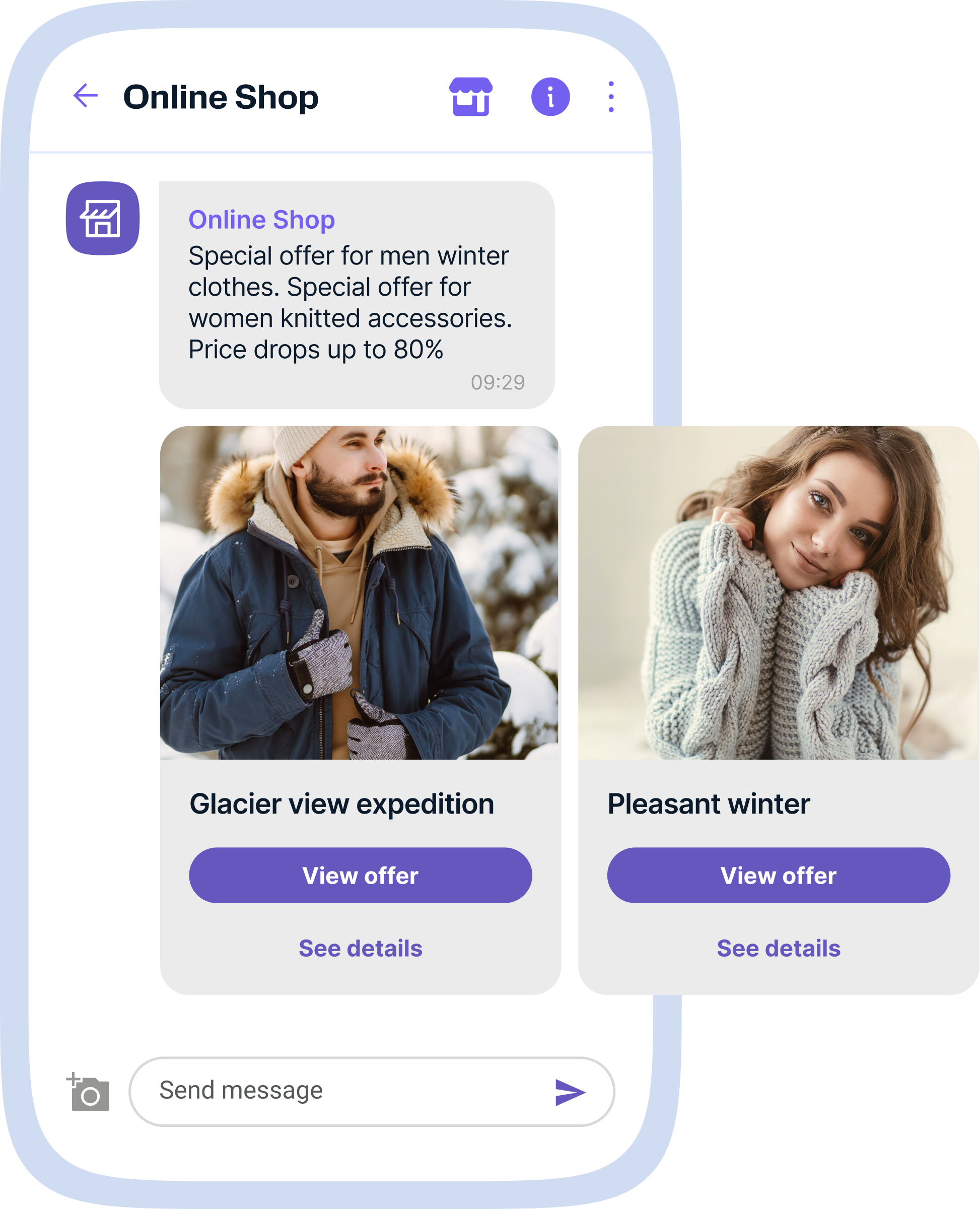
Carousel messages enable businesses in any industry to display up to five swipe-able cards within a single message. Each card can feature an image, text, emojis, and up to two call-to-action buttons that link directly to a website or online store. This format is ideal for sharing bundle deals, product recommendations, special offers and new arrivals, making it easy for users to explore and engage with what interests them most.  

Viber Carousel Messages

6. OTP messages

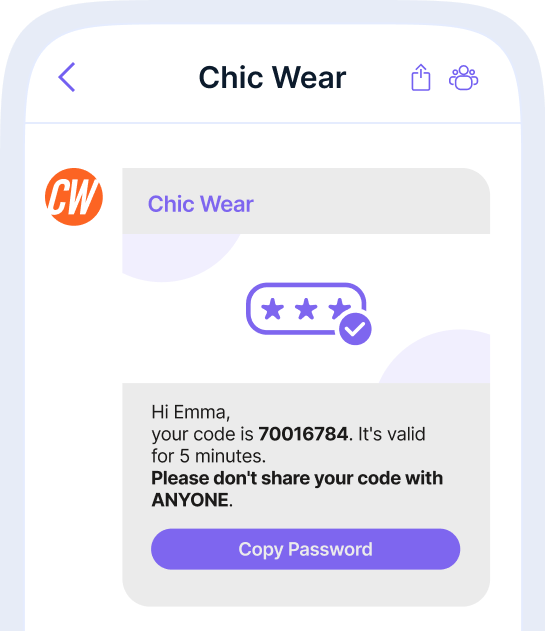
OTP Messages enable a secure and straightforward way to verify users and complete transactions. They help reduce fraud and strengthen customer confidence with fast, dependable code delivery. With Viber’s rich messaging capabilities, OTPs can include clear instructions and branding, making the authentication process smoother and more user-friendly.  

Viber OTP messages

Getting started with Viber marketing

Setting up Viber for business is simple and can be done in a few steps.

1. Choose an official Viber partner

Working with an official partner like Infobip ensures smooth onboarding, verified sender IDs, message approval processes, and access to rich templates. Choose an official Viber partner

2. Register and verify your business profile

Verification helps customers immediately recognize your brand and ensures your messages meet Viber compliance guidelines.

3. collect user opt-ins

Consent is crucial for compliance and engagement. You can collect opt-ins via:

  • QR codes
  • Website forms
  • App onboarding flows
  • Call center deflection
  • SMS-to-Viber migration campaigns

4. Connect via API or platform tools

Use Infobip APIs or no-code tools and solutions such our customer engagement solution, cloud contact center and chatbot builder to craft campaigns and automate journeys.

5. Set fallback options

If a customer is not on Viber, messages can automatically fall back to SMS ensuring full reach for critical notifications.

With the technical setup complete, the next step is designing a strong, strategic marketing approach.

Crafting an effective Viber marketing strategy

Building a successful Viber marketing strategy is not only about choosing a message type but also using the channel intentionally to support broader customer experience goals.

A successful Viber marketing strategy blends personalization, segmentation, and creative storytelling to build journeys that feel timely, relevant, and genuinely helpful.

Here are a few steps of how you can get started:

  1. Segment your audience by grouping customers based on how they shop, browse, or interact with your brand so each group receives content that matches their needs.
  2. Tailor messaging for each segment, recognizing that first-time buyers, loyal customers, and different product interests require different approaches.
  3. Personalize each message by using details like names, recently viewed items, or active orders to create continuity and make communication feel relevant.
  4. Use strong, direct calls to action so customers immediately understand the next step, whether it’s viewing an offer, tracking an order, or contacting support.
  5. Maintain a consistent messaging cadence to stay visible without overwhelming users, building trust through predictable communication.
  6. Leverage rich interactive formats such as carousels, list messages, buttons, and images to make messages more engaging and guide users through their journey.
  7. Incorporate chatbots and automation to handle support, product discovery, and post-purchase interactions at scale.

With the right strategy in place, it’s just as important to follow compliance rules and best practices.

Compliance, consent and best practices

Trust sits at the center of Viber’s user experience, which means brands need to uphold high standards of consent, transparency, and relevance. Before sending any promotional content, make sure customers have explicitly opted in.

This not only ensures compliance with GDPR and local privacy regulations but also sets the stage for higher engagement because opting in signals genuine interest.

Key compliance rules

  • Always secure user opt-in before sending promotional messages
  • Strictly follow GDPR and local privacy laws
  • Ensure promotional content is pre-approved
  • Provide an easy opt-out option

Best practices for strong performance

Once a customer is subscribed, treat that permission with care. Message frequency should feel balanced, not intrusive. Here are a few best practices you can follow:

  • Provide clear value in every message
  • Use a friendly, human tone
  • Test and optimize timing, content, and formats
  • Use fallback channels like SMS to ensure messages reach customers
  • Remember to experiment as testing is a continuous process, not a one-off task

Now let’s look at what Viber marketing can achieve in real-world scenarios.

Viber marketing use cases

Secure authentication and verification (OTP messages) 

Use encrypted Viber OTPs for 2FA, transaction approval, and login verification. Compared to SMS, Viber OTPs offer: 

  • Faster delivery, lower cost, and bank-grade security. 
  • Ideal for mobile-native customers who seek convenience. 

Use case: A user logs in to a banking app and instantly receives a Viber OTP. They verify their identity securely and proceed, all without relying on SMS. 

Interactive banking menus (List messages) 

Enable customers to self-serve: 

  • Options like “Check balance,” “View recent transactions,” and “Locate ATM.” 
  • Reduces call center volume and speeds up support. 
  • Especially effective for conducting customer surveys. 

Use case: Customers are invited to vote on new banking features or services, such as “Which new feature would you like to see next? Mobile deposits, Budgeting tools, or Rewards program?” 

Promote products (Carousel messages) 

Present relevant offerings, like credit cards, loan plans, insurance, through visual, tappable carousels.

Use case: A customer receives a visually engaging carousel featuring three credit card offers, swipes to compare benefits, and taps to “Apply Now” within Viber. 

Boost conversions with visual campaigns (Carousel messages) 

Leverage product-rich carousels to highlight collections, exclusive deals, or seasonal promotions.

Use case: During a limited-time flash sale, customers receive a carousel featuring top deals; with one tap they view the product and add it to cart. 

Streamline support and orders (List messages) 

Offer order tracking, delivery options, FAQ access, and customer surveys within the chat.

Use Case: Post-purchase, a customer receives a list message asking, “How satisfied are you with your recent order?” with options like “Very satisfied,” “Satisfied,” “Neutral,” or “Unsatisfied.” The customer taps their choice, instantly submitting feedback. 

Frictionless account security (OTP messages) 

Use OTPs at sign-up or checkout to reduce cart abandonment and boost trust. 

Use case: During checkout, a Viber OTP verifies the purchase, delivering a smooth, secure experience.

Real-world success stories

To better understand how brands are using Viber in practice, let’s explore how leading businesses in the retail and finance markets have incorporated Viber Business Messages into their communication strategy. 

Primer

During the pandemic Primer wanted to provide a safe option for customers to buy the products they needed by encouraging them to purchase online rather than in physical stores. 

Viber Business Messages was key to this process. Research showed that the messaging app was heavily used by customers and provided all the tools to engage with customers in a human and empathetic way. 

  • A discount voucher was sent to customers via Viber that was only redeemable on the eCommerce site 
  • By using Viber to track which customers were active, Primer was able to focus their messaging and marketing budget on active consumers only 

The results were impressive – the brand achieved a 53% code redemption conversion rate and a 401% increase in total sales. 

NLB bank

NLB Bank in Montenegro has been a forerunner in adopting Viber as a marketing communication channel. Noting that Viber was one of the primary messaging apps used by their customers and that it ensured the security of data, they started to use it for both transactional and event-triggered messaging. 

Retaining SMS as a failover channel, the bank used the two-way capability of Viber Business Messages to promote their “Arrange a meeting” offer, resulting in a 30% increase in meeting requests compared to previous campaigns. 

By incorporating Viber into the sales process, they have also achieved a 30% increase in sales leads and 15% increase in overall sales – all attributable to the conversational experience that the app provides. 

Metrobank 

Metrobank, one of the top three banks in the Philippines, has successfully leveraged Viber Business Messages to transform its customer communication and marketing strategy.  

By integrating Viber for Business with its existing Salesforce Marketing Cloud CRM system, using Infobip’s plugin solution, Metrobank was able to quickly deploy personalized, rich media messages featuring images, videos, and interactive buttons. This integration required minimal technical resources and was set up in just two days, with live campaigns launching after a week of testing. 

Results: 

  • Up to 50% cost reduction on marketing message delivery compared to SMS, especially for detailed messages that would otherwise require multiple SMS segments. 
  • Enhanced customer engagement through rich content and personalized communications. 
  • Seamless integration allowing marketing teams to manage campaigns independently without disrupting existing processes. 

Why Infobip is your preferred partner for Viber Business Messaging 

Viber for Business isn’t just a communication channel, it’s a strategic advantage for banks and retailers. With OTPs, List, and Carousel formats, your brand can: 

  • Deliver secure, cost-effective authentication 
  • Offer interactive self-service that empowers customers 
  • Drive sales with immersive campaigns 

Using Viber on our platform, you will have access to:  

  • Unmatched expertise – Platinum Partnership backed by deep knowledge of Viber’s APIs and best practices. 
  • Faster time to market – Pre-built Viber journeys get you started in days, not weeks. 
  • Security & compliance – Robust infrastructure ensures end-to-end encryption and GDPR compliance. 
  • Data-driven performance – Advanced analytics help optimize every message and user flow. 
  • Trusted by top brands – Our platform powers over 530 billion interactions yearly, with strong momentum in retail and finance.

As a Platinum Partner, Infobip can offer you early access to these new features and help you get started the right way. We bring deep expertise in onboarding, integration, and analytics to help you maximize Viber’s potential.

FAQs

Ready to lead the future of messaging with Viber? 

Partner with Infobip to launch your Viber marketing strategy and start creating smarter campaigns.

Cebu Pacific: Delivering a seamless customer-centric experience with Viber

75%

increase in Net Promoter Score

Cebu Pacific white logo
Share

CHALLENGE

Enhancing customer experience in a fast-changing digital environment

Cebu Pacific is the leading airline in the Philippines, operating across over 60 domestic and international destinations. Positioning itself as a value-driven and budget-friendly airline, it caters to price-conscious travelers by offering low fares and seat sales promoting through digital communication.  


Although digital communication was key for Cebu Pacific, the airline faced significant challenges in the initial stages in ensuring timely, relevant communication with millions of customers across different stages of their journey.  


Previously, the airline used email and SMS as the primary channels for communication. However, since the process was manual, they faced challenges in delivering the right message at the right time, leading to customer dissatisfaction.  


Cebu Pacific needed a communications solution provider who could help them leverage digital channels to automate their customer experience and drive higher engagement

Before Infobip, communicating with our customers was difficult. That is one of the reasons we sought out a communications partner. The world was getting more digital at that time, and we wanted to be resilient. We wanted to adapt to the times.

Edzel, Cebu Pacific

Jose Edzel T. Del Rosario V

Senior Manager – Digital Media Optimization, Cebu Pacific

SOLUTION

Creating seamless digital experiences leveraging Viber and SMS 

After evaluating many companies, Cebu Pacific selected Infobip as its communication partner due to our platform stability and localized presence in the Philippines. A physical office in the Philippines proved to be a major differentiator as the airline company was looking for local support, which most other providers could not offer.  

As digitalization and timely communication were key requirements of Cebu Pacific, we helped them leverage Viber, the most popular communication app in the Philippines, and SMS, the most trusted channel when it came to deliverability.  

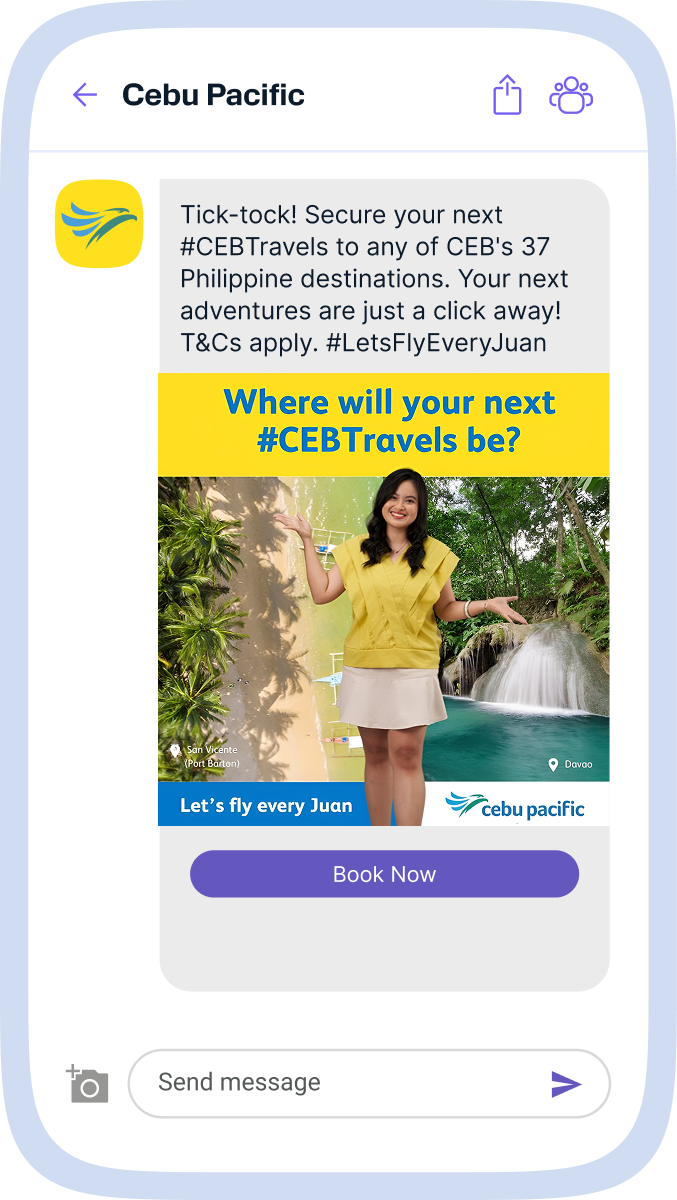
A smartphone screen shows a message from Cebu Pacific promoting travel to any of their 37 Philippine destinations with the hashtag #CEBTravels. The message reads: "Tick-tock! Secure your next #CEBTravels to any of CEB's 37 Philippine destinations. Your next adventures are just a click away! T&Cs apply. #LetsFlyEveryJuan." Below is an image with the text "Where will your next #CEBTravels be?" and photos of San Vicente (Port Barton) and Davao, with the tagline "Let’s fly every Juan" and the Cebu Pacific logo. A purple button labeled "Book Now" is visible below the image.

The onboarding process was completed very fast, and within a few days after the documentation process, they were able to get started. Our local sales team made the onboarding seamless by providing the required training and helped them roll out their first use case. 

We looked at the amount of support that Infobip could offer before choosing a communications partner, and we would say that onboarding was normal. Any service connected to a telco should expect a ton of documentary requirements, right? It’s good to note that the Infobip team helped us 100% with all those, indicating the actual requirements and submitting them to the telcos.

Edzel, Cebu Pacific

Jose Edzel T. Del Rosario V

Senior Manager – Digital Media Optimization, Cebu Pacific

Viber + SMS: A combination that delivered results 

We helped Cebu Pacific implement a holistic communication strategy by combining Viber and SMS to enhance customer experience. Viber was used as a primary channel for communication due to its rich messaging capabilities and ability to provide delivery reports. On the other hand, SMS was used as a failover option to reach out to customers who had not received Viber messages.  

The airline leverages Viber for various promotional campaigns due to its core features, such as a high character limit and rich media support, which provide more creative freedom.  

For instance, Cebu Pacific periodically runs seat sale campaigns on Viber to attract and engage customers using eye-catching visuals such as images and GIFs. 

Viber works best for commercial or marketing use cases. So, every time there is a big sale, 11:11 or 12:12 or something to that effect, one of the choices for communicating those sales is Viber, at least from Cebu Pacific’s point of view. Viber is utilized every time there is a big sale.

Edzel, Cebu Pacific

Jose Edzel T. Del Rosario V

Senior Manager – Digital Media Optimization, Cebu Pacific

Besides promotional campaigns, Viber and SMS are used for regular passenger communication and updates, such as sending notifications about flight delays, boarding gate changes, or any other information about upcoming flights.  

Automation and personalization: Key pillars for Cebu Pacific  

Cebu Pacific gives prime importance to automation to drive operational efficiency and scale their campaigns. In one of the campaigns for existing customers, the airline has been automating and segmenting audiences to recommend the next best ancillary product to customers ahead of their flight. 

For example, if a passenger has not added a checked bag while booking the flight, and historical data combined with automation show that passengers with similar profiles typically do, a targeted offer is sent to the passenger via Viber, SMS, and email.  

This personalized approach is driven by a propensity model that leverages historical purchase behavior to predict which ancillary services a passenger is most likely to purchase. 

RESULT

Achieved 75% increase in Net Promoter Score and higher business growth 

By implementing Viber use cases powered by Infobip, Cebu Pacific has witnessed a continuous increase in the Net Promoter Score and a higher conversion rate for promotional campaigns.  

As a data-driven organization with a strong culture of testing and learning, the airline conducts frequent experiments with Viber use cases. These tests have consistently shown positive uplifts in customer engagement and purchase behavior. 

Here are some of the key results achieved:

  • 75% increase in Net Promoter Score in 2024 compared to the previous year
  • 6% increase in the conversion after running promotional campaigns on Viber, followed by SMS as a failover channel 

For all our customers, everybody who has flown, a survey is sent out after their flight. We have an analytics team that looks after the results. Reading through all of the survey entries, we do see appreciation when it comes to the timeliness of when they receive information regarding their flights.

Edzel, Cebu Pacific

Jose Edzel T. Del Rosario V

Senior Manager – Digital Media Optimization, Cebu Pacific

Cebu Pacific is one of the few companies that conducts frequent testing, analyzes results, and takes improvement initiatives accordingly. Partnering with us has helped the airline successfully elevate its digital engagement strategy, ensuring timely, personalized communication at scale.   

Infobip and Cebu Pacific, we’ve been partners for pretty much six or seven years, and I think the length of that partnership is a testament to the quality of service that Infobip provides to Cebu Pacific. From the six or seven years that I can recall, I don’t recall ever having a ticket to be filed. So, congratulations to you guys.

Edzel, Cebu Pacific

Jose Edzel T. Del Rosario V

Senior Manager – Digital Media Optimization, Cebu Pacific

COMPANY PROFILE

Cebu Pacific is the leading airline in the Philippines. Established in 1988, it is the largest airline in the country by fleet size, operating flights to over 60 domestic and international destinations across 14 countries, including China, Japan, Singapore, Australia, and the United Arab Emirates. The airline has been increasing its footprint in the Philippines and Southeast Asia by offering a safe, reliable, budget-friendly travel option.    

Viber for Business in retail: A practical guide to engagement, sales, and loyalty

Using Viber for Business in retail helps brands drive sales, improve NPS, and build loyalty. See plug-and-play use cases for sales, loyalty, and customer experience.

Ana Rukavina Content Marketing Specialist
Skip to table of contents

Viber for Business is one of the most effective channels for engaging retail customers throughout the journey. With rich media options, two-way conversations, and cost-effective delivery, it gives retailers the tools to turn everyday interactions into moments of engagement, conversion, and loyalty.

33%

increase in global retail messaging interactions in 2024

169%

growth in Asia 

New products launch daily, customer expectations change with every interaction, and budgets rarely stretch as far as marketers would like. In these cases, the channels you choose to connect with customers can make the difference between another missed opportunity and a long-term relationship.

And with Infobip as your partner, Viber for Business doesn’t just sit alongside your existing channels, it seamlessly integrates into your retail customer journey, powering personalized messages from discovery to post-purchase loyalty.

Whether you’re looking to drive conversions, improve Net Promoter Score (NPS), or make support more efficient, this guide will show you practical, retail-specific ways to make Viber a high-impact channel for success. Inside, you’ll find: 

  • Retail-specific use cases for every stage of the customer journey, from discovery to loyalty. 
  • Plug & play message flows you can adapt quickly to promote new arrivals, recover carts, cross-sell, confirm orders, and collect feedback. 
  • Examples of Viber for Business features in action, including carousels, buttons, images, and two-way chat. 
  • Tips for maximizing ROI, showing how Viber for Business can boost engagement, sales, and NPS while staying cost-efficient. 
  • How Infobip makes it easy, by integrating Viber for Business into your broader engagement strategy with automation and analytics. 

Let’s start with discovery.  

Discovery: Promote new arrivals with rich, conversational messaging 

In retail, we know that timing is everything. Customers want to be the first to know about new collections, seasonal offers, or limited drops, but they also want updates to feel personal and easy to act on.  

With Viber’s rich media formats like images, carousels, and call-to-action buttons, you can showcase new arrivals in a way that grabs attention and drives action instantly.  

For example, a fashion retailer can use Viber for Business to spotlight a new line with carousel images, while a tech store can highlight the latest smartphone along with a quick link to buy. With interactive messages, customers don’t just see what’s new, they can click through, browse, and purchase without friction. 

And with Infobip’s automation tools, these announcements can be scheduled or personalized at scale. That means the right customer sees the right product, at the right time, without extra manual work for your team. 
Message flow example (Discovery): 

  • Retailer sends this message to the customer: “Our new summer collection is here! Browse the latest arrivals now.” [Carousel of items + “Shop now” button] 
  • Customer clicks CTA and goes to the product page. 
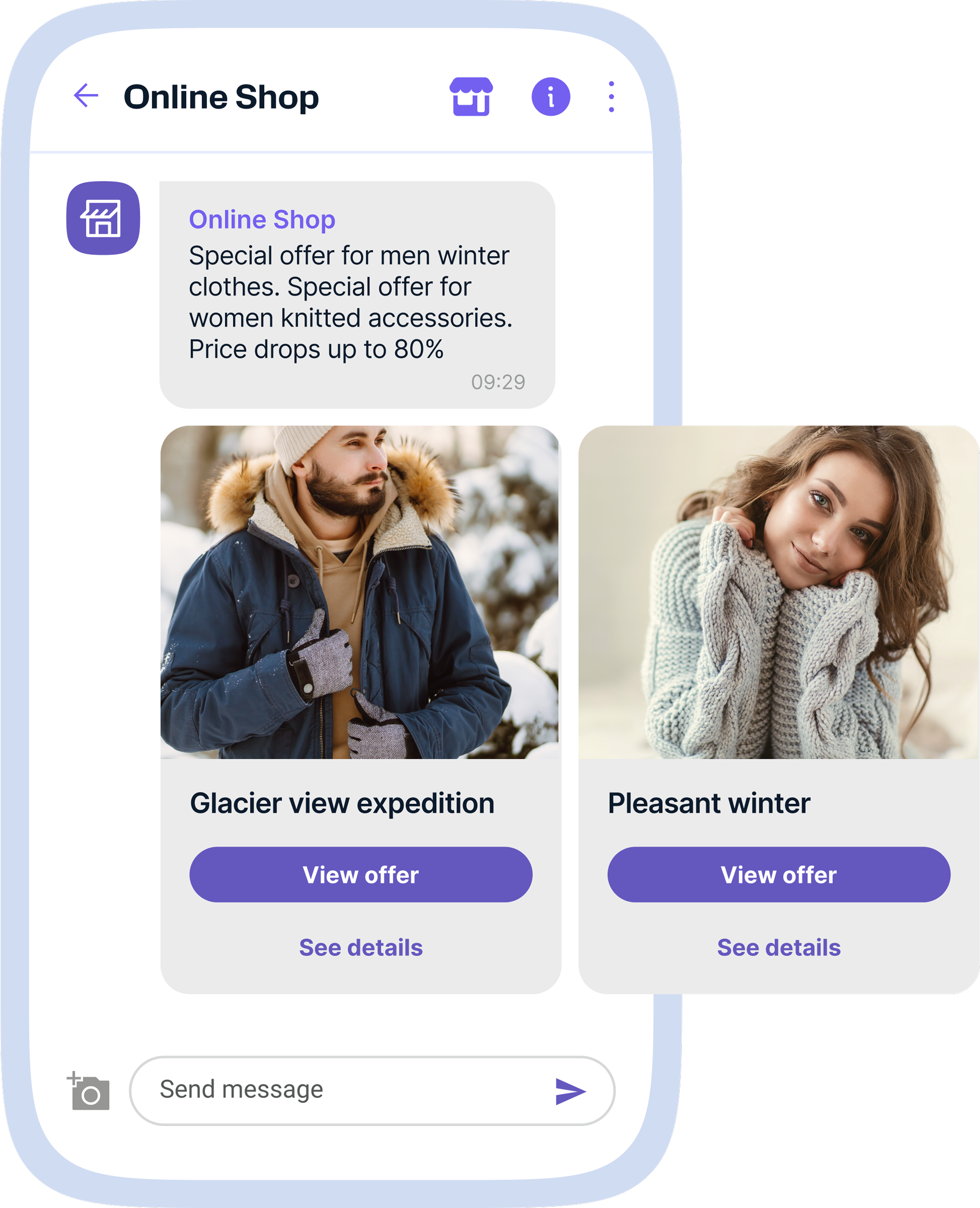
A smartphone screen shows a Viber chat with "Online Shop." At the top, the shop sends a promotional message: "Special offer for men winter clothes. Special offer for women knitted accessories. Price drops up to 80%." Below, two carousel-style promotional cards are displayed. The first card has an image of a man wearing a blue winter jacket, gloves, and a beige hat outdoors in the snow. Text reads "Glacier view expedition," with two purple buttons: "View offer" and "See details." The second card shows a woman in a gray knitted sweater, leaning her head on her hands, smiling warmly. Text reads "Pleasant winter," with the same "View offer" and "See details" buttons below.

Consideration: Recover abandoned carts with personalized reminders 

In the consideration phase, customers weigh their options, but many never make it to checkout. That’s why cart abandonment is one of the biggest challenges in retail and eCommerce. Shoppers browse, add items, and then disappear, often just a step away from completing their purchase. Every abandoned cart represents lost revenue but also a chance to re-engage customers. 

Viber for Business makes cart recovery simple and effective. With personalized reminders that include product images, prices, and direct checkout links, retailers can nudge customers back to their purchase in a conversational and non-intrusive way. Adding an incentive, such as a discount or limited-time offer, can create urgency and increase the likelihood of conversion. 

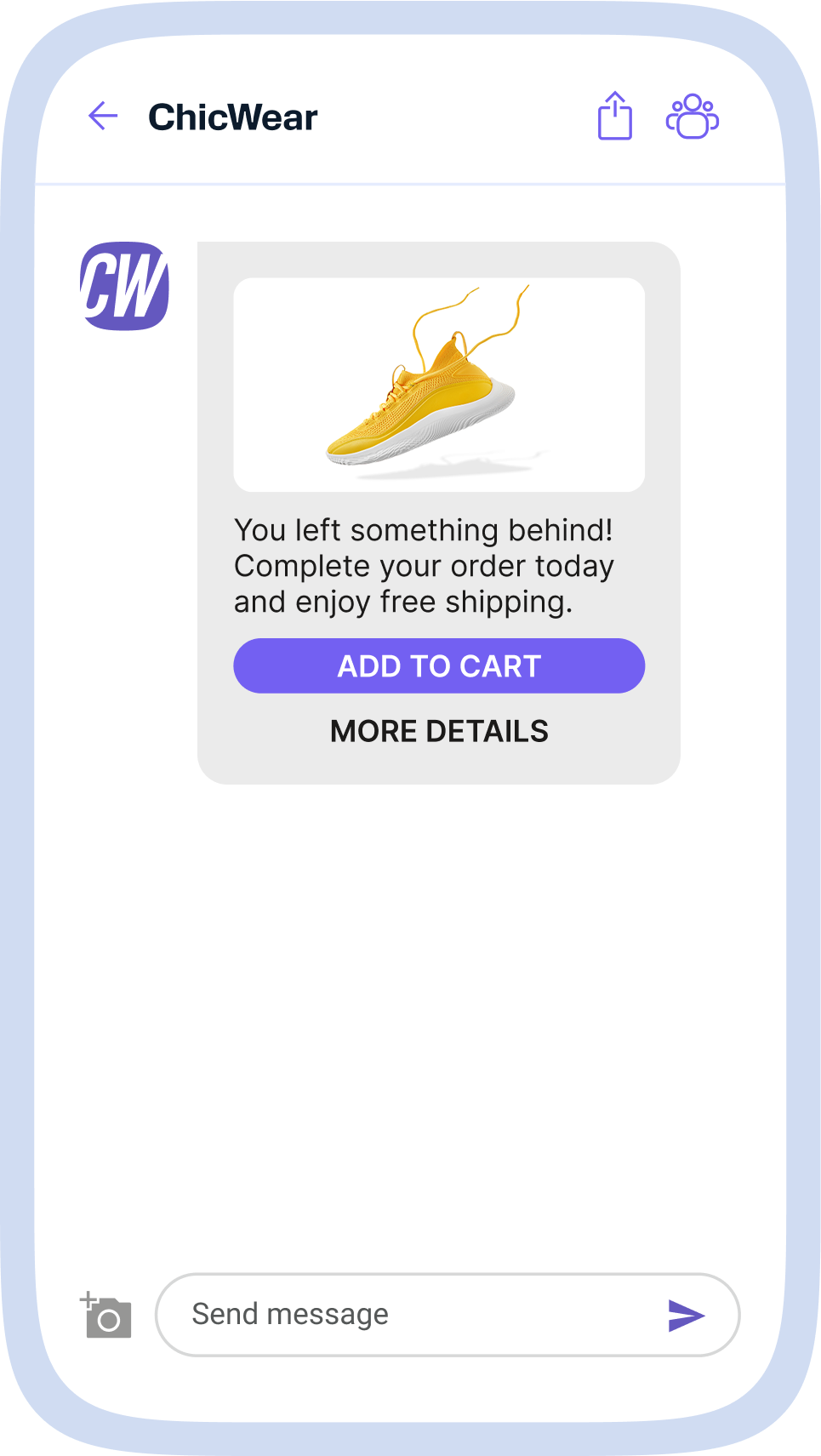
For example, if a shopper leaves a smartphone in their cart, a follow-up message can display the exact product image alongside a “Complete purchase” button. If paired with automation through Infobip’s customer engagement solution, Moments, these reminders can be sent within hours (or minutes) of abandonment, ensuring the message feels relevant and well-timed. 

Beyond recovering lost sales, cart reminders on Viber for Business improve the overall customer experience. Instead of receiving a generic email, customers get a quick, visually engaging message right in their chat feed, making it easier to pick up where they left off. 

Message flow example (Consideration):

  • Retailer sends this message to the customer: “You left something behind! Your [Product Name] is still waiting for you. Complete your order today and enjoy free shipping.” [Product image + “Complete purchase” button] 
  • Customer clicks the button and completes the order. 
A smartphone screen shows a Viber message from “ChickWear” with the brand logo at the top. The message contains a product image of a bright yellow sneaker. The text says: “You left something behind! Complete your order today and enjoy free shipping.” Below the text are two buttons: a purple button labeled “Add to cart” and a gray button labeled “More details.”

Conversion: Cross-sell and upsell with complementary products 

At the conversion stage, the goal isn’t just to close the sale, it’s to maximize its value. Customers who are ready to buy are also more open to suggestions for complementary products or premium upgrades that enhance their purchase. 

Viber for Business makes cross-selling and upselling seamless. With interactive messages, retailers can recommend accessories, bundles, or higher-value alternatives right inside the chat. Carousels and product images make it easy for shoppers to browse options without leaving the conversation, while call-to-action buttons drive them directly to checkout. 

For example, a customer purchasing a smartphone could be offered a protective case, headphones, or an extended warranty through a carousel message. A fashion retailer might suggest shoes or accessories that match items already in the cart. These small prompts can significantly increase average order value (AOV) while also creating a more personalized shopping experience. 

When powered by Infobip’s automation tools, these messages can be triggered based on real-time behavior. That means higher conversions without guesswork or wasted spend. 

Message flow example (Conversion):

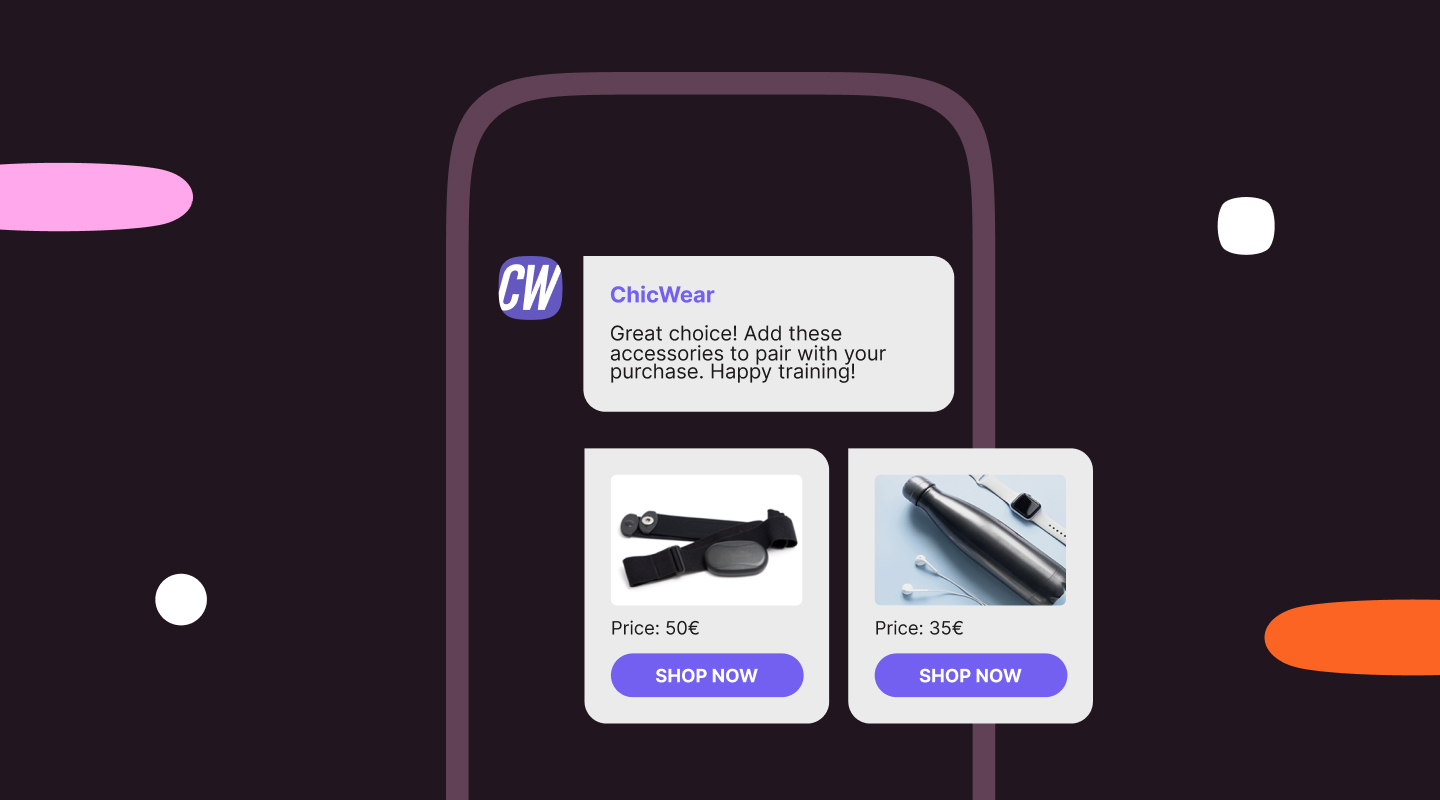
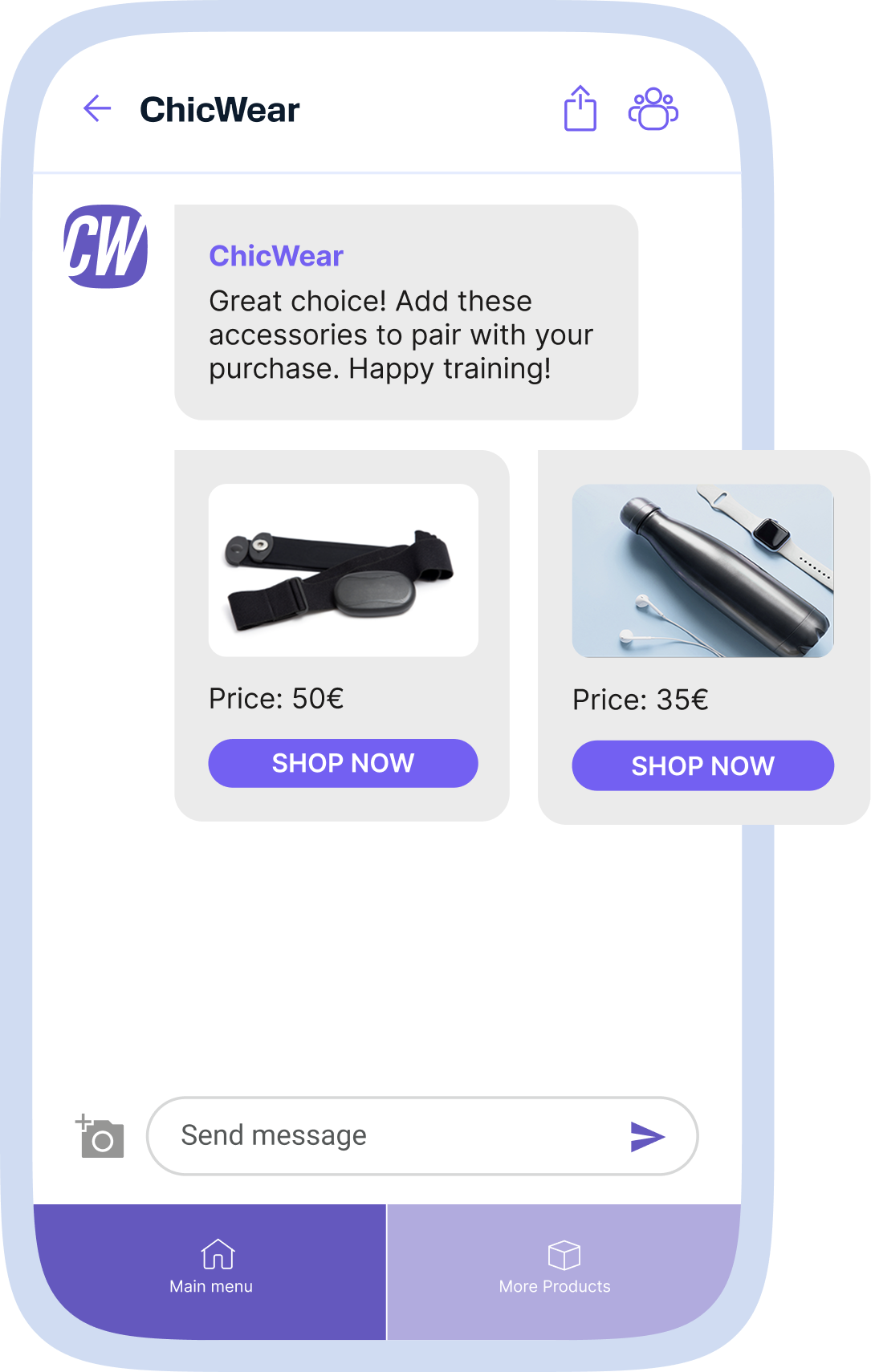
  • Retailer sends this message to the customer: “Great choice! Add these accessories to get the most out of your new [Product Name].” [Carousel of related products + “Add to cart” button] 
  • Customer selects a complementary product and increases their order value. 
A smartphone screen shows a Viber message from “ChicWear.” The message text says: “Great choice! Add these accessories to pair with your purchase. Happy training!” Two product cards are displayed: one for a black strap priced at 50 euros and another for a metallic water bottle priced at 35 euros. Each product card has a purple “Shop now” button.

Post-purchase: Order confirmation and real-time tracking

The customer journey doesn’t end at checkout. In fact, post-purchase is one of the most critical stages for building trust and long-term loyalty. Customers want reassurance that their order has been received, processed, and is on its way, and they expect updates to be quick and convenient. 

With Viber for Business, retailers can send instant order confirmations, shipping notifications, and real-time delivery updates directly to customers’ chat feeds. Rich media formats allow you to include order details, product images, and tracking links, so shoppers can easily stay informed. 

For example, a customer buying sneakers can receive a confirmation message with the order summary and a button to “Track my delivery.” As the package moves through each stage, automated Viber updates keep the customer informed, reducing the need for calls or emails to customer support. 

Beyond efficiency, these updates build confidence. By proactively sharing information, retailers show customers they’re in control of the process, which increases satisfaction and reduces anxiety around online shopping. 

Message flow example (Post-purchase):

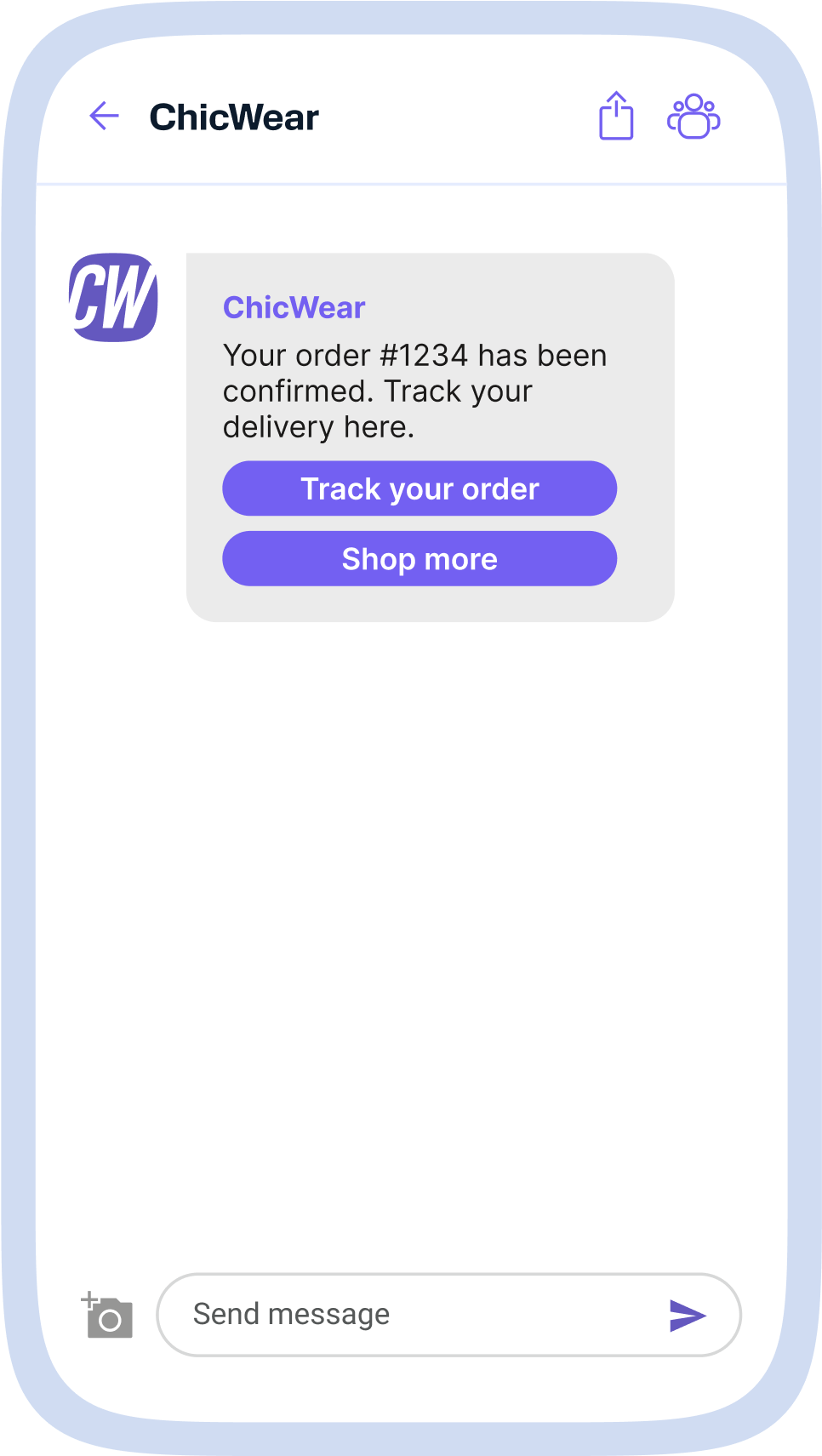
  • Retailer sends this message to the customer: “Your order #1234 has been confirmed. Track your delivery here.” [“Track my order” button] 
  • Customer clicks the button to view real-time tracking updates. 
A smartphone screen shows a Viber message from “ChicWear.” The message says: “Your order #1234 has been confirmed. Track your delivery here.” Below the text are two buttons: a purple button labeled “Track your order” and another purple button labeled “Shop more.”

Support: Handle delivery changes and customer inquiries with ease 

Even with the best planning, retail purchases don’t always go perfectly. Customers may need to update their delivery address, reschedule a shipment, or ask questions about a product. How quickly and smoothly you handle these requests can make or break the overall experience. 

Viber for Business enables two-way conversations that make support simple and cost-effective. Instead of waiting on hold or drafting an email, customers can send a quick message in the same channel where they received their order updates. Retailers can respond instantly, whether through live agents, automated chatbots, or a combination of both. 

For example, a customer who realizes they’ll be out during a delivery slot can reply directly in Viber to reschedule. A chatbot can handle simple requests like “change delivery date,” while more complex cases can be seamlessly escalated to a human agent. This reduces friction for customers and lowers the pressure on call centers. 

By consolidating service into Viber for Business, retailers also maintain a single history of the customer’s journey, from browsing to buying to after-sales care. This context helps agents provide faster, more personalized answers. 

Message flow example (Support):

  • Customer messages the retailer: “I need to change my delivery time.” 
  • Retailer responds with options: “No problem. Please select a new slot:” [Buttons: Tomorrow 10–12, Tomorrow 12–14] 
  • The customer selects a time and receives a confirmation message. 

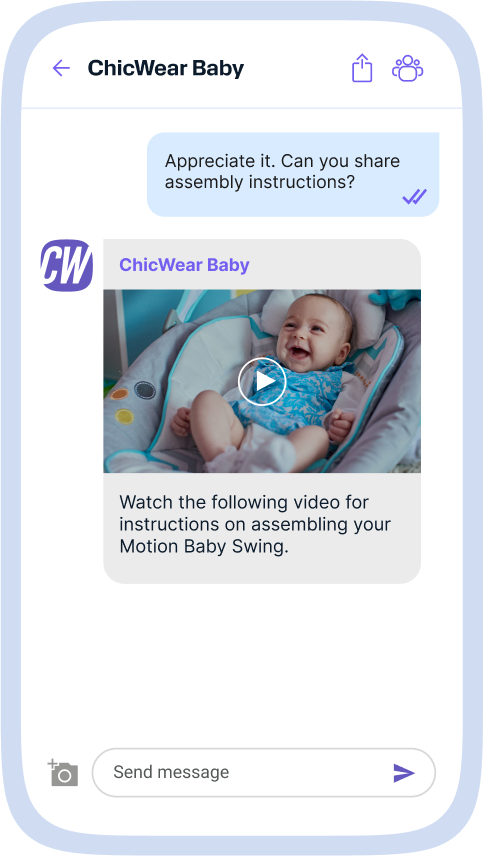
A smartphone screen displays a Viber message from “ChickWear.” The customer asked: “Appreciate it. Can you share assembly instructions?” The retailer replies with a video thumbnail of a baby in a swing. The text says: “Watch the following video for instructions on assembling your Motion Baby Swing.”

Loyalty: Collect feedback and boost NPS 

The most valuable insights often come after the sale. At the loyalty stage, engaging customers for feedback not only strengthens relationships but also provides the data retailers need to improve experiences and increase NPS.

Viber for Business makes feedback collection simple and engaging. Instead of sending long surveys that risk low response rates, retailers can share short, conversational questionnaires with quick-reply buttons, emojis, or star ratings. Keeping feedback requests within the same channel is far more appealing than being redirected to long survey forms. 

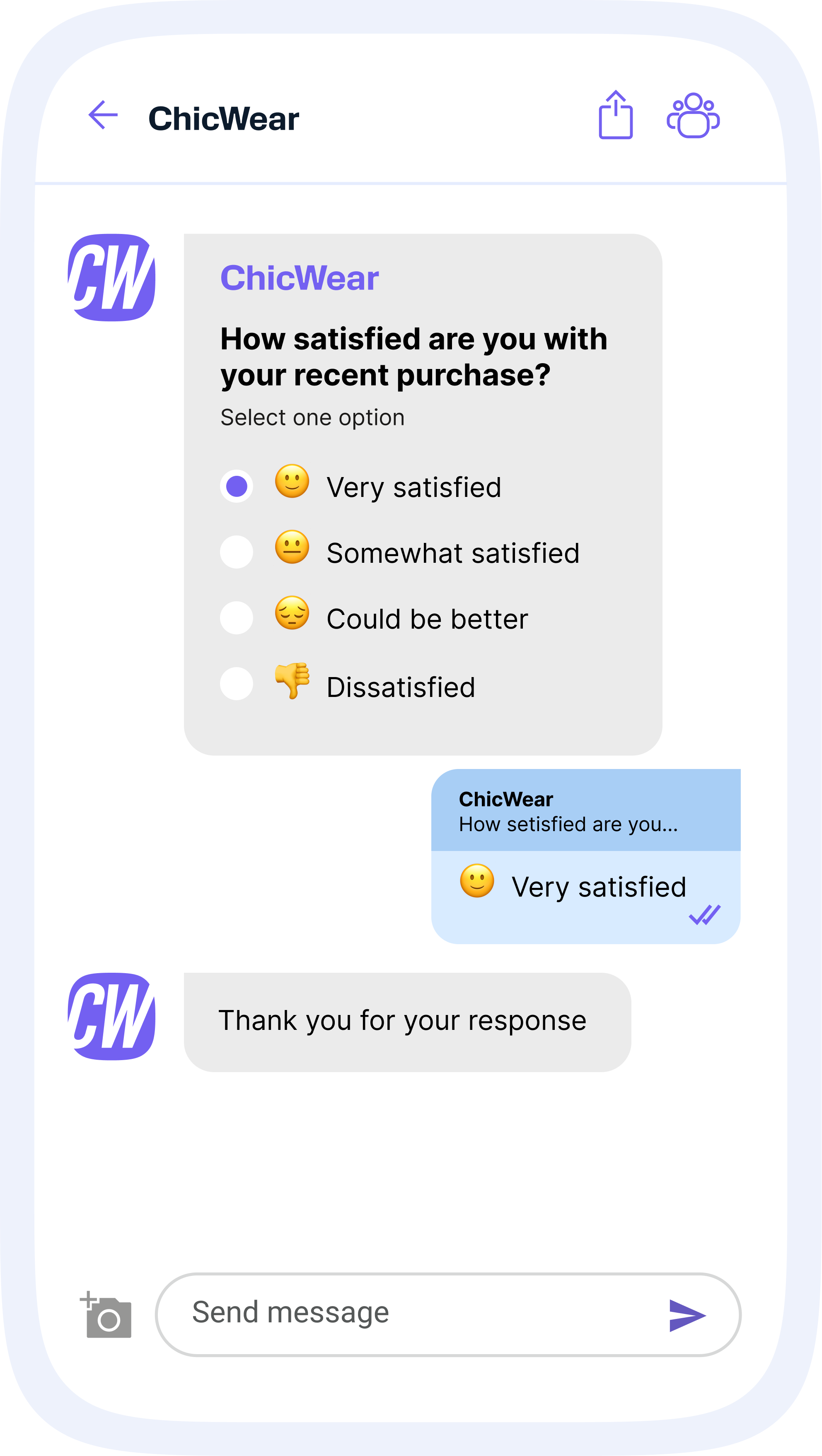
For example, after a delivery is completed, a Viber message could ask: “How satisfied are you with your order?” with options ranging from very satisfied to not satisfied. For deeper insights, follow-up questions can be triggered automatically, such as asking what could be improved if the rating is low. 

Beyond improving NPS, these interactions show customers their opinions matter. Closing the loop, acknowledging feedback, and making visible improvements builds trust and increases the likelihood of repeat purchases. 

When powered by Infobip, feedback flows don’t exist in isolation. They can be integrated into your broader customer data strategy, giving you a holistic view of satisfaction across channels and touchpoints. 

Message flow example (Loyalty):

  • Retailer sends this message to the customer: “How satisfied are you with your recent order?” [Quick-reply buttons: Very satisfied / Neutral / Not satisfied]
  • The customer selects an option. 
  • Retailer responds: (If not satisfied) “Sorry to hear that. Could you tell us what we can improve?” [Free text or predefined options] 
A smartphone screen shows a Viber chat with ChicWear. The brand sends a survey asking: "How satisfied are you with your recent purchase? Select one option." Four options are listed: Very satisfied, Somewhat satisfied, Could be better, and Dissatisfied. The user selects "Very satisfied," which appears as their reply in the chat. ChicWear responds with the message: "Thank you for your response." The interface includes the ChicWear logo in purple and standard Viber chat features like message input and send button.

Key takeaways across the retail customer journey 

  • Discovery: Promoting new arrivals on Viber helps retailers boost visibility, cut through digital noise, and drive conversions quickly, all while staying cost-efficient. 
  • Consideration: Cart abandonment doesn’t have to mean lost revenue. With Viber, retailers can transform abandoned carts into completed purchases while showing customers they’re paying attention to their needs. 
  • Conversion: Viber enables retailers to capture more value at the point of purchase by making upsell and cross-sell offers feel natural, personalized, and easy to act on. 
  • Post-purchase confidence: Viber turns routine post-purchase updates into trust-building moments, giving customers peace of mind while lowering the strain on support teams. 
  • Support: With Viber, retailers can resolve issues in a channel customers already use, turning potential frustrations into moments of convenience and care. 
  • Loyalty: With Viber, feedback is a natural part of the conversation. Retailers can boost NPS, improve service, and nurture long-term loyalty, all while keeping engagement cost-efficient and human. 

Closing the loop on the customer journey in retail with Viber for Business 

Retail success isn’t defined by a single touchpoint but by the entire journey, from the first moment of interest to long-term loyalty. Each interaction is a chance to create value, strengthen relationships, and keep customers coming back. 

Viber for Business helps retailers deliver on that promise by providing a familiar, trusted channel that makes communication more engaging, responsive, and efficient. 

And with Infobip as your partner, Viber becomes more than just another channel. It becomes part of an integrated customer engagement strategy, powered by automation, data, and scalability, designed to lift conversions, improve NPS, and build loyalty that lasts.  

Treat conversations as moments that matter, and customers will reward you with trust and repeat business. Viber for Business makes it seamless. Infobip makes it scalable. 

Start the next chapter of your retail journey with Viber for Business through Infobip

Start turning everyday conversations into high-impact retail outcomes.  

Related content:

Get the latest insights and tips to elevate your business

By subscribing, you consent to receive email marketing communications from INFOBIP. You have the right to withdraw your consent at any time using the unsubscribe link provided in all INFOBIP’s email communications. For more information please read our Privacy Notice

Mobile app adoption

Drive mobile app downloads and engagement with personalized onboarding and proactive support.

Be there on their channels of choice

No matter where your customers are, no matter which channels they prefer, you can be there for them in the important moments of their lives.

SMS

IN APP

WA

VIBER

MESS

BFSI Telcos

The pain points:

  • Many users may not be aware of the full range of features and benefits offered by your mobile app. If they don’t know about everything your app can do, they might not see the value in downloading it.
  • Without a strong mobile app presence, businesses may miss out on valuable opportunities to drive sales, promote offers, and build customer loyalty.

How mobile adoption helps:

  • Guide new users through the app’s features and benefits with personalized onboarding experiences, ensuring they understand its value and how to use it effectively.
  • Provide proactive support and guidance to users, answering questions, resolving issues, and encouraging continued app usage
  • Offer exclusive incentives, rewards, or early access to features to encourage users to download and actively use the mobile app.

The business benefit of mobile adoption:

  • Drive higher levels of customer engagement and interaction through personalized content, exclusive offers, and convenient mobile access to services.
  • Gather valuable data on user behavior and preferences through mobile app interactions, allowing for personalized recommendations and targeted marketing campaigns.
  • Drive sales, promote offers, and generate revenue through targeted mobile app campaigns and personalized recommendations.

Mobile adoption across industries:

Discover more:

Debt collection

Recover more debt faster and at a lower cost. Transform your debt collection into a modern, efficient digital process.

Be there on their channels of choice

No matter where your customers are, no matter which channels they prefer, you can be there for them in the important moments of their lives.

EMAIL

SMS

MMS

RCS

Voice

WA

Viber

Apple

The problem with traditional debt collection methods:

  • Lack of customer segmentation and Profile scoring: Difficulty in targeting the right customers based on their debt profiles and behavior patterns.
  • Increased operational cost due to anual processes and lack of automation: Many companies still rely on manual debt collection efforts, leading to inefficiencies. Automated workflows for reminders and follow-ups are needed.
  • Poor Debt collection intelligence: No advanced tools or strategies to understand customer behavior and improve collection processes. Limited analytics to guide decision-making.
  • Live agent in the loop: Debt collection can damage relationships; companies need a balance between automation and human interaction.
    People are willing to pay their debt more if they speak to a human.
  • Multi-channel engagement and failover: Some companies struggle to effectively reach customers via their preferred channels. Failover options ensure every message gets delivered.
  • Compliance concerns: Companies need solutions that adhere to local regulations.

How debt collection with Infobip solutions helps:

  • Ensure the message is always delivered
  • Decrease your DSO (Days Sales Outstanding) with automated payment reminders
  • Increase your Promise to Pay Rate with human-to-human interactions
  • Boost payment recovery with flexible deadline extensions
  • Recover more debt with refinance options
  • Create a conversational bot experience

The business benefit of debt collection on messaging channels:

  • Enhance cash flow: Ensure timely payments with professional tools and processes, resulting in healthier cash flow.
  • Optimize internal resources: Automate payment reminders to free up your team’s time and enable them to focus on core business activities.
  • Reduce operational costs: Eliminate the expenses associated with hiring and training in-house collection staff by leveraging automated workflows and Infobip’s expertise.
  • Quick deployment: Immediate setup with a predefined configuration without lengthy onboarding times.
  • Ensure compliance: Utilize Infobip’s proven payment reminder use cases, pre-configured to meet local regulatory requirements and reduce compliance risks.
  • Maintain client relationships: Seamlessly transition from AI-driven communication to human agents for sensitive conversations, preserving customer trust and loyalty.
  • Unified customer data: Centralize data from all touchpoints to build 360-degree customer profiles for better insights.
  • Personalized interactions: Deliver tailored messages across channels like SMS, RCS, WhatsApp, Email, and Push notifications.

Discover more:

Refund and returns

Allow customer to automatically find solutions for their product troubles and ask for returns.

Be there on their channels of choice

No matter where your customers are, no matter which channels they prefer, you can be there for them in the important moments of their lives.

SMS

RCS

LIVECHAT

EMAIL

VIBER

WA

MESS

TELEGRAM

The pain points:

  • Return policies are often lengthy text filled with technical jargon. Customers might not understand the terms or be able to find the information they need.
  • Even when the information is accessible, return policies can be confusing and inconsistent across different retailers. Customers may struggle to understand eligibility criteria, deadlines, and required documentation.
  • Customers often feel left in the dark about the status of their return requests.

How refunds and returns helps:

  • Allow customers to initiate return requests, track their status, and receive updates through their preferred messaging channels.
  • Guide customers through the return process with clear instructions, automated updates, and personalized support.
  • Offer personalized assistance and address customer concerns through messaging interactions.
  • Streamline the return process with automated approvals, quick refunds, and efficient communication.

The business benefit of refunds and returns:

  • Improve customer satisfaction: Enhance customer satisfaction by providing hassle-free return experience. Happy customers are more likely to become repeat customers and recommend your brand to others.
  • Increase efficiency: Streamline return processes, reduce manual effort, and improve operational efficiency.
  • Reduce return rates: By providing clear information about products and returns and proactively addressing customer concerns proactively, you can potentially reduce the number of returns.

Discover more:

Payment confirmation

Use verified messages when sending payment confirmations. This assures the customer of the message’s authenticity and increases trust in the transaction

The pain points

  • Customers may feel anxious or uncertain after making a payment whether their payment was received or not, especially if they don’t receive immediate confirmation.
  • Phishing scams and fraudulent activities are common. Customers need assurance that their payments have been processed securely, and that the confirmation message is legitimate.

How payment confirmations help

  • Provide immediate confirmation of successful payments, giving customers peace of mind and a positive experience.
  • Use verified messaging to assure customers of the message’s authenticity and increase trust in the transaction.
  • Include relevant payment details in the confirmation message, such as the amount paid, transaction date, payment method, and order or reference number.
  • Provide customers with a convenient way to access and store payment confirmation records for their own tracking.

The business benefit of payment confirmations

  • Reduce customer support inquiries: Minimize customer support inquiries related to payment status and confirmation by providing proactive and detailed information.
  • Enhance efficiency: Automate payment confirmation processes to improve efficiency and reduce manual effort
  • Reduce risk of disputes: Provide clear and verifiable payment confirmations to minimize the risk of payment disputes or discrepancies.

Discover more:

Frequent flyer program

Use digital assistants and pre-built flows to interact with loyalty program members, provide updates on rewards, assist with redemption, and answer program-related queries.

Be there on their channels of choice

No matter where your customers are, no matter which channels they prefer, you can be there for them in the important moments of their lives.


Marketing

EMAIL

RCS

LIVECHAT

IN APP

VIBER

WA

APPLE

LINE

The pain points:

  • Generic emails and infrequent communication can make loyalty program members feel undervalued.
  • Many loyalty programs lack user-friendly tools and clear guidance, leaving members frustrated and unsure how to use their hard-earned rewards.
  • Trying to get help with your frequent flyer account can sometimes feel like sending a message into a black hole. Long wait times, impersonal responses, and limited support channels are some of the issues customers face.
  • Without proactive communication, valuable rewards can be forgotten and expire.

How frequent flyer program engagement on messaging channels helps:

  • Deliver tailored messages and updates to loyalty program members, providing relevant information about their rewards, benefits, and exclusive offers.
  • Use chatbots to provide immediate assistance with program-related queries, redemption requests, and account management through their favorite messaging channels.
  • Proactively engage with members, reminding them about expiring miles, upcoming promotions, and personalized travel recommendations.
  • Simplify the rewards redemption process with easy-to-use tools and guidance, allowing members to quickly and easily book flights or redeem points for other travel benefits.

The business benefit of frequent flyer program engagement on messaging channels:

  • Improved program participation: Encourage active participation in the loyalty program by making it easy and rewarding for members to engage with your brand.
  • Data-driven insights: Valuable data on member preferences, behaviors, and engagement patterns through messaging interactions can be used to personalize offers, optimize the program, and improve the overall customer experience.
  • Cost-effective: Reduce customer support costs and improve efficiency by automating communication and providing self-service options through messaging channels.

Discover more:

Driver registration

Streamline the driver registration process and improve user experience by employing a conversational approach through different channels. It also helps reduce the number of registration dropouts and provides 24/7 support.

Be there on their channels of choice

No matter where your customers are, no matter which channels they prefer, you can be there for them in the important moments of their lives.


Operations

WA

VIBER

MESSENGER

APPLE

RCS

The pain points:

  • Traditional driver registration processes often involve lengthy paper forms, manual data entry, and long wait times.
  • Complex requirements, legal jargon, and unclear instructions can make the registration process confusing and intimidating for drivers.

How driver registration helps:

  • Break down the registration process into manageable steps, providing clear instructions and helpful prompts along the way.
  • Enable drivers to easily submit required documents, such as licenses and certifications, through messaging channels..

The business benefit of driver registration:

  • Faster onboarding: Reduce the time it takes to onboard new drivers, allowing them to start working soone.
  • Reduce costs: Minimize administrative costs associated with paper-based processes, data entry, and customer support inquiries.
  • Wider reach and accessibility: Reach a wider pool of potential drivers by offering registration through popular messaging channels, making it easier for them to apply, regardless of their location or access to traditional communication methods.
  • Improve data accuracy: Reduce errors and improve data accuracy by automating data collection and verification processes.

Discover more: