




Best RCS for Business providers in 2026: A practical guide to choosing the right one for your business
RCS for Business is the channel everyone has been waiting for, and in 2025 it finally delivered. Here is what to look for in an RCS provider in 2026.

RCS for Business is the channel everyone has been waiting for, and in 2025 it finally delivered. Think of it as SMS younger sibling that grew up with chat apps: rich, interactive messaging delivered straight into the inbox your customers already use, no app download required. According to Infobip Messaging Trends 2026, based on 628 billion mobile channel interactions across the platform, the numbers speak for themselves:
This is no longer a niche experiment. The brands that are ahead right now are the ones who picked a provider and ran a campaign. If you are about to become one of them, here is what you need to know first.
So, if you are looking to launch your first RCS campaign, one question comes up quickly:
Where do I even start, and who should I work with?
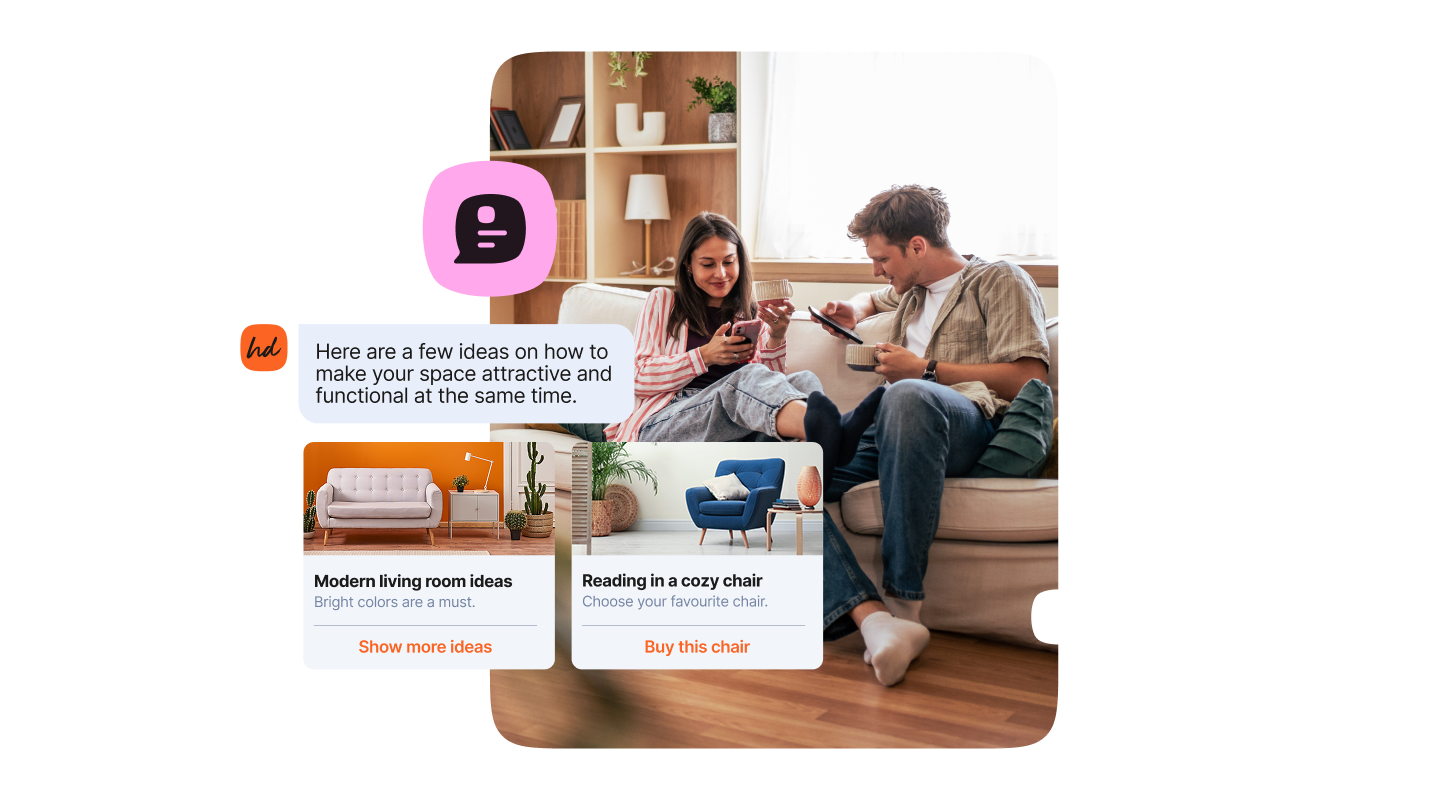
The RCS ecosystem is powerful, but also complex. Choosing the right provider is less about ticking feature boxes and more about finding a long-term partner who can guide you through it.
Why your RCS provider matters more than you think
Unlike SMS or messaging apps, RCS sits at the intersection of multiple moving parts:
- Mobile operators
- Platform providers (Google, Apple)
- Operating systems (iOS, Android)
- CPaaS providers
- And your brand
That means delivery, reach, features, and even pricing can vary depending on carriers, devices, and markets, sometimes significantly.
This is exactly why your choice of RCS provider matters so much. The provider you choose will shape and influence how fast you can launch, how many customers you can reach, and how much control you have over the experience you are building.
This guide breaks down what to look for in an RCS provider in 2026, and ends with a practical cheat sheet of questions you should always ask before committing.
What to look for: 7 things that separate good RCS providers from great ones
1. Connectivity and reach: Can they actually get your messages where they need to go?
A provider network determines where your messages can reach customers. RCS delivery depends on a provider partnerships with mobile operators, which can be direct and indirect. The stronger and broader those relationships are, the more customers you can reliably reach.
For you, this means:
- Knowing which countries and networks you can launch in
- Having confidence that messages will be delivered
- Being able to expand into new markets
Providers with direct operator connections can usually:
- Get you live faster
- Resolve delivery issues more quickly
- Support local and global rollouts with fewer dependencies
It is also important to understand that reach is not just about providers. It is about the devices your customers use too. Apple adopted RCS in 2024, and the impact was immediate: markets including the US, France, Germany, and UK saw measurable lifts in deliverability rates. But availability still depends on carrier rollout in each market, not on the messaging provider alone.
Top tips:
- If you are planning to launch RCS in one country, ask your provider exactly which networks are supported there.
- If you are planning a global rollout, this matters even more. Not all providers offer the same coverage, consistency, or readiness across markets.
2. Migration from SMS and MMS to RCS: You are not starting from scratch
You have probably invested real time and money into your SMS/MMS setup: integrations, APIs, logic. The good news is you do not have to throw that away to start with RCS.
Look for providers that support automatic channel upgrade: if a recipient device and telecom support RCS, the message routes over RCS. If not, it falls back to SMS. No separate campaign builds, no extra work for your product team. It is one of the more underrated features to ask about early.
3. Built-in failover: Because your customers need to get the message, every time
RCS delivery depends on a few things going right at the same time: network support, device capability, operator configuration. Even the best providers cannot guarantee 100% RCS delivery every time.
What they can guarantee is that your customer still gets the message. Automated fallback to SMS or any other channel should be standard, not an upsell. Ask specifically whether it is built in or something you would configure yourself.
Any serious RCS provider in 2026 should offer:
- Automatic fallback
- Transparent delivery reporting
- No manual intervention required
4. Pricing transparency and predictability: No surprises on the invoice
RCS pricing has more variables than SMS, and it is easy to get caught out if you do not ask the right questions upfront.
Things that affect what you pay: which country and carrier you are sending to, what type of message you are sending (a basic text, or with rich features), whether it is one-way or two-way, and monthly volumes you are sending.
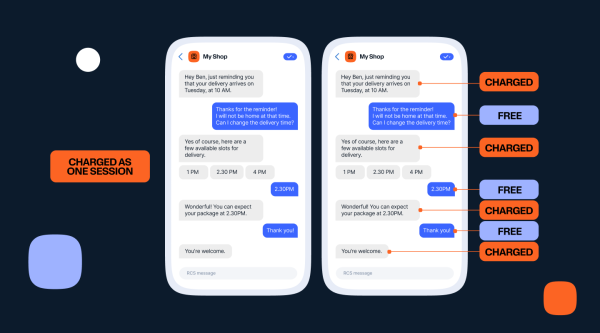
Providers can support various billing and pricing types. Some charge per message, some per monthly active user, some by session, some even support SMS-based billing logic.
There is no universally right model. It depends on your use case and goal. But whatever model you need, you should understand it clearly before you commit.
Top tips:
- Get specifics on delivery reporting too: the better your visibility into what is delivered and how, the easier it is to predict costs and measure campaign performance.
- And worth knowing: when a provider routes indirectly through other aggregators, that extra hop can show up in the price.
5. Onboarding and time to first campaign: How long before you actually go live?
How long does it actually take to send your first RCS campaign? What does your engineering team need to do? What does support look like during setup? Can you test before you scale?
These feel like operational details, but they can have real consequences. A slow onboarding process means your competitors are already in market while you are still in configuration.
Top tip: Ask for a realistic timeline, and check the quality of the API docs before you commit.
6. Feature depth: The basics are the floor, not the ceiling
Every reputable RCS provider will give you the basics: verified sender profile, brand name and logo displayed in the inbox, and read receipts. That is the floor, not the differentiator.
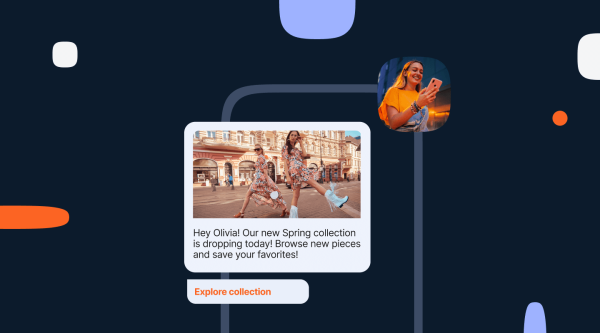
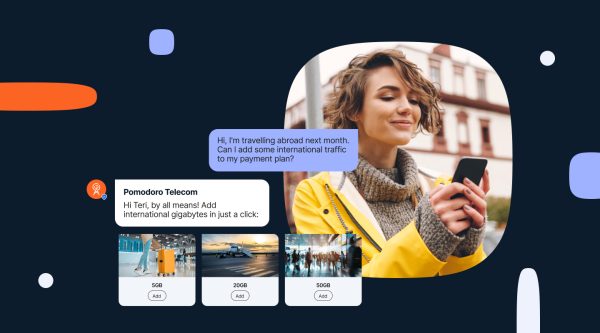
Where RCS gets genuinely interesting is everything beyond that. Rich cards, carousels, suggested replies and actions, GIFs, videos, PDFs, webviews. Native integrations with Maps, Calendar, and Google Wallet. And more recently, entry points from Google Search, meaning customers can start a conversation with your brand directly from search results, without ever visiting your website.
It is a lot. And the channel is still evolving.
That is the practical reason feature parity matters. Some providers support the full Google RCS for Business specification: every format, every integration, early access to betas as new capabilities roll out. Others have partial implementations, which works fine until you want to do something they have not built yet.
If you are planning to grow with this channel, ask the question directly: what is not supported on your platform yet, and what is the roadmap? How they answer tells you a lot about where you will be in twelve months.
7. Omnichannel and the bigger picture: RCS does not exist in isolation
For most brands, RCS is one part of a broader messaging strategy. You are probably also running SMS, WhatsApp, email, and increasingly, you are thinking about automated and AI-assisted conversations, not just broadcast campaigns.
Ask whether your provider manages other channels natively or whether you would need a separate vendor for each. Check what integrations exist with the platforms your team already uses: CRM, marketing automation, customer service tools. And ask about their AI story specifically. Not what is on the roadmap, but what is live and working for customers today.
The direction of travel for RCS is toward two-way, conversational, and eventually agentic experiences. Your provider platform should be heading that way already.
RCS by the numbers: What 2025 actually looked like
Before diving into specific providers, it helps to understand the scale of what happened last year. According to Infobip Messaging Trends 2026, based on 628 billion mobile channel interactions across the platform:
- 311% global growth in RCS traffic in 2025
- 10 billion RCS messages successfully delivered in Q3 2025 alone
- North America: 70x growth
- LATAM: 753% growth
- APAC: 516% growth
- Europe: 398% growth
- Marketing and advertising: 32x growth in RCS use
- Retail and eCommerce: 353% growth
- Finance and fintech: 264% growth
Apple iOS 18 RCS support, launched in 2024, drove measurable improvements in deliverability across the US, France, Germany, and UK. Approximately 25% of global markets still face slower adoption due to delayed carrier infrastructure migration and limited interoperability agreements.
The takeaway: RCS is growing fast, but it is growing unevenly. The provider you choose determines which part of that growth curve you can access.
311%
global growth in RCS for Business in 2025
10B
messages delivered in Q3 2025 alone
70x
growth in North America
753%
growth in LATAM
311%
global RCS for Business growth on Infobip platform in 2025
10B+
RCS for Business messages delivered in a single quarter
32x
growth in marketing and advertising use cases
10x
growth in conversational support
Top RCS for Business providers in 2026
Here is a look at the providers shaping the RCS market in 2026 and what each one brings to the table.
Source: Juniper Research, 2026
Infobip
Infobip operates one of the largest direct-to-operator RCS for Business networks in the world, with coverage spanning over 60 countries. RCS for Business sits inside a broader omnichannel platform, so businesses can run SMS, WhatsApp, email, and RCS for Business from a single interface with automatic fallback built in. The platform supports the full Google RCS for Business specification and includes live AI and conversational automation capabilities, not just roadmap promises.
Source: Infobip Messaging Trends 2026, based on 628 billion mobile channel interactions.
Sinch
Sinch is a global CPaaS provider with significant RCS reach, particularly strong across North America and Europe. Their platform is developer-centric with robust API documentation and a straightforward migration path for teams moving from SMS. Sinch is a solid choice for businesses that prioritize developer experience and breadth of operator coverage.
Twilio
Twilio RCS offering is built for engineering teams that want maximum flexibility. Their API-first approach means deep customization is possible, but the trade-off is a steeper setup process compared to managed platforms. Twilio works well for technical teams with existing Segment or Salesforce integrations who want to add RCS without rebuilding their messaging stack.
Vonage (Ericsson)
Vonage, now part of Ericsson, brings deep telecom infrastructure to its RCS offering. Its enterprise focus and carrier-grade reliability make it a strong option for large organizations with complex messaging needs, particularly in regulated industries such as finance and healthcare.
Bird (formerly MessageBird)
Bird offers a unified communications platform with RCS as part of a broader channel mix. Their focus on data-driven marketing automation makes them a strong fit for brands running high-volume campaigns across multiple channels simultaneously.
LINK Mobility
LINK Mobility is a European specialist with strong direct operator relationships across the Nordics and wider Europe. If your primary market is European and you need localized expertise and regional carrier knowledge, LINK is worth evaluating.
Telnyx
Telnyx takes a competitive pricing approach to RCS, targeting cost-sensitive businesses and developers. Their cloud-native infrastructure and transparent pricing model make them attractive for startups and scale-ups launching their first RCS programs.
Kaleyra
Kaleyra focuses on enterprise business messaging with RCS capabilities concentrated in key markets including India, Europe, and North America. Their strength is in high-volume transactional messaging use cases.
Syniverse
Syniverse background in telecom interconnection gives it unique visibility into carrier routing and delivery. For enterprises prioritizing delivery transparency and operator-level insights, Syniverse offers infrastructure depth that fewer providers match.
Bandwidth
Bandwidth is a US-focused provider with direct carrier connections that make it particularly effective for domestic North American campaigns. Their strength is in direct-to-carrier reach and pricing transparency, though global coverage is more limited compared to larger CPaaS players.
The 10-question RCS provider cheat sheet
Before choosing an RCS provider, ask:
- How many direct operator connections do you have, and in which markets? Direct connections matter for reach, pricing, and delivery transparency. Know whether you are buying direct or through a chain.
- Can my existing SMS traffic automatically upgrade to RCS without changes to my integration? Channel upgrade should be built into the platform. If it sounds like a custom project, that is a red flag.
- What happens if an RCS message cannot be delivered, is fallback to SMS automatic? It should be. If it is something your team has to configure manually, factor that into your setup timeline.
- Walk me through your pricing by message type, volume, and destination. Get this in writing before you sign. Vague pricing answers at the sales stage usually become surprise invoices later.
- What delivery data do I get back, and how granular is it? Good reporting is how you manage costs and measure what is actually working. If the reporting is thin, your campaign analysis will be too.
- How long does onboarding realistically take, from contract to first send? Ask for a reference customer example, not a best-case estimate from the sales deck.
- What RCS features are not yet supported on your platform? The gaps are as important as the feature list. This is also a good signal for how honest they are with you.
- How do you handle the differences between iOS and Android RCS rendering? This affects your creative and campaign setup. A provider who cannot answer this clearly has not thought it through enough.
- What other channels does your platform support natively, and how does fallback work across them? Switching vendors mid-campaign because your fallback is not set up properly is a bad day. Know this upfront.
- What AI and conversational capability do you have live today, not on the roadmap? The channel is heading toward two-way and AI-assisted experiences. You want a provider who is already there, not planning to be.
So, how do you decide?
The honest answer is: no single provider is the right fit for every brand.
What matters is whether they can reach your customers, get you live quickly, give you the features you need, and support you when things do not go as planned.
Use the questions above as your filter. The ones who give you straight, specific answers are the ones worth talking to seriously.
What the data from 2024 and 2025 makes clear is that RCS is not a future promise anymore. It is a live channel with real results behind it. The brands that are ahead of this right now are the ones who picked a provider, ran a campaign, and learned from it. That is the only way to know what the channel can do for you.
If you are looking for a provider that covers all seven of the criteria above without requiring a separate vendor for each piece, Infobip is the strongest candidate on this list. Direct operator connections across 60+ countries, full Google RCS for Business specification support, built-in omnichannel fallback, and live AI capabilities, not a roadmap item, make it the platform most equipped to grow with you as RCS matures. The 311% growth Infobip tracked in 2025 across every region and vertical is not a coincidence. It is what happens when the infrastructure is already there.
FAQs
RCS for Business is a messaging channel that delivers rich, interactive messages directly to a customer’s native inbox, with no app download required. It supports brand verification, read receipts, rich cards, carousels, suggested replies, and more.
The seven key criteria are: connectivity and reach, SMS-to-RCS migration support, built-in failover, pricing transparency, onboarding speed, feature depth, and omnichannel capability. A strong provider should cover all of these without requiring separate vendors.
If a recipient device or carrier does not support RCS, the message should automatically fall back to SMS. This should be built into the platform by default, not something your team configures manually.
According to Infobip Messaging Trends 2026, RCS traffic grew 311% globally in 2025. North America saw 70x growth, LATAM grew 753%, and marketing and advertising use cases grew 32x.
Yes. Apple adopted RCS with iOS 18 in 2024. Markets including the US, France, Germany, and UK saw measurable improvements in RCS deliverability rates as a result.
At minimum: verified sender profile, brand name and logo in the inbox, and read receipts. Strong providers also support rich cards, carousels, suggested replies, GIFs, videos, PDFs, webviews, and integrations with Maps, Calendar, and Google Wallet.
Get more from RCS for Business
See how Infobip can help you launch, scale, and optimize your RCS campaigns across 60+ countries.