




What is conversational billing for RCS, and why does it matter for US businesses?
RCS Interactive Sessions are live in the US. Learn what conversational billing means, how it differs from per-message billing, and what it unlocks for CX teams.

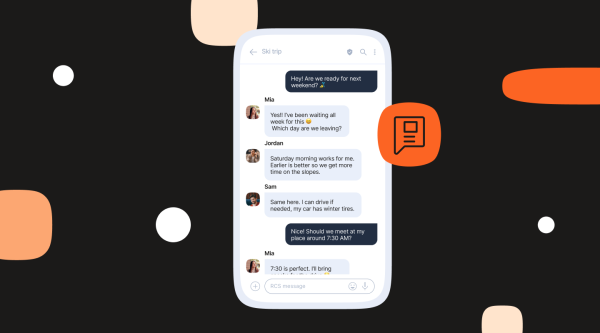
Ask a CX team in Europe or Asia how they handle a customer follow-up on RCS. They stay in the thread, the conversation continues, one session covers the whole exchange.
Ask a US brand the same question and the answer is different. Per-message billing has made genuine back-and-forth commercially difficult, so conversations get cut short or redirected.
That’s changing. RCS Interactive Session billing has launched in the US, and for the first time, US businesses can design conversational messaging around what customers actually need, not around what the billing model will allow.
What is conversational messaging?
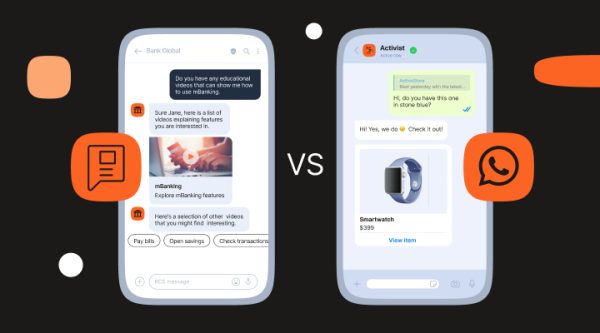
Conversational messaging is two-way, real-time communication between businesses and customers through channels like RCS, WhatsApp, and SMS.
Instead of just sending messages, businesses can have real conversations with their customers. Customers can ask questions, request changes, get clarification, and sort things out right there in the chat. No jumping between websites or call centers, no repeating themselves, and no waiting on hold.
For businesses, that means every interaction becomes an opportunity to resolve, convert, or retain, rather than just inform.
Why conversational messaging is growing
Two things have changed the economics of conversational messaging in recent years.
First, AI. Early automation tools handled simple, scripted deterministic flows. Modern conversational AI maintains context across a session, understands intent, manages handoffs to human agents, and supports complex and dynamic journeys end to end. The quality gap between automated and human conversation has closed significantly.
Second, customer expectations. Messaging is how people communicate. Consumers already use it for everything from coordinating plans to managing finances. The expectation that businesses meet them in the same channel, with the same responsiveness, has followed naturally.
For businesses to commit to conversational experiences, the commercial model has to support it. Every follow-up, every clarification, every moment of genuine helpfulness needs to be economically viable.
What is conversational billing for RCS (Interactive Sessions)?
Conversational billing means paying for an active customer conversation, not for every individual message within it. For RCS, this model is delivered through Interactive Sessions.
Instead of a separate charge for each message sent or received, businesses pay one fee for all messages exchanged within a defined time window, typically 24 hours.
Think of it as paying for the dialogue, not the sentences.
What are the differences between non-conversational and conversational billing?
Two billing models apply to RCS, each with its own rates depending on the message type. Which one you use is determined by your sender-level billing category, which is set before launch and locked afterward. It isn’t something you switch on a per-conversation basis, so it’s worth deciding which model fits your use case before you go live.
Traditional per-message billing
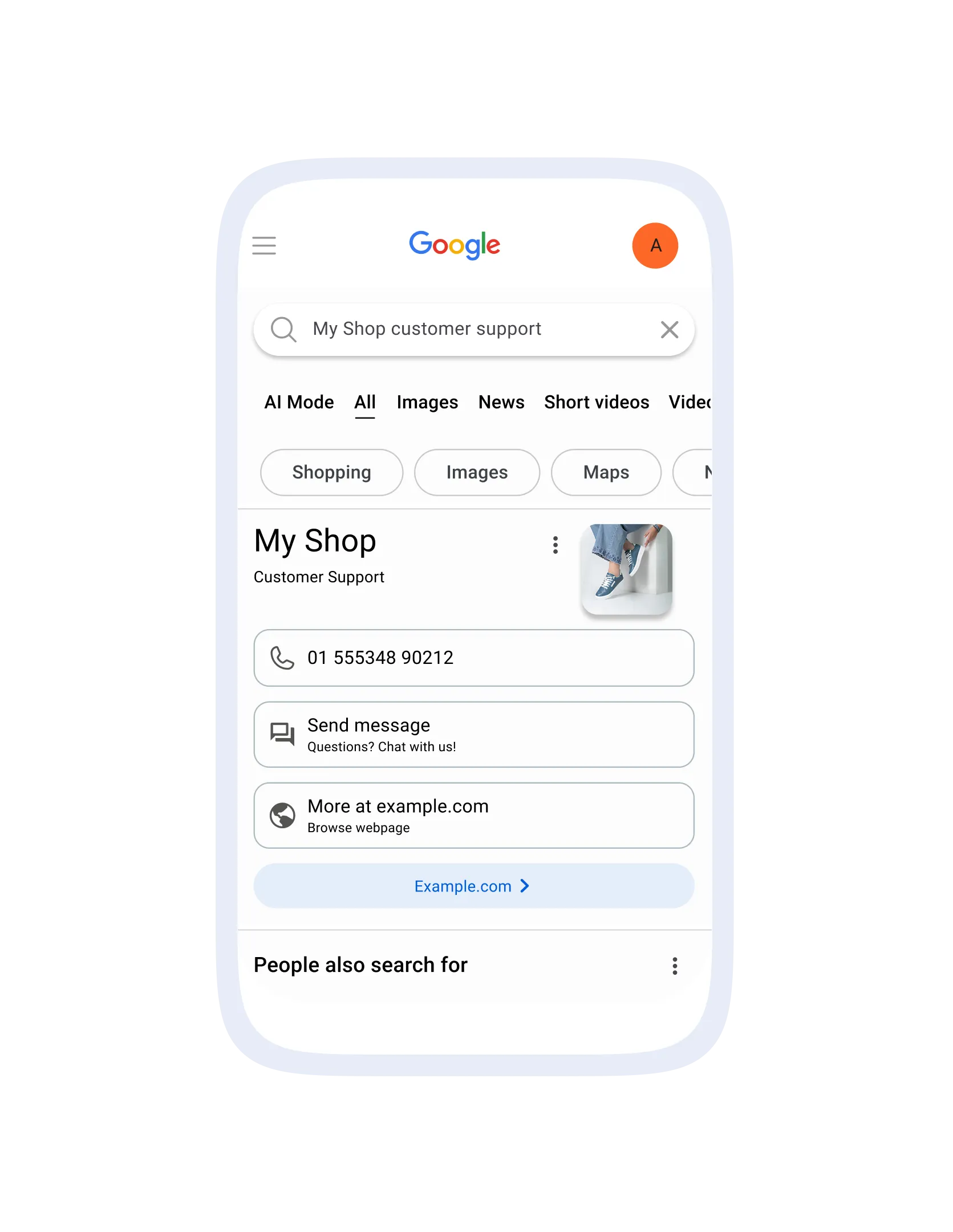
In a P2A flow, where a customer initiates contact through an entry point like Google Search, every message exchanged between the customer and business carries a separate charge*. The longer and more actively the conversation runs, the higher the cost.
That makes spend unpredictable. Total cost depends entirely on how the customer engages, and businesses have no way to know in advance how many exchanges a single issue will require. Many respond by shortening replies or routing customers away from the thread, which defeats the purpose of a conversational channel.
Non-conversational billing charges per delivered message. It works well for one-way messaging such as OTPs, alerts, notifications and promotions. For sustained, two-way interactions, it creates the wrong incentive.
Customers don’t think in messages. They think in conversations. They ask questions, change their minds, and look for reassurance, guidance, and confirmation, often within the same interaction. A billing model that charges per message treats every helpful reply as a cost to minimize, meaning that good CX and achieving the right outcome for the customer may be compromised.
*Not all carriers charge for messages sent from a customer.
Conversational billing (RCS Interactive Sessions)
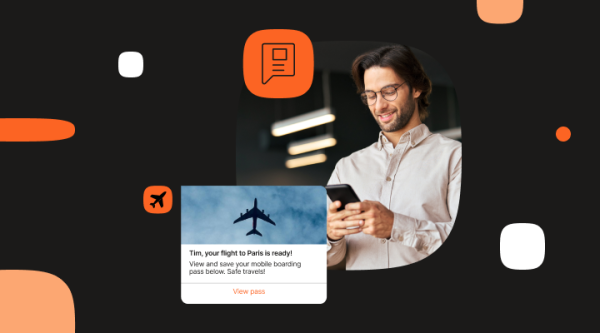
To address the challenge of not knowing the exact cost of a conversation in advance, conversational (Interactive Session) billing provides a more predictable model. In the US, a session is triggered once four messages have been exchanged: at least two from the business and at least two replies from the customer. From the first of these four messages, a 24-hour session window begins. Sessions can start either way: in an A2P conversation the business starts (triggered by an MT message), and in a P2A conversation the customer starts, including from Google entry points (triggered by an MO message).
4
At least four rich or rich media messages are exchanged between brand and customer
2+
Including at least two outbound messages from the brand
2+
And at least two replies from the customer
During this window, all messages are covered by a single fee. Customers can follow up, ask questions, or take action, while businesses can respond freely without considering the cost of each individual message.
If the customer doesn’t reply within 24 hours, or the threshold isn’t met, messages are billed individually at standard rates, ensuring full cost transparency.
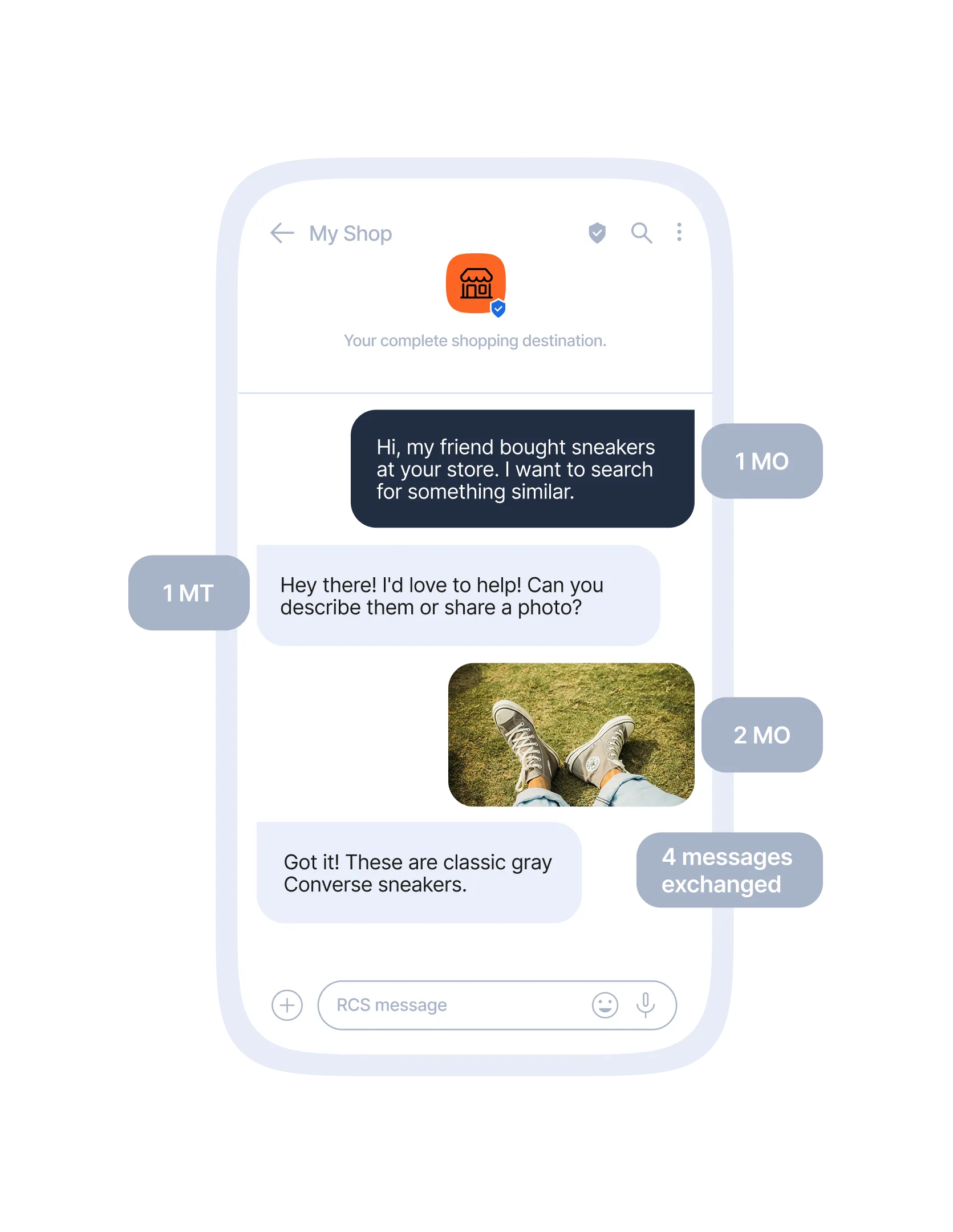
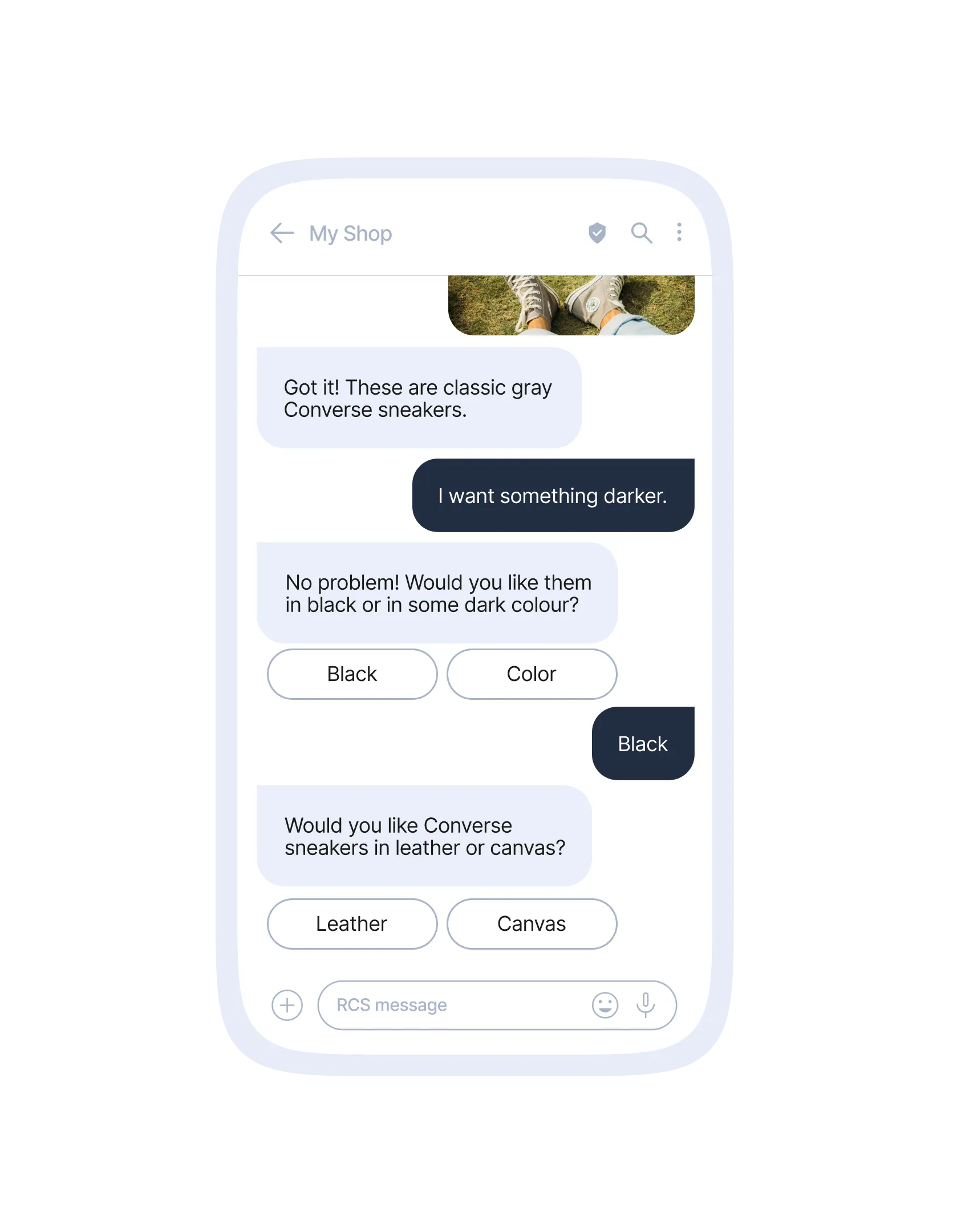
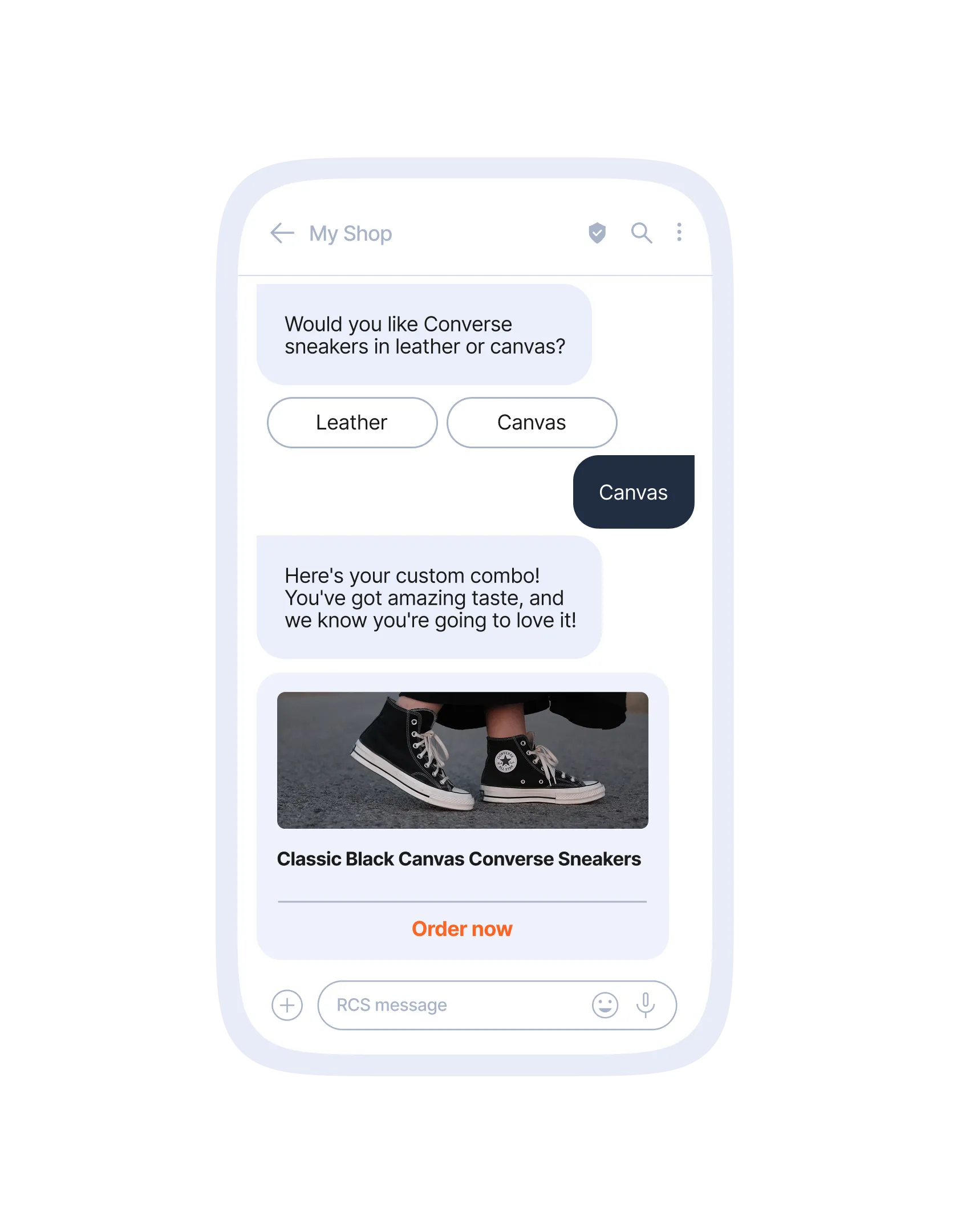
A concrete example
Business-initiated conversation (A2P) example
Without conversational billing
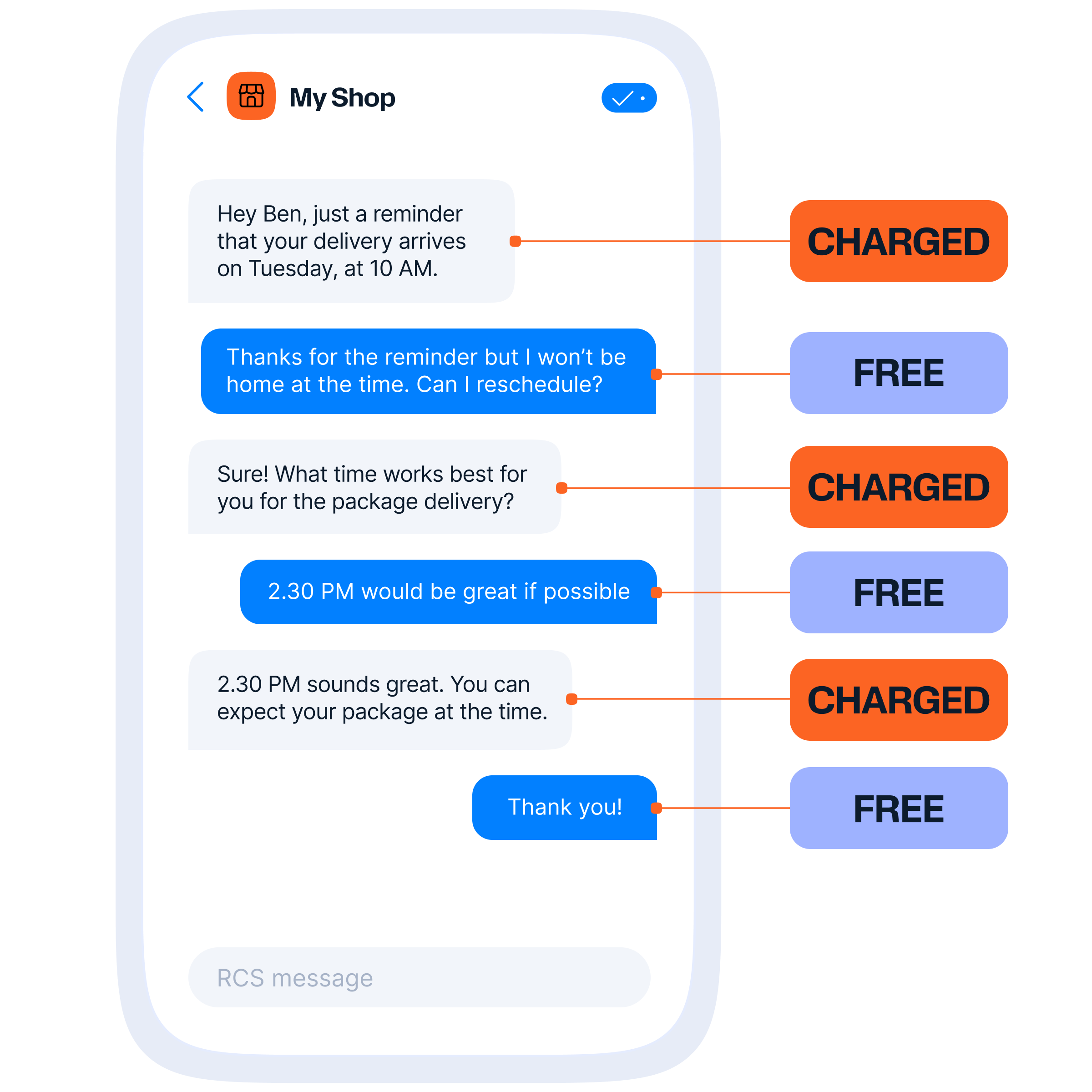
Every exchanged message adds to the bill. The commercial model works directly against providing a good service.
With conversational billing
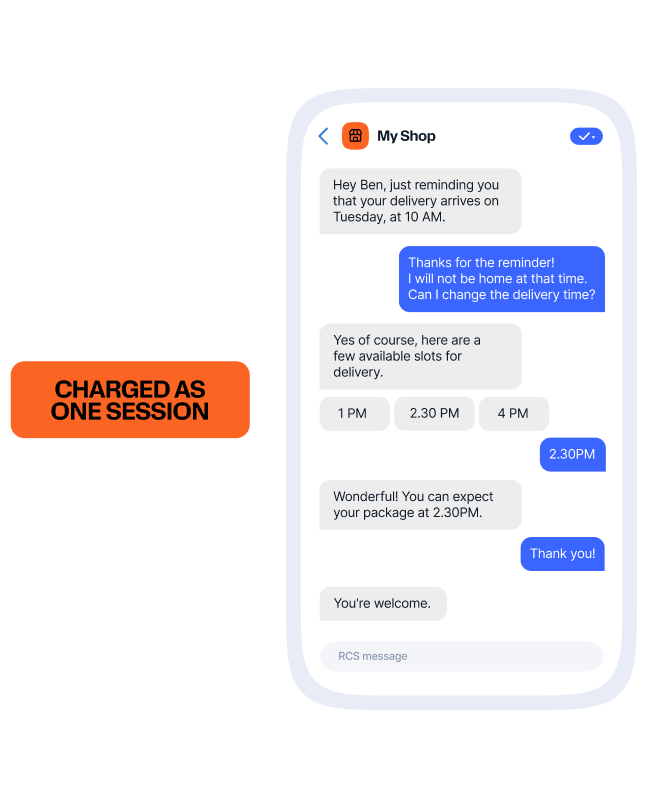
One session. One predictable cost. A far better experience.
User-initiated conversation (P2A) example
Without conversational billing
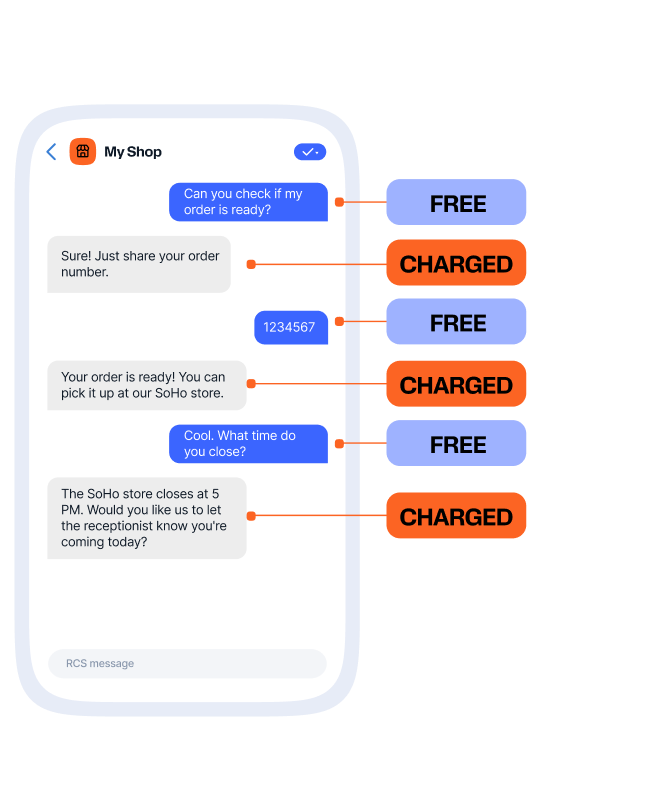
Every clarification, every reassurance, every useful reply adds to the cost.
With conversational billing
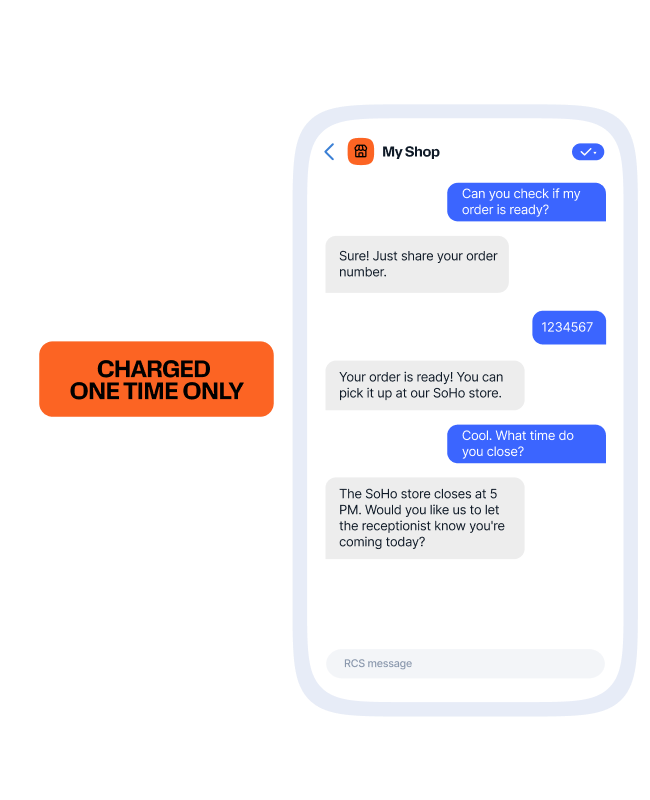
One session covers it all.
| Rich (US) | Rich Media (US) | |
|---|---|---|
| Overview | Branded, verified. No media. | Branded, verified. Media with size limits. |
| Characters | Up to 160 UTF-8 bytes | 3,072 |
| Suggested buttons and actions |
RoW Basic: none. US Rich: all suggested replies, plus some actions (Open URL, Dial a phone). |
All, including suggested replies and actions, and Open URL with webview |
| Media | None | All RCS media types |
In the US, Rich Messaging is similar to Basic Messaging in the rest of the world. The main difference is that Basic only supports text, while Rich Messaging also supports buttons. Single and Rich Media are exactly the same.
This session model is aligned between Google and US carriers, and Infobip fully supports it.
What Interactive Session billing unlocks for CX teams
With Interactive Session billing in the US, CX teams will gain something they haven’t had before: the ability to design around customer intent and outcomes, not channel economics.
That means:
- Support that resolves issues in one conversation, not across five disconnected touchpoints
- Shopping journeys that adapt in real time based on user responses
- Post-purchase engagement that feels helpful rather than intrusive
- Sales conversations that are consultative, not promotional
- Customer-initiated exchanges that happen on the customer’s schedule
All without pushing users to download apps, create accounts, or repeat themselves. This is where RCS moves from being “a better SMS” to becoming a genuine CX channel.
Where Infobip makes the difference
Conversational billing creates the conditions for better CX. Execution determines whether that potential becomes business value.
Infobip helps businesses translate conversational capability into measurable customer outcomes through:
- End-to-end orchestration across messaging, automation, and human agent handover
- Visibility and controls that keep CX and commercial teams aligned
- Integration with existing systems and customer data, without rip-and-replace work
- Proven experience deploying conversational messaging at enterprise scale across global markets
- Guidance on choosing the right sender-level billing category before launch, since it can’t be changed afterward
Full transparency in your billing reports
To give you total transparency and better cost prediction, we’ve added new fields to Infobip billing reports:
- which billing model was applied: Rich, Rich Media or Interactive Session
- whether the message can start a conversation
- which session it belongs to, so you can see which messages were billed together
- whether the message was sent or received, and in which format
Rather than treating conversations as isolated events, Infobip enables brands to manage them as part of a continuous customer journey, from the first message through to resolution or conversion.
Now, when the Interactive Session billing is live in the US, that orchestration layer becomes more important. The goal isn’t to have more conversations. It’s to design better ones.
RCS makes those experiences possible. Conversational billing makes them scalable. Infobip makes them work in the real world, at enterprise scale.