


How to use data to improve customer experience across every channel
Most businesses collect more customer data than they can act on. This guide covers how to close the gap between data collection and real CX outcomes, from identifying the right data sources to activating insights across every channel where customers interact.

Most businesses collect more customer data than they can act on. CRM systems log every purchase. Web analytics track every click. Support tickets document every complaint. But only 39% of consumers report receiving experiences that feel genuinely personalized, even though 90% of companies consider it a strategic priority, according to Forrester. IE University puts the market commitment even higher. 95% of CX leaders have already invested or plan to invest in data platforms.
This guide covers how to build a data strategy that closes that gap, from identifying the right data sources (including one most companies overlook entirely) to activating insights in real time across every channel where customers interact. Infobip powers billions of customer conversations across 17+ channels, and the patterns we see from that scale inform everything below.
Why most data-driven CX strategies fail (and what to do instead)
Organizations often diagnose their CX problems correctly. Customers aren’t being recognized across channels, agents lack context, and personalization is inconsistent. The usual response is to buy more data tools. The problem often lies in the integration between tools and the architecture it sits in. The result is a data-to-action gap like how insights exist, but they never reach the channels where customers interact.
Two failure modes show up consistently:
1. The data silo problem
Customer data lives in disconnected systems by default. The CRM holds contact details and purchase history, web analytics tracks browsing behavior, the contact center logs support tickets, and marketing automation records email engagement. None of these systems share data naturally, which means no single team has a complete picture of any customer.
The results are predictable. A customer who just filed a support complaint receives a promotional email that same afternoon. A loyal buyer of three years gets treated as a first-time visitor when they switch channels. Or an agent spends the first two minutes of every call asking questions the customer already answered somewhere else.
Research shows most businesses sample only 7% of customers when measuring CX. That isn’t a reliable sample to build entire CX journeys on. And the most underutilized data source of all doesn’t live in any of those siloed systems. It’s the conversations customers have directly with businesses, across messaging channels, chatbots, and phone calls, in real time.
2. Collection without activation
The second failure mode affects organizations that have solved the silo problem. They’ve built a data warehouse, they have dashboards, and their analysts produce excellent weekly reports. But still nothing changes in the customer’s experience.
Data sitting in a dashboard can’t personalize a WhatsApp message. Insights that require a quarterly review cycle can’t trigger a real-time response to a frustrated customer. The distance between where insights are generated and where customers interact is where CX strategies quietly fall apart.
The fix isn’t more analysis. It’s activating data in the channels where it matters, which requires infrastructure that connects insight directly to action. That’s the gap the sections below address.
The customer data that actually improves CX
Not all data delivers equal CX value. Before building a collection and unification strategy, it helps to understand which data types produce the highest-impact outcomes.
Conversational data: The missing layer
Every customer interaction via messaging, live chat, AI chatbot, or voice call generates something that no dashboard captures well: intent. What does this customer actually need, right now, in their own words?
Conversational data covers chat transcripts, message threads, chatbot conversation logs, and voice call summaries. It reveals purchase intent, product confusion, recurring complaints, and sentiment patterns that no other data source matches. It’s direct, contextual, and real-time. Unlike survey responses, which are delayed and self-reported, or click data, which requires inference; conversational data captures what customers mean, not just what they do.
Few competitors position conversational data as a primary CX input. That’s a significant gap, because it’s the richest signal available. Infobip processes billions of conversations across 17+ channels. When that data is unified into a single customer profile, every subsequent interaction benefits from the full context of what that customer has said, asked, and resolved before.
Behavioral, transactional, and feedback data
Three other data types complete a full CX picture.
- Behavioral data (website visits, app sessions, feature usage) shows how customers interact with your product.
- Transactional data (purchase history, order value, renewal patterns) shows what they buy and when.
- Feedback data (Net Promoter Score (NPS), CSAT, Customer Effort Score (CES), reviews) shows how they feel about those experiences.
Each type contributes something useful. Behavioral data surfaces friction, transactional data segments customers by value and lifecycle stage, and feedback data flags problems after they’ve occurred. The limitation of relying on these three alone is that they describe customer behavior after the fact rather than capturing customer intent in real time. Conversational data fills that gap, and Infobip’s Conversational CDP within AgentOS unifies all four types into a single, continuously updated customer profile.
With the right data types identified, the next question is how to collect, connect, and activate them. That’s where most organizations need a clearer structure.
A practical framework for data-driven CX improvement
The four steps below cover the full arc from data collection to CX outcome. Each step builds on the previous one; treating them as independent initiatives is one reason most data strategies stall before producing results.
Step 1: Collect data from every customer touchpoint
Most businesses over-index on web and email data because those channels have the most mature analytics tooling. If customers are also contacting you via WhatsApp, SMS, live chat, RCS, or voice, that interaction data is often missing from the customer profile entirely.
A complete collection strategy covers messaging channels, chatbot and AI agent conversations, contact center interactions, mobile app behavior, social media interactions, in-store touchpoints, and transactional events from eCommerce and CRM systems.
Two principles matter here. First, prioritize first-party and zero-party data. Information customers provide directly (through conversations, explicit preference settings, account behavior) is more accurate and more privacy-compliant than third-party data. Second, collect at the channel level. Infobip captures interaction data natively across 15+ messaging channels, which means conversational data gets included in the customer profile automatically rather than requiring a separate integration for each channel.
Step 2: Unify data into a single customer profile
Collecting data from multiple channels creates a different kind of silo problem: multiple partial profiles for the same customer across different systems. Identity resolution (matching the same person across email, phone number, device ID, and messaging handle) is what converts those fragments into a single usable record.
A Customer Data Platform (CDP) handles this unification layer. It connects to all data sources, resolves identities across them, and maintains a profile that updates as new interactions happen.
Infobip’s Conversational CDP within AgentOS does this for messaging data natively. Because Infobip sits in the communication infrastructure layer, every WhatsApp message, SMS, and chatbot session enriches the customer profile automatically, without exports, middleware, or lag. The resulting profile includes not just what customers bought, but what they asked, or complained about, and how those issues were resolved.
Step 3: Analyze for actionable CX insights
Unified data enables analysis that siloed data can’t support. With complete customer profiles, it becomes possible to map customer journeys across channels rather than within a single channel. A customer who starts on your website, escalates to live chat, and follows up via WhatsApp is one journey, not three separate interactions.
It also becomes possible to predict churn using behavioral signals before customers disengage. Patterns like declining open rates, unresolved support tickets, and reduced purchase frequency tend to precede churn by weeks, leaving enough lead time to intervene. Sentiment analysis across conversational data can surface recurring pain points that are almost invisible in NPS scores alone. If 30% of chatbot conversations in a given week include variations of the same complaint, that’s actionable data worth acting on immediately. AI can also surface segment patterns that aren’t visible in manual analysis, grouping customers by behavioral signals, conversation topics, and lifecycle stage to identify audiences that weren’t previously tracked.
The CX metrics that matter most across a unified data strategy. NPS for loyalty, CSAT for interaction quality, CES for ease of resolution, FCR (first contact resolution) for support efficiency, containment rate for self-service effectiveness, and conversation sentiment trends. Infobip’s Insights and Analytics module within AgentOS surfaces these metrics across all channels, not just web.
Step 4: Activate insights across every channel in real time
This is where most strategies fall short. Insights are generated; reports are shared, but then nothing changes until the next planning cycle.
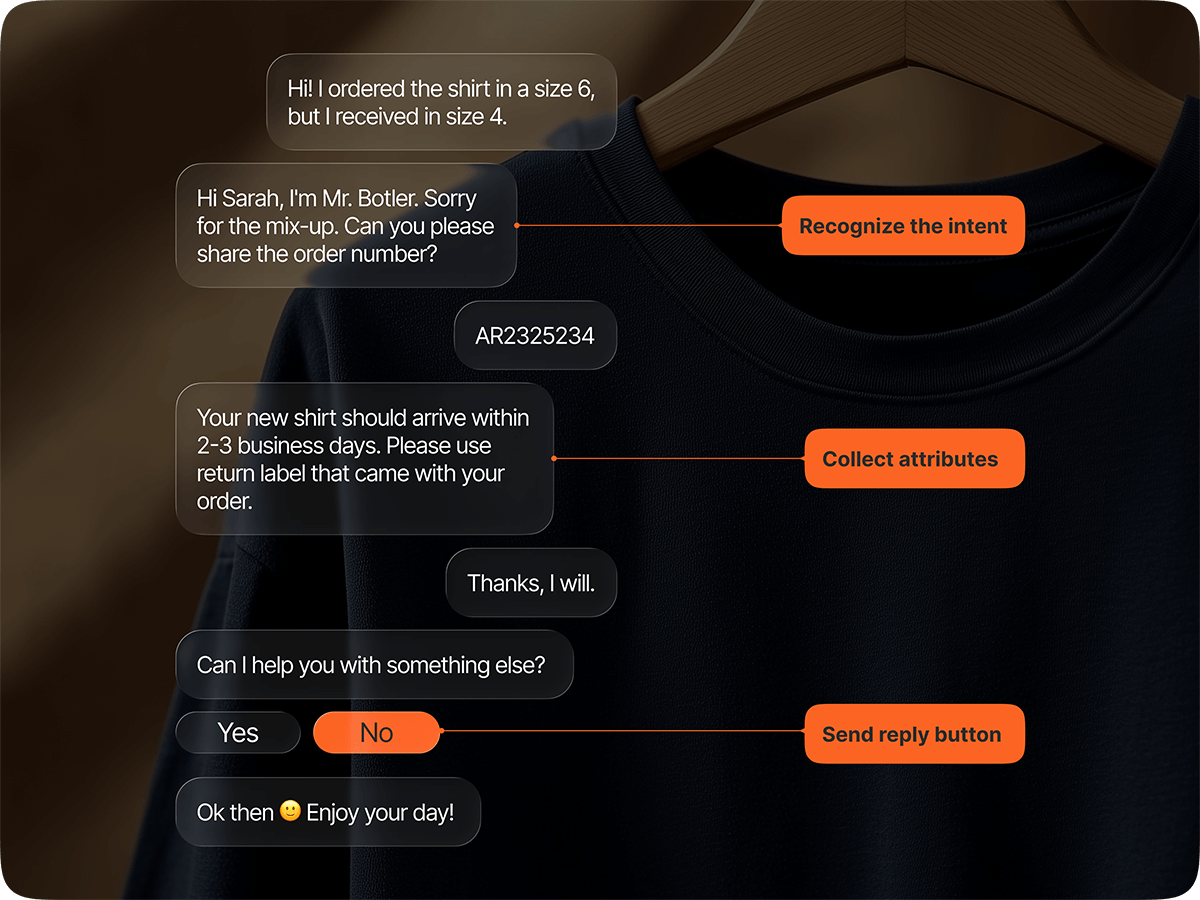
Real data activation looks different. When a customer with a history of premium purchases opens a chatbot conversation, their AI agent response draws on that purchase history to offer relevant recommendations rather than a generic greeting. When a support ticket remains unresolved after 48 hours, a proactive notification goes out via the customer’s preferred channel without requiring a human to trigger it. Behavioral signals pointing toward a renewal decision trigger a tailored journey automatically.
AgentOS connects the CDP to action natively. The chatbot builder, AI agents, journey orchestration, and cloud contact center all read from the same customer profile. There’s no export step, no data pipeline to maintain, no lag between insight and customer response. The sections below show what this looks like in practice.
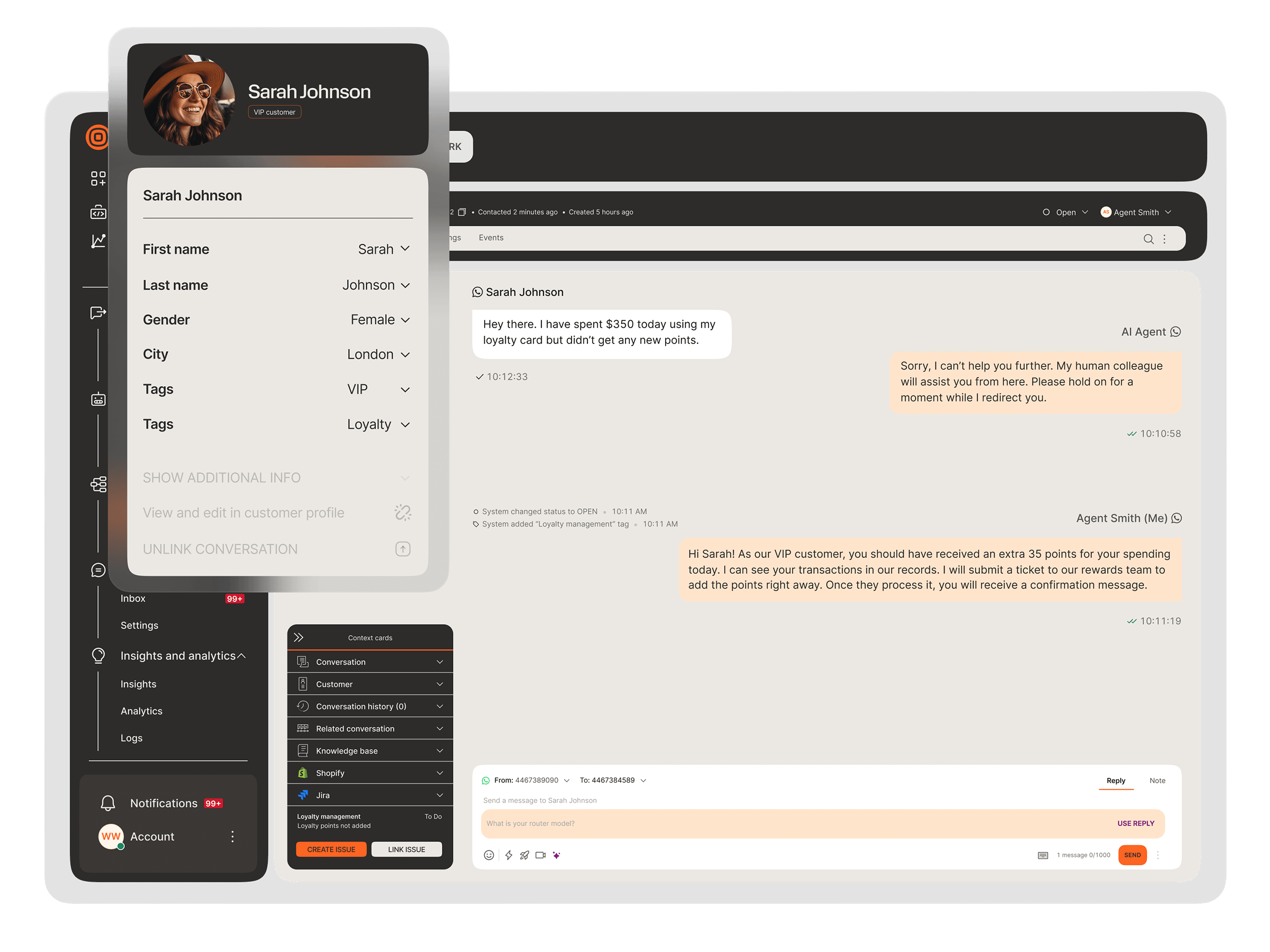
AgentOS Cloud Contact Center with integrated data from CDP.
Real-world examples of data-driven CX improvement
Personalized conversational journeys
Bolt needed to increase conversion on their sign-up flow across markets. Rather than sending the same WhatsApp sequence to every prospect, they personalized journeys based on regional data and user behavior. Treating each sign-up as a unique conversation rather than a broadcast increased conversion rates by 40%.
Intelligent support routing with full context
Farm Superstores built a WhatsApp-based support operation where every customer interaction surfaces the full account context before a human agent ever needs to intervene. Agents know what the customer bought, what they’ve asked before, and how previous issues were resolved. That context eliminated the time wasted on repeated questions and drove a 60% reduction in operational costs.
Proactive customer engagement
LAQO Insurance deployed an AI chatbot that uses customer profile data to provide contextually accurate responses rather than generic policy information. When a customer asks about a claim, the chatbot already has the policy details, claim history, and relevant coverage information. Thirty percent of queries are now resolved entirely by the AI, with 90% of those resolved within three to five interactions.
Cross-sell and upsell based on behavioral signals
Customer data enables product recommendations that are relevant to where a customer is on their journey, not just what’s currently on promotion. A customer who has recently expanded their account and has a history of adopting new features is a fundamentally different upsell prospect than someone who has been stable for two years. With CDP data flowing into the messaging layer, those recommendations can be delivered in context, inside a conversation the customer initiated, rather than as an unsolicited marketing email.
These examples share a common thread: they all run on the same underlying infrastructure, connecting customer data directly to the channels where it can do something useful.
Getting started: building your data-driven CX stack
The technology foundation for data-driven CX has four components:
- a CDP for data unification
- omnichannel messaging infrastructure for collection and activation
- AI analytics for insight generation
- journey orchestration for automated execution
For a practical walkthrough of how these fit together, the conversational AI integration guide covers the implementation considerations in detail. IE University research shows companies that get the infrastructure right see up to an 80% increase in revenue.
Most enterprises already have parts of this. The gap is usually in the connections between them: data collected in the contact center doesn’t reach the messaging layer; analytics insights don’t trigger immediate responses, and the CDP and the channels operate as separate systems.
AgentOS is built as an integrated platform covering all four components natively. The Conversational CDP unifies data from messaging interactions, CRM systems, and behavioral data sources. The journey orchestration and AI agents read that data and act on it in real time across 17+ channels. The Insights and Analytics module surfaces CX metrics across the whole picture, not just one channel at a time.
For enterprises that need implementation support, Infobip’s professional services team handles integration architecture, data mapping, and activation strategy. The starting point is usually a conversation about where your data currently lives and where the activation gaps are. Infobip was also named a Leader in the 2026 Gartner Magic Quadrant for CPaaS, recognizing the platform’s ability to execute at enterprise scale.
Closing the gap between data collection and CX outcomes isn’t a strategy problem. Most organizations already have the data. The challenge is infrastructure: getting the right insight into the right channel at the right moment, without manual intervention at every step. That’s what a unified data-to-action architecture makes possible, and it’s where the biggest CX gains are waiting.
17+ channels. 130+ languages. 850+ carrier connections. 190+ countries. 99.95% uptime. Your data activated everywhere your customers are.
FAQs
Data analytics improves CX by revealing patterns in customer behavior, preferences, and pain points across every touchpoint, enabling businesses to personalize interactions, resolve issues faster, and anticipate needs before customers articulate them. The most effective approach combines conversational data from messaging channels with behavioral and transactional data in a unified customer profile, then activates those insights in real time. Infobip’s AgentOS provides this end-to-end capability. A Conversational CDP for data unification, AI-powered analytics for insight generation, and omnichannel activation across 17+ channels.
The four most valuable data types for CX improvement are conversational data (chat transcripts, messaging interactions, chatbot conversations, voice call insights), behavioral data (website visits, app usage, feature adoption), transactional data (purchase history, order value, frequency), and feedback data (NPS, CSAT, CES surveys, reviews). Conversational data is the most underutilized of the four. It captures customer intent and sentiment in real time, in their own words, across the channels they actually use.
A data-driven customer experience is one where every interaction is informed by unified customer data, from personalized chatbot responses to intelligent support routing to proactive messaging. Rather than treating customers as anonymous visitors, data-driven CX uses identity resolution, behavioral signals, and conversational history to deliver contextually relevant experiences at every touchpoint. The key distinction is real-time data activation: insights need to flow into the channels where customers interact, not just into dashboards and reports.
A Customer Data Platform improves CX by breaking down data silos and creating a single, unified profile for each customer, combining data from CRM, analytics, support, messaging, and transactional systems. This unified profile enables personalization at scale, intelligent routing, proactive engagement, and contextual cross-sell and upsell. A Conversational CDP, like the one within Infobip’s AgentOS, goes further by enriching profiles with real-time conversational data from 15+ messaging channels.
Key CX metrics include Net Promoter Score (NPS) for loyalty, Customer Satisfaction Score (CSAT) for interaction quality, Customer Effort Score (CES) for ease of resolution, First Contact Resolution (FCR) for support efficiency, containment rate for self-service effectiveness, channel preference shifts for engagement patterns, and conversation sentiment trends for real-time CX monitoring. Track these across all channels, not just web, to get a complete picture of CX performance.
AI improves CX by processing unified customer data at scale to deliver personalization, prediction, and automation that manual processes can’t achieve. Specific applications include sentiment analysis of conversational data, churn prediction (identifying customers likely to disengage before they leave) using behavioral patterns, intelligent routing based on customer profile and query type, proactive engagement triggered by behavioral signals, and AI agent responses grounded in customer history and knowledge bases. Infobip’s AgentOS combines AI agents with a native CDP to deliver AI-powered CX at enterprise scale.
Breaking down data silos requires a unification layer, typically a CDP, that connects to all data sources (CRM, analytics, contact center, messaging, eCommerce) and creates a single customer profile. The key is choosing a platform that integrates natively with your customer interaction channels rather than one that requires complex middleware for each connection. Infobip’s Conversational CDP within AgentOS unifies data from 15+ messaging channels, web, and enterprise systems into a single profile that is immediately actionable across every touchpoint.
Conversational data is the information generated from customer interactions across messaging channels (WhatsApp, SMS, RCS), chatbot conversations, live chat, and voice calls. It includes intent signals, sentiment, topic patterns, resolution outcomes, and language preferences. It’s the most direct signal of customer need, captured in real time, in the customer’s own words. Unlike survey data (delayed and self-reported) or behavioral data (inferred from actions), conversational data provides immediate, actionable insight into what customers want and how they feel.
Privacy-first CX requires collecting only first-party and zero-party data, ensuring GDPR and CCPA compliance in data storage and processing, providing transparent consent mechanisms, enabling data residency controls, and using platforms with enterprise security certifications. Conversational data from opted-in messaging interactions is inherently privacy-compliant and high-value. Infobip operates with SOC 2 Type II, ISO 27001, and GDPR compliance across 43 data centers with data residency options.