
RCS encryption explained: How secure is RCS messaging for businesses?

Explore how RCS messaging secures business communications with TLS encryption, verified senders, global compliance, and what’s next on the path toward full end-to-end protection.

Nina Vresnik Content Marketing Specialist
Skip to table of contents

Security is often the first question businesses ask when exploring RCS messaging.

Unlike SMS, which sends messages in plain text, RCS provides encryption and verified sender protections that significantly improve message security. 

Still, many teams are unsure whether RCS matches the safety of fully end-to-end encrypted apps like WhatsApp, and whether it’s ready for sensitive use cases like banking, healthcare, or government services.

In this blog, we’ll explain:

  • The difference between TLS encryption in transit and end-to-end encryption (E2EE) in RCS
  • Why business RCS messages aren’t yet fully E2EE, and how Google and telecom partners are evolving the standard
  • How Infobip ensures secure delivery, verified senders, and regulatory compliance worldwide
  • How fallback channels like WhatsApp and secure SMS keep messages protected when RCS isn’t supported

What is RCS and how is it different from SMS?

RCS (Rich Communication Services) was developed by the GSMA as a modern upgrade to SMS, bringing richer media, verified branding, and interactive features directly into the native messaging app on supported devices.
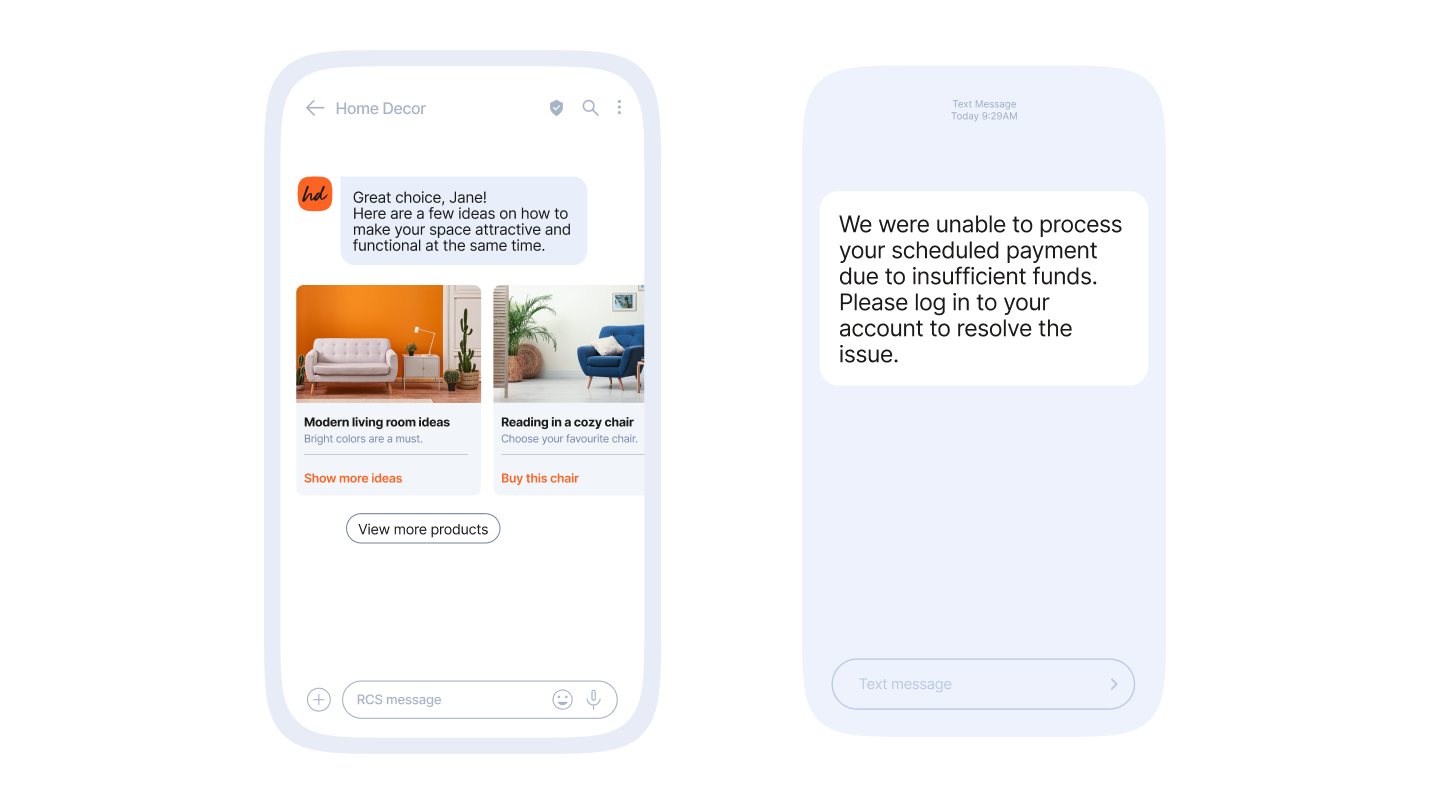
A side by side visual comparing an SMS to RCS. On the left side, we can see the RCS message coming from a verified user. The message says "Great choice Jane! Here are a few ideas on how to make your space attractive and functional at the same time." Below we can see interactions such as buttons for in-message purchases. On the right side, we can see an SMS message, with no images or interactions. The message says "We were unable to process your scheduled payment funds. Please log in to your account to resolve the issue.

Quick recap of RCS

  • Built for richer engagement: Supports read receipts, branded sender IDs, carousels, buttons, and rich media
  • Native integration: Pre-installed on most Android devices via Google Messages or carrier apps, requiring no additional downloads
  • Business-ready: Designed to handle both person-to-person (P2P) and application-to-person (A2P) messaging use cases

Is RCS encrypted? Yes, but it differs for P2P vs A2P

  • P2P (Person-to-Person): When two users chat via Google Messages, RCS messages are end-to-end encrypted, meaning only the sender and receiver can read the content.
  • A2P (Business Messaging): When brands send messages to customers, RCS uses TLS encryption in transit. This ensures messages are protected as they travel between the brand, Infobip, carriers, and the recipient’s device, but it’s not yet end-to-end encrypted.
  • Google is actively working with telecom operators and the GSMA to extend end-to-end encryption to business messaging in future updates.
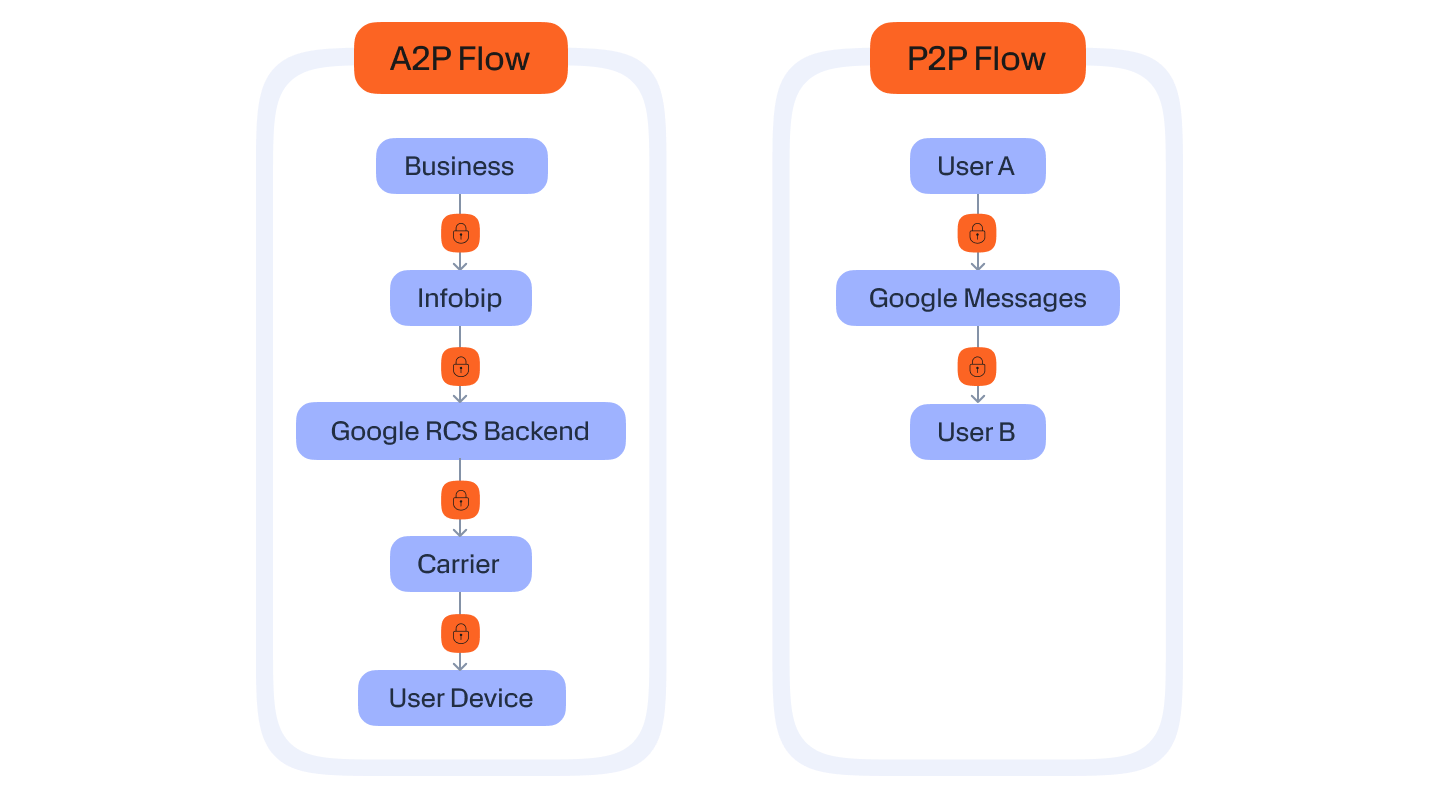
Visual type: Simple diagram / flow illustration Concept: Title: “Encryption in RCS: P2P vs A2P” • Left side (P2P): Two smartphones facing each other with a padlock icon directly between them. Caption: “End-to-End Encrypted – Only sender and receiver can read.” • Right side (A2P): A flow line showing: Brand → Infobip → Carrier → Customer Device. Along the path, padlock icons appear on the arrows, labeled “TLS in transit.” Caption: “Encrypted during transfer, not end-to-end.” • Footer note (lighter text): “Future updates aim to bring end-to-end encryption to business messaging.”

For non-RCS users, Infobip ensures message security with:

  • TLS encryption on SMS where supported.
  • Fallback to secure OTT channels like WhatsApp for sensitive or high-value communications.
Channel Encryption type Business messaging support
SMS None (plaintext) Yes
RCS P2P = End-to-end
A2P = TLS in transit
Yes
WhatsApp End-to-end encrypted Yes

Understanding RCS encryption

RCS brings significant security improvements over SMS, but encryption levels differ depending on whether it’s used for business messaging (A2P) or person-to-person (P2P) chats.

Encryption in transit vs. end-to-end

  • Business (A2P) RCS: Messages are encrypted in transit as they move between the business sender, Infobip, Google’s RCS backend, the mobile network operator, and the recipient’s device. This TLS-based encryption prevents unauthorized access during delivery but does not encrypt messages all the way from sender to recipient device.
  • Person-to-person (P2P) RCS: When two users chat via Google Messages on supported devices, the conversation can be fully end-to-end encrypted (E2EE), ensuring only the two participants can read the content.

Why A2P RCS is not fully E2EE yet

  • Cloud routing: Business messages often need to route through cloud infrastructure to handle high volumes, cross-carrier delivery, and automatic fallback to SMS or WhatsApp for non-RCS users
  • Verification and trust: RCS includes sender verification and message logging features to prevent spoofing and phishing. To support this, some message metadata must remain readable to authorized systems
  • Analytics and compliance: Businesses need access to delivery receipts, read statuses, and interaction metrics. Full E2EE would currently block these features, so encryption in transit is used instead
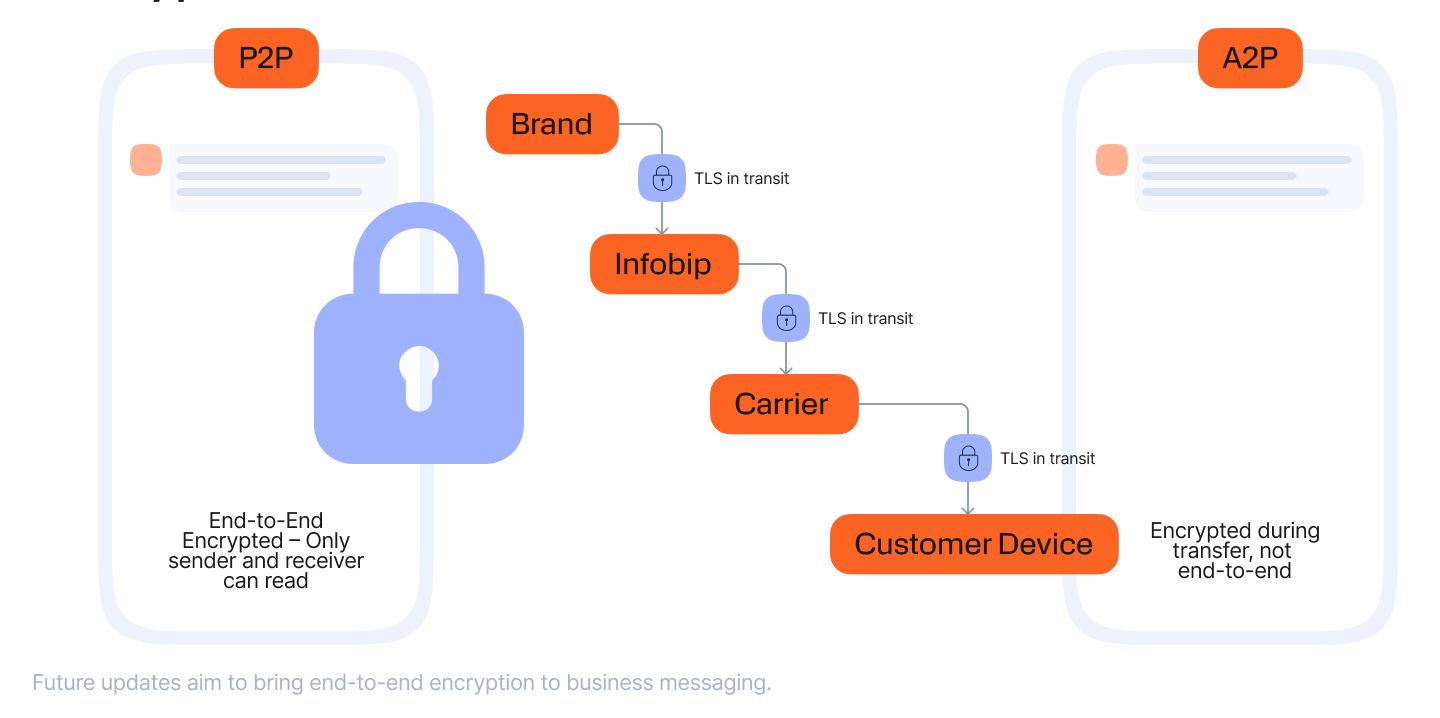
Visual type: Simple diagram / flow illustration Concept: Title: “Encryption in RCS: P2P vs A2P” • Left side (P2P): Two smartphones facing each other with a padlock icon directly between them. Caption: “End-to-End Encrypted – Only sender and receiver can read.” • Right side (A2P): A flow line showing: Brand → Infobip → Carrier → Customer Device. Along the path, padlock icons appear on the arrows, labeled “TLS in transit.” Caption: “Encrypted during transfer, not end-to-end.” • Footer note (lighter text): “Future updates aim to bring end-to-end encryption to business messaging.”

Common security questions about RCS

Security is a top consideration for businesses adopting new messaging channels. Here’s what you need to know about RCS encryption, sender verification, and cross-platform safety.

Is RCS safe for financial or healthcare use?

Yes, when implemented through a certified provider like Infobip.

  • Encryption in transit protects message content as it moves between the sender, carrier, and recipient.
  • Verified senders ensure only authenticated businesses can send RCS messages.
  • Infobip’s platform adheres to GDPR, local telecom regulations, and ISO-certified security standards.

These safeguards make RCS suitable for many regulated industries, including finance, healthcare, and government, while supporting secure notifications, fraud alerts, and patient communications.

Can messages be spoofed or intercepted?

  • Spoofing: RCS uses branded and verified sender IDs. Businesses must pass carrier and/or Google validation before sending messages. A blue checkmark appears next to verified senders, helping customers trust the message origin and reducing spam risks.
  • Interception: RCS messages are protected using TLS encryption in transit, preventing unauthorized access while the message travels across networks.

Infobip further enhances security with:

  • Brand verification for all clients
  • Secure APIs to prevent abuse
  • Telco-grade delivery infrastructure trusted by global carriers

What about iOS support?

  • With iOS 18, RCS is supported on both Android and iOS, improving interoperability and enabling rich messaging between devices.
  • Where RCS isn’t fully supported, Infobip automatically falls back to SMS or WhatsApp, ensuring message delivery while maintaining appropriate encryption levels.

What about interoperability across devices?

  • RCS is rapidly becoming a global standard for rich messaging on both Android and iOS platforms.
  • Infobip automatically handles cross-device compatibility, fallback routing, and message formatting, so campaigns reach all users consistently.
  • Looking ahead, Infobip will support the GSMA’s Messaging Layer Security (MLS) standard once it becomes available, enabling cross-platform end-to-end encryption for business messaging.

How Infobip keeps RCS messaging secure

Infobip provides enterprise-grade security for RCS business messaging, ensuring messages are delivered safely, verified for authenticity, and compliant with global regulations.

Secure delivery infrastructure

  • Direct carrier connectivity: 800+ direct telco connections across 190+ countries ensure messages never take insecure, indirect paths
  • Local compliance routing: Infobip adheres to regional data residency and telecom regulations, ensuring lawful and safe message delivery
  • Certified security standards: Our platform is certified with ISO 27001 (Information Security) and ISO 27701 (Privacy Information Management), with data encrypted both at rest and in transit
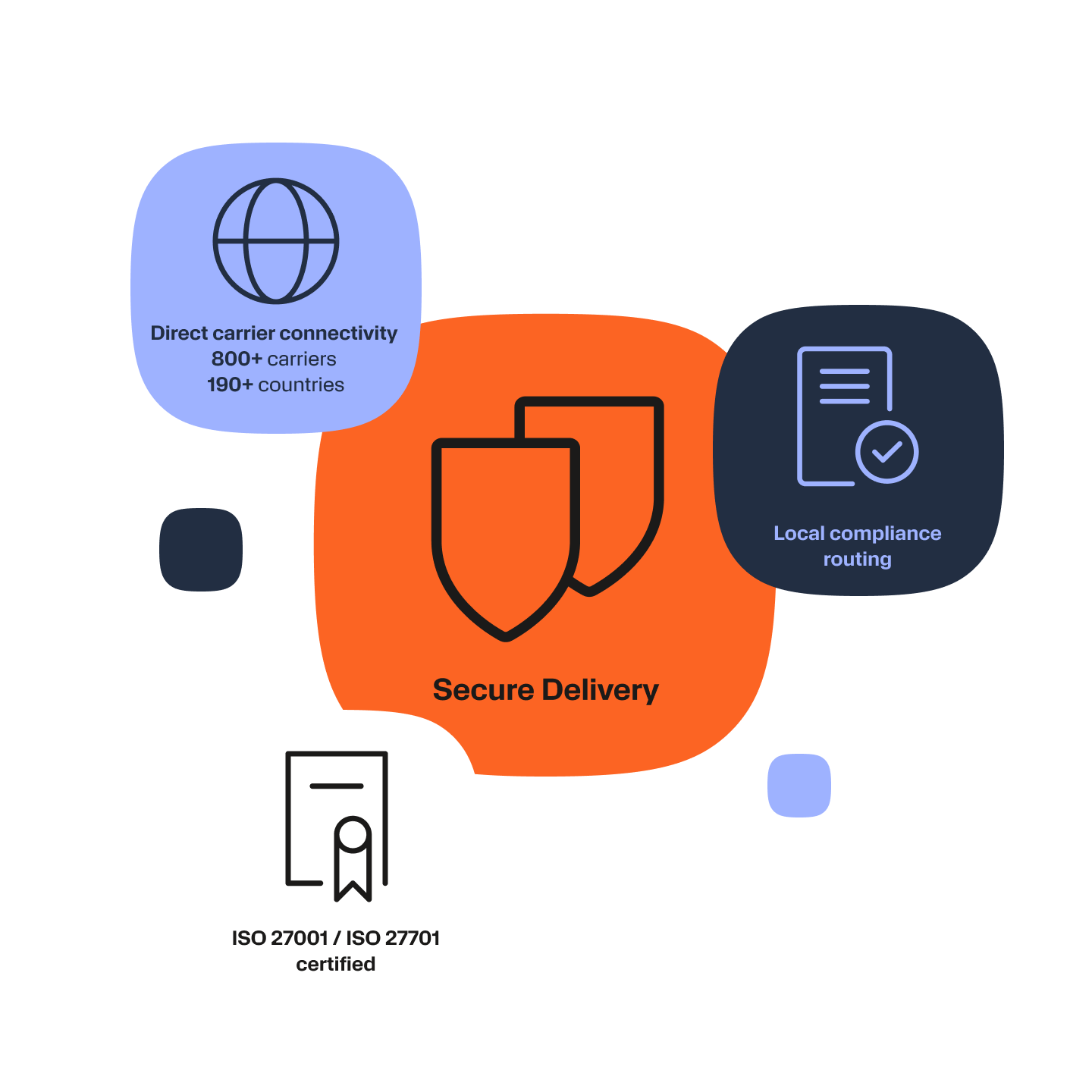
Title: Shield/Network graphic • A large shield icon in the center labeled “Secure Delivery”. • Three callouts radiating out, each with a small icon + short text: o Globe + arrows: Direct carrier connectivity (800+ carriers / 190+ countries) o Document + checkmark: Local compliance routing o Lock + certificate: ISO 27001 / ISO 27701 certified
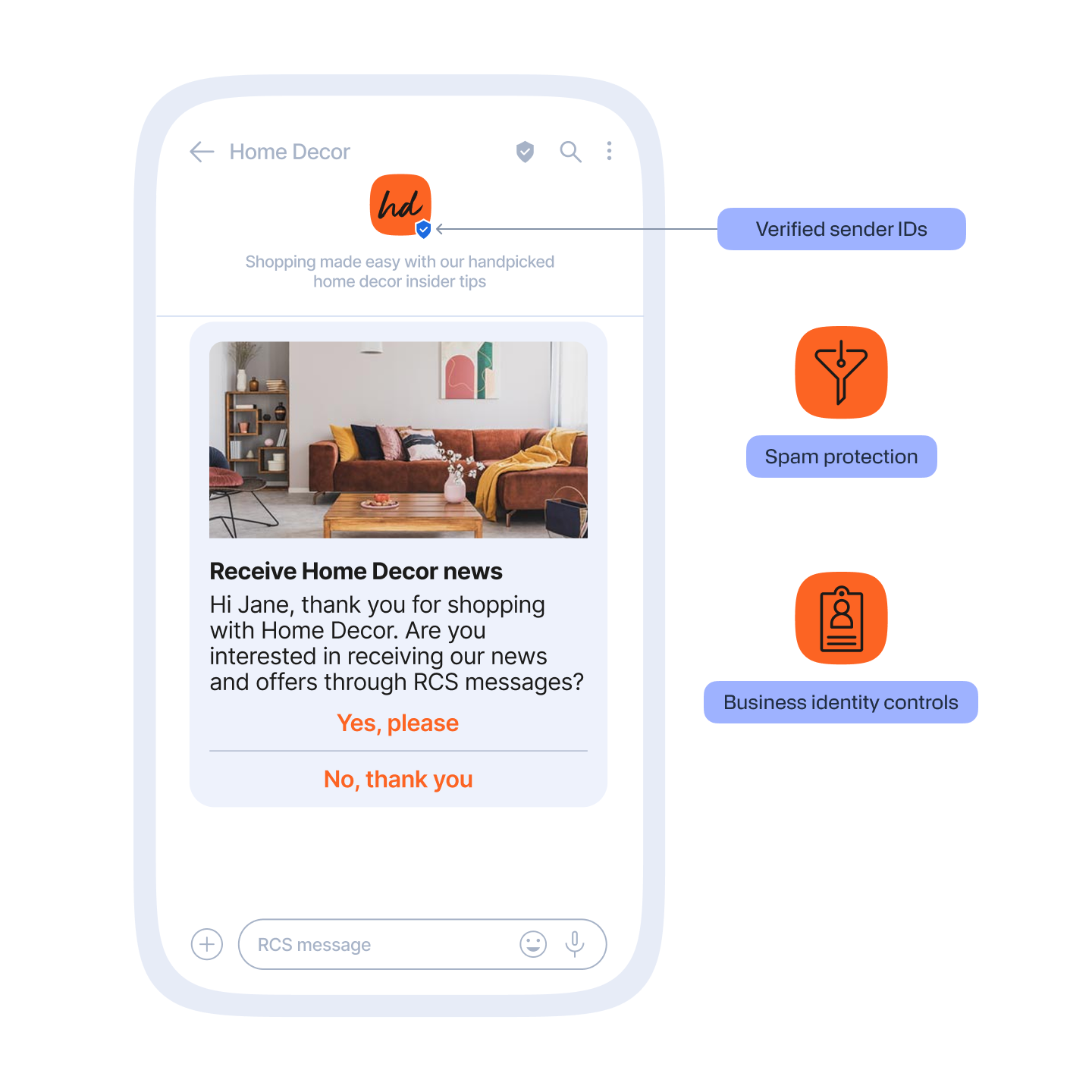
Title: Brand and Sender Verification Visual type: Chat bubble + checkmark graphic • A smartphone mockup showing a branded RCS chat thread. • At the top: sender name with a blue checkmark. • Three small labels around the phone: o Verified sender IDs (with shield/check icon) o Spam protection (with filter icon) o Business identity controls (with ID card icon)

Brand and sender verification

  • Verified sender IDs: All RCS messages are sent from authenticated, branded accounts to prevent spoofing or phishing
  • Spam protection: Built-in filtering and validation mechanisms stop unauthorized messages before they reach end users
  • Business identity controls: Infobip manages business verification with carriers and Google, ensuring a blue checkmark and trusted brand presence

Compliant fallback across channels

  • If a recipient’s device doesn’t support RCS, Infobip automatically falls back to secure SMS or WhatsApp, ensuring delivery without breaking compliance
  • Encryption integrity is maintained across fallback channels, preserving data protection and trust in every scenario
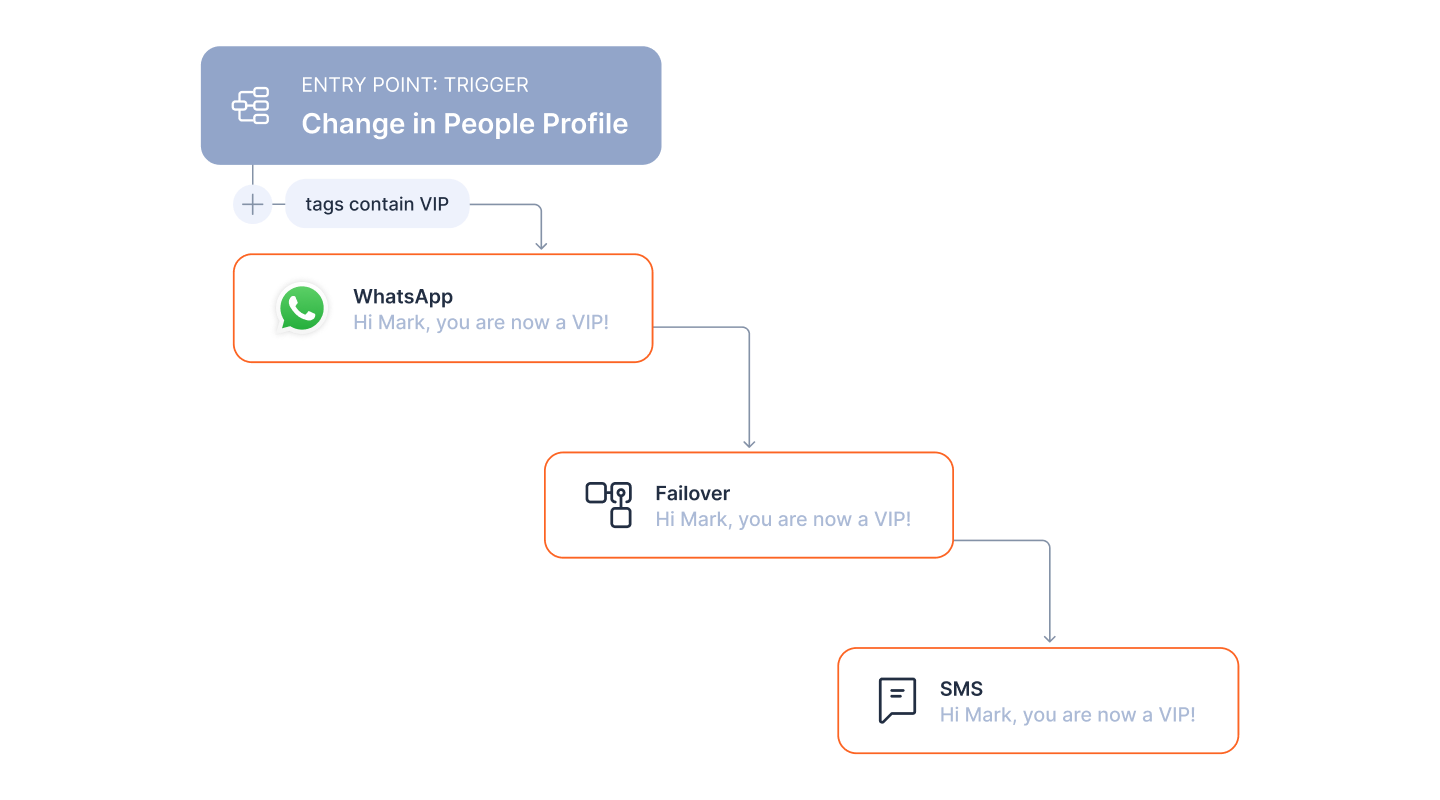
Visual showing fallback logic and secure messaging continuity. I tstarts with the entry point and showcases three same messages - first is whatsapp where the message reads "Hi Mark, you are now a VIP!". The second and third blocks show how the failover works, going from whatsapp to RCS, to SMS.

Industry examples and adoption

RCS is gaining traction across multiple regulated industries that require secure, compliant communication. Infobip enables these businesses to leverage RCS while ensuring fallback and encryption integrity.

Financial services

Financial institutions are adopting RCS for secure alerts and authentication flows:

  • Send transaction notifications, fraud warnings, and payment reminders using verified RCS brand IDs.
  • Use one-tap action buttons for card activation or secure login flows.
  • Automatically fallback to encrypted WhatsApp or SMS OTPs for customers without RCS support, ensuring compliance and message continuity.

Healthcare and public services

Hospitals and public agencies use RCS for patient updates and public safety alerts:

  • Send appointment reminders, vaccination notices, or health campaign updates via RCS rich cards.
  • Manage opt-ins and consent flows to comply with HIPAA and GDPR regulations.
  • In emergencies, Infobip’s secure SMS failover ensures critical updates reach every recipient instantly.

Retail and eCommerce

  • Verified branded promotions and interactive product showcases
  • Secure order confirmations and delivery tracking with RCS buttons and rich media
  • Fallback to WhatsApp or SMS to maintain security and coverage across the entire customer base

FAQs: RCS encryption

Build a messaging strategy your customers will love over channels of your choice
Read more:

Why CAPTCHA isn’t enough: Best alternatives in 2025

CAPTCHA alone can’t keep up with modern bots. Explore CAPTCHA alternatives that go beyond visual puzzles to block fraud in real time. See how Infobip Signals detects fake OTP traffic, stops AIT, and protects your platform, without adding friction for real users.

Sandra Posavac Content Marketing Specialist
Skip to table of contents

Basic CAPTCHA defenses break under modern bot pressure. In 2025, more businesses are replacing them with smarter, user-friendly, and more secure CAPTCHA alternatives. 

This guide explains why CAPTCHA is no longer effective and what alternatives are available. It also explains how Infobip Signals protects against modern threats like AIT and SMS fraud, without slowing down real users. 

What is CAPTCHA and why it’s failing today 

CAPTCHA, short for Completely Automated Public Turing test to tell Computers and Humans Apart, has long been used to stop bots. It requires user interaction to solve simple puzzles before they can submit forms, request OTPs, or view certain content. These tasks may include: 

  • Selecting specific images (visual puzzles) 
  • Solving math problems 
  • Typing distorted text 
  • Completing drag and drop actions 
  • Listening to and solving audio CAPTCHAs 

These are some of the most common types of CAPTCHA. They help confirm that the user is human. 

But there’s a growing problem: bots have become smart enough to solve these tests faster than people. 

Because of AI, modern bots can now solve CAPTCHA challenges, including reCAPTCHA v3, faster than human users. And with services like 2Captcha or DeathByCaptcha, or open-source tools available on GitHub, bypassing CAPTCHA has become low-cost and automated. 

Even worse, CAPTCHA can harm your platform in several ways: 

It frustrates real users and slows conversions: CAPTCHAs often get in the way of legitimate users, especially on mobile. They slow down sign-ups and increase form abandonment. 

It limits access for some users: Tasks like image selection or distorted text can be difficult for users with visual impairments, making CAPTCHA less inclusive. 

It gives a false sense of security: Many businesses rely on CAPTCHA alone. But without additional safeguards, attackers can easily bypass it, making it a weak line of defense. 

While CAPTCHAs can block simple bots, they fall short as a mitigation tool against advanced ones. 

The evolving threat: Why businesses need CAPTCHA alternatives

Modern bots use AI and machine learning to mimic human behavior. Many bots can now automatically get past CAPTCHA. These fake visits, called artificially inflated traffic (AIT) or SMS pumping, waste your money and create serious security problems. 

Attackers can: 

  • Trigger fake OTPs to exhaust SMS credits 
  • Flood your system with signups or logins to scrape data 
  • Exploit forms to launch phishing or spam campaigns 
  • Launch DDoS-style overloads using seemingly human interactions 

That’s why it’s time to look into alternatives to CAPTCHA that protect users and platforms more effectively. 

Diagram showing message filtering with three paths from a message icon. The top and bottom paths lead to icons representing groups of people and end with orange checkmarks, indicating approval. The middle path leads to an icon of a person wearing a hood and ends with a black circle containing a white "X," indicating rejection.
Your business receives OTP requests, but not all of them are legitimate traffic.

How to strengthen your anti-bot strategy 

Here are some of the most effective and accessible CAPTCHA alternatives businesses are now using: 

Behavioral analysis 

Instead of asking questions, this method observes how users behave by:

  • Analyzing actions like mouse movements, typing rhythm, scrolling, and clicking.
  • Distinguishing between bots and humans in real time
  • Avoiding interruptions for human users
  • Achieving high accuracy for detecting automated bot patterns
  • Working invisibly behind the scenes, improving UX

Example: A concert ticket site can tell if you are a real person by how naturally you move your mouse around the screen. Human users tend to have inconsistent movement patterns, while bots follow straight lines or have no mouse movement. The system silently blocks those sessions before checkout. 

Device fingerprinting 

This method collects information about your device and browser, like screen size and operating system, to create a unique ID for each visitor. Bots struggle to imitate these details consistently. 

  • Passive and background-based 
  • Highly effective on both web and mobile apps 
  • It detects bots even when they change IP addresses 

Example: A banking app notices 50 registrations all coming from devices with matching specifications. That’s a strong indicator of bot activity using fake phone numbers, so the app blocks those attempts. 

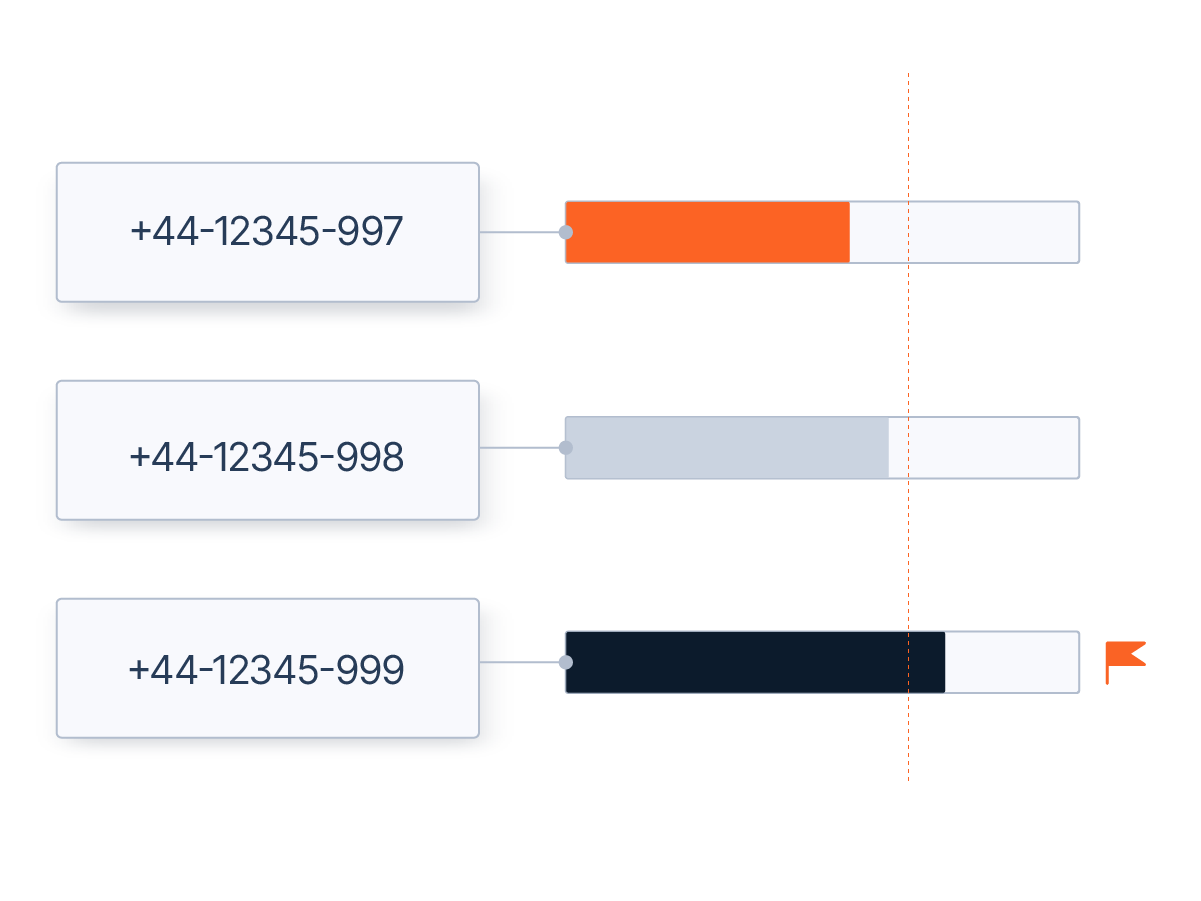
A chart showing three phone numbers with corresponding horizontal bars representing risk scores. The numbers are +44-12345-997, +44-12345-998, and +44-12345-999. The third phone number's bar is mostly filled with black, indicating the highest risk level, and has a small orange flag to the right of the bar, suggesting it is flagged as fraudulent.
Infobip’s platform uses data and insights to block numbers if the risk score is above the defined target.

Hidden field techniques 

A form includes an extra field that real users never see (because it’s hidden via CSS or JavaScript). Bots that auto-fill all fields will complete it, instantly flagging them as non-human. 

  • Simple, effective, and easy to implement 
  • No added steps for users 
  • Best for basic spam protection 

Example: On a contact form, there is a hidden “website” field. The hidden field is invisible and stays hidden from users, so they never notice or fill it out. Only bots that automatically complete all form fields will fill it, which helps spot them. 

Invisible CAPTCHA 

This method works quietly in the background and triggers challenges only when it detects suspicious behavior. Google’s reCAPTCHA v3 is an example. 

  • Less intrusive than image or text puzzles 
  • Still vulnerable to bot evolution and captcha-solving services 
  • Must be combined with additional layers for full protection 

Example: When you log in to a shopping site, it checks your behavior, like how you move your mouse, scroll the page, or type. If the system detects typical human behavior, it grants immediate access. If it detects suspicious activity, it presents a challenge to verify the user. 

Although CAPTCHA still helps with bot protection, it’s no longer the main solution. Businesses need smarter tools that adapt to behavior.

AI-driven solutions: Why Infobip Signals is an advanced CAPTCHA alternative 

Other CAPTCHA alternatives rely on simple logic or passive behavior tracking. Infobip Signals uses real-time AI to detect and stop fraud, without asking users to do anything. 

Here’s how Infobip Signals helps you: 

1. Detects and blocks AIT automatically 

Infobip Signals automatically detects and filters out fraudulent OTP requests before they reach your system, preventing unnecessary SMS costs by blocking illegitimate traffic without any extra work on your part. 

2. Analyzes traffic patterns and IP addresses 

It uses advanced detection to assess whether traffic is real or fake, flagging suspicious behaviors, and device signatures. 

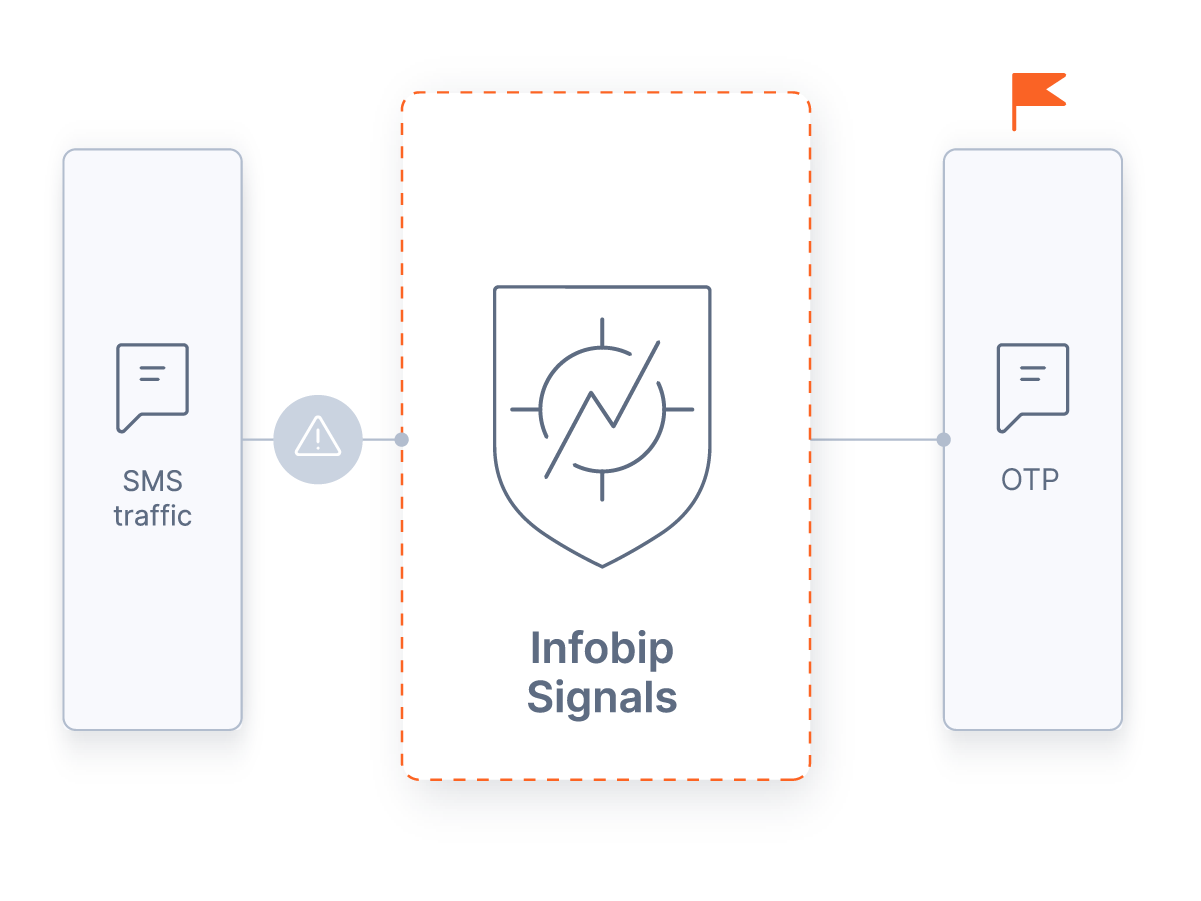
A visual showing Infobip Signals will check for patterns and flag numbers that are potentially fraudulent.
Infobip Signals will check for patterns and flag numbers that are potentially fraudulent.

3. Works alongside CAPTCHA 

Instead of replacing CAPTCHA entirely, Infobip Signals strengthens it. Low-risk users avoid friction, while high-risk sessions receive extra checks. This makes it a key part of modern anti-fraud CAPTCHA solutions. 

4. Filters fake from genuine users 

Signals separates malicious bots from human users in milliseconds. That means better UX, fewer CAPTCHA challenges, and more reliable data. 

5. Protects from AIT, DDoS, and abuse 

Whether you’re facing AIT, DDoS attacks, or credential abuse, Signals adapts to block evolving threats. 

Customer success stories show the real impact of this approach

Cabify, a major mobility platform in over 40 cities, used our solution to stop fake SMS traffic. By blocking fraudulent bots in real time, they cut financial losses from fake traffic by 15.7% in just three months. 

Similarly, NEXT plc, a large UK clothing brand, improved security and customer trust by blocking about 175,000 fake messages every month with Signals. 

One-minute video about an intelligent solution that cuts costs by blocking AIT:

Pros and cons of popular CAPTCHA alternatives

Traditional CAPTCHA (Visual/auditory puzzles) 

Pros:

  • Easy to implement 

Cons:

  • Bad for accessibility 
  • Annoying for users 
  • Weak against modern bots 

reCAPTCHA v3 (Invisible Google CAPTCHA)

Pros:

  • Frictionless for users 
  • Works well with behavioral data 

Cons:

  • Still beatable by advanced bots 
  • Can reduce site speed and privacy 

Behavioral analysis 

Pros:

  • Strong detection of bots 
  • Great user experience 
  • Works well with other layers 

Cons:

  • Requires good data management 

Device fingerprinting 

Pros:

  • Works in background 
  • Strong bot resistance 

Cons:

  • Needs privacy compliance 
  • Can be blocked by some browsers 
  • Fingerprint collision problem 

Hidden field trap 

Pros:

  • Simple to deploy 
  • Effective for spam 

Cons:

  • Not strong against smart bots 
  • Can be bypassed by custom scripts 

Infobip Signals 

Pros:

  • AI-driven, real-time fraud prevention 
  • No user effort required 
  • Best for AIT protection, SMS abuse, and OTP fraud 
  • Easy to integrate with existing systems 

Cons:

  • Bots hate it, but you’ll love it

Choosing the right alternative CAPTCHA for your platform 

The best CAPTCHA alternative depends on your specific needs. Consider the following: 

Focusing on user experience? Choose solutions that work in the background and avoid puzzles that frustrate users. 

Dealing with fake signups or SMS pumping? Use real-time detection tools that identify and stop misuse instantly. 

Are you experiencing financial loss due to AIT or malicious traffic? You’ll need automated systems that can block threats before they cause damage. 

Need your service to be usable by everyone? Use CAPTCHA alternatives that don’t rely on images, audio, or clicking. These are more inclusive for users with various limitations. 

PRO TIP: Combining two or more methods can also boost protection. For example: pair device fingerprinting with Infobip Signals for stronger protection, without adding friction for real users. 

Smarter security starts with smarter tools 

In 2025, CAPTCHA on its own no longer provides adequate protection. The rise of automated bot attacks, AIT, and fraudulent signups demands more intelligent, user-friendly, and scalable defenses. 

CAPTCHA alternatives FAQs

Go beyond CAPTCHA – Stop fraud where it starts  

Cabify: Combatting artificial inflation of traffic and enhancing CX with innovative fraud and security solutions 

15.7%

financial loss reduction in one quarter

Share

CHALLENGE

Mitigating fraudulent and artificially inflated SMS traffic in real-time  

Cabify is a leading multi-mobility company with a mission to improve how people, businesses, and drivers connect safely in over 40 cities.  

To do this the company relies on multiple communication channels, including reliable and legitimate text messaging to facilitate trustworthy customer experiences. 


From sending OTPs for verification to providing real-time updates on ride status, SMS plays a key role in ensuring customer satisfaction and operational efficiency. Because of this, Cabify is constantly implementing new solutions to mitigate the significant challenges posed by Artificial Inflation of Traffic (AIT) within tech services. 


“We aim to address these challenges as we know first-hand how important security is in our value proposition,” said Jesús Díaz, Engineering Manager at Cabify. 


“We proactively started seeking solutions to help identify and stop bot-generated artificial traffic. However, these measures were difficult to apply equally in every market, making it a non-scalable solution,” he said. Traditional methods of mitigating AIT, such as IP blocking entire countries where the problem occurred, often led to the unintentional blocking of legitimate SMS traffic.


Over the years, AIT practises evolved, and a more robust solution was needed to ensure stronger response potential.

We’ve been following AIT trends and it was clear to us that in order to address the pressing challenges posed by AIT and enhance the user experience we needed to reinforce our capabilities.

Jesús Díaz photo

Jesús Díaz

Engineering Manager, Cabify


To address the pressing challenges posed by AIT and enhance the user experience, Cabify sought a reliable and innovative communication partner. 

SOLUTION

Safeguarding SMS traffic with an AI and machine-learning powered solution

Cabify was already using Infobip’s SMS services for various marketing and operational needs.

“We were already working with Infobip in the marketing team, and they were happy with the service,” Jesús Díaz explained. 

Impressed by our reliable infrastructure, delivery capabilities and excellent customer service, Cabify turned to Infobip Signals, an intuitive machine learning solution designed to detect and block fraudulent traffic.

Jesús Díaz noted, “We started talking about Signals and we said: Let’s try. Let’s see how it works.” 

Infobip Signals employs machine learning to automatically detect and block fraudulent traffic without any interventions from the business. By identifying patterns and anomalies, the solution effectively distinguishes between legitimate and bot-generated traffic and automatically blocks fraudulent traffic without any need for intervention from the business’ end. 

In addition to enhancing security, Cabify sought to improve the user experience of OTP delivery. With more customers using WhatsApp for P2P messaging, Cabify chose the channel as their primary OTP channel, with SMS as a failover to ensure guaranteed delivery.  

“WhatsApp is very commonly used. So, we started to deploy it, and the experience has been good,” said Jesús Díaz.

The zero-tap OTP autofill feature on WhatsApp, powered by our platform, further streamlined the process, eliminating the need for users to manually input OTPs on Android phones. This innovative approach improved customer satisfaction and reduced friction in the registration and login processes.   

RESULT

Fraudulent message blocked effectively and increased operational efficiency

By implementing our fraud and authentication solutions, Signals and OTPs via SMS and WhatsApp, Cabify achieved significant improvements in security, customer experience, and operational efficiency. 

Real-time monitoring and blocking of AIT strengthened Cabify’s position as a safe mobility company.  


Some of the key results included: 

  • The financial loss caused by AIT was reduced by 15.7% in a quarter 
  • Smoother user experience 
  • Higher operational efficiency 
  • Higher OTP delivery rate 

In addition, implementing and going live with Signals took less than 10 minutes to set up, making it an effective and quick solution. 

By using our fraud and security solutions, Cabify has not only overcome the challenges posed by AIT but has also elevated its customer experience and strengthened its position in the market.  

Infobip has been a valuable partner in helping us combat AIT and enhance our user experience. Their Signals solution has been instrumental in protecting our business from fraudulent traffic, while an omnichannel approach to authentication made OTP deliveries more user friendly and cost effective. The integration process was smooth, and the support team has been excellent. We are confident in our decision to partner with Infobip.

Jesús Díaz photo

Jesús Díaz

Engineering Manager, Cabify

COMPANY PROFILE

Cabify is a leading multi-mobility platform that aims to transform cities into better living spaces through innovative ride-hailing solutions. Operating in multiple countries across Latin America and Europe, including Spain, Chile, Argentina, Peru, Colombia, and Uruguay, Cabify connects passengers with a network of professional drivers. The company offers a range of services, from ride-hailing to corporate mobility solutions, providing safe, reliable, and efficient transportation options. 

A guide to global SMS compliance laws

SMS compliance involves adhering to specific legal and industry guidelines that ensure text messages are sent responsibly and with customer consent. These rules protect consumer privacy and vary across different countries. In this blog we cover the crucial aspects you need to know.

Dan Mekinec Senior Content Marketing Specialist
Skip to table of contents

Did you know that in France, businesses can’t send SMS messages on Sundays? And that in Malaysia, the message header must clarify that recipients won’t be charged for receiving it?

When sending SMS to customers, staying compliant is crucial, but it’s not straightforward. Each country and state may have its own laws, and mobile carriers add another layer of complexity. While achieving 100% compliance might seem impossible, the risks of non-compliance—blocked messages, reputational damage, lost business, and fines—are too significant to ignore.

To help you stay informed, we’ll start this guide by summarizing the most common aspects of A2P SMS compliance globally, and then move on to specific regions.

Please note: This content is provided for information purposes only and should not be relied on as legal or compliance advice.

A summary of global SMS rules

  • Opt-in (and out): In most countries you can only send SMS messages to customers that have opted-in to receiving them. Beware that that the definition of ‘opt-in’ has matured and usually has to be explicit, usually through a sign-up form or by sending a keyword. Implied opt-in because a customer bought a product or service and forgot to uncheck a tick-box is no longer acceptable. Opt-out allows customers to stop receiving messages by following a simple process, such as replying ‘STOP’.”
  • Sender ID: A Sender ID refers to the name of the sender in the recipient’s inbox. In some markets, you can use alphanumeric senders, meaning that you can send SMS messages using your own brand name rather than a number your customers don’t recognize. However, this option is not available everywhere, and you might need to pre-register your Sender ID due to rules that prevent duplication and SMS fraud.
  • Message content: Most countries differentiate between transactional and marketing messages and apply different restrictions. A delivery notification or a weather alert would be classed as transactional, while any promotional or sales message would come under marketing. Even in regions where promotional SMS messages are allowed, there are usually additional restrictions on content related to gambling, drugs and alcohol, adult-themed products, and both political and religious topics.
  • Message length: It is commonly accepted that 160 characters is the limit for SMS messages, but this can be less in some countries. It is up to individual carriers in each country whether to support truncation (concatenated messages). Be warned that some carriers will only send the first 160 characters, with the rest being discarded.
  • Sending time: In many countries, you are only allowed to message customers between certain hours, such as 8am and 8pm, and sometimes not at all on certain days, for example on Sundays in France.
  • ‘Do not contact’ registries: In many countries, consumers can opt out of receiving business communications by signing up to do-not-contact or do-not-disturb registries. If you ignore this, you run the risk of service suspensions or fines.

SHAFT guidelines on restricted message content

SHAFT is an acronym covering Sex, Hate, Alcohol, Firearms, Tobacco, but the guidelines also cover other disallowed content like gambling, including online casinos, sports betting, lotteries, high-risk financial services, pyramid schemes and other shady ‘get rich quick’ offers, debt collection and forgiveness, illegal substances, and third-party lead generation.

These guidelines are enforced by the Cellular Telecommunications and Internet Association (CTIA) to ensure that SMS marketing remains safe and appropriate for all audiences

Next, we will provide you with a summary of the rules in each region. For information on specific countries please have a look at our SMS coverage and connectivity guide with details on just about every country in the world.

SMS regulations in the US

These are the most important elements of SMS compliance in the United States.

  • Registration required: In the US all messaging programs must be registered. Unregistered traffic is not allowed. Businesses must register their messaging programs with mobile carriers to ensure compliance with legal and carrier-specific guidelines. This process includes providing information about the type of messages being sent and ensuring adherence to opt-in rules.
  • Content restrictions: Certain types of content, such as gambling, drugs, alcohol, firearms, and adult content, are prohibited from being promoted. Promotion of some financial products, such as certain loans, debt relief, and credit repair, is also prohibited. Lead-generation campaigns that involve sharing collected information with third parties are also disallowed.
  • Opt-in requirement: Both marketing and transactional messaging are allowed, but only to subscribers who have opted to receive them.
  • Two-way messaging: All commercial text messages must be two-way, which enables customers to opt out of receiving further messages and obtain support by texting “HELP”.
  • Multiple sender types: In the US businesses can use short codes or 10-digit long codes (10 DLCs).
  • Legislation: The key legislation covering SMS messaging in the US is the Telephone Consumer Protection Act (TCPA). The Cellular Telecommunications Industry Association (CTIA), a trade group representing wireless carriers and others in the telecom industry, lays out additional guidelines for SMS marketing in its Short Code Monitoring Handbook. Also, each individual carrier network is privately owned and operated, and as such, they reserve the right to approve, reject, question, or disable any campaign on their network. Some carriers have their own individual Code of Conduct.
  • The Federal Communications Commission (FCC) plays an active role in regulating SMS in the United States and reports directly to Congress. The FCC adopts rules and regulations to address issues related to SMS, such as requiring providers to maintain a point of contact for reporting erroneously blocked texts and proposing measures to extend the National Do-Not-Call Registry’s protections to text messages. The FCC also enforces compliance with these regulations to ensure that consumers are protected from fraudulent and unwanted text messages.

SMS compliance checklist for the US

Before diving into the specific steps, it’s crucial to understand the distinction between legal requirements and carrier guidelines in the United States.

  • The TCPA sets the legal framework, prohibiting the sending of unsolicited text messages (SMS) to consumers without their consent. Non-compliance can lead to hefty class-action lawsuits and fines of up to $1500 per text.
  • CTIA guidelines are carrier-specific rules that further protect consumers. Adhering to them is essential to avoid fines, maintain a positive reputation and ensure uninterrupted sending capabilities.

With that explained, here are the steps you need to take to keep your SMS program compliant in the US:

Additional information about SMS compliance in the US

The following is a summary of a 45-minute live session we at Infobip organized for marketing platforms and agencies on the topic of SMS and MMS compliance. A panel of mobile messaging experts answered the questions.

1. Shared short codes no longer allowed

Shared short codes are no longer permitted in the US. Each brand must have a dedicated short code. If another customer wants to use your messaging services, obtain a new source (dedicated short code, 10DLC, or text-enabled toll-free number) for their messaging.

Even if your front-end customer is the sole user of a short code, it may still be considered shared if they share it with other brands or clients. All messaging on a short code must be controlled by a single entity and dedicated to a specific brand.

2. Why we insist on CTA compliance

The CTIA (Cellular Telecommunications Industry Association) established CTA guidelines agreed upon by all mobile carriers. Specific elements within a CTA ensure best practices and transparency and inform subscribers about what they’re signing up for.

To get your campaign approved as Infobip’s customer, including all necessary elements in your CTA is crucial. We adhere to contractual agreements with mobile carriers, ensuring compliance with their code of conduct.

3. Third-party data sharing is strictly prohibited

Lead generation and affiliate marketing campaigns are prohibited as they involve third-party data sharing and can lead to spam. This also applies to customer requests to use 10DLC numbers for collecting opt-in and forwarding to lead generation agencies.

4. Requirements for specific use cases

Donation campaigns: These have additional requirements and must conform to the CTIA Messaging Principles and Best Practices.

Abandoned cart reminders: Carriers have specific requirements for abandoned cart reminders to protect consumers. You must ensure the program name explicitly states that customers are signing up for cart reminders (not just generic marketing alerts). Also, keep in mind:

  • Cart reminders need to be mentioned in your T&C.
  • Program name, description, T&C, and cart reminders should align.
  • You should use a double opt-in process for added security.
  • You should explain how information is captured (e.g. via cookies or webhooks) in the privacy policy.

Missing information may lead to campaign rejection.

Fraud alerts: There is a TCPA exception for fraud alerts with an implied opt-in, but you must remember that approval is at the carrier’s discretion and that there are additional requirements.

CBD messaging: CBD is not federally legal. Any messaging must meet federal laws. Just because many states have legalized cannabis, it is not legal at the federal level, so the carrier networks have disallowed this messaging content.

You can find more info about messaging use cases in the US here.

5. TCPA compliance does not guarantee approval

TCPA requirements are the bare minimum requirement. Programs must also meet CTIA and carrier guidelines and ultimately the carriers are privately owned and operated networks and can approve/deny any program.

6. Why stop menus are no longer used

Stop menus are only necessary when a short code is being shared but shared short codes are no longer permitted. If a customer requests to opt-out of a short code program, then they must be completely removed from receiving messages from the short code. No further message can be sent unless another opt-in occurs. This includes short codes with multiple use cases for the same brand.

SMS regulations in Europe

There are 27 countries in the European Union and a further 3 countries in the European Economic Area (EEA) that are also covered by European rules that apply to privacy and electronic communication (Norway, Lichtenstein, and Iceland).

GDPR is the mostly widely recognized Europe-wide legislation, but there are others like the E-privacy Directive. The GDPR protects consumer data privacy, requiring explicit consent for data use, while the E-privacy Directive focuses specifically on electronic communications, including SMS, ensuring messages are sent legally and ethically.

There are also specific regulations in individual countries. For example, some EU countries allow one-way commercial SMS messages to be sent, and others do not.

On the whole however, SMS regulations in Europe are some of the tightest and strictly enforced in the world, especially when it comes to opt-in and crucially opt-out.

  • Consumers must explicitly opt-in to receive marketing communication – it must be clear and unambiguous, and all the information required for them to understand what they are signing up for must be easily available, for example via a link to the company’s privacy policy.
  • All marketing messages sent from a business, including SMS, must include a simple and free method of opting out, for example replying with the text STOP. Removing consent has to be as easy as granting it in the first place.

GDPR is definitely not toothless legislation. Just ask British Airways who were fined £20 million after the personal data of over 400,000 customers was stolen by hackers. Hotel chain Marriott International took an even bigger hit of nearly £100 million when it had to pay compensation to millions of people whose private data was stolen from the organization.

While fines for not complying with SMS regulations are nowhere as high, they are still significant enough that businesses have to be very careful to not break any rules.

SMS regulations in APAC (Asia-Pacific)

The Asia-Pacific region is the largest SMS market in the world. In the list of countries with the most active mobile phone users, the top three spots are occupied by APAC nations: China, India, and Indonesia. Have a more detailed look into the regulations for the most significant APAC markets below:

China

In China, the following types of marketing/promotional messages are strictly prohibited: real estate, stocks, loans, investment banking, education, immigration, politics, adult supplies, pornography, violence, gambling, and other illegal information.

Business SMS messaging is restricted to long codes, which are are standard phone numbers used for business messaging, offering a recognizable format for recipients and ensuring compliance with local regulations.

To send SMS messages, businesses need to register message templates and a business license, along with company details:

  • Official website
  • Company (entity) name
  • Type of traffic
  • Message content
  • Sender name and signature

India

To send commercial SMS in India, businesses must register with telecom authorities or service providers using Distributed Ledger Technology (DLT).

DLT uses blockchain technology to stop unsolicited communication. In short, it synchronizes mobile subscriber data who opted for Do Not Disturb (DND) services with all Mobile Network Operators (MNOs). It is used keep a record of every SMS sent, specifying the business sending the SMS, the actual sender name displayed, the main content of the SMS, and the nature of the consent that the SMS recipient has agreed to.

When registering on a DLT platform, you will need to provide the business’s name along with the templates (messages that will be sent), headers (Sender IDs), and consent templates.

Clickable links in SMS messages

There have been recent updates regarding clickable links in SMS messages in India.

Under the new regulations, any clickable links in SMS messages, such as URLs, short links, or CTAs (Call-to-Action links), must now be whitelisted on the DLT (Distributed Ledger Technology) platform.

If a message contains a link that has not been whitelisted, it will fail the DLT scrubbing process and will not be delivered to the recipient.

Example: If your SMS includes a link like: https://www.xyz.com/, you must whitelist it in advance on the DLT platform. Without this, the message will not pass regulatory checks and will fail delivery.

Content restrictions

  • Window for sending promotional messages: between 10 AM and 9 PM.
  • Gambling and cryptocurrency messages are forbidden.

You can learn more about the process of registering an SMS sender in India here.

Indonesia

These are the most important aspects of SMS compliance in Indonesia:

  • Gambling, religious, adult, and racial content is prohibited.
  • It is mandatory to register a sender with Indonesian network operators.
  • To register a sender, you must provide a Letter of Authorization (LOA).
  • Different requirements apply for local and international senders.
  • Sender name should not exceed 11 characters (including spaces and punctuation).
  • You can only register one sender ID per company. For multiple IDs, you need to provide a statement.
  • Only alphanumeric sender IDs are allowed. You must use brand-related sender IDs; generic senders are not allowed.

You can learn more about SMS guidelines for Indonesia here.

Australia

No adult, religious, or political content is allowed when sending SMS to customers in Australia. There are certain restrictions regarding gambling:

  • Anyone providing a regulated interactive gambling service in Australia must hold a license under Australian State or Territory laws.
  • Gambling promotional messaging is strictly prohibited for new users unless the user specifically opts in with the gambling company before the actual SMS termination.
  • Inducing new or existing users to gamble is prohibited in the message content.
  • Opt-in/opt-out is required for all promotional or transactional gambling messages.
  • Online sports betting is legal through licensed operators, with numerous additional restrictions.

You can use an alphanumeric sender ID, a virtual long number, or a short code. To register as a business sender, you must provide a Letter of Authorization (LOA). You can learn more about SMS guidelines for Australia here.

SMS regulations in MENA (Middle East & Northern Africa)

Our latest Messaging Trends report shows an increasing demand for SMS and CPaaS solutions due to a wider adoption of CRM systems across industries, investments in customer experience, and growing cybersecurity demands.

Here is an overview of SMS regulations in some of the largest markets in MENA.

Saudi Arabia

Saudi Arabia is a highly regulated country in terms of SMS. Here are the most important aspects to consider:

  • A2P SMS traffic is categorized into local and international traffic (by origin), and transactional and promotional (by type).
  • Your company must have a local presence and provide relevant documentation for local SMS termination.
  • Alphanumeric senders are allowed.
  • Gambling, betting, Spam, loan traffic, crypto, Forex, and adult content are likely to be blocked by Saudi Arabian operators.
  • URL shorteners (e.g., bit.ly, goo.gl) are strictly forbidden. Other URLs in message content need to be safelisted beforehand.
  • Promotional traffic can only be sent between 8 AM and 10 PM local KSA time zone.
  • When sending promotional traffic, companies should add a suffix “-AD” to the sender name.

Morocco

In Morocco, A2P SMS traffic is categorized into local and international (by origin), and sender registration is mandatory for both types, with proper documentation.

Sender IDs must adhere to the following rules:

  • Maximum length: 11 characters
  • Generic senders, special characters, spaces, and numbers are not allowed

Two-way messaging is available for local traffic only, meaning that recipients can only respond to messages sent by businesses located within Morocco.

Promotional (marketing) traffic is allowed only between 10 AM and 8 PM local time. This corresponds to 9:00 to 19:00 UTC.

There are no specific content restrictions.

Algeria

In Algeria, you can use a dynamic alphanumeric sender. However, numeric senders might get blocked on some networks. Two-way SMS is currently unavailable.

These are the only restrictions for A2P messaging:

  • Gambling traffic is forbidden.
  • Traffic with illegal, adult, religious, and political content is prohibited and will be blocked.

SMS regulations in LATAM (Latin America)

Here is a summary of the most important aspects of SMS compliance in the some of the biggest LATAM markets:

Brazil

  • Dedicated and shared short codes allowed: Short codes are commonly used for SMS communication in Brazil. Both dedicated and shared short codes are allowed, but it’s crucial to comply with local regulations and obtain the necessary approvals.
  • Alphanumeric sender IDs allowed only for local customers: Alphanumeric sender IDs are only allowed for local companies that have a local presence in Brazil. When using alphanumeric sender IDs, we advise our customers to consult with their dedicated Account Manager, who can provide guidance on the specific requirements and restrictions.
  • Virtual Long Numbers are not allowed: Virtual Long Numbers (VLNs) are prohibited for SMS messaging in Brazil. If you plan to use long numbers, ensure they are physical and comply with local regulations.
  • Messages with bank and MNO names need authorization: Messages containing references to banks or mobile network operators (MNOs) must be authorized by the respective companies. Unauthorized use of their names may lead to compliance issues.
  • Political and gambling content not allowed: SMS messages related to political campaigns or gambling activities are prohibited.
  • Marketing messages require opt-in: You need to obtain explicit opt-in consent before sending marketing messages.
  • Opt-out (unsubscribe) is mandatory: You need to include an opt-out option in your SMS messages, allowing recipients to unsubscribe easily.
  • DND (Do Not Disturb) registry available: A DND registry is available in Brazil. However, end-users must explicitly request it. You must respect their preferences and avoid sending messages during restricted hours.
  • Messaging time windows: Messages can be sent between 8 AM and 8 PM on workdays (Monday to Friday), and from 8 AM to 2 PM on Saturdays. No SMS messages are allowed on Sundays.
  • Keywords recommended for MO (Mobile Originated) messages: When setting up MO messages, use specific keywords to ensure that the right customer receives the message. Generic keywords may lead to misdirected messages.

Colombia

  • Short codes allowed (shared or dedicated): Short Codes (shared or dedicated) are allowed for sending SMS notifications (transactional, marketing, debt collectors, etc.).
  • Virtual Long Numbers not allowed: Virtual Long Numbers (VLNs) are prohibited for SMS messaging in Colombia.
  • Opt-in required: You need to collect explicit opt-ins from end users before sending any messages.
  • Restrictions for debt collectors and marketing content: The CRC (Telecommunications Regulator) imposes restrictions on debt collectors and marketing content. These types of messages are allowed only between 8:00 AM and 9:00 PM.
  • Restrictions for political content: You must have opt-ins to send political content. Every political message must contain a Spanish version of the text “paid political ad.”
  • NLI not supported: NLI (Non-Latin Identifiers) are not supported.
  • Short codes must be active: If short codes are not being used, the regulator may remove them. Ensure that your short codes remain active and relevant.

How to ensure SMS compliance globally

To summarize, there are some best practices that are common across most global regions that you should follow to ensure SMS compliance:

  • Obtain clear consent: Always get explicit consent from customers before sending text messages.
  • Send appropriate content: Check and respect the legal restrictions in the country regarding message content.
  • Respect time windows: Send texts at appropriate times and avoid spamming.
  • Register your sender: Use a verified business sender for messaging, according to country-specific regulations.
  • Ensure an opt-out mechanism: Provide an easy way for subscribers to opt out of receiving further messages.

Maintaining SMS compliance across countries can pose quite a challenge. There is little doubt that to succeed, you will need the help of an experienced and proven enterprise SMS provider.

We would love to help. We have years of hard-won experience in international SMS delivery and compliance capability is actually built into our platform. And we certainly know our rules – we have staff on the ground on every continent keeping on top of local legislation and maintaining relationships with the biggest network of providers of any SMS supplier.

The end result? Our customers remain compliant in every territory and get the best possible delivery rates.

Talk to an expert about your own SMS compliance requirements

This blog was originally published in May 2022 and has been updated regularly as global SMS regulations evolve. The latest update was in March 2025 and included the latest information on global SMS trends, and updates to specific legislation in the United States and India.

Related content:

Generative AI security: How to keep your chatbot healthy and your platform protected

Discover essential strategies to secure AI chatbots from growing GenAI threats. Learn how to protect your AI investments now and keep them healthy and thriving.

Content Marketing Specialist

Ana Rukavina

Content Marketing Specialist

Everyone is talking about AI. From ChatGPT to countless other generative AI tools popping up daily, it feels like we’re constantly told that seizing AI is the key to staying ahead. But amidst the excitement, it’s crucial not to overlook the potential security risks.

We’re integrating AI into our browsers, emails, and even file systems, entrusting it with sensitive personal and business data. This convenience comes with a price – an increased risk of cyberattacks and data breaches.

In this blog, we’ll look into the impact of generative AI on data security and practical strategies for mitigating potential risks.

Let’s look at the stats first.

McKinsey reports that one-third of organizations already use GenAI tools in at least one business function, and the market is expected to grow exponentially between 2023 and 2030. At the end of 2023, it stood at just under $45 billion, nearly double the size of 2022. This growth of almost $20 billion annually is expected to continue until the end of the decade.

However, this widespread use of GenAI is accompanied by a growing awareness of its security implications. A Menlo Security Report reveals that over half (55%) of generative AI inputs contained sensitive, personally identifiable information. This highlights the potential for data breaches and privacy violations if adequate security measures aren’t in place.

Immuta’s findings further underscore the disconnect between AI adoption and security preparedness. While 88% of data professionals say that their employees are using AI, 50% admit that their organization’s data security strategy fails to keep up with its rapid evolution. The fear of sensitive data exposure through AI prompts is noticeable, with 56% of respondents citing it as their top AI concern.

Looking ahead, Gartner predicts that by 2027, 17% of total cyberattacks will involve Generative AI. At the same time, through 2025, GenAI will trigger a spike in the cybersecurity resources required to secure it, leading to a 15% increase in security software spending.

These stats highlight the need for proactive security measures to protect sensitive data and mitigate the risks associated with AI adoption.

Security concerns in the age of generative AI with examples

The OWASP Top 10 list highlights the most critical security risks associated with large language models (LLMs).

Here are some of the key concerns with illustrative examples:

Prompt injection attacks

By carefully crafting prompts, attackers can manipulate generative AI models to reveal confidential information, perform unintended actions, or even generate malicious code.

Training data poisoning

Malicious actors can inject biased or misleading data into training sets to manipulate the model’s behavior, potentially causing it to generate inaccurate or harmful outputs.

Supply chain vulnerabilities

The complexity of GenAI systems often involves integrating third-party components or relying on external data sources, which creates potential supply chain vulnerabilities. If any of these components or sources are compromised, the entire GenAI system can be exposed to risks.

For instance, a vulnerability in a third-party library used by your chatbot could allow attackers to gain unauthorized access or inject malicious code.

Sensitive information disclosure

Employees might inadvertently expose sensitive information while interacting with GenAI tools. For instance, pasting confidential client data into a chatbot prompt could lead to unauthorized access or disclosure.

Similar risks apply to other generative AI applications, like those that help you write code, can be a risk. If developers accidentally include confidential code snippets or proprietary algorithms in their requests to the AI, this sensitive information could end up being learned by the AI and later exposed to others, or even worse, to hackers.

Hallucinations and off-topic

GenAI models can sometimes “hallucinate” or generate completely fabricated or unrelated responses to the given prompt. If relied upon for critical decision-making, this can lead to misinformation, confusion, and even harmful consequences.

How to mitigate GenAI security risks

The examples we’ve explored underscore GenAI’s potential pitfalls but don’t be discouraged. You can confidently implement GenAI’s transformative power by proactively implementing strong security measures and responsible AI practices.

It’s about striking a balance – reaping the benefits of AI innovation while safeguarding your valuable assets and maintaining the trust of your customers.

In the face of growing GenAI security threats, a proactive and multi-layered approach is crucial. Here are some essential strategies to help safeguard your data, systems, and reputation:

1. Enhance security awareness and training

Empower your employees with the knowledge to handle the AI landscape safely. Provide extensive training that teaches them how to use GenAI tools securely, identify phishing scams, and avoid sharing sensitive data with chatbots. Help your team develop the skills to verify information, spot deepfakes, and recognize misinformation.

2. Prioritize data security and privacy

Implement strong access controls to ensure that only authorized individuals can access it. Add an extra layer of security with strong authentication methods like multi-factor authentication.

Before feeding sensitive data into AI models or chatbots, anonymize or pseudonymize it to protect privacy—Encrypt data both at rest and in transit to prevent unauthorized access. Stay proactive by conducting regular data audits and impact assessments.

3. Establish secure AI model development and deployment

Keep your AI models updated with the latest security patches to address any potential vulnerabilities. Before deployment, thoroughly test your AI-powered systems and continuously monitor them for any unusual behavior or possible breaches. Employ explainable AI (XAI) techniques to understand the decision-making processes of your AI models, helping you identify biases and vulnerabilities.

4. Partner with specialized technology providers

Partner with specialized technology providers that provide automated AI chatbot pentesting services. Their AI red teams (security teams) proactively probe for vulnerabilities in your chatbot deployments, allowing you to identify and address security weaknesses before they can be exploited.

Penetration testing, or pentesting, is like a simulated cyberattack. It’s where a cybersecurity expert tries to find any weak spots in your computer system and see if they can be exploited.
 
Similarly, AI red teams challenge AI systems to uncover hidden weaknesses and flaws.

Secure path forward with GenAI

While the risks associated with GenAI are real, the future remains bright. By prioritizing security awareness, implementing robust data protection measures, securing AI models, and utilizing automated security solutions, businesses can confidently accept GenAI’s transformative power.

To further support your journey towards secure AI adoption, Infobip is proud to partner with SplxAI. Their state-of-the-art AI chatbot pentesting services proactively defend against vulnerabilities, ensuring your chatbot deployments are resilient and secure. Together, we’re committed to helping you address the challenges of GenAI security so you can unwrap its full potential without compromising safety.

Learn more about our AI security solutions and how we can help you protect your business in the age of generative AI

Contact us
Sep 16th, 2024
7 min read
Content Marketing Specialist

Ana Rukavina

Content Marketing Specialist

Keep on exploring

Read some of our latest blog posts

Promote subscriptions 

Encourage customers to sign up for recurring plans with targeted messaging that highlights the benefits and value proposition. 

Pain points:

Struggling to retain customers

Revenue churn

High acquisition costs

  • Turning one-time buyers or customers into loyalists can be challenging. 
  • Struggling to retain customers can lead to churn and decreased customer lifetime value. 
  • This has a direct effect on revenue and increases customer acquisition costs.

How subscription promotions help? 

  • Welcome new customers and introduce the value proposition of your subscription plan alongside single purchases. 
  • Showcase subscription benefits through targeted messages highlighting convenience, cost savings, exclusive content, or early access to new products. 
  • Collect invaluable first-party customer data which helps you provide personalized recommendations to upsell, suggest relevant subscription options that complement their interests, nudging them towards a recurring service. 
  • Customers might hesitate before committing. Offer free trials or introductory discounts to encourage them to try the subscription.
  • Simplify the sign-up process with seamless in-message subscription options, making it easy for customers to convert. 
  • Nurture the relationship with your subscribers by providing exclusive perks, early access to sales, or loyalty programs. 
  • Send personalized messages reminding customers of subscription benefits and upcoming renewals, fostering long-term loyalty. 

Business benefits

  • Increase recurring revenue: Easily promote subscription plans, highlighting their benefits to existing customers to increase customer stickiness and revenue
  • Boost customer lifetime value: By converting customers to subscriptions, you build stronger relationships and generate predictable income. 

Available channels

Functions

Sales

Industry

eCommerce & retail

Telcos Healthcare

Media and publications

Dating app security: Prevent romance scams and safely connect verified users

As more and more people look to the internet to find someone special, fraudsters are evolving their tactics to take advantage. With almost half of couples in the US now meeting on dating sites, there are a massive number of potential victims. With technology being available to prevent the majority of romance fraud, it becomes the responsibility of dating sites to protect their users.

In the lead up to Valentines Day we look at some common types of romance fraud and what can be done to prevent them.

Love as a business

57.4 million

registered dating site users in the US

40%

of new couples in the US met on dating sites in 2023

$3.12 billion

annual global revenue for dating apps in 2023

5 types of romance fraud

Here are just a few ways that criminals use dating sites to commit fraud.

Catfishing

We are all familiar with this MTV favorite. What people may not realize is that there are different levels of catfishing. From genuine people using older or edited photographs of themselves in their profiles, all the way through to completely fake profiles, designed to trap unwary singles into forming an attachment with an imaginary person. Even though they have never met, by being manipulated they may end up providing personal details or sending money to the fraudsters. Dating websites should be able to protect their users from catfishing scams by properly verifying the identity of all site users.

Foreign service scams

Pretending to be a soldier posted overseas or someone working for an aid organization seems to be a very common tactic used by romance scammers. Firstly, these jobs have noble and romantic associations, they also provide a valid excuse for having patchy internet service, no webcam, and they support a number of believable scenarios where the scammer can request money – for example to pay for a webcam, additional safety equipment, or for a flight to see the victim.

The US military even publishes guidance on how to spot fake military accounts. For example, they state that any member of the US miliary will have an email address ending in “.mil.” If the person saying that they are a serving soldier is not using a .mil email address, then that should be a major red flag.

Inheritance scams

This is a variation of the infamous ‘Nigerian Prince’ scam where the fraudster sends out a mass email blast trying to persuade people that they need help moving a large amount of cash or gold out of their home country. In the romance version, the scammer will set up multiple dating site profiles and say that they stand to inherit a large sum of money, but only if they are married. In exchange for splitting the money they ask the victim to pay for a flight so that they can meet up to get married. Of course, once the money has been paid, they are never heard from again.

Blackmail

On some sites things can move very quickly and users might find themselves persuaded to exchange intimate photos or videos with the people they match with. If it is a fake account set up by a criminal, then these can be used to blackmail the victim into sending cash so that the photos are not made public.

Dating sites that require user verification are far less likely to attract criminals as they can easily be reported and traced if they try this scam.

Fake dating websites

There are a lot of dating websites available for people that are looking for that special someone, or just to meet new people. Some are well known, but others may be new and seemingly full of attractive singles looking to mingle. Beware, as these could be sites that have been set up by scammers with the sole purpose of gathering personal and financial information. This can be used to defraud victims or sold on to other scammers.

In this situation, the responsibility falls on the person to research the website before they join or provide any personal details. If you are new to the online dating scene it is recommended to stick to well-known sites that have a good reputation and have the technology in place to properly verify their users.

True romance is never a scam

According to Atlas VPN, throughout 2021, United States residents lost more than $343 million to romance scams. That represents a roughly $40 million increase on the amount reported to the Federal Trade Commission (FTC) in 2020. The FTC, an independent United States government agency whose principal mission is the enforcement of civil U.S. antitrust law and the promotion of consumer protection, reported that romance scams were among the most effective for fraudsters, accounting for 24% of all fraud damages recorded by the FTC in 2021.

Now, we realize that this all sounds scary, especially at a time when people could do with a little bit of extra love. So, with Valentine’s quickly approaching, how does your business ensure a safe and secure platform that brings people together?

How dating apps can stop romance fraud

App identity verification

The best way to ensure peace of mind for people trying to create meaningful connections through your app or service is to stop fraudsters from gaining access to it. It really is that simple.

You might already require users to submit some sort of verification or identity confirmation upon registration or login. This could include a check on details like their real first and last names, age, security questions, profile picture, and their username and password. This is a good start, but would not be enough to stop the Tinder Swindler.

Passwords can be stolen, as well as accounts and entire identities. This becomes increasingly complicated with a rising number of digital newcomers trying online dating for the first time. At the same time, you want to cater to these people and make their first online dating experience a frictionless one.

Your dating app, and users, deserve a solution that not only eliminates the complexity of getting out there with simple app registration and user experience, but also offers elevated security.

Mobile Identity – quicker, more secure access to meaningful connections

With Mobile Identity and authentication you can have your cake and eat it too. Mobile Identity uses mobile operators’ subscriber data to verify and authenticate mobile users through their mobile numbers without the need for them to take any additional steps.

As part of Mobile Identity, silent mobile verification allows your dating app to distinguish real from potentially fraudulent users based on their mobile number, which translates into secure verification that eliminates friction on service sign-up and login. Additionally, the service identifies and prevents SIM swap fraud before it can ever take place.

This represents a revolution in user account security and provides near perfect account takeover protection, ensuring conversations happening on your dating app are conducted safely and securely.

What’s even better, the entire user authentication process takes less than 5 seconds.

You, like us, are in the business of creating connections. When you’re out looking for love, the last thing on your mind should be user authentication. It’s about interactions with other people, through your already great service. It’s time to let your users enjoy it to the fullest.

This Valentine’s Day, implement quicker, more secure access to meaningful connections with mobile identity.

Mobile Authentication

The Future of Mobile Security and User Engagement

Download White Paper
Jan 16th, 2024
6 min read

Schrems II: What businesses need to know to comply

What does the Schrems II ruling mean for businesses within the EU and the rest of the world, and what is Infobip doing to help businesses stay compliant? Read on to find out.

Director of Marketing EMEA

Zoha Tapia

Director of Marketing EMEA

If you’re a business operating in the EU or dealing with EU customers, you’ve probably heard about Schrems II. It’s a landmark ruling that has significant implications for data protection and privacy, and it’s important for businesses to understand what it means for them.

In this blog post, we’ll cover everything you need to know about Schrems II, including the ruling itself, impact on businesses in the EU, and the rest of the world, and how Infobip can help in complying with the EU data transfer requirements imposed by the judgment.

What is the Schrems II ruling?

Schrems II is a ruling by the European Court of Justice (ECJ) that invalidates the EU-US Privacy Shield framework, which was used by thousands of businesses to transfer personal data from the EU to the US. The ruling was made in July 2020 and followed a legal challenge by Austrian privacy activist Max Schrems.

The ruling also placed strict new requirements on the use of Standard Contractual Clauses (SCCs), which are another way that businesses can transfer personal data from the EU to countries outside the EU. SCCs are legal agreements that set out the terms for the transfer of data and are used by businesses of all sizes.

The ECJ found that the Privacy Shield did not provide adequate protection for EU citizens’ personal data when it was transferred to the US. This was due to US surveillance laws, that allowed authorities to access the personal data of non-US citizens without adequate safeguards.

The ECJ also ruled that businesses using SCCs must carry out a case-by-case assessment of the laws and practices in the destination country to ensure that EU citizens’ personal data is adequately protected. This means that businesses must ensure that the recipient country has appropriate safeguards in place to protect personal data.

Schrems II requirements and the cloud communication conundrum

In recent years we have seen a rise in remote working and businesses adopting cloud communication technologies for workforce management and to deliver superior customer experiences.

Think of it: public cloud platforms, such as Microsoft Azure and Amazon Web Services, have become almost indispensable to businesses. This trend is set to continue, with worldwide end-user spending on public cloud set to grow 20.7% to total $591.8 billion in 2023, up from $490.3 billion in 2022, according to Gartner.

20.7%

increase in end-user spending on public cloud

And to add to that the global cloud communication platform market size was valued at $3.15 billion in 2022 and is expected to expand at a CAGR of 14.18%, reaching $6.98 billion by 2028 (Source: MarketWatch).

However, in the context of Schrems II, this has added another layer of complexity to the equation. For example, if an EU business was looking to store customer data on servers based in a non-EU country, any data transfer to these servers would have to undergo an individual risk assessment to ensure it is compliant with appropriate requirements published by European Data Protection Board (EDPB), a body that includes representatives from data protection authorities of all EU member states.

With security and data protection already being a key priority when using public cloud platforms, the additional complexities emanating from Schrems II offer a tough challenge for Chief Technology Officers (CTOs) to handle and businesses to manage.

The impact of Schrems II ruling on businesses in the EU

The impact of Schrems II on businesses in the EU is significant. Many businesses relied on the Privacy Shield framework to transfer personal data from the EU to the US, and its invalidation has left them without a clear way to do so.

Businesses using SCCs now face increased scrutiny and must ensure that the recipient country provides adequate protection for personal data. This can be a complex and time-consuming process, and many businesses may need to review their data protection processes and procedures to ensure compliance. And this includes their communication technology to interact with customers.

The ruling has also highlighted the importance of data protection and privacy for businesses operating in the EU. Customers are increasingly concerned about the security of their personal data, and businesses that fail to take appropriate measures to protect it risk damaging their reputation and losing customers.

Impact of Schrems II on the rest of the world

The Schrems II requirement is that any business that transfers personal data from the EU to countries outside the EU, must comply with the new requirements set out by the ECJ.

This means that businesses must ensure that they have appropriate safeguards in place to protect personal data. and that they comply with the law in the destination EU country. This can be a complex and time-consuming process, and businesses may need to review their data protection processes and procedures to ensure compliance.

However, Schrems II also presents an opportunity for businesses to differentiate themselves by demonstrating their commitment to data protection and privacy. By investing in robust data protection measures and demonstrating compliance with the new requirements, businesses can build trust with customers and gain a competitive advantage.

Schrems II requirements for customer experience

Schrems II has significant implications for customer experience. Customers are increasingly concerned about the security of their personal data, and businesses that can demonstrate their commitment to data protection and privacy are likely to build trust and loyalty with customers.

The ruling requires businesses to carry out a case-by-case assessment of the laws and practices in the destination country before transferring personal data from the EU to countries outside the EU.

Customers are more likely to trust businesses that are transparent about their data protection practices and can demonstrate compliance with the latest regulations and standards. By investing in robust data protection measures and demonstrating compliance with the new requirements, businesses can improve customer experience and build long-term relationships with customers.

Businesses should keep several things in mind about Schrems II:

  • They should ensure that their businesses are compliant with the new requirements set out by the ECJ. This may involve reviewing data protection processes and procedures, as well as ensuring that appropriate safeguards are in place to protect personal data.
  • CX leaders should communicate with customers about their commitment to data protection and privacy.
  • CX leaders should consider the opportunities presented by Schrems II. By investing in robust data protection measures and demonstrating compliance with the new requirements, businesses can differentiate themselves from competitors and gain a competitive advantage.

Schrems II requirements add an advantageous edge

Schrems II presents several opportunities for businesses.

  1. Firstly, it provides an opportunity for businesses to demonstrate their commitment to data protection and privacy.
  2. Secondly, Schrems II presents an opportunity for businesses to differentiate themselves from competitors. By investing in data protection measures and demonstrating compliance with the new requirements, businesses can set themselves apart from competitors who may be struggling to adapt to the new regulatory environment.
  3. Finally, Schrems II presents an opportunity for businesses to improve their data protection practices. By carrying out a case-by-case assessment of the laws and practices in the destination country, businesses can gain a better understanding of the risks and challenges associated with data protection and can take steps to mitigate them.

However, to do all this and gain a competitive edge it’s imperative that your cloud communication platform is linked to a regionally locked data center, that safeguards any personal information.

EU region-locked data center: the key to Schrems II compliance

One of the main implications of the Schrems II ruling is that businesses must carry out a case-by-case assessment of the laws and practices in the destination country before transferring personal data from the EU to countries outside the EU. This means that businesses must ensure that the personal data they are transferring is adequately protected, and that the destination country provides an adequate level of data protection.

One of the great ways that businesses can ensure compliance with the Schrems II ruling is by storing and accessing personal data only from the EU and adequate countries. By storing and accessing personal data in or from the EU, and adequate countries businesses can ensure that the data is subject to EU data protection laws and regulations, and that the data is adequately protected.

Storing personal data in a local EU data center also has other benefits. For example, it can increase trust and credibility, along with a better understanding of the personal data that’s being collected and how it’s managed.

In addition, storing personal data in an EU region-locked data center can also improve customer experience. By storing personal data in an EU region-locked data center, businesses can communicate their commitment to data protection and privacy to customers and improve customer experience.

Infobip: investing in CX that complies

At Infobip, we’re committed to helping businesses stay compliant with the latest regulations and standards, including Schrems II. One of the ways we’re helping businesses stay compliant is by offering an EU region-locked data center.

Our EU region-locked data center provides businesses with a secure and reliable data storage solution that is compliant with the latest regulations and standards. By storing personal data in this EU region-locked data center, businesses can ensure that the data is subject to EU data protection laws and regulations, and that the data is adequately protected.

Infobip always strives to support its customers in their compliance with applicable personal data protection laws and is devoted to designing its products and services to meet customers’ evolving security and privacy-related needs and expectations. Also, we are aware that data localization requirements are increasing globally as well as the challenges that customers face regarding the personal data transfer restrictions. Thus, data localization planning is part of our business strategy and one of the priorities in designing our products and services.

This EU region-locked data centre is a significant investment for Infobip. It follows several other safeguarding procedures that enable Infobip to provide customer support from EU only, demonstrating our commitment to keeping its customer’s data in a location of customer’s choice.

Aurora Volarević

VP Corporate Affairs at Infobip

Thereby making our EU region-locked data center an important solution for businesses looking to stay compliant with the latest regulations surrounding Schrems II.

Looking to learn more about Schrems II?

Download our white paper and find out how you can stay Schrems II compliant.

Download the Schrems II white paper
May 9th, 2023
8 min read
Director of Marketing EMEA

Zoha Tapia

Director of Marketing EMEA

Everything you need to know about generative AI and security

Senior Content Marketing Specialist

Tomislav Krevzelj

Senior Content Marketing Specialist

What is generative artificial intelligence?

Generative AI is a subset of artificial intelligence (AI) capable of generating new data by using data it was trained on. For example, say an AI was trained on textual data. You could ask it to describe a flower. 

And this is what ChatGPT would tell you: 

Alternatively, giving Dalle-2, a generative AI trained on visual data, the prompt “a flower” yields this result: 

Impressive, right? 

Now think about what an AI could do with a bank of passwords attained from any of the 1,063 security incidents in 2022 which resulted in over 408 million breached records. And hold that thought for a moment.  

How does generative AI work?

Recently, we spoke about what you can do with ChatGPT – arguably the most popular generative AI right now – where we get into the workings.  

Generative AI relies on machine learning and neural networks to identify patterns in the datasets it’s “fed”. These learned patterns are then used to process user prompts and output something new. 

There are differences in how this is done. This depends on learning approaches, foundation models, and algorithms – basically, how inputs are processed, what they’re matched against, and as what they’re output. 

Examples of generative AI

Most people will have encountered OpenAI’s ChatGPT large language model (LLM) by either using it or having at least heard of it. It’s all but unavoidable. 

But LLMs aren’t the only type of generative AI tools. Others include:

  • Text generative tools (Jasper, AI Writer) 
  • Image generation AI (DALL.E, Midjourney, Stable Diffusion) 
  • Music generation 
  • Code generation (OpenAI Codex) 
  • Multimodal

These generative AI tools all draw from existing data to create new textual, visual, audio, content, code, semiconductor blueprints… the possibilities are virtually endless. 

They can also be used to generate new security threats by analyzing and learning from past attacks and network breaches. But the inverse is also true – and generative AI can be used to protect from cyber threats.

How can AI be used for security?

What is AI security?

First off, let’s define what AI security is. Simply put, AI security is the practice of applying artificial intelligence and machine learning to identify, analyze, remedy, predict, and protect people and businesses from cybersecurity threats. 

These threats are multiplied in enterprises as security experts deal with protecting: 

  • A long frontline vulnerable to cyber attacks 
  • Multiple devices in each organization 
  • Numerous potential attack vectors 
  • High volumes of internal network traffic humans can’t monitor 

How AI is changing cyber security

The machine learning tools employed in generative AI can be used to do more than turn prompts into homework.  

AI and machine learning can analyze immense volumes of data at an incalculably faster rate than humans can. This allows for the detection of even well-hidden threats. 

For example, machine learning can learn to detect new malware threats by drawing from data analyses of previously detected threats. What’s more is that it can detect these threats even when they’re hidden in seemingly innocuous code. 

By analyzing past threats, AI and machine learning can also help:

  • Predict breach risks 
  • Detect phishing and smishing attempts 
  • Filter spam 
  • Protect passwords 
  • Identify bots 
  • Conduct vulnerability management 

These are just a few examples of AI/ML-assisted real-time threat prevention. 

But AI and machine learning can do even more. Cybersecurity experts are also using generative AI to enhance security.  

How AI can improve cyber security

AI and machine learning predictions can help you identify potential attack vectors and set up your defenses accordingly. And generative AI can be used by cyber security experts to hone these defenses.  

One example we’re familiar with is the use of AI and machine learning in SMS firewalls. The application  here is to track certain keywords and combinations to filter out smishing attempts. 

Other broader examples include: 

Simulating attacks 

Cybersecurity teams can use generative AI to create highly realistic attacks to test and expose human and system preparedness.  

This helps prevent future attacks by exposing and remedying any vulnerabilities. 

Simulating environments 

Generative AI can also simulate real-world environments to test security systems and exposing vulnerabilities to help shore up defenses.  

By improving security, malicious actors will be deterred from attempting to breach hardened defenses and move on to more vulnerable systems. 

Can AI be a threat to cyber security?

Generative AI can be used to defend against a multitude of attacks; but it can also be used to generate a broad range of new and improved threats

Risks posed by generative AI 

Ever received a poorly spelled email or text telling you you’ve won a prize and to click on a link to claim it? 

We all have. 

And you probably didn’t click on that link because poor spelling is a telltale sign of malicious intent hiding in an innocent email. 

Or it used to be. 

One of the biggest security threats generative AI poses is generating convincing spam and smishes devoid of telltale spelling and grammatical errors.  

Threats used to be isolated to widely spoken languages – mostly English. But generative AI’s multilingual ability spreads the threat across lingual barriers. 

But well-worded scam emails and smishes avoiding early detection aren’t the only threats generative AI poses. 

I’m reminded of the scene in Terminator 2: Judgement Day when the T1000 answers the phone disguised as John Connor’s guardian. [SPOILER ALERT] The savior of humanity in the robot uprising nearly gives away his location to a robot sent back in time to kill him

Generative AI can almost perfectly synthesize anyone’s voice using a brief sample of a voice recording. This means that a malicious actor can fully disguise themselves as you. Or someone you trust. Or even voice biometric identifiers to access your personal data. 

It gets scarier

Sticking with popular culture… last year a “deepfake artist” made it to the finals of America’s Got Talent. Artist Christ Umé’s company Metaphysic real-time deepfaked an opera performance by the show’s own host and judges. It was so convincing that the show’s creator called it the best performance in history and fans voted it into the final. 

If this can be done live on stage in front of an audience and panel of judges, then just imagine what malicious actors can do.

Generative AI and security vulnerabilities

In April 2023, a group called Home Security Heroes developed a password cracking AI, PassGAN. This AI can crack passwords in less than half a minute65% in under an hour and 71% in a day and 81% within a month. Which is fast. 

It is a concerning development. PassGAN is a game changer since it employs a Generative Adversary Network (GAN). This is a machine learning model that autonomously learns from actual data breaches.  

Not only are your passwords at risk, but so are existing security systems. 

Most current systems are designed to detect attacks based on common elements – like aforementioned spelling and grammar mistakes. However, just like people learn from their mistakes, so does generative AI. 

Generative AI can be used to debug code. While this is great for developers, it also means this AI can be used to detect system vulnerabilities and adapt to slip through with ever increasing efficiency.

Generative AI security concerns 

In addition to the threats we’ve mentioned regarding realistic faked content and biometric voice identification systems, there are general security concerns related to how the technology is used. 

A common defense of AI is that it is neutral and can’t do anything the user doesn’t want it to do. OpenAI even put safeguards on ChatGPT which placed ethical and moral limitations on what it can do. 

Enter the DAN GPT jailbreak

Users discovered a prompt that commands GPT-4 to “Do Anything, Now”, unleashing the world’s most accessible AI. 

Around the same time, AutoGPT – an open-source tool that uses ChatGPT to autonomously complete user-prompted tasks – demonstrated its ability when a user employed it to create ChaosGPT.  

Warning – the story makes for scary reading.  

It’s even scarier when you consider that OpenAI founder Sam Altman himself is calling for regulation of AI, adding “now that [large language models] are getting better at writing computer code, [they] could be used for offensive cyberattacks.” 

That is concerning. 

Also concerning is the lack of precautions being exercised using generative AI. Recently, workers at electronics giant Samsung leaked top secret data when they enlisted ChatGPT’s help. Big oof. 

One of the greatest threats posed by generative AI are the people using it. This risk can only be mitigated through educating users and enacting company policies regulating how users interact with generative AI. 

What are the advantages and disadvantages of AI in cybersecurity?

Generative AI has both advantages and disadvantages in cybersecurity. Here are some of them: 

Advantages of generative AI in cybersecurity

  1. Detecting anomalies: Generative AI can detect anomalies in network traffic or system logs indicating an attack. 
  2. Identifying vulnerabilities: Simulating attacks helps identify and remedy system weaknesses 
  3. Creating synthetic data: Using synthetic data to train machine learning models for cybersecurity tasks like malware detection, resulting in larger and more diverse data sets.

Disadvantages of generative AI in cybersecurity 

  1. Vulnerability to adversarial attacks: This is an attack where an attacker creates input data that is designed to fool the AI model into producing incorrect outputs in an attempt to circumvent security measures and gain unauthorized access to systems. 
  2. Lack of interpretability: Generative AI models can be difficult to interpret, which makes it challenging to understand how they make decisions and identify potential biases or flaws in the model. This is problematic for situations in which transparency and accountability are important – for example, in legal proceedings.

Future of AI in cybersecurity

According to a Salesforce survey of over 500 IT leaders, generative AI is viewed as a game changer. Over 67% will prioritize generative AI for their business over the next 18 months.  

But71% expect that generative AI will introduce new security risks to their data. And 99% of respondents believe their business must take measures to properly leverage generative AI. 

This indicates that, while the technology is here – most organizations are excited by it, but unprepared for it. 

Generative AI models are, however, expected to play an increasingly important role in cybersecurity. One of the key applications of generative AI is predicted to be in the development of new cybersecurity tools. 

For example, generative models can be used to generate signatures for new types of attacks, or to test security systems by generating new attack scenarios. 

Humans are already struggling to monitor the immense volumes of network traffic even without the threat of increased attacks from generative AI-fueled bad actors. 

Security teams will need to arm themselves with their own generative AI security tools to help identify learned patterns from previous threats to detect new ones in real time. 

Already there are tools that can be used to identify whether content was created by AI – and similar tools are expected to be used in cybersecurity to detect AI attacks.

Will AI take over cyber security?

While the role of generative AI is certain to grow in importance, it is unlikely to ever fully replace security teams. There will always be a need for human expertise and intervention. 

Generative AI can be used to enhance cybersecurity systems, but it can’t replace the creativity or critical thinking skills of human experts. 

In addition to that, training a generative AI model requires a lot of computing power, data, and training. The cost of these crucial elements puts development out of the hands of most organizations.

Instead, most will need to rely on commercial or open-source models – which may not be a perfect out-of-the-box fit for them. This, again, will necessitate human involvement.

Conclusion: The rise and risk of generative AI

Coming out of the field of machine learning, generative AI can create realistic images, text, and even full songs. In the hands of skilled programmers, this technology has numerous beneficial applications.

However, it can also be used to disrupt online privacy by creating fake profiles or manipulating images and video.

Clearly, this technology has both positive and negative implications.

Authentication systems

An authentication system is the first line of defense against unauthorized access to customer data. It works by verifying the identity of a user or system before allowing access.

Authentication can come in various forms, from passwords to certain biometric scans. These systems prevent unauthorized access to personal data and can also halt intruders attempting to manipulate or extract data for nefarious purposes.

Customer data platforms

A customer data platform (CDP) is another way to secure customer privacy from generative AI. CDPs collect data from various sources, which is then organized and presented to create a single view of customer behavior across multiple channels.

CDPs enable marketers and businesses to segment consumer audiences and tailor messaging while keeping data private. With a CDP, customer data is central to the brand rather than getting lost in disparate systems.

Safeguarding personal data

Businesses that employ authentication systems and customer data platforms are doing what they can to safeguard personal data against cyberattacks or malicious application of generative AI.

However, technology is not enough. Employees and customers must have a basic understanding of how to prevent bad actors from accessing or manipulating information.

Apr 28th, 2023
10 min read
Senior Content Marketing Specialist

Tomislav Krevzelj

Senior Content Marketing Specialist

451 Research highlights Infobip’s focus on trusted communications

Over the past few years, more and more people have been using mobile communications and digital engagement. Unfortunately, this has also led to an increase in abusive and fraudulent practices like robocalls, SMS spam, and fake traffic. These practices can harm a brand’s reputation and cause financial losses for everyone involved – consumers, businesses, mobile network operators (MNOs), and technology vendors.

The need for trusted communication services in a digital world

This is where trusted communication services come in. They are becoming increasingly important for digital engagement and are a key method for businesses to differentiate themselves in a crowded market. That’s why Infobip has developed a comprehensive product strategy for trusted communications, with solutions for both enterprises and mobile network operators.

According to the latest 451 Research report, Infobip’s offerings are designed to detect potentially fraudulent activities and provide two-factor authentication SMS to ensure a secure customer journey and protect their customers and their own reputation, while delivering a better customer experience.

Infobip – A trusted communication provider

According to 451 Research’s Voice of the Enterprise: Workforce Productivity & Collaboration, Technology Ecosystems 2022 survey, the growing adoption of digital communications over the past two years has raised awareness of the need to address problems such as robocalls and spam SMS. Survey results show that two-thirds of respondents consider the use of trusted communications (e.g., verified business caller ID, verified SMS) to protect customers from scams, unwanted calls, and account takeover attacks an “important” or “very important” strategy for improving the customer experience.

73%

digitally driven organizations rank trusted communications as very important

58%

of organizations without a formal digitization strategy rank the importance of trusted communications

Infobip has been highlighted for our emphasis on being a trusted communication provider by 451 Research in their latest report on “Trusted Communications: A Critical Component of Digital Engagement”. The report highlights Infobip’s efforts in combatting abusive and fraudulent practices in the digital world with their comprehensive product strategy for trusted communications.

If you want to learn more about Infobip’s solutions for trusted communications and how they can benefit your business, download the 451 Research report now.

Download the report to discover:

  • How to combat abusive and fraudulent practices in the digital world
  • The importance of trusted communication services in improving customer experience
  • Infobip’s comprehensive product strategy for trusted communications for enterprises and MNOs
  • How Infobip can help you build a secure and trusted customer journey

You may also be interested in