



What is an NLP chatbot? How AI chatbots with NLP work in 2026
Why do some chatbots feel like intuitive, helpful assistants, while others feel like talking to a brick wall? The difference usually isn’t the platform or the brand. It is how the bot processes language.

In the past, rigid menu trees and button-based bots were sufficient. But as we approach 2026, the standard for customer experience has shifted. Customers now expect immediate, accurate, and conversational interactions. They expect the machine to understand them, not the other way around.
This brings us to the NLP chatbot.
In this guide, we will break down exactly how AI chatbots with NLP work today. We will look beyond the buzzwords to explain the architecture of intelligent bots, the rise of Agentic AI that can plan and execute complex tasks, and the practical use cases that are driving real ROI for businesses today.
What is an NLP chatbot? (And why it’s not just a buzzword)
In the early days of automation, “chatbots” were often glorified by search bars. If you didn’t type the exact keyword the developer had programmed, the bot hit a wall. Today, technology has matured.
An NLP chatbot is a conversational interface that uses Natural Language Processing (NLP) to interpret human language and convert unstructured messages into a structured format that a computer can understand. Instead of forcing users to speak “computer,” NLP allows computers to understand “human.”
Defining Natural Language Processing (NLP)
At its core, NLP is the bridge between the messy, unpredictable way humans speak and the logical, code-based way machines operate. It allows a chatbot to handle:
- Tokenization and normalization: This breaks a sentence down into discrete pieces of information. It filters out “stop words” (insignificant words like “a,” “the,” or “and”) to focus on the core message.
- Correction and flexibility: Human speech is full of errors. A rule-based bot might fail if a user types “emali” instead of “email.” An NLP chatbot uses autocorrection to recognize the error, map “emali” to “email,” and identify the user’s intent correctly.
- Synonym matching: Users rarely use the exact vocabulary your business uses internally. If your training data uses the word “baggage,” but a customer types “luggage,” NLP ensures the bot recognizes these as the same concept.
- Intent recognition: This is the ability to identify the user’s specific goal, such as creating a booking or canceling an appointment, regardless of how they phrase it.
The evolution: Rule-based vs. NLP vs. Agentic AI
To understand where we are going in 2026, it helps to see where we came from. Chatbots generally fall into three evolutionary stages:
| FEATURE | RULE-BASED CHATBOT | NLP CHATBOT | AGENTIC AI |
|---|---|---|---|
| Cote technology | Decision trees & keywords | Machine learning & NLP | LLMs, reasoning & tools |
| Understanding | Exact keyword matching only | Intent & context (handles typos) | Complex goals & nuance |
| Flexibility | Rigid; breaks if off-script | Flexible; handles variations | Autonomous; adapts on the fly |
| Scope of action | Provides links or static answers | Retrieves specific data | Executes multi-step workflows |
| Maintenance | Manual updates for every new rule | Retrains on new conversation data | Self-improving with feedback |
| Best for | Simple FAQs & navigation | Customer support & lead gen | Full-cycle resolution & sales |
How AI chatbots with NLP work in 2026
It is easy to think of conversational AI as a “black box” where messages go in, and answers magically come out. In reality, modern AI chatbots operate on a sophisticated pipeline that processes every interaction in milliseconds.
In 2026, this architecture is no longer just about understanding words, it is about orchestrating complex workflows. Here is a high-level look at how technology functions under the hood.
The NLP layer (The brain)
The first step in any interaction is making sense of the user’s input. This happens in the Natural Language Understanding (NLU) layer, a subset of NLP.
- Intent classification: This is the most critical step. The AI analyzes the user’s message to determine their goal. For example, if a user says, “I want to return my shoes,” the NLP engine classifies this under the return_product intent. This classification triggers the specific workflow associated with returns.
- Entity extraction: Once the intent is clear, the bot needs details. In the sentence “Book a flight to London next Friday,” the bot identifies “London” as the destination and “next Friday” as the date.
- Sentiment analysis: Modern bots also assess the emotional tone. If the NLP layer detects anger or frustration, it can flag the conversation for immediate human escalation or adjust its response style to be more empathetic.
Dialogue management & LLM integration (The conversation)
Once the bot knows what the user wants (Intent) and the specific details (Entities), the Dialogue Manager takes over to decide how to respond.
In older systems, this was a rigid “if/then” flowchart. Today, we integrate Large Language Models (LLMs) to make conversations fluid.
- Generative response: Instead of pulling a pre-written, robotic script from a database, the system can use an LLM to generate a natural response. It takes the structured data from the NLP layer and wraps it in conversational language.
- Context retention: The dialogue manager remembers previous turns in the conversation. If a user says “Show me red sneakers” and then follows up with “What about blue?”, the bot understands “blue” refers to the sneaker request from the previous message.
Agentic RAG (The knowledge & action)
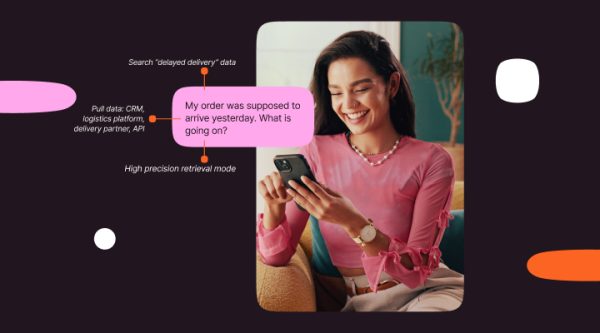
The biggest shift in 2026 is the adoption of Agentic RAG (Retrieval-Augmented Generation). This solves the problem of AI “hallucinations” (making things up) by grounding the AI in your company’s actual data.
- Retrieve: When a user asks a complex question (e.g., “Does my policy cover dental?”), the NLP understands the query and searches for your specific knowledge base or documents for the answer.
- Validate: The system evaluates the retrieved information to ensure it is relevant and accurate.
- Generate: The LLM constructs an answer based only on the validated company data.
This approach combines the fluency of generative AI with the factual accuracy required for business. It enables chatbots to not just chat, but to act as reliable experts on your specific products and policies.
Why modern businesses need Agentic AI (Moving beyond simple answers)
For years, the metric for chatbot success was “deflection”: how many tickets could the bot keep away from human agents. But deflection does not always mean resolution. Often, it just means the customer gave up.
The shift toward Agentic AI changes the goalpost from “answering” to “doing.” While a traditional NLP chatbot acts as a smart receptionist, an AI agent acts as a skilled worker. It doesn’t just retrieve information; it performs tasks autonomously.
Autonomy and planning
The defining characteristic of Agentic AI is its ability to reason and plan. Standard chatbots are reactive, they wait for input and provide a corresponding output based on a script.
AI agents are proactive. When given a complex goal, they break it down into logical sub-tasks using a continuous execution cycle: receiving input, analyzing the goal, taking action, and evaluating the result.
For example, if a user says, “I want to return this item,” a standard bot might simply paste a link to the return policy. An AI agent creates a dynamic plan:
- Analyze: Check the user’s order history to identify the item.
- Verify: Check if the item is still within the return window.
- Interact: Ask the user for the reason for the return.
- Execute: Generate a shipping label and schedule a courier pickup.
This ability to chain thoughts and actions together allows the bot to handle multi-step processes that previously required a human agent.
Tool use and integration
For a chatbot to be truly useful, it needs “hands.” In the world of software, those hands are integrations and APIs.
Agentic AI systems are designed to use tools. They can connect deeply with your backend systems (CRM, inventory management, billing platforms) to execute actions in real-time.
- Orchestration: For highly complex scenarios, an “Orchestrator” agent can coordinate multiple specialized sub-agents. It might direct a “Scheduling agent” to check dates and a “Payments agent” to process a fee, combining their work into one smooth interaction.
- Transactional capability: Instead of sending a user to a website to finish a purchase, the agent can process the payment, issue the receipt, and update stock levels directly within the chat interface.
- Workflow triggers: If a complex issue arises, the agent acts as a triage nurse. It summarizes the issue, categorizes the priority, and creates a ticket for the support team, ensuring the human agent has full context before they even pick up the chat.
By combining NLP’s understanding with Agentic AI’s ability to execute, businesses can move from simple support automation to full-cycle customer service resolution.
Top business use cases for NLP chatbots
In 2026, the question isn’t “can a chatbot do this?” but “should a human be doing this?”.
By deploying NLP-driven bots, businesses are moving away from static forms and decision trees toward dynamic conversations that drive real outcomes. Here are the four high-impact areas where NLP is changing the game.
Customer support automation
The most immediate value of NLP is its ability to handle high-volume, repetitive queries without losing human touch. Unlike rule-based bots that fail when a customer goes “off-script,” NLP bots understand context.
- 24/7 availability: AI chatbots provide support 24/7/365, ensuring customers get instant answers even outside of business hours.
- Intent-driven resolution: If a customer asks, “Where is my package?” or “Track my delivery,” the bot recognizes both as the same intent and triggers the tracking workflow.
- Deflection with empathy: By automating standardized, low-value inbound tickets, chatbots reduce the load on your support team, allowing humans to focus on complex, high-value issues.
Sales and lead qualification
Static lead forms are friction. Conversational AI is engagement. NLP chatbots can act as the first line of your sales team, engaging prospects in natural dialogue to qualify them before they ever speak to a human.
- Entity extraction for scoring: As the user chats, the bot uses Named Entity Recognition (NER) to extract critical details like budget, timeline, or company size, and stores them as attributes.
- Contextual handoffs: If a lead meets your qualification criteria (e.g., “Enterprise” size), the bot can instantly route the conversation to a live sales rep. Because the bot has already collected the data, the sales rep has the full context immediately.
Transactional conversations
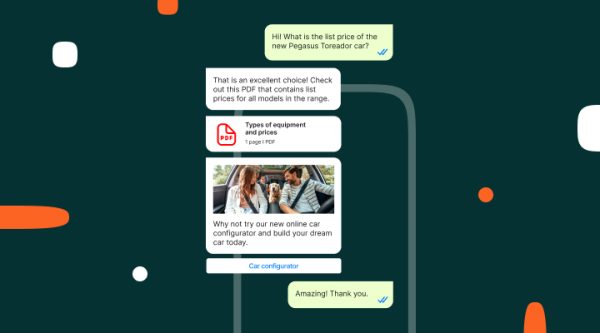
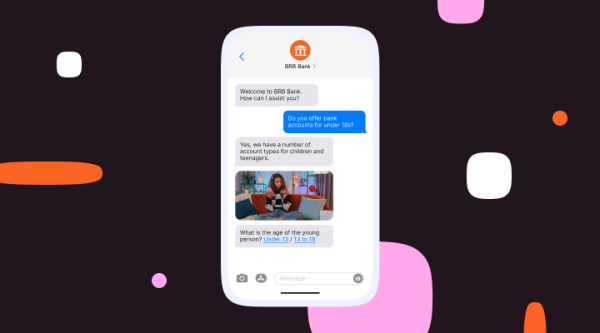
Modern NLP chatbots (specifically AI Agents) can manage multi-step operations, turning a conversation into a transaction. This allows customers to complete tasks directly within their preferred channel, such as WhatsApp or Apple Messages for Business.
- In-chat payments: Users can pay bills or buy products without leaving the chat app.
- Complex bookings: An AI agent can handle a request like “Book a flight to New York next Tuesday” by identifying the destination and date entities, checking availability via API, and finalizing the reservation.
Proactive engagement
Standard chatbots are reactive: they wait for the user to speak. NLP allows for proactive engagement that feels natural rather than spammy.
- Two-way notifications: Instead of sending a “no-reply” alert about a delivery delay, you can send a message that invites a response.
- Scenario: You send: “Your appointment is tomorrow at 2 PM.” The user replies: “I can’t make it, can we do 4 PM?” An NLP bot understands the reschedule intent and the new time entity 4 PM, checks the calendar, and confirms the change automatically.
Best practices for building an NLP chatbot strategy
Building an NLP chatbot is not a “set it and forget it” project. It is an iterative process. To ensure your bot remains accurate, helpful, and trusted by users, you need to follow a strict set of design and training principles.
Based on our experience deploying thousands of bots, here are the essential best practices for 2026.
Prioritize your training data
An NLP model is only as good as the data it learns from. If your training phrases are too sparse or too similar, the bot will struggle to distinguish between intents.
- Volume matters: To ensure your bot can identify intents correctly, you need a sufficient volume of data. While you can start with a minimum of 10 training phrases per intent, it is recommended to add at least 100 phrases for optimal performance.
- Use variations: Users express the same goal in countless ways. Ensure your training data covers different phrasings. For example, a currency exchange bot should be trained on variations like “change from EUR to USD” as well as “convert dollars to pounds”.
- Avoid overlap: If two different intents (like “Check Balance” and “Transfer Money”) have very similar training phrases, the bot may get confused. Keep the language distinct for each intent.
- Balance the dataset: If one intent has 1,000 examples and another has only 10, the bot will be biased toward the larger one. Ensure critical business intents (like “Buy Product”) have robust datasets compared to minor intents (like “Hello”).
Design for “fallbacks” and human handoff
Even the most advanced AI will occasionally encounter a query it doesn’t understand. You must design a safety net for these moments.
- The fallback logic: When the NLP engine cannot match a user’s message to a known keyword or intent, it should trigger a specific “Fallback” dialog rather than silence or a generic error loop.
- Seamless handoff: There will be situations where a bot cannot resolve the user’s issue. In these cases, you should use a “Redirect to Agent” element. This transfers the conversation context to a live agent in your contact center (such as Infobip Conversations), allowing the human to pick up exactly where the bot left off.
Use a hybrid approach (Keywords + NLP)
You don’t have to choose between rigid keywords and fluid NLP. The best chatbots often use both.
Infobip’s architecture allows you to prioritize keywords for specific navigation (like “Press 1 for Sales”) while keeping NLP active for free-text queries.
- Process: The system first checks for exact keyword matches. If no match is found, it activates the NLP engine to tokenize and analyze the text.
- Autocorrection: This hybrid approach helps handle typos. If a user types “emali” instead of “email,” the NLP layer can autocorrect the token and still route them to the correct dialog.
From chatbot to AI Agent: Your next move
The difference between a frustrating chatbot and a revenue-generating AI agent lies in how it understands language.
As we move toward 2026, the era of simple button-mashing bots is fading. Customers expect NLP chatbots that can understand intent, handle complex workflows, and act with autonomy. Whether you are automating support tickets or building a fully transactional sales agent, the foundation is the same: robust Natural Language Processing.
FAQs about the NLP chatbots
A rule-based chatbot relies on strict keywords and buttons. An NLP chatbot uses artificial intelligence to autocorrect words, match synonyms, and understand the intent behind free-text questions.
Yes. Modern chatbots often use a hybrid approach. They use NLP to accurately identify what the user wants (intent) and then use Generative AI (like GPT models) to draft a fluid, conversational response based on that intent.
Yes. Through tokenization, NLP chatbots automatically correct spelling errors (e.g., changing “emali” to “email”) before processing the user’s intent.
To be accurate, an NLP model typically needs at least 50–100 distinct example phrases for each specific “intent” (goal) it needs to recognize. The more varied the examples, the smarter the bot becomes.
A standard chatbot typically answers questions or retrieves information. An AI Agent is more advanced; it can plan and execute multi-step tasks autonomously, such as logging into a CRM to update a record or processing a refund without human help.
Not anymore. Platforms like Infobip Answers provide “low-code” or “no-code” builders. These tools handle the complex NLP technology in the background, allowing you to build and train sophisticated bots using a visual drag-and-drop interface.