



Conversational AI use cases: Real-world examples and results by industry
See how enterprises in retail, banking, healthcare, and telecoms are using conversational AI to cut costs, improve CX, and drive revenue. With real results.

Most enterprise “conversational AI” is still a glorified FAQ page with a chat bubble. Meanwhile, LAQO’s AI assistant resolves 90% of insurance queries in under five messages, Floward handled 54,000 WhatsApp conversations on Valentine’s Day, and iBancar funnels 60% of loan leads through approval without a single human agent.
This guide covers what’s working, who’s doing it, and what the numbers actually look like, broken down by industry.
What is conversational AI (and why it matters now)
Conversational AI is the technology behind machines that can hold a real back-and-forth with a person. It combines natural language processing (NLP), machine learning, and deep learning to understand what someone means, not just what they typed.
For the full technical breakdown, we have a separate guide on what is conversational AI. What matters here is the business side.
Three years ago, most of these systems could handle single-turn interactions. Ask a question, get a pre-written response. Today they retain context across conversations, learn from every exchange, and work across channels at the same time. A customer starts asking about a return on WhatsApp, switches to your website mid-conversation, and picks it back up on RCS a day later. The AI remembers all of it.
Allied Market Research projects the conversational AI market will hit $32.6 billion by 2030. That growth is coming from enterprises, not consumers, because the ROI is trackable. Lower support costs, faster resolutions, better satisfaction scores, and new revenue from conversational commerce.
The shift goes beyond enterprise adoption. Consumer behavior is changing too. People now ask ChatGPT questions they used to type into Google. Voice assistants and AI chatbots are becoming the default interface between people and information. For businesses, this means the conversation channel is no longer a support add-on. It’s where customers expect to interact first. And increasingly, it’s where they expect to buy: more consumers are now completing purchases directly inside chat apps, making messaging channels a new commercial entry point, not just a service one.
But conversational AI gets lumped in with chatbots and AI agents constantly, and the differences matter when you’re deciding what to build.
Chatbots vs. conversational AI vs. AI agents
These three terms get used interchangeably. They shouldn’t be.
Rule-based chatbots follow scripted decision trees. They handle simple FAQ scenarios and break the moment a customer goes off-script. No learning. No memory.
Conversational AI uses NLP and ML to understand intent, manage multi-turn conversations, and improve over time. Think of it as the technology behind ChatGPT: it understands what you’re asking, holds context across the conversation, and gives you a relevant answer. It handles ambiguity, remembers past interactions, and adapts to how the customer actually talks. Its strength is in Q&A: FAQs, policy questions, product queries, and status checks.
AI agents are the 2026 evolution. Where conversational AI answers questions, agents complete tasks. A useful analogy: if conversational AI is ChatGPT, AI agents are more like Claude Code. They don’t just respond, they act. An AI agent can check inventory, apply a discount, process a return, and schedule a courier pickup, all in one WhatsApp thread, without waiting for a human to approve each step.
In practice, the line between the two blurs. Many real-world deployments combine both. A customer asks a question (conversational AI), then the system processes a refund (agentic). The distinction matters most when you’re deciding what to build: if the use case is primarily Q&A, conversational AI is sufficient. If the use case involves executing tasks, touching systems, or running multi-step workflows, you’re in agentic territory.
Agentic AI is now the fastest-growing enterprise tech priority, up 31.5% year over year according to Futurum Group’s 2026 survey of 830 IT decision-makers. For a detailed comparison of chatbot vs conversational AI, see our blog.
With those distinctions in mind, here’s what conversational AI looks like in practice across seven industries.
Conversational AI use cases by industry
Customer service
Conversational AI for customer service is the most established use case, and still the one with the clearest payoff. The logic is simple. Automate high-volume, low-complexity queries so human agents handle the conversations that actually need a human.
That looks like AI resolving FAQs, order status checks, and appointment confirmations without agent involvement. It looks like intelligent routing that detects frustration or complexity and passes the conversation to a person with full context, so the customer doesn’t start over. It also looks like agent assist, where the AI works alongside reps in real time, surfacing knowledge base articles and suggesting replies.
The agentic next step: Agents that go beyond answering to acting – processing a refund, updating an order, rescheduling a delivery, all within the same conversation thread.
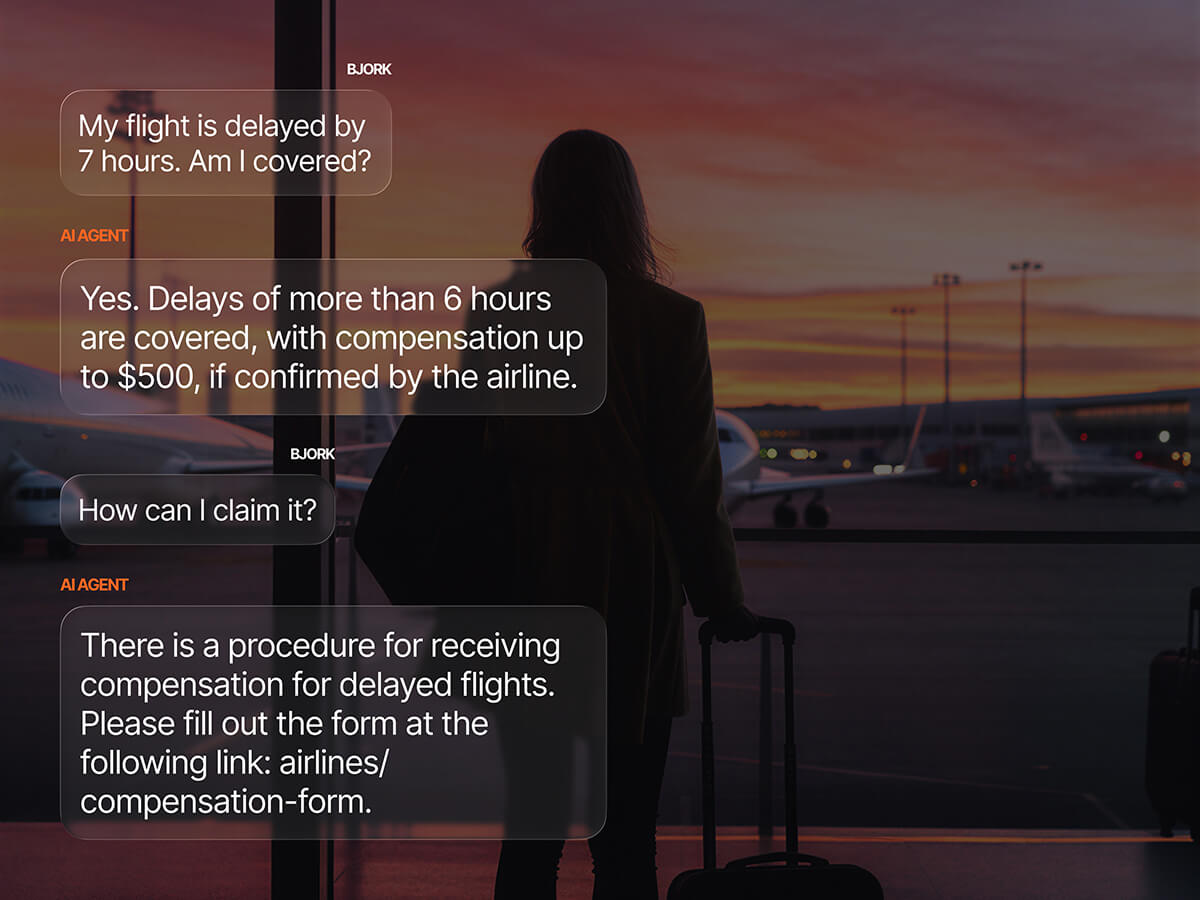
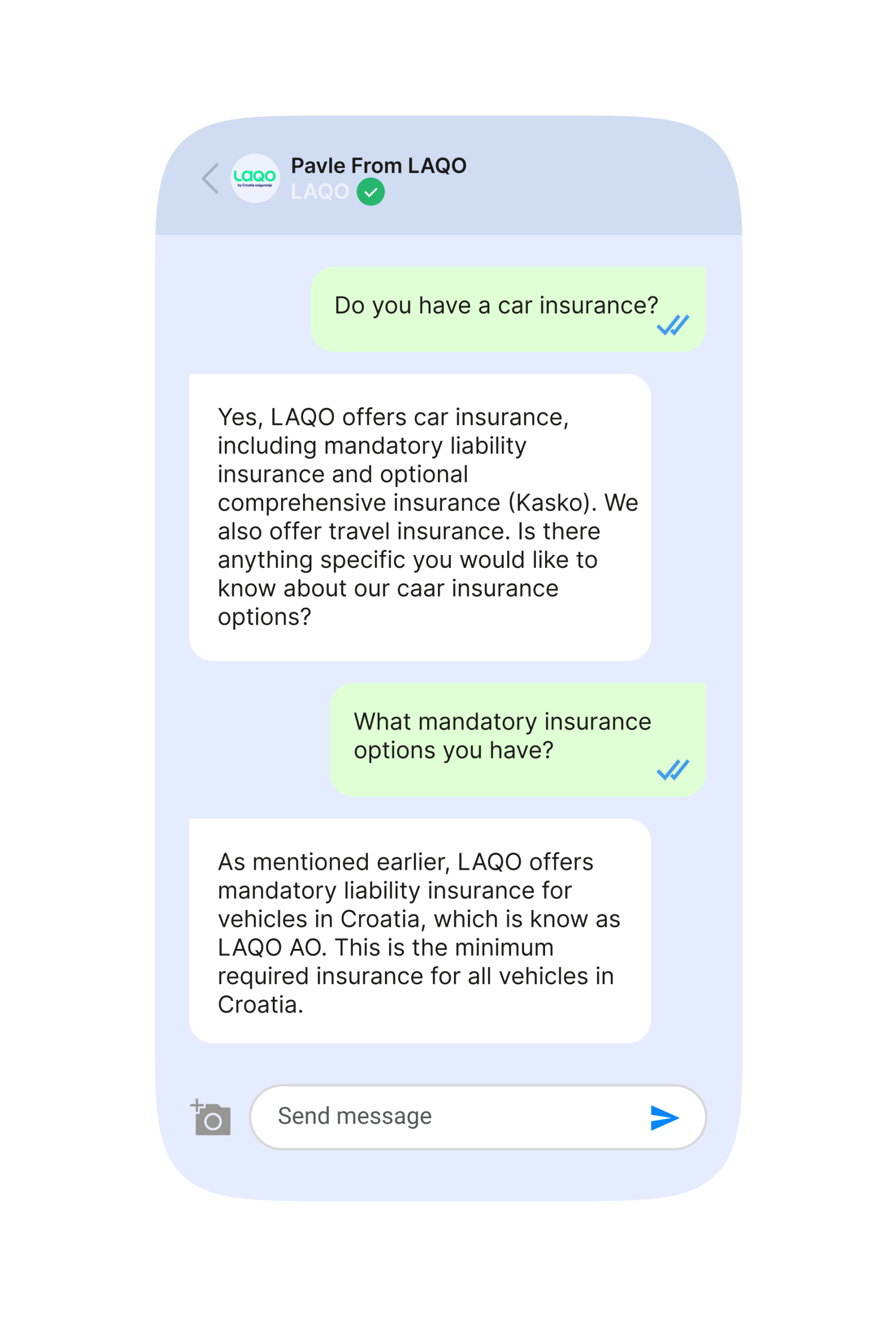
LAQO, Croatia’s first fully digital insurer, built a Gen-AI assistant on Infobip’s platform with Azure OpenAI. 30% of customer queries are now handled entirely by AI, and 90% of those resolve in 3-5 messages. The human agents who used to answer “what does my policy cover?” all day now handle complex claims, and they close them within 24 hours.

Vero, one of Brazil’s largest ISPs, moved its customer service to WhatsApp as the primary channel, with SMS for notifications. The headline number is 16x ROI, but the detail that stood out is that invoice resending dropped 65% in just three months, which saved BRL 500,000 annually (BRL 110,000 of that from call center costs alone).

Infobip helped us digitize customer interactions on a large scale, from billing to technical support, providing a 16x return on investment and strengthening our ability to serve residential and commercial customers throughout Brazil.

Eduardo Vale
CIO at Vero
Gartner predicts agentic AI will resolve 80% of common service issues by 2029, cutting operational costs by 30%. And 62% of consumers already say they’d rather talk to a chatbot than wait in a hold queue.
For high-volume operations, an AI-powered contact center extends this across every channel and language.
Retail and eCommerce
Conversational AI in retail touches every stage of the buying journey.
Product discovery is the obvious one. A customer types “I need a dress for an outdoor wedding in June, under $200” into a WhatsApp thread and gets suggestions pulled from real-time inventory, filtered by their browsing history and past purchases.
Every retailer offers order tracking, but only a few make it frictionless. Customers who can type “where’s my order?” into a WhatsApp thread and get a real-time update with a tracking link, without calling a 1-800 number or digging through email, come back more often. Proactive delivery alerts (shipped, out for delivery, delivered) on the customer’s preferred channel cut inbound “where is it?” volume by 30-50%, and WISMO queries account for up to 80% of eCommerce support tickets.
Loyalty and repeat purchases are where conversational AI compounds its value over time. Conversational AI in eCommerce lets brands send personalized offers, birthday messages, back-in-stock alerts, and product recommendations based on actual purchase history, all through the messaging channels customers already check daily. A WhatsApp message with a relevant offer gets opened at 90%+ rates. A promotional email sits at 20%. The channel changes the math.
The agentic next step: Cart abandonment recovery that doesn’t just send a nudge, it applies a discount, confirms the size, and completes checkout in two taps. Returns that get processed start to finish without a human agent.
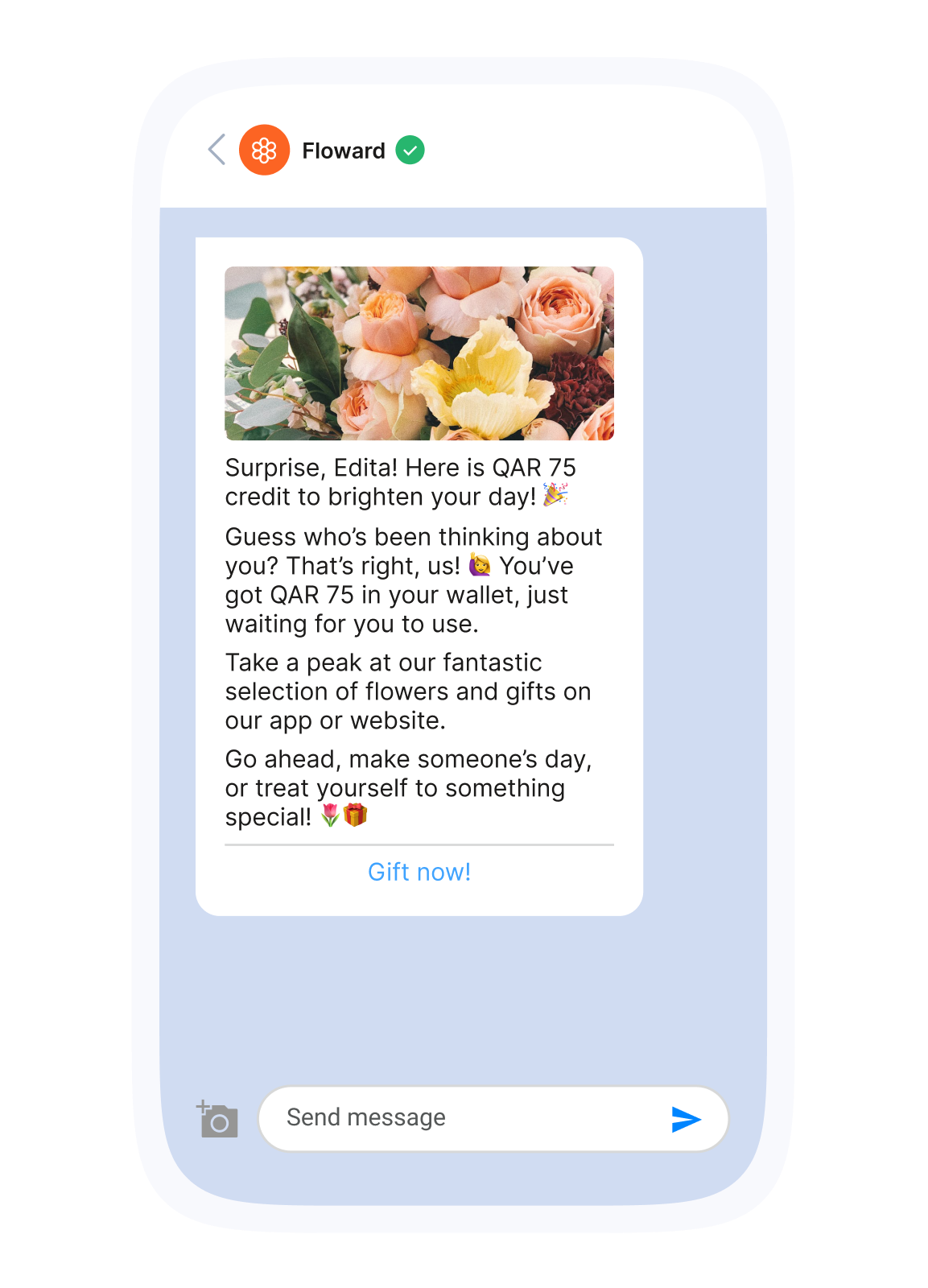
Floward, a flowers and gifts company across MENA and the UK, runs chatbots on WhatsApp, Instagram, and Messenger for delivery tracking, personalized notes, and general inquiries. On Valentine’s Day 2024, the system processed 54,000 conversations in a single day. Their normal volume is 4,000-5,000.

Automotive
Automotive has one of the longest and most fragmented sales cycles in any consumer category. A buyer researches for weeks, visits multiple sites, abandons configurators, and ghosts dealerships before making a decision. By the time a human sales rep follows up, the lead is often cold or already gone to a competitor. Conversational AI closes that gap by engaging buyers at every stage, on the channels they’re already using.
Lead qualification is where the ROI is most immediate. Instead of collecting a form submission and waiting for a rep to call back, a WhatsApp chatbot qualifies the lead in real time. Budget, model preference, trade-in, financing interest, all captured in a conversation that takes three minutes and happens at 11pm when the buyer is actually browsing.
Post-purchase is just as important. Service reminders, recall notifications, accessory upsells, and financing renewal prompts all reach customers on WhatsApp or RCS instead of getting lost in email. A customer who hears from their dealership between purchases is more likely to return for their next vehicle.
The agentic next step: Agents that handle the full scheduling flow; model selection, location, time slot, confirmation, reminder, end-to-end without human involvement. Financing renewal prompts that move customers through a complete re-engagement sequence.
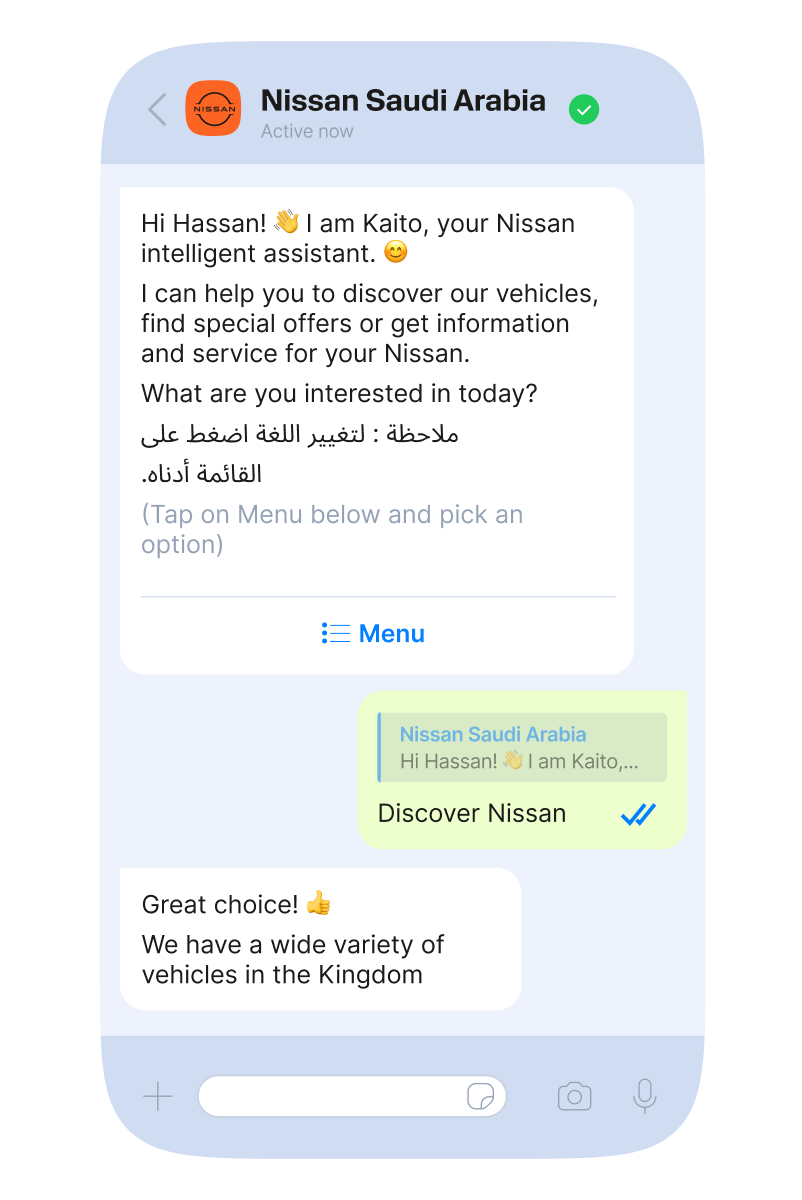
Nissan Saudi Arabia paired a WhatsApp chatbot for lead generation with a conversational AI gamification campaign. The chatbot delivered 138% more leads and 71% more unique users. The gamification side hit a 200% engagement increase and 68% conversion rate across 3,400+ sessions.

Financial services and banking
Banks and fintechs need accuracy, regulatory compliance, and airtight security. Conversational AI in banking has to get all three right, or it doesn’t ship.
Account management over messaging channels (balance checks, transaction history, card activation, spending alerts) removes the need for app downloads or branch visits. Loan origination over WhatsApp lets customers apply, upload documents, and receive approvals through a single conversational thread, with the AI pre-qualifying applicants and routing edge cases to specialists. Fraud alerts with two-factor authentication let customers confirm or deny suspicious transactions in seconds, on the same channel.
The agentic next step: Loan origination over WhatsApp where an agent pre-qualifies applicants, guides them through document upload, and routes edge cases to specialists. Payment reminder sequences that adapt based on customer response. Full claims initiation for insurance without human involvement.
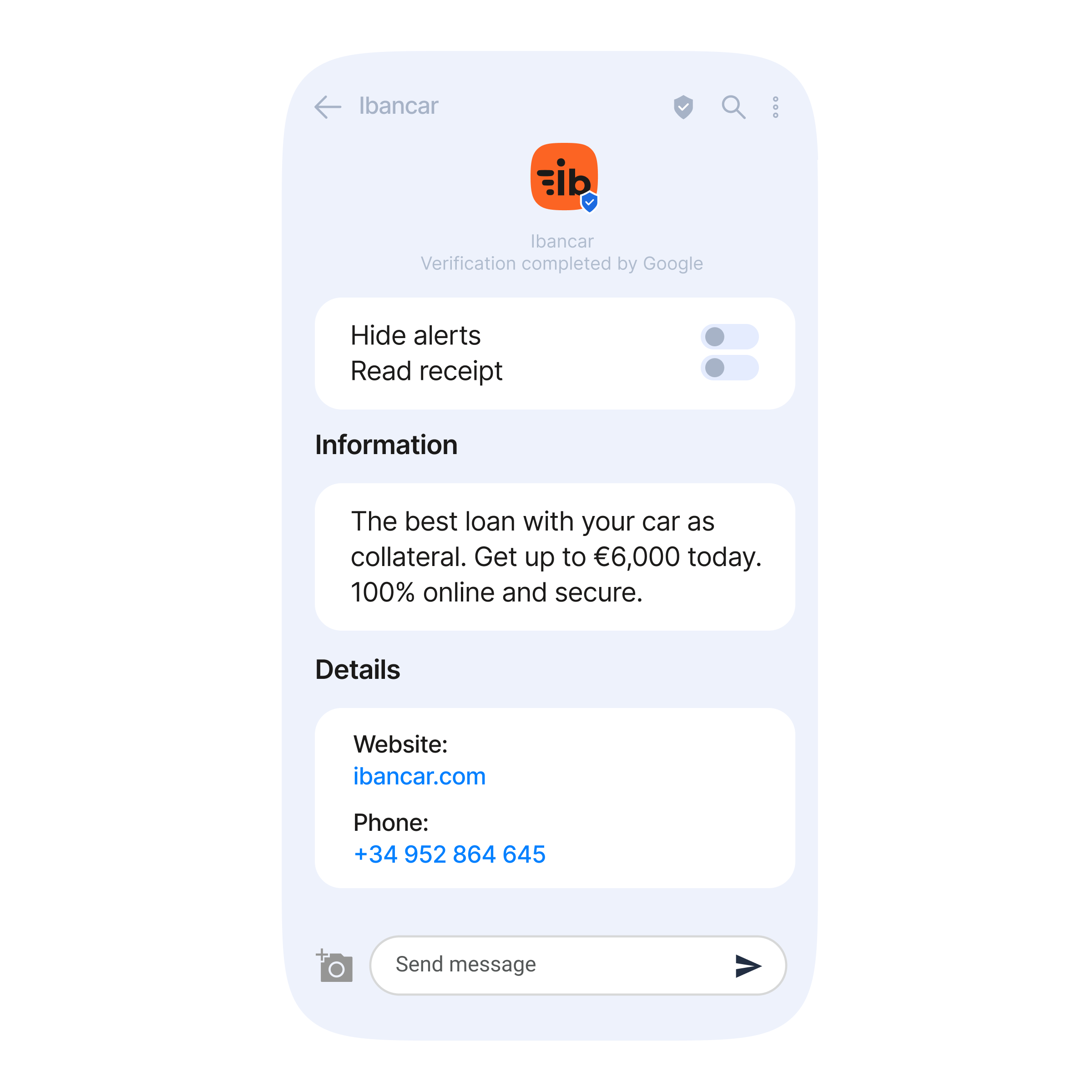
iBancar, a Spanish fintech lender, went further. They deployed a WhatsApp chatbot for 24/7 loan support, a customer data platform for unified data, RCS and SMS for loan approvals and payment reminders, and a cloud contact center for agent handoff.

The same patterns apply to conversational AI for insurance, where policy questions, claims initiation, and document collection follow the same high-volume, low-complexity logic that makes automation pay off fast.
Healthcare
Healthcare sits at the intersection of high patient expectations and strict regulatory requirements. Conversational AI in healthcare works when it gives patients speed without cutting corners on privacy or compliance.
Appointment scheduling and reminders over WhatsApp or SMS are the entry point. Automated reminders alone cut no-show rates by 29-34% according to a systematic review of 29 studies, which adds up fast for any practice running dozens of appointments a day.
Post-discharge follow-up handles check-ins after procedures, flags concerns, and alerts clinical staff when something looks off. Pre-visit intake (questionnaires, insurance verification, consent forms) gets completed through messaging before the patient walks in.
The agentic next step: Chronic-care monitoring, where an AI agent collects readings, flags patterns, and alerts clinical staff based on defined thresholds without the patient needing to initiate contact.
Magdalena Clinic in Croatia built the Megi Health platform on Infobip’s platform, a WhatsApp-based virtual assistant for chronic-care patients with hypertension. Patients record blood pressure readings, track symptoms, and get personalized education through the assistant. Cardiologists get bi-weekly progress summaries. When BP values fall outside regulated ranges, the system escalates automatically.
The outcome was better treatment adherence, less patient anxiety, and a persistent link between patients and their care teams that doesn’t depend on office hours.

Employee experience and HR
The same technology that handles customer queries can absorb the repetitive internal questions that eat up HR teams’ days. Conversational AI for HR gives people answers without making them wait for someone to check their inbox.
Onboarding is the clearest win. New hires get walked through paperwork, benefits enrollment, IT setup, and company policies by an AI assistant that customizes the flow by role, department, and location. A remote engineer in Berlin and an office-based marketer in London both get exactly what’s relevant to them, without HR duplicating effort.
Internal FAQ handling covers the questions that HR gets fifty times a week. Leave balances, expense policies, benefit details, IT troubleshooting. For global companies, multilingual support means teams in different countries get answers in their own language.
IT and support ticket triage works the same way. Requests get categorized and routed automatically. Simple stuff (password resets, VPN access, software license requests) resolves without anyone touching it. Complex cases reach the right person with full context, so nobody gets bounced between three departments.
The agentic next step: Agents that process leave requests, update employee records, and run onboarding workflows end to end. Training recommendations and completion tracking that happen in the background without HR managing spreadsheets.
Gartner projects that 75% of employee interactions with HR will be initiated through conversational AI platforms by 2025, and early adopters like IBM already automate over 80 HR tasks through their internal virtual agent.
Social media and messaging
Every competitor in this space talks about “chat” and “voice” abstractly. None of them can show you what conversational AI actually looks like when it’s running natively on WhatsApp at enterprise scale, with RCS fallback and SMS notification.
WhatsApp Business is where most of the action is. Product catalogs, order management, customer support, payments, all within the app that 3+ billion people already have on their phones.
Instagram and Messenger automation turns DMs and comment-driven inquiries into structured conversations that end in a purchase or a resolved issue. RCS brings branded, interactive messages (carousels, quick-reply buttons, verified sender identity) to the native messaging app on Android.
The agentic next step: What changes the game is when these channels work together. A customer starts on Instagram, moves to WhatsApp, gets a follow-up via RCS. Context carries across all of them. The customer never repeats themselves.
The companies getting this right aren’t building conversational AI for a generic “chat” widget. They’re building for the specific channels their customers open every day.
Marketing and lead generation
Conversational AI in marketing turns one-directional campaigns into actual dialogues. Conversational AI for sales picks up where marketing leaves off.
Instead of blasting a promotional SMS with a link, you send a WhatsApp message that starts a conversation. The lead gets qualified in real time. Product questions get answered. A demo gets booked before the prospect moves on to the next tab. For lead qualification at scale, AI agents ask the right questions, score based on responses and behavior, and route hot leads to sales while everyone else enters a nurture sequence.
The agentic next step: AI agents ask the right questions, score based on responses and behavior, and route hot leads to sales while everyone else enters a nurture sequence. Product launch campaigns with quizzes, polls, and gamified elements delivered through WhatsApp or RCS. Some campaigns are hitting conversion rates above 60%.
For enterprises connecting conversational AI automation with their existing marketing stack, the move is to start with one campaign, measure what happens, and expand from there.
The use cases above are what’s working today. What follows is where the technology is heading next.
Conversational AI trends shaping the next 12 months
Six things to watch in 2026 and into 2027.
1. Agentic AI replaces reactive chatbots
Agentic AI is the fastest-growing enterprise tech priority, up 31.5% YoY as a top-ranked investment area. The shift is from bots that answer questions to agents that complete tasks on their own. Check inventory, process a return, schedule an appointment, escalate when needed.
2. Multimodal AI reaches production
Voice, text, and image processing in one conversation thread. A customer sends a photo of a damaged product via WhatsApp. The AI sees the damage, confirms the issue, initiates the return. No human touches it.
3. Channel-native deployment over retrofitting
The old way was building for a generic “chat” interface, then bolting on WhatsApp support. The new way is designing for each channel’s native capabilities from the start (WhatsApp catalogs, RCS carousels, Messenger quick replies). Conversational AI in telecom is where this is most visible. Vero deployed WhatsApp Payments with Pix integration and saw debt collection returns jump 194%.
4. EU AI Act makes compliance non-optional
Transparency requirements, human oversight obligations, and data governance are now regulatory mandates. Build compliance in on day one or retrofit it painfully later.
5. Multi-agent orchestration
Specialized AI agents that collaborate on complex tasks. One handles the conversation, another queries the CRM, a third processes payment, a fourth updates the order system. They coordinate without a human dispatcher.
6. MCP (Model Context Protocol) servers
A standardized way for AI agents to connect to enterprise tools and data sources (CRMs, ERPs, knowledge bases) through a single protocol. Replaces the custom-integration-for-every-system approach that slows most deployments down. See our MCP glossary entry for more.
Best practices for getting started with conversational AI
Every enterprise in this article started small. Here’s the playbook that keeps showing up.
Name the problem
Before picking a use case, name the problem you’re trying to solve. High support costs. Low CSAT scores. Appointment no-shows. Cart abandonment. Leads going cold before sales can follow up. The right use case follows directly from the problem. Start there, and the technology decision becomes straightforward.
Once you’ve identified the problem, look for interactions that are repetitive, high-volume, and don’t require human judgment. FAQ handling, order status, appointment booking, and payment reminders. These prove ROI quickly and build confidence across the organization.
Pick the right first use case
Go for high-volume, low-complexity interactions like FAQ handling, order status, and appointment booking. These prove ROI quickly and build confidence across the organization. Nobody gets fired for automating “where’s my order?”
Define metrics before you build
Resolution rate, CSAT, cost per interaction, containment rate. Set baselines first. Without them, you’ll have a deployment but no way to prove it’s working.
Start with one channel
In MENA and Latin America, that’s WhatsApp. In North America and parts of Europe, web chat or RCS. Get one channel working well before you add more. Our conversational AI strategy guide walks through the framework.
Design the handoff before launch
When does the AI escalate? What context transfers to the human agent? Can the agent pick up without the customer repeating everything? These questions need answers before you go live, not after.
Iterate based on real conversations
Use analytics to find where the AI gets stuck, which questions it can’t answer, and where customers abandon the conversation. Retrain, expand scope, add channels. Repeat.
Start with the use case that matters most
LAQO started with customer query automation. Floward started with delivery tracking. iBancar started with loan support. Nissan started with lead generation. All of them expanded after proving results on a single use case and a single channel.
AgentOS gives you the infrastructure to do the same. Build, deploy, and scale AI agents across messaging channels, with built-in handoff to human agents, conversation analytics, and enterprise-grade compliance.