
How retail chatbots can personalize shopping experience

Shoppers expect quick, helpful responses. Retail chatbots have become a popular tool for brands to meet that demand. Learn how they’re transforming the way companies interact with their customers.

Ana Rukavina Content Marketing Specialist
Skip to table of contents

As online shopping grows, with estimated global retail sales of $32.8 trillion by 2026, retailers seek new ways to engage with customers and enhance their shopping journey. One such solution is a retail AI chatbot.  

In this blog, we will explore how retail bots can transform the shopping experience for your customers, making it more enjoyable, convenient, and tailored to their preferences. 

What is a chatbot for retail? 

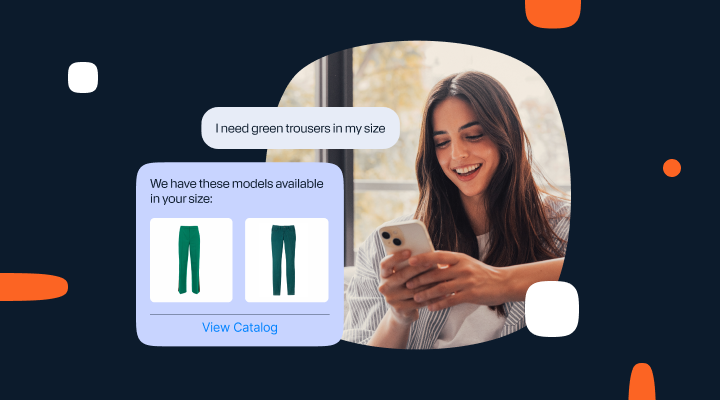
Retail chatbots are automated shopping assistants that use artificial intelligence (AI) technology to answer customer’s FAQs, provide recommendations, search for products, upsell, and engage in interactive conversations to enhance customer experience.  

They can be integrated into various websites, mobile apps, social media, and chat apps, such as Messenger, Instagram, Viber, WhatsApp, or Kakao, to assist customers throughout their shopping journey and create an omnichannel experience. 

They are excellent at guiding customers through the buying process and helping reduce carts abandoned by providing timely support. 

Retail chatbots help drive conversational commerce as a perfect mix of meeting modern customer expectations on the one side while improving customer satisfaction on the other.  

Types of chatbots for the retail industry 

Shopping chatbots that are available to meet various customer needs and improve the shopping experience usually fall into one of two broad categories: 

1. Rule-based chatbots

Rule-based chatbots are powered by pre-defined rules or decision flows and are programmed to assist with a series of options. These rules dictate how the chatbot should respond to a specific user input or scenario.  
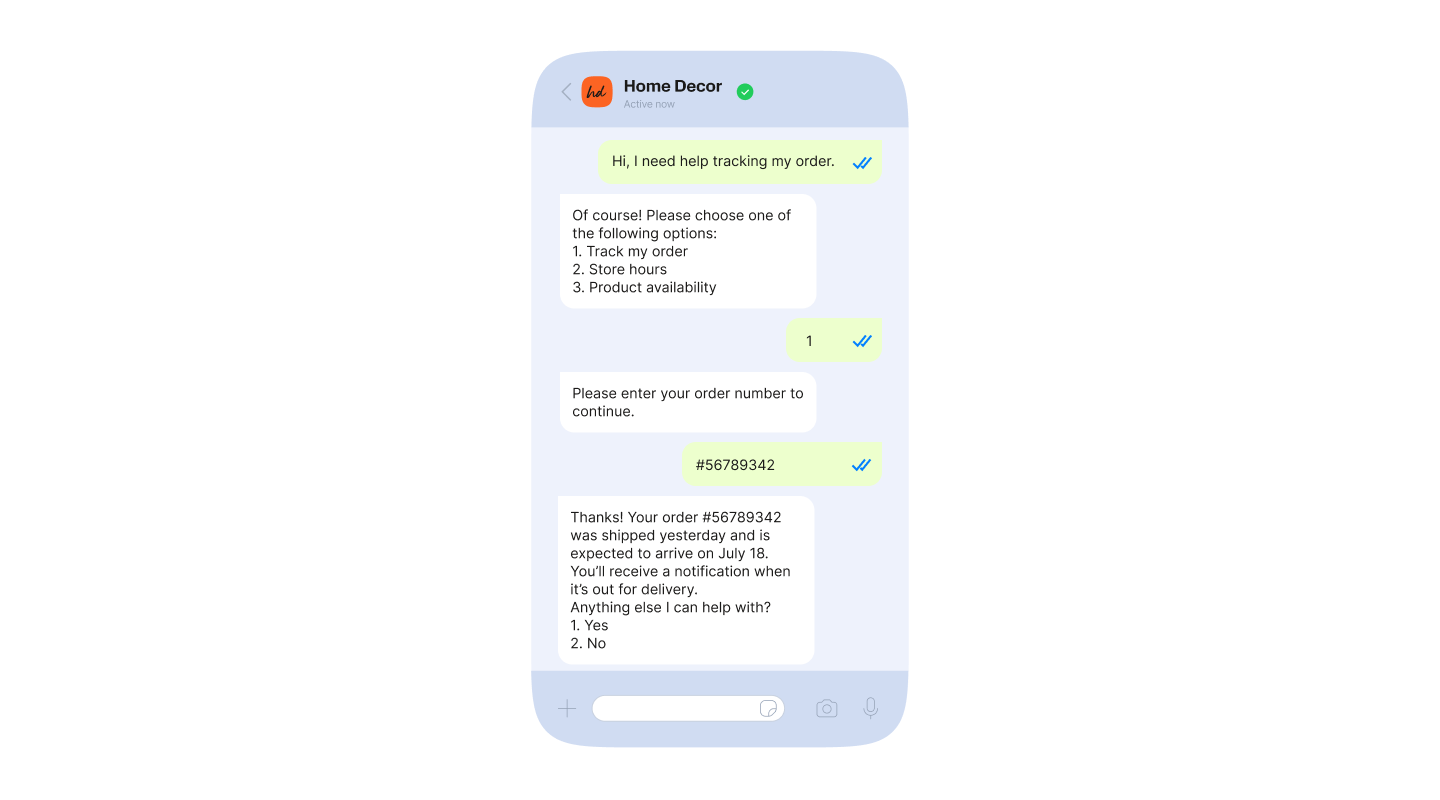
A visual showing a chat conversation with Home Decor in a messaging app. The user asks for help tracking their order. The automated response presents options: 1. Track my order, 2. Store hours, 3. Product availability. The user selects option 1 and enters the order number #56789342. Home Decor replies that the order was shipped yesterday and is expected to arrive on July 18, with a notification to be sent when it is out for delivery. The message asks if the user needs further assistance, offering options: 1. Yes, 2. No.

Even though they do not learn from user interaction or adapt to new information over time, they are well-suited for handling routine and predictable tasks, such as providing standard product information and frequently asked questions like return policies or order tracking updates. 

Imagine this scenario: your business often gets more customer inquiries on open hours or return policies than human agents can handle. Implementing rule-based chatbots helps you provide 24/7 customer support with consistent responses, reduces customer wait times, and frees time for your agents to focus on more complex inquiries. 

Other benefits of using rule-based chatbots in retail are: 

  • Scalability – They can handle a large volume of routine queries simultaneously. This is particularly valuable during peak periods such as Black Friday, Cyber Monday, or Singles’ Day sales. 
  • Customization and control – Your business completely controls your rule-based chatbot’s rules and decision-making process. You can tailor the chatbot’s responses to align with your brand identity, industry requirements, or other standards. 
  • Cost-effective – They can reduce the need for live agents and reduce costs. 
  • Quick deployment – Rule-based chatbots are relatively easy and quick to deploy since they rely on predefined rules. 

2. AI-powered chatbots

AI chatbots use AI, machine learning (ML), and natural language processing (NLP) to understand users’ intent and respond to an inquiry in a conversational way. They can learn from data, adapt to user inputs, and improve their responses. 
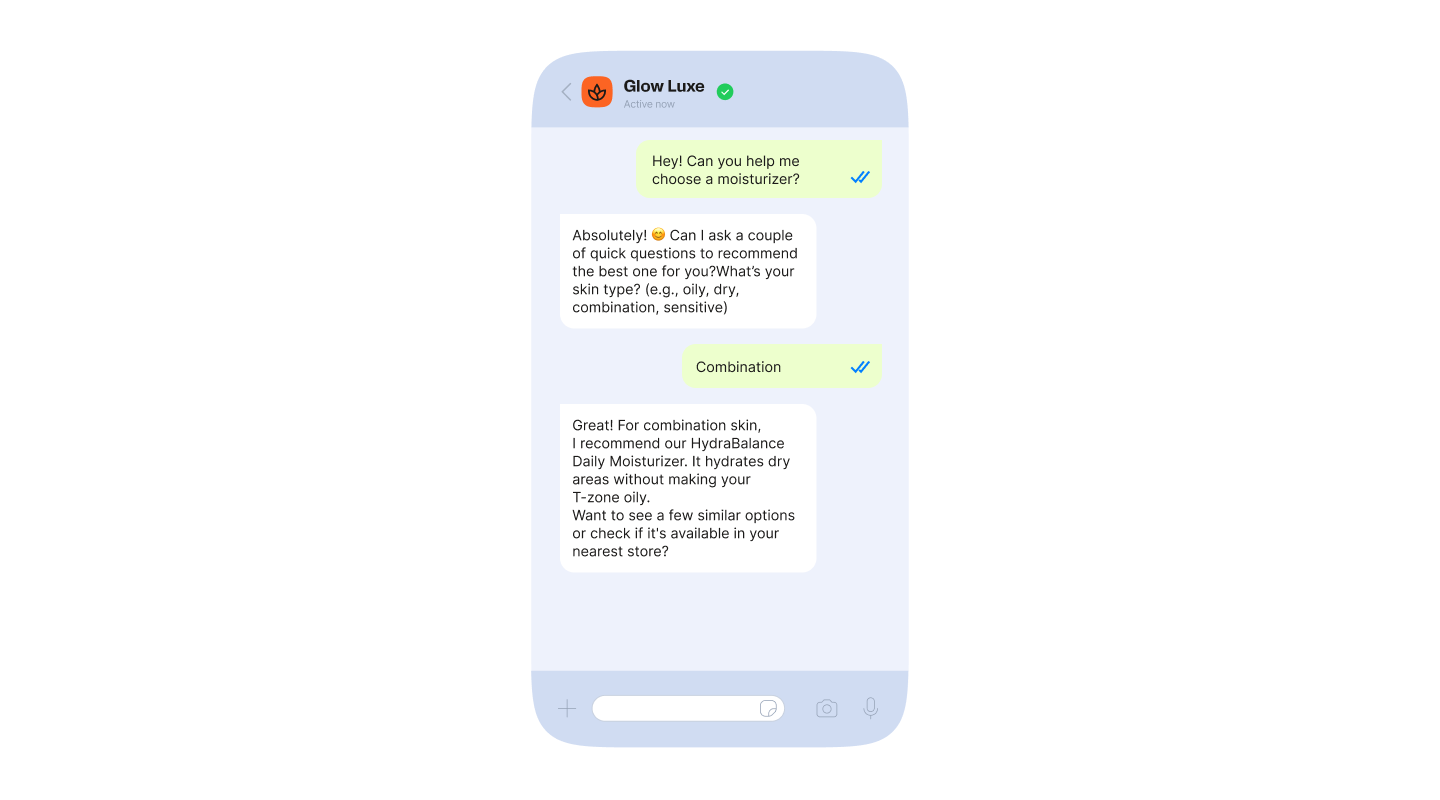
A visual showing a chat conversation with Glow Luxe. The user asks for help choosing a moisturizer. Glow Luxe replies, "Absolutely! Can I ask a couple of quick questions to recommend the best one for you? What’s your skin type? (e.g., oily, dry, combination, sensitive)" The user responds with "Combination." Glow Luxe then suggests their HydraBalance Daily Moisturizer, explaining it hydrates dry areas without making the T-zone oily, and asks if the user wants to see similar options or check availability at the nearest store.

Let’s take the beauty sector, for example. Your retail AI chatbot can give them tips on applying products, what skin type the product is best suited for, get information on skin care routines, and suggest other similar products they might like, creating an interactive and customized shopping experience. Our research shows that all generations prefer receiving personalized messages from the brand. 

The benefits of conversational AI chatbots in the retail industry are numerous, to name a few: 

  • Continuous learning and improvement – AI algorithms allow chatbots to continuously learn from interactions, adapting and improving their responses over time. 
  • Data-driven insights – AI-powered chatbots collect and analyze vast amounts of customer data, providing valuable insights into preferences, behaviors, and trends that can help drive increased sales, improve conversion rates, and increase revenue.  
  • Personalized shopping experience – This includes everything from personalized product recommendations and context-aware conversations to awarding loyalty points, tailored discounts, helping in the decision-making process, and gathering feedback. They can even suggest nearby stores with product availability to enhance offline sales. 

A step further: Agentic AI 

Agentic AI chatbots can go beyond traditional AI by proactively taking initiative, handling tasks, making decisions, and guiding customers across channels without waiting for explicit prompts. These advanced chatbots interact autonomously, orchestrate complex workflows, and collaborate smoothly with human support when needed, resulting in faster problem resolution and more human-like shopping experiences. 

A visual of a chat conversation with BrewEase. The conversation goes as follows: BrewEase asks Brandon if he is looking for the perfect coffee machine and if he prefers espresso, drip coffee, or something versatile. Brandon replies that he mostly drinks espresso but wants something that can also make lattes. BrewEase recommends the BaristaPro 5000 coffee machine, highlighting features like a built-in frother and customizable settings, and mentions it is on sale for $249, including a link to view the product. Brandon asks to add it to his cart. BrewEase responds by offering house blend coffee for $13.99.

Chatbot use cases in retail 

There is no better way of understanding the value of retail bots than seeing how they can be applied in the real world. Here are a few examples: 

Unilever: 14x higher product sales

Unilever was looking for a new and unique approach to its promotional efforts. After some research, they realized that the best way to promote the products was to approach the customers in a way they’re familiar with and mimic how such products get recommended organically. 

Result: 14x higher sales with a chatbot campaign that promoted product awareness and generated interest 

Salmoiraghi & Vigano: 100% CSAT score 

Salmoiraghi & Vigano wanted to digitally transform their business to improve and personalize customer service, so they chose WhatsApp as their starting point. With the help of our customer experience team, they also built an intuitive chatbot with Answers.  

Result: 46% of customers using the WhatsApp chatbot for support 

Farm Superstores: 60% reduction in operational cost

Farm Superstores was looking for digital-first solutions that would help them accommodate changing consumer needs and enhance their customer experience. 

They implemented a WhatsApp Business chatbot to answer frequently asked questions and offload repetitive customer queries from agents. 

Result: 60% reduction in operational costs thanks to seamless integration with existing systems and fast responses 

Now, let’s look at some tips and best practices to help you deploy similar effective chatbots for the retail industry. 

Tips and best practices for chatbots in retail 

1. Define clear goals and objectives 

Prioritize a clear understanding of your business objectives and identify key customer pain points. With this knowledge, tailor your chatbot to address them effectively. Don’t just implement a chatbot because everyone is doing it.  

2. Craft the right chatbot persona

Consistency in user experience is one of the key building blocks when building trust and brand loyalty. This means that even your chatbot persona should align with your brand’s tone and values. If your brand’s personality is fun and playful, make your chatbot like that; your customers will love it.  

How LAQO shaped Pavle’s character into a human-like bot with a great sense of humor in line with their brand personality:

3. Choose the right provider to build your chatbot 

When selecting a provider, you should review client feedback and examine their portfolio to ensure they have relevant experience and proven results.  

Consider Infobip Conversational Experience Orchestration Platform (CXOP), which represents the next evolution in chatbot technology by combining agentic AI with unified data and automation. CXOP lets businesses create chatbots and conversations that understand customer intent and adapt in real time. It also allows humans and AI to work together smoothly, so complex issues get resolved faster. 

This unified platform improves customer engagement by delivering personalized, goal-oriented conversations at scale while reducing response times and operational costs. 

Create your retail chatbot with a chatbot building platform

How to calculate cart abandonment rate 

Learn how to calculate cart abandonment rate and why it’s important for optimizing your eCommerce strategy.

Monika Lončarić Senior Content Marketing Specialist
Skip to table of contents

For any eCommerce business, tracking the performance of online sales is a must. Keeping tabs on the right metrics can help identify potential pain points with your checkout process and clarify which steps are needed to mitigate any issues. 

Cart conversion rate vs. cart abandonment rate 

The cart conversion rate and the cart abandonment rate are two essential metrics that eCommerce businesses use to measure and analyze their online sales performance. 

Cart conversion rates represent the percentage of visitors who complete a purchase after adding items to their shopping cart. It provides insights into the effectiveness of the website in converting potential customers into paying customers and increasing the number of completed purchases. 

On the other hand, the cart abandonment rate refers to the percentage of visitors who add items to their shopping cart but leave the website without completing the purchase. It reflects the number of lost sales opportunities and can indicate potential issues in the checkout process or overall user experience.  

Calculate your cart abandonment rate 

While the cart conversion rate focuses on successful purchases, the cart abandonment rate highlights missed conversion opportunities and helps businesses identify areas for improvement in order to reduce abandonment and increase sales

Calculate your brand’s cart abandonment rate in a couple clicks to better understand how many shopping carts result in the number of completed purchases: 

0%

Now let’s walk through the nitty-gritty steps on what goes on behind the calculation: 

1. Determine the timeframe 

The first step to calculating cart abandonment rate is to determine the timeframe you want to analyze. You can calculate the rate for a specific period, such as a week or a month, or for a specific event, such as a sale or a new product launch. Many businesses track shopping cart abandonment during seasonal promotions or events. 

2. Collect data

You need to collect data on the number of users who add items to their cart and the number of users who complete the purchase. You can find this information in your website’s analytics or eCommerce platform. Make sure to capture data like the number of shopping carts created, completed purchases, and payment options used, such as credit card or alternative payment methods. 

It’s also helpful to compare your data with industry benchmarks and cart abandonment statistics to better understand how your numbers compare to your competitors. Factors like high shipping costs often cause online shoppers to drop out before completing their purchase, a point we’ll explore later.

3. Formula for abandoned cart rate 

Once you have collected the data, you can calculate the cart abandonment rate using the following formula: 

Divide the total number of purchases by the total number of carts created. 

Subtract that number by 1 and multiply by 100 to get the percentage. 

For example:

You had 100 purchases and 350 carts created: 

100 / 350 = 0.285 

1 – 0.285 = 0.71% 

0.71 x 100 = 71% 

In this instance, your rate of cart abandonment is 71%.  

4. Analyze and improve 

After calculating your cart abandonment rate, it’s important to analyze the data and identify potential issues with your checkout process. Some common reasons for cart abandonment include unexpected shipping costs, a complicated checkout process, limited payment options like only offering credit card payments, and a lack of trust with the website. Free shipping incentives can also significantly reduce cart abandonment. Once you have identified the issues, you can take steps to improve your checkout process and reduce cart abandonment. 

Cart abandonment statistics and common reasons 

Before analyzing your own performance, it helps to have a general sense of how cart abandonment typically looks across industries. On average, the shopping cart abandonment rate across industries is 69.99%. This means nearly seven out of ten online shoppers abandon their cart before completing the purchase. 

Cart abandonment rates also vary by industry. Sectors involving more expensive or complex purchases, such as cruise bookings, automotive sales, or luxury goods, tend to see much higher abandonment rates. On the other hand, industries like grocery and essentials usually have the lowest abandonment rates, mainly because these purchases are driven by immediate need and higher purchase intent. 

The source of traffic also plays a significant role. Online shoppers who land on your website via social media are more likely to abandon their cart, with abandonment rates reaching as high as 91%. In contrast, visitors who arrive through search engines or direct traffic typically show a stronger intent to purchase, resulting in lower abandonment rates. 

Timing can influence shopper behavior, too. Cart abandonment often drops at the end of the month, coinciding with paydays, and during major holidays when shoppers are more motivated to complete their purchases. 

Calculate abandoned cart rates to improve your eCommerce strategy 

Calculating your cart abandonment rate is an important step in understanding the effectiveness of your eCommerce store. By regularly tracking and analyzing your cart abandonment rate, you can identify potential issues and take steps to improve your checkout process and increase conversions. Dig deeper into what pain points your customers experience, whether it’s high shipping costs, lack of payment options, or insufficient trust signals, and explore options on how you can reach out to them to recover their carts and complete their purchase.

Discover how to improve cart recovery rates and boost conversions 

Discover cart abandonment recovery strategies to lower your shopping cart abandonment rate and convert more online shoppers into paying customers. 

Retail customer engagement: All you need to know for 2025

Learn about customer engagement in retail and how to build the ideal customer engagement strategies for your business. 

Sandra Posavac Content Marketing Specialist
Skip to table of contents

Remember when a great product was enough to attract customers? Now, expectations go beyond the product. 

Retail experiences have changed because customers expect personalized interactions, instant support, and flawless service every time. To stay relevant and drive brand loyalty, retailers must move beyond generic strategies. 

But what does customer engagement mean exactly, and how should you engage  customers in retail? This blog will walk you through all you need to know to make your retail business thrive off relevantly engaging customers. 

What is customer engagement? 

Customer engagement is about building a customer relationship with customers through every interaction, whether it’s marketing, sales, or service-related.  

These interactions can be initiated by the brand or the customer, and they happen throughout the entire customer journey – before, during, and after a purchase. Whether it’s a one-way message or a two-way conversation, online or in-store, any touchpoint a customer has with your brand counts as engagement. 

Examples of customer engagement include: 

  • Sending push notifications about special offers 
  • Nudging them to complete a purchase to their abandoned cart with SMS reminder 
  • Enabling shopping on preferred channels like WhatsApp or RCS 
  • Asking for customer feedback through surveys on their favorite chat apps 

To boost results, meet customers where they already are. Engaging customers on their preferred digital channels creates more personalized experiences and encourages loyalty through relevant, timely conversations. 

Why is customer engagement important? 

Relevant engagement boosts sales and cuts churn. In fact, 80% of customers say the shopping experience matters just as much as the product itself. That means how you connect with customers can make or break your success.

When done right, customer engagement leads to: 

  • More frequent purchases and bigger orders 
  • Higher retention and fewer lost customers 
  • Increased revenue and stronger profitability 
  • Deeper emotional connection to your brand 
  • Loyal customers who advocate and refer others 

Customer engagement vs. customer service 

Customer service is the help a customer gets when they reach out to a brand with a question or issue. 

Customer service is a type of customer engagement and it’s just a piece of the puzzle. True engagement happens when retailers proactively connect with customers in meaningful ways. 

Common customer service use cases include:

  • Answering product-related questions via live chat or call 
  • Helping customers track, modify, or cancel orders 
  • Processing returns, refunds, or exchanges 
  • Resolving issues with delivery or payment 
  • Offering technical support for product setup or usage 
  • Providing assistance through chatbots outside business hours 

Customer engagement vs. customer experience (CX) vs. customer satisfaction 

To avoid confusion, it’s also helpful to understand how customer engagement differs from similar terms.  

Customer engagement 

This is all about how customers interact with your brand on an ongoing basis. 

It includes things like: 

  • Clicking on a promo email 
  • Messaging your support team 
  • Browsing or buying through your app 
  • Responding to a social media post 

Customer engagement is the sum of all the ways customers stay connected with your brand over time. 

Customer experience (CX) 

This is the overall perception a customer forms about your brand, based on every step of their journey. 

It covers things like:

  • How easy it is to find and buy a product 
  • The tone and clarity of your communication 
  • How smooth your website or app feels 
  • How they’re treated during support interactions 

CX is the big picture, from the first impression to the post-purchase moment. 

Customer satisfaction 

This zooms in on how a customer feels after a specific moment or experience. 

It answers questions like: 

  • “Was this easy?” 
  • “Did this solve my problem?” 
  • “Would I come back?” 

Satisfaction is often measured through quick surveys, star ratings, or NPS scores, and it helps you understand what’s working and what needs fixing. 

How customer engagement works in 5 stages 

In retail, customer engagement typically happens across five key stages. Customers don’t always follow them in order, they can jump ahead or return to earlier stages. What matters is understanding their needs at each point to create a better shopping experience. 

1. Awareness 

This is the first moment customers discover your product, service, or brand. It could happen through social media, ads, online searches, or recommendations. Your goal here is to grab their attention and make a memorable first impression. 

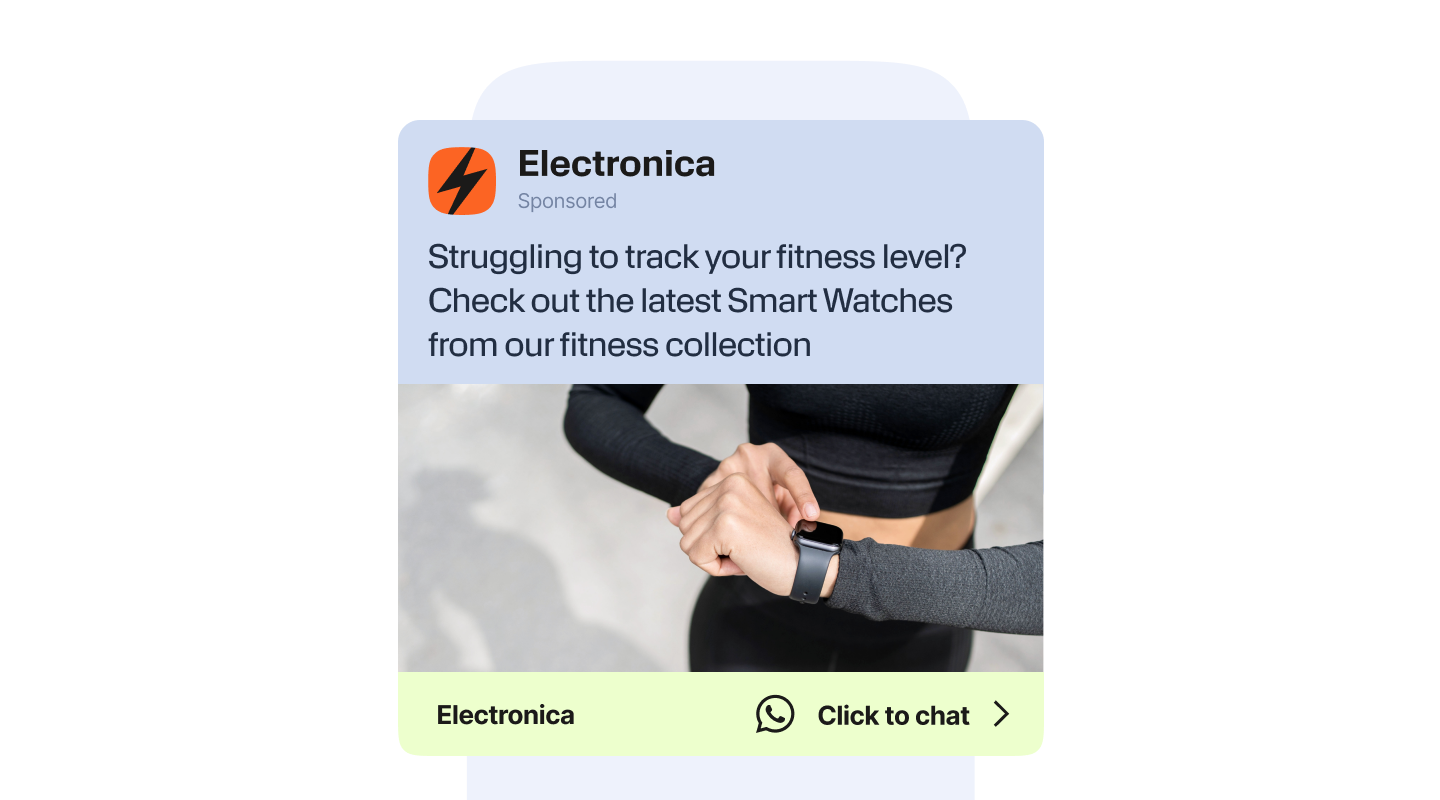
Pro tip: Use click-to-chat ads on platforms like Instagram and Facebook to invite customers into direct conversations with your brand. 

A visual showing an ad from Electronica promoting smartwatches for fitness tracking. The image shows a person wearing a black long-sleeve top checking their smartwatch. The ad text reads: "Struggling to track your fitness level? Check out the latest Smart Watches from our fitness collection." Below is a light green bar with the Electronica logo and a "Click to chat" button featuring a WhatsApp icon.

2. Interest 

Once they know you exist, potential customers start looking deeper. They compare options, explore features, and evaluate benefits. You need to provide helpful, engaging content that shows how your product stands out. 

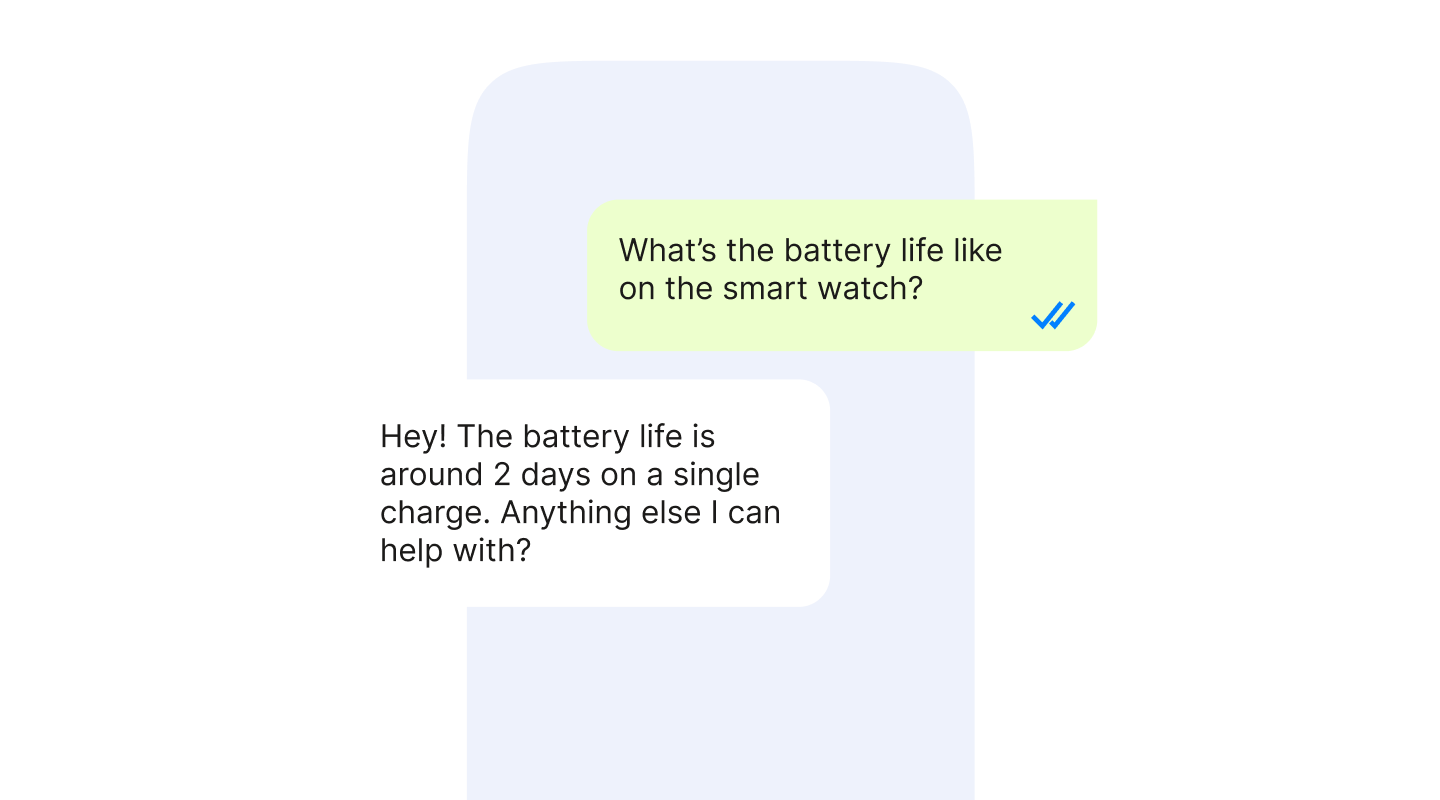
Pro tip: Set up a friendly, fast chatbot to answer common questions about your products, offering real-time support boosts interest and trust. 

A visual showing a chat conversation where the user asks, "What’s the battery life like on the smart watch?" The reply states, "Hey! The battery life is around 2 days on a single charge. Anything else I can help with?"

3. Consideration 

At this stage, customers are weighing whether or not to buy. They’re checking your prices, quality, reviews, and reputation. Now is the time to make a clear case for why your product is worth it. 

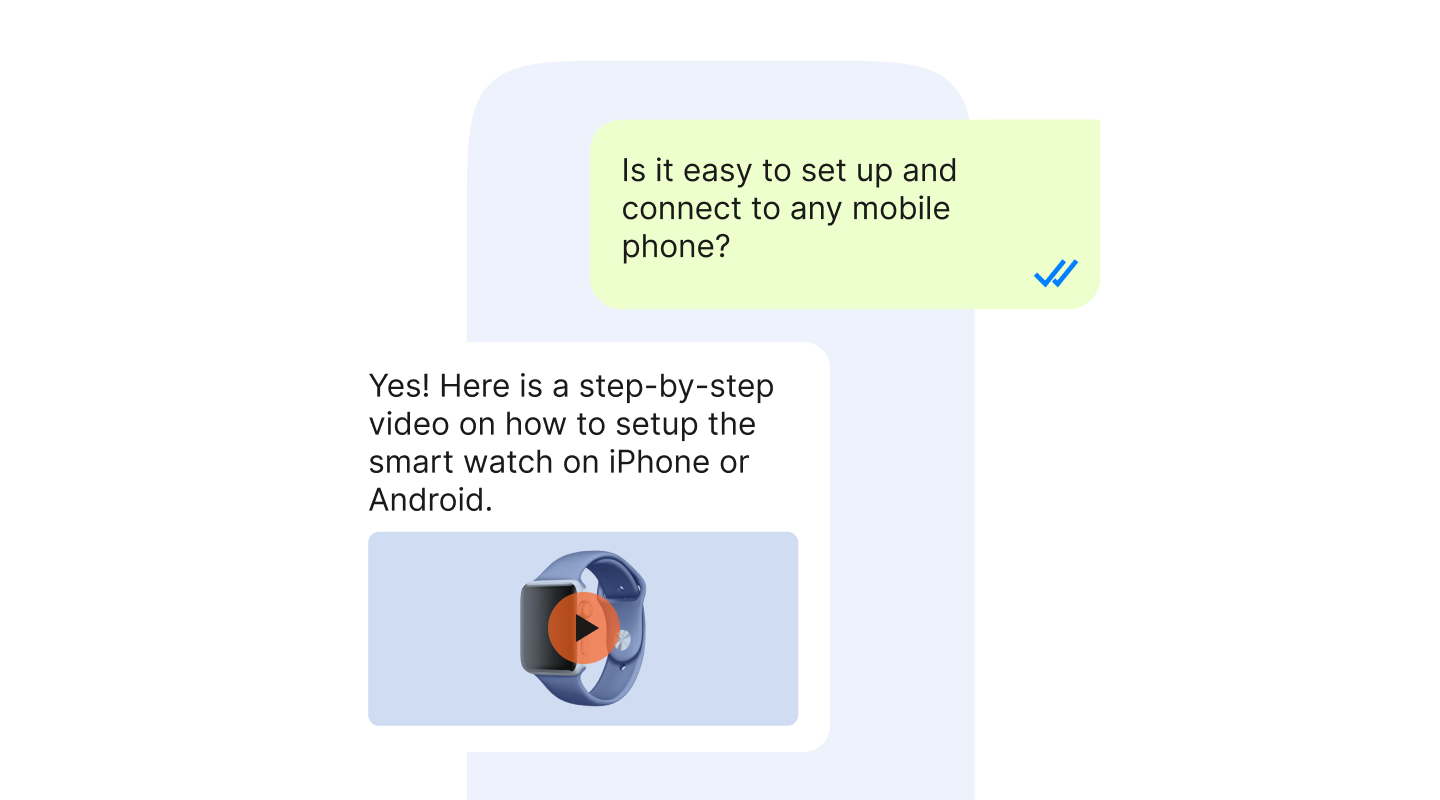
Pro tip: Add value to your conversations with videos, images, and rich media that explain what makes your product better and easier to buy. 

A visual showing a chat conversation where the user asks, "Is it easy to set up and connect to any mobile phone?" The response says, "Yes! Here is a step-by-step video on how to set up the smart watch on iPhone or Android," accompanied by an image of a blue smartwatch with a play button icon in the center, indicating a video tutorial.

4. Conversion 

Here’s where interest becomes action. Whether it’s buying a product, subscribing, or signing up, the key is to make it as simple and stress-free as possible. 

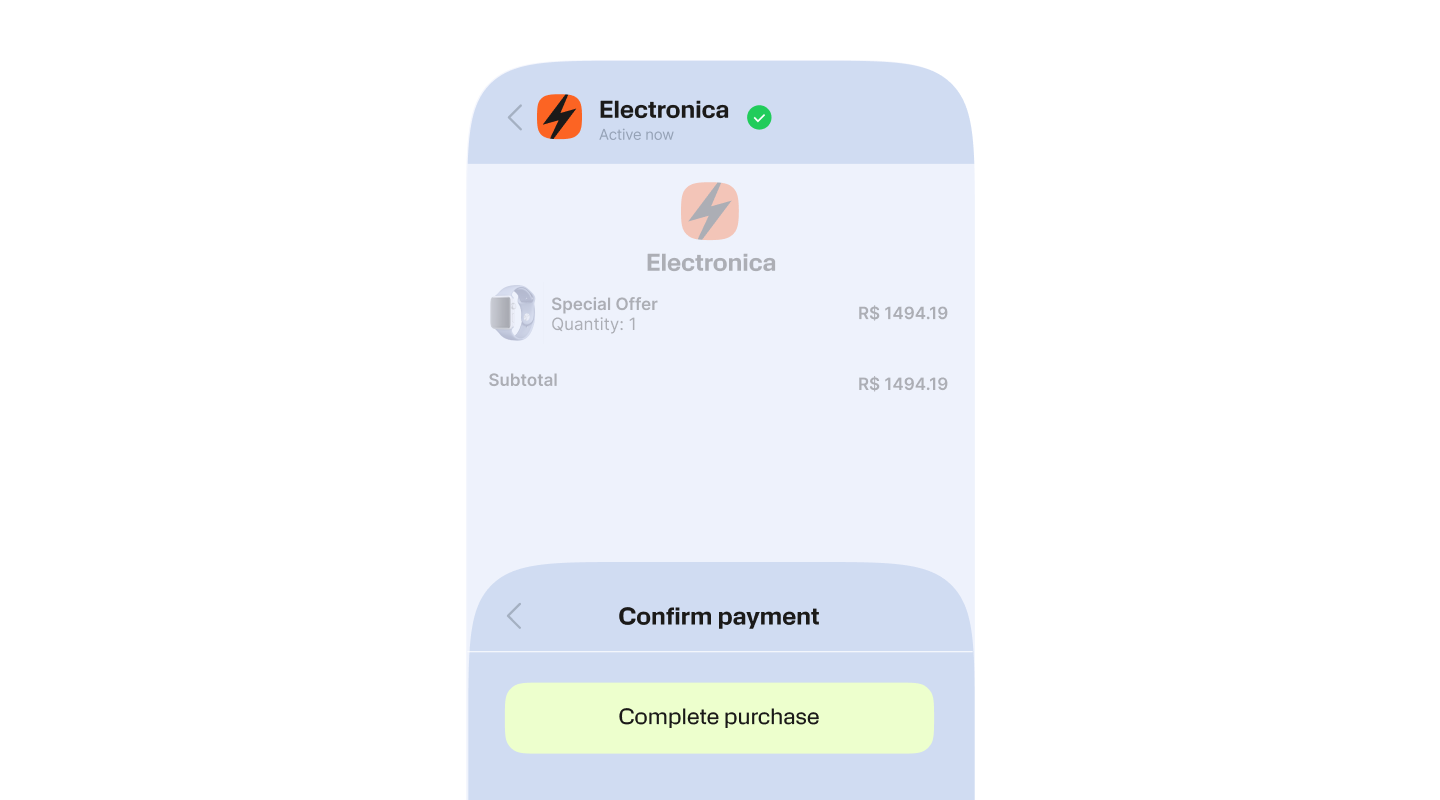
Pro tip: Let customers pay directly in the chat – tools like WhatsApp payments remove friction and help close the deal instantly. This helps improve conversion rates. 

A visual showing a mobile chat interface from Electronica displaying a payment confirmation screen for a special offer smart watch priced at R$1494.19, with a button to complete the purchase.

5. Loyalty 

After the purchase, it’s all about keeping the customer coming back. Great service, personalized experiences, and thoughtful follow-ups turn one-time buyers into loyal customers and loyal brand advocates. 

Pro tip: Use customer data to create tailored campaigns that suggest relevant products and spark the next purchase, boosting customer loyalty long term. Consider offering a loyalty program. 

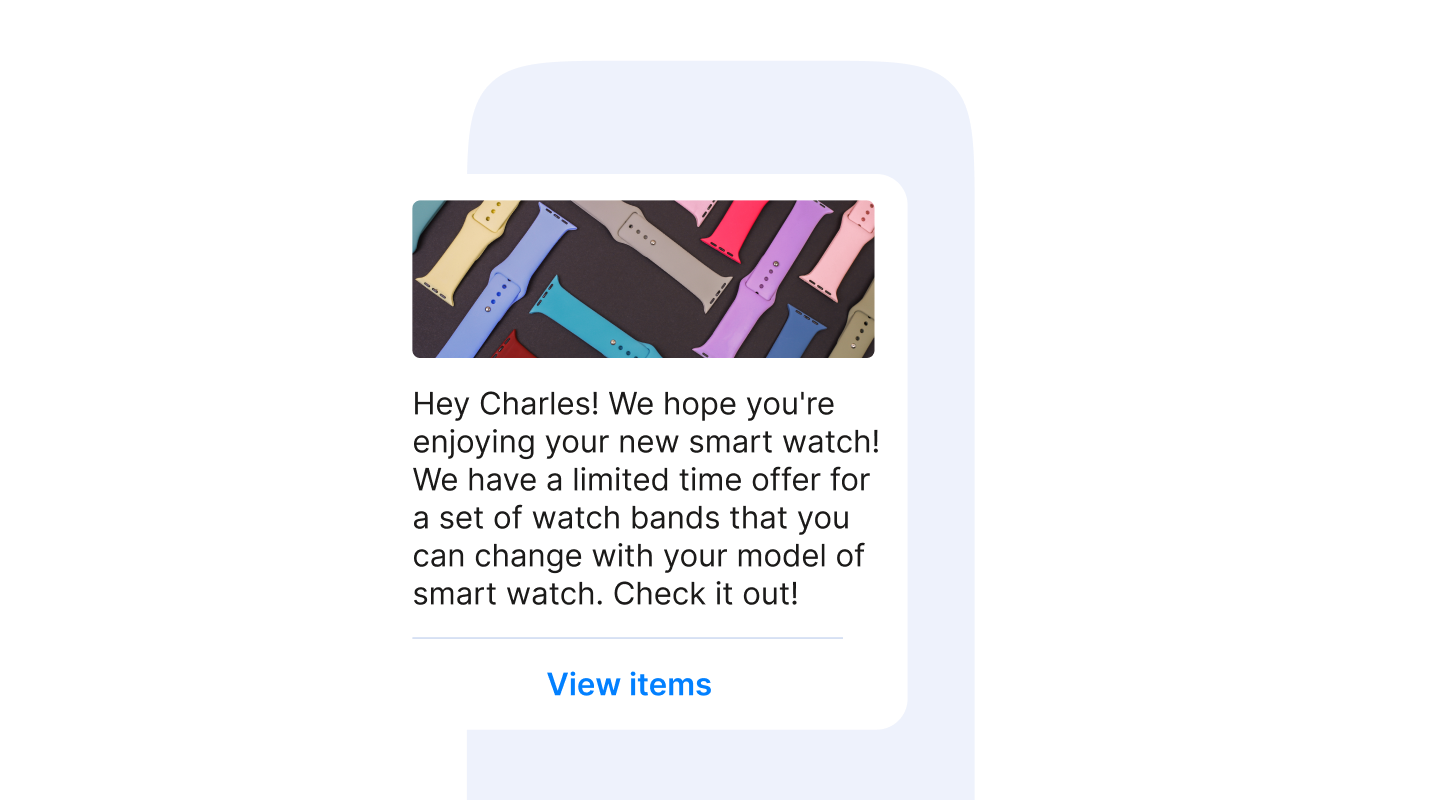
Chat message showing a variety of colorful smart watch bands. The message reads, "Hey Charles! We hope you're enjoying your new smart watch! We have a limited time offer for a set of watch bands that you can change with your model of smart watch. Check it out!" with a clickable link labeled "View items."

How to build a strong customer engagement framework 

A customer engagement framework outlines how retailers can keep customers involved and connected with their brand. Here’s how to get started: 

Research and prepare 

Understand your audience by analyzing customer behavior and collecting data to create buyer personas. This helps you identify customer needs and intent across interactions. 

Map the customer journey 

Create a journey for each person, pinpointing key touchpoints and pain points. This shows where and how customers currently engage with your brand, and where there’s room to improve. 

Build your engagement strategy 

Use journey insights to find what’s working and what’s not. Focus on customer preferences, like communication channels and messaging style, to shape a plan that meets their expectations. 

Use the right platforms and tools 

Implement an omnichannel platform that supports personalized, automated conversations across multiple channels. This ensures a seamless and consistent experience. 

Measure success 

Track key metrics like ROI, customer satisfaction, churn, and NPS to understand what is working. Use these insights to refine your approach over time. 

A visual showing a person holding a smartphone. Surrounding the person are three chat bubbles representing different communication channels: an email saying "Thanks for joining us! Here’s 15% off your first order," an SMS message stating "Hey Lisa, your delivery arrives today!," and a WhatsApp notification reading "Just a heads-up: Items in your cart are almost out of stock!"
If a customer engagement framework is implemented effectively, it helps retailers connect with customers across digital channels through personalized and timely messages, keeping them engaged and connected to the brand.

10 effective strategies to improve customer engagement in retail 

Customer engagement is now a key driver of loyalty and revenue. Retailers must evolve their communication strategies to match shifting customer expectations, especially across digital platforms.  

The CX Maturity Report shows that over half of brands (57%) struggle to effectively engage customers. If you’re facing similar challenges, here are 10 proven strategies to help you create stronger, more meaningful interactions with your customers: 

1. Use an omnichannel approach 

Customers expect consistent, connected experiences, no matter which channel they use. An effective omnichannel retail strategy aligns communication and service across platforms like: 

Use each channel strategically across different stages of the customer journey, from discovery and purchase to post-sale support and re-engagement. Additionally, use rich media features (e.g., carousels, video, stickers) to make messaging more engaging and product-focused. 

2. Personalize every interaction 

Start by analyzing how shopping habits are shifting. Segment your audience based on how they browse, buy, and interact. Then, personalize your messages.  

Customers don’t want generic outreach. Go beyond using a customer’s name. Go into their purchase history, preferences, and behaviors to tailor recommendations, send relevant offers, and acknowledge milestones (like birthdays or anniversaries). Personalization increases trust and customer retention. 

3. Send time-sensitive messages that drive action 

Timely messages can accelerate conversions. Use SMS to send limited-time offers, low-inventory alerts, or shipping updates. For account creation or logins, simplify the process with one-click authentication or time-based codes to speed up transactions without disrupting the shopping experience. 

4. Streamline mobile checkout with identity verification 

A complicated checkout process is a leading cause of cart abandonment. Implement Mobile identity verification to automatically fill out forms and validate user information in real time. This helps customers complete purchases quickly, without frustration or friction. 

5. Use conversational AI and smart chatbots 

AI-powered chatbots offer 24/7 support and instant answers to common questions. With natural language processing, chatbots can simulate human conversations and: 

  • Guide users through purchase decisions 
  • Suggest products based on previous behavior 
  • Provide order updates or help with returns

This reduces the load on support teams while delivering fast, personalized service. 

6. Optimize post-purchase engagement 

Continue engaging customers even after the purchase is complete. Follow up with helpful content like setup guides, style tips, or care instructions. Encourage reviews or ask for feedback via survey links on their preferred channel. This keeps the conversation going and shows you value the customer beyond the transaction.  

For example, you can improve post‑purchase experience with WhatsApp Utility Messages. 

7. Empower loyalty through gamification 

Introduce rewards programs with gamified elements, like badges, points, and tiered perks, to encourage repeat purchases. Give customers more reasons to engage by allowing them to earn rewards through referrals, reviews, or sharing content. 

8. Offer real-time support through live chat 

Integrate live chat support on your website or mobile app to offer help during critical decision-making moments. Easy access to human can be the difference between a sale and a lost customer, especially for expensive purchases. 

9. Connect in-store and online shopping using phygital marketing 

Phygital marketing brings together the best of both physical and digital retail to improve the customer experience. This strategy appeals to customers who like the convenience of online shopping but still enjoy visiting stores. For example, you can: 

  • Use QR codes in-store to link shoppers to online deals or product info 
  • Offer mobile payments and contactless checkout for faster service 
  • Personalize in-store experiences using customer data from online activity 

10. Use user-generated content (UGC) 

Encourage customers to share photos or reviews on social media and tag your brand. Display UGC on your product pages to build trust and foster community. Seeing real people use your products is one of the most authentic forms of engagement. 

How NIVEA achieved 207% of its campaign reach target with innovative customer engagement: 

How to measure customer engagement 

To understand how well your engagement efforts are working, track these key metrics: 

Net promoter score (NPS) 

Measures how likely customers are to recommend your brand to others – an indicator of trust and loyalty. 

  • Example question: “On a scale of 1–10, how likely are you to recommend us?” 
  • Follow-up with open-ended questions for deeper insights. 

Churn rate 

Shows customer retention by calculating the percentage of customers lost during a given period. 

  • Formula: (Lost customers / total customers at the start + acquired during period) 

Customer satisfaction score (CSAT) 

Assesses customer satisfaction through simple surveys. 

  • Often measured on a numeric scale or with emojis/emotions. 

Web engagement metrics 

Track how users interact with your digital content: 

  • Pages per session 
  • Campaign click-through rates 
  • Time spent on site or specific actions 

Retail success with customer engagement platform 

The bottom line: Customers now want messages that feel personal, quick, and conversational, not just a sales pitch.  

To meet these expectations, retailers in 2025 need single intelligent platform capable of engaging customers in real time, across any channel, without juggling multiple disconnected tools. 

Infobip CXOP (Conversational Experience Orchestration Platform) answers this need by placing agentic AI at the core of every interaction. Unlike traditional rule-based automation, CXOP uses autonomous AI agents that understand context, sentiment, and customer intent, enabling dynamic, goal-driven conversations. 

CXOP can help people choose what to buy, send them personalized messages, or connect them to a real person when things get tricky. It puts messaging, automation, and AI into one easy-to-use platform. The outcome includes more conversion rates, happier loyal customers, and lower costs for the business. 

Convert browsers to top shoppers 

Bring your retail customer engagement to life and watch loyalty grow. 

Optimizing retail touchpoints for elevated customer journeys

Unlock ways to optimize your retail touchpoints to offer better customer journeys and drive business results.

Ana Rukavina Content Marketing Specialist
Skip to table of contents

Every time a customer interacts with your brand, whether it’s on your website, through an app, or via social media, that moment matters. These interactions, known as retail touchpoints, collectively shape the customer journey and have a direct impact on satisfaction, loyalty, and revenue.

The modern customer demands digital and user-friendly interactions with little tolerance for pain points. In fact, 86% of customers will leave after two bad experiences with a brand.

No matter how strong your product is, the quality of each interaction ultimately defines your customer experience. Every interaction contributes to the customer’s impression of your brand and their overall experience while shopping with you.

Meaning, each touchpoint matters.

The key is to identify and optimize them to meet the expectations of your customers, and in turn, you can boost conversions and improve your bottom line.

What is a customer touchpoint?

A customer touchpoint is an interaction between a customer and your brand that influences their perception of you. This can be anything from seeing an advertisement to speaking with customer support or downloading your app.

These touchpoints are mapped out throughout the customer journey and provide insight into how customers interact with your business. Each touchpoint offers retailers a chance to impress and satisfy customers, improving their overall experience.

Now that we’ve defined them, let’s explore where these touchpoints typically appear along the customer journey.

Examples of retail touchpoints

Touchpoints exist in every stage of the customer journey. From pre-purchase to post-purchase, every interaction will determine if customers feel satisfied enough to purchase from you again. 

Map out all the interactions customers have with your brand to determine if those touchpoints add value to the relationship or have developed into pain points.  

Each of these interactions is a chance to reinforce your brand, remove friction, and deliver meaningful value. 

Here are some typical touchpoints for retail:

Pre-purchase During purchase Post-purchase
Social media posts Account signup Re-engagement messages
Ads and influencer content Website or app browsing Delivery updates
Blog content Checkout process Feedback surveys
Online reviews Customer support Returns and exchanges
Word of mouth In-store assistance Loyalty programs

Identifying the right touchpoints is the first step to optimizing them. Here’s how to find what matters most.

How to identify touchpoints in retail?

Put yourself in the customer’s shoes and find every point of contact they have with your brand across channels. You can use feedback surveys and reviews to determine the emotions associated with each touchpoint and find pain points you didn’t know existed.  

Take Petpetgo, for example.  

The eCommerce retailer found that Facebook ads and generalized email campaigns resulted in low return on advertising spend (ROAS). These touchpoints were not adding value to their potential and existing customers, which meant their bottom line was suffering.    

After auditing their retail touchpoints, they realized these channels weren’t driving engagement or value. By shifting to a personalized, omnichannel messaging strategy, they doubled purchase frequency and reduced ad spend by 10%.  

Infobip tip: Optimize underperforming touchpoints by making them more contextual, timely, and personalized.

Evaluate your touchpoint readiness with Infobip’s CX Maturity Assessment

Before optimizing your retail touchpoints, it’s important to understand where your business currently stands. Are your channels connected? Are you delivering a consistent, personalized experience at every step of the customer journey?

Infobip’s CX Maturity Assessment helps you evaluate how advanced your current setup is in managing retail touchpoints and delivering a seamless customer experience.

This quick, guided assessment benchmarks your business across four dimensions:

  1. Channel coverage: Are you engaging customers where they prefer to interact (e.g., social media, messaging apps, email)?
  2. Customer insight: Do you have the data to understand how each customer interacts with your brand?
  3. Journey orchestration: Can you deliver the right message, on the right channel, at the right time?
  4. CX agility: How quickly can you adapt and optimize your communication strategies?

Whether you’re just getting started or ready to scale with automation and personalization, the assessment gives you a clear view of your strengths and opportunities and guides you toward the next level of customer experience excellence.

5 messaging techniques to improve retail touchpoints

Relevant messaging plays a huge role in the success of transforming touchpoints into seamless experiences, much like in Petpetgo’s case.  

These five techniques help you turn each touchpoint into a moment of value.

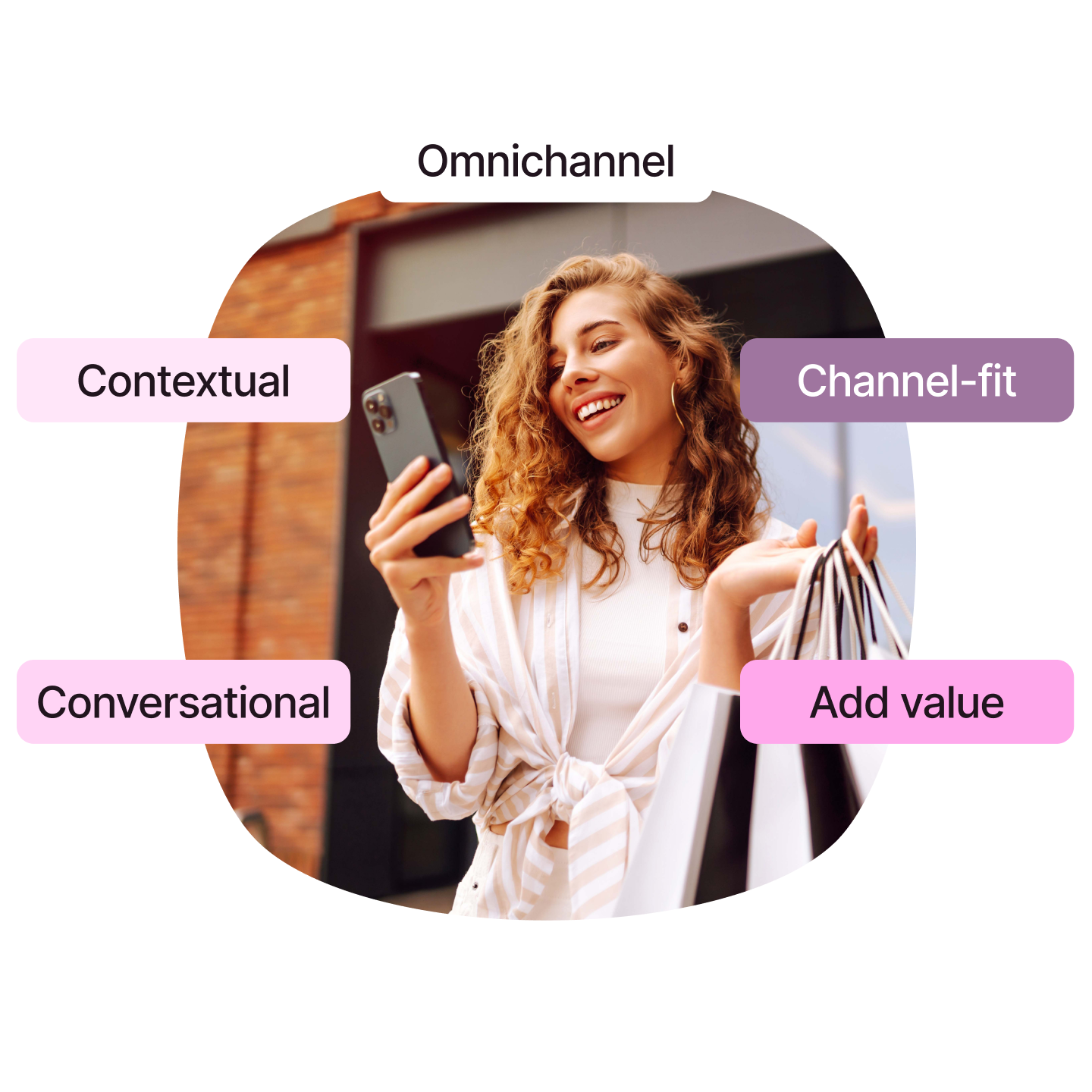
Smiling shopper holding a phone and shopping bags surrounded by messaging labels like omnichannel, contextual, and channel-fit, visualizing effective retail touchpoints.

1. Prioritize omnichannel and timely communication

Customers don’t want to repeat themselves across channels. A connected, omnichannel experience helps unify conversations and data, ensuring each customer interaction feels consistent and frictionless. Use customer preferences and activity data to send messages at the right time, on the right channel.

2. Make messages contextual and behavior-based

A generic message is easily ignored.

Make your communication touchpoints behavior or event-driven, and always have something relevant to say to your customers. A personal touch is also the perfect way to re-engage customers who may be on the fence, seem disengaged, or have shown any periods of inactivity. What’s more, compelling, personalized offers and incentives get attention and stand out above all other types of generic digital noise. 

3. Keep it conversational

Ultimately, customers respond best to human-to-human communication, which is at the heart of conversational and meaningful interactions. But artificial intelligence and digital apps play a major role in enabling brands to achieve a conversational customer journey. 

Using seamless CRM, customer service integrations, chatbots, and a range of messaging apps allows instant, interactive, and more personable communication between brands and customers – a recipe for customer satisfaction and overall better touchpoints. 

4. Make sure your messages fit the style of the channel

When messaging customers via apps like Viber and WhatsApp, you need to fit in with the other messages they will receive on those channels. Most of their contacts are likely family and friends, so if you send a formal business message or a flashy advertisement, it could be seen as invasive and spammy and get ignored. 

You must be prepared to interact with your customers how, where, and whenever they choose. If you keep your communication strategy conversational and natural, sending relevant and personalized messages at the right moment, you’re sure to see better results.  

Leverage the likes of mobile app messages, chat apps, and RCS to embed clickable buttons that ensure customers can reply easily and quickly. If you want your customers to participate in touchpoints, you need to make it as easy and painless as possible for them to comply. 

5. Always add value

Great customer messaging touchpoints always add value. When you have a customer’s contact details, don’t take advantage of that to send a stream of ads or reminders to visit your website. 

Your messages should offer something that makes your customer’s life easier and happier. 

Where possible, always give your customers options – people love the freedom to choose. Provide helpful and exciting content customized to suit their interests and preferences. 

Optimizing key retail touchpoints across the customer journey

Learning where and how to apply these essentials can make or break your touchpoints. But they allow you to optimize your interactions and improve the overall experience. 

Of course, there are some touchpoints that you can’t directly optimize, such as word of mouth or customer reviews. But with time and determination, customer satisfaction scores will go up, leading to better experiences and more positive reviews. 

Before we dive into specific pre-, during-, and post-purchase optimizations, let’s look at how different types of touchpoints (owned, paid, and earned) typically appear across the retail journey:

Stage Owned Paid Earned
Pre-purchase Blog, app Social ads Reviews, referrals
Purchase Website, support Sponsored search Product mentions
Post-purchase Email, chatbot Retargeting ads UGC, feedback

This table can help you identify where your current efforts are focused and where you may have gaps. A balanced strategy includes all three channel types, supporting a seamless and omnichannel customer experience.

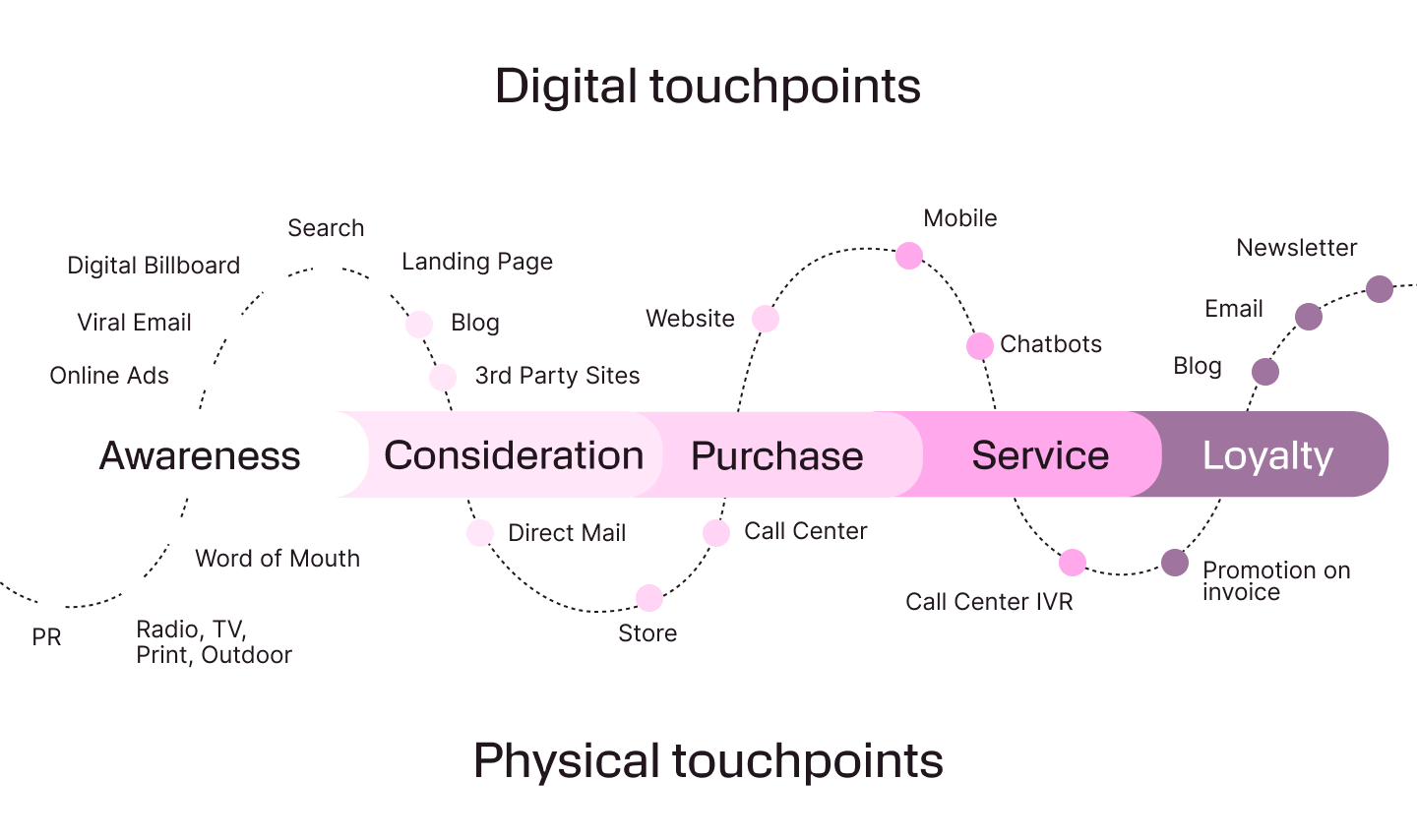
Customer journey flowchart illustrating digital and physical retail touchpoints across awareness, consideration, purchase, service, and loyalty stages.

Now, let’s break down ways to optimize important retail touchpoints throughout the customer journey to improve the overall customer experience: 

Pre-purchase touchpoints

Social media

  • Make sure everything your customers need to know is readily available, up to date, and accessible on your social pages. 
  • Use metrics to determine which posts perform the best and lead to conversions. 
  • Create a strategy around your customers’ behavior and leave them with a great impression after viewing your social page. 

87%

of online shoppers use social media while shopping for products

Infobip tip for social media:

Remove the need to switch between apps. If a customer is browsing your Instagram and sees a product they like, allow them to message your brand directly to ask questions before purchasing the product. The rise of social commerce is not slowing down. Gartner predicts that 60% of millennials will prefer to make purchases on their favorite social platforms over traditional eCommerce sites. Give them a simpler and faster way to purchase products, adding value to the entire interaction.

Advertisements

Similar to social media, metrics are key.

  • Use performance metrics to determine which ads get the most interactions and drive the highest conversions.
  • Identify which campaigns resonate with your target audience and refine the ones that miss the mark.
  • Focus on relevance. Ensure your ads are timely, personalized, and aligned with your customer’s interests.

Infobip tip for advertisements:

Relevance is essential since the modern online shopper expects brands to know what is relevant to them and get irritated with content that doesn’t carry meaning. A customer data platform can help you gather data on your customers and segment them based on their interests, allowing you to send targeted campaigns to the right customers.

Blog

  • Use blogs to educate customers about your products, services, and related topics they value.
  • Link to relevant products within blog content to support discovery and boost conversions.
  • Develop content around customer interests, such as beauty, health, or lifestyle, based on your industry.

Infobip tip for blogs:

Learn about your customer’s intent to make this touchpoint count. Why are they visiting your blog, and what do they hope to learn from it? SEO research can go a long way in ensuring you write content with the right intent that interests your audience, adding value to their interaction with you.

Account signup

  • Streamline the signup and login process to reduce friction and avoid drop-offs.
  • Identify common points of frustration during account creation and look for ways to improve them.
  • Offer incentives to encourage customers to create a profile, such as discounts, loyalty points, or early access to new products.

Infobip tip for account signup:

If you’ve been collecting and segmenting data on your customers, you have insight into which communication channels they prefer to use and which devices they use to shop. Send verification messages or codes over their favorite channel to make the login process as simple as possible.

During purchase touchpoints

Web and app

  • Ensure your website and app offer a seamless, user-friendly experience from download to checkout.
  • Identify friction points in browsing or navigation that may prevent customers from completing a purchase.
  • Optimize performance across devices and personalize the interface based on customer behavior and preferences.

Infobip tip for web and apps:

Send push notifications based on their browsing history. Send them relevant discounts on products they viewed, enticing them to reopen the app and complete the purchase. Adding a touchpoint like this can improve sales and add relevance to your engagement.

Customer support

  • Provide responsive, multichannel support to avoid long queues and boost satisfaction.
  • Equip your agents with context about each customer interaction for faster issue resolution.
  • Make it easy for customers to reach you, wherever they are and whenever they need help.

Infobip tip for customer support:

Add a chatbot to your customer support team and a cloud contact center solution for optimized performance from service agents. Your brand can interact with customers on their favorite channels by adding a chatbot. With natural language processing (NLP) technology, chatbots can provide a real conversational experience, speed up resolution time and ensure customers are left satisfied. 

Checkout

  • Simplify the checkout process to reduce abandonment by minimizing the number of steps and input fields.
  • Offer flexible payment options and guest checkout for ease and speed.
  • Ensure mobile optimization, as many customers complete purchases on their phones.

Infobip tip for checkout:

Once the order has been placed, avoid sending order confirmations over email. Instead, send it over WhatsApp, Viber, or whatever communication channel they prefer. This way, you can ensure it does not get lost in promotional inboxes and customers get automatic assurance their purchase is on the way. 

Post-purchase touchpoints

Billing

  • Send billing receipts and order confirmations instantly to maintain trust and transparency.
  • Make invoices easily accessible and downloadable across devices.
  • Ensure billing communication is clear, accurate, and secure.

Infobip tip for billing:

Use rich messaging (RCS) to elevate this touchpoint. You can send branded messages to customers with PDF documents of their receipts and bills, ensuring they can trust your brand and that they won’t overlook the message.

Delivery

  • Keep customers informed about order status with real-time delivery updates.
  • Notify them proactively about any delays or changes, don’t wait for them to ask.
  • Enable tracking and self-service options to reduce frustration and support load.

Infobip tip for delivery:

You can optimize this touchpoint by allowing two-way communication over channels such as WhatsApp or Messenger. Let customers track their purchases and resolve their questions quickly over these chat apps. This will allow you to smooth any pain points during the delivery process and leaves a positive impression on your brand. 

Feedback

  • Collect feedback right after a purchase or support interaction while the experience is still fresh.
  • Use short, actionable surveys to capture key insights without overwhelming customers.
  • Show that you value feedback by acting on it and communicating improvements.

Infobip tip for feedback collection:

Make it even easier for customers to give feedback with call-to-action buttons or by prompting simple replies in chat apps. Remove the need to switch pages and complete a survey online and provide them with an easier way to give you valuable feedback.  

Returns

  • Simplify return and exchange processes to maintain trust even after a product doesn’t work out.
  • Allow customers to initiate returns on their preferred channel with minimal effort.
  • Be transparent about return policies and timelines upfront.

Infobip tip for returns and exchanges:

Allow customers to request return tickets over any channel and provide them with the documents they need right in the app. This will ensure customers can quickly access what they need and leave them satisfied with your brand, even if they weren’t 100% satisfied with the product. 

Re-engagement

  • Send relevant, personalized content to re-engage inactive or one-time customers.
  • Use behavior and location data to offer tailored promotions at the right time.
  • Deliver messages on the channels where each customer is most likely to respond.

Infobip tip for re-engagement:

With an omnichannel solution, you can use geo-targeting to send customers relevant deals based on where they are. When they are close to your retail store, send them special deals available only when they come to shop in your store. Draw their attention and get them to participate in a physical touchpoint with your brand using digital interactions.  

Create customer-centric retail touchpoints

Your customer experience is only as strong as your weakest touchpoint. By identifying gaps, using omnichannel strategies, and applying personalized messaging tactics, you can turn everyday customer interactions into lasting brand moments. By following these tips and practicing proactive outreach, you can create memorable experiences for your customers, with their needs center focused. You will build painless touchpoints and strong relationships that keep them coming back for more. 

Improve retail experiences with omnichannel solutions

Up your game with Infobip.

Related content:

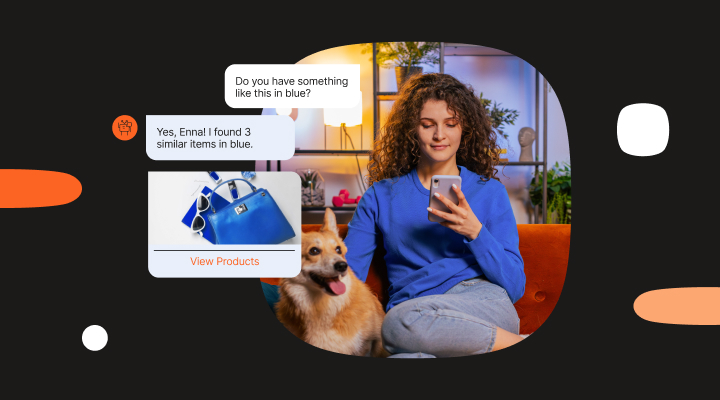
A visual showing a person wearing a blue sweater and holding a smartphone. Overlaid on the image is a chat conversation where the person asks, "Do you have something like this in blue?" and receives a reply, "Yes, Enna! I found 3 similar items in blue," along with a product image of a blue handbag and sunglasses, and a "View Products" link below.
Posted onAugust 18, 2025.

How to make AI shopping assistants your brand ambassadors.

Learn how AI shopping assistants are transforming the retail landscape, driven by the need for exceptional customer experiences in an era where every interaction matters. 

Tags:
  • Blog.
  • Conversational experience.
  • eCommerce.
  • Retail.
  • Best Practices.
A visual showing a person holding a smartphone. Surrounding the person are three chat bubbles representing different communication channels: an email saying "Thanks for joining us! Here’s 15% off your first order," an SMS message stating "Hey Lisa, your delivery arrives today!," and a WhatsApp notification reading "Just a heads-up: Items in your cart are almost out of stock!"
Posted onJuly 15, 2025.

The complete guide to retail customer engagement.

Win your customers’ hearts! Learn about customer engagement in retail and how to build the ideal customer engagement strategies for your business.

Tags:
  • Blog.
  • Marketing.
  • Retail.
  • Best Practices.
A woman shops online using her smartphone and credit card, with a promotional message and ad from a sunglasses store offering 50% off for Black Friday. Text on image reads “A strategic guide to seasonal marketing” with Infobip branding.
Posted onJuly 4, 2025.

Make every season count: A strategic guide to seasonal marketing.

Learn how to create compelling marketing campaigns that resonate with your audience, regardless of the season.

Tags:
  • Marketing.
  • Best Practices.
Cart abandonment header image
Posted onJuly 1, 2025.

Cart abandonment: 11 proven strategies for eCommerce success.

Cart abandonment is a major challenge in eCommerce. This blog breaks down why shoppers leave without buying, and more importantly, what you can do about it.

Tags:
  • eCommerce.
  • Best Practices.
Decorative header image for blog about SMS marketing benchmarks
Posted onJune 23, 2025.

SMS marketing benchmarks: Key stats by industry.

Find out how your SMS marketing ranks against the averages for your industry and how you can move the needle to achieve better results.

Tags:
  • Blog.
  • SMS.
  • Best Practices.
Omnichannel retail strategy header image
Posted onMay 29, 2025.

Omnichannel retail strategy for transformed customer experiences.

With the right omnichannel retail strategy, you can personalize every step of the customer journey and create a smoother path to purchase and loyalty. Explore how to make it happen.

Tags:
  • Blog.
  • Retail.
  • Best Practices.
Graphic representing phygital marketing, with a digital product carousel displaying options such as high heels, a black blazer, and a handbag in the foreground. The layout and design emphasize the blend of physical and digital shopping experiences.
Posted onMay 20, 2025.

What is phygital marketing? 11 examples of phygital experiences.

Let's explore everything you need to know about phygital marketing and how it can help you build a successful marketing strategy.

Tags:
  • Blog.
  • People CDP – customer data.
  • Inspiration.
Retailtainment announcement: "You're in! Secret pop-up with Sabrina Carpenter. More details coming soon."
Posted onMarch 14, 2025.

Retailtainment 101: How to create immersive customer experiences.

Retailtainment helps transform the retail industry from a place of transaction to a hub of experience. Join us as we explore the strategies, examples, and benefits and help you discover how to create an entertainment-rich environment that captivates your customers.

Tags:
  • Retail.
  • Retail.
  • Awareness.

Digitaleo: Introducing RCS Business Messaging to clients

72%

open rate

3x

higher conversion rate

10%

lower cost per click

Share

CHALLENGE

Need for an innovative channel to build conversational marketing campaigns

As a leading digital marketing agency in France, Digitaleo is committed to innovative marketing campaigns for their clients. This commitment drives them to constantly seek out emerging trends and channels that boost engagement and drive better results. 

Their clients, in turn, were hungry for richer, more engaging customer conversations, demanding features like rich media in their marketing campaigns.

Recognizing the untapped potential of RCS early on in 2019, Digitaleo partnered with Infobip to be the first to use the channel effectively in France.

They knew this innovative channel, with its rich feature set and two-way communication capabilities, was the key in delivering conversational marketing campaigns for their clients.

“We got interested in RCS in 2018, and then we launched the first RCS campaign in France with Infobip in 2019. Our goal was to always be very responsive to emergent conversational marketing channels
,” said Martin Briantais, Senior Product Manager at Digitaleo.

Digitatlio’s first RCS campaign was in France, with their client Beaux-de-mer Auto, a car dealership. At that time, the reach was lower due to RCS only being available on Android devices. However, in the span of a few years, the reach has greatly increased, and we regularly get 50% of reach coverage. With the Apple launch, RCS will prevail as an essential conversational marketing channel.

Village Motos: Making “Open Days” a commercial success

Village Motos, a high-end motorcycle dealership, approached Digitaleo to increase the commercial success of its “Open Days” by highlighting promotions and special offers. Digitaleo knew to make their “Open Days” a success they needed a messaging channel that would cut through the noise and deliver the message in a timely and impactful manner.

We chose to launch RCS to create campaigns with richer and more impactful content than SMS, notably using carousels. The conversational aspect of RCS also interested us a lot in collecting data from customers who respond or react to the RCS messages they receive,” said Valentin Pennetier, Head of Communication at Village Motos

SOLUTION

Solution: A rich media, interactive RCS campaign to increase awareness and revenue

To run a successful RCS campaign, Digitaleo needed a partner with the right experience and relationship with Google that could support them with implementation and usage. Hence, RCS powered by Infobip’s conversational experience platform.

To operate RCS campaigns for our clients, we decided to work with Infobip, as they have the technical expertise around RCS that saves us a lot of time, especially thanks to the already established relationship they have with Google. And this is very useful to be able to quickly go through the first steps of verifying a brand by Google before launching a RCS campaign.

Martin Briantais

Senior Product Manager at Digitaleo

And their support has been useful throughout the campaign management as they were able to answer technical questions quickly. In addition, their platform interface was simple to build campaigns and generate reports,” added Briantais.

The Village Motos campaign in action

The overall goal of the Village Motos campaign was to increase awareness in store traffic to their “Open Days” event.

Digitaleo deployed an RCS campaign with our help along with an SMS campaign in parallel. This way, they were able to compare the impact of each channel, and for customers whose phones weren’t RCS-enabled, SMS was the failover option.

Here’s how the Village Motos “Open Days” campaign unfolded:

  1. Personalized RCS messages: Customers received a rich, interactive RCS message, personalized with their first name. The campaign was specifically targeted to recent Village Motos customers or those who had interacted with the dealership previously.
  2. Interactive carousel: The message featured a carousel of four images showcasing the new store and directing customers to take specific actions.
  3. Website link: One carousel card linked directly to the Village Motos website for more information.
  4. Google Maps integration: Another card provided a direct link to Google Maps, pre-loaded with the new store’s location for easy navigation.
  5. Digital catalog: A third card offered a browsable digital catalog of the latest models and special offers, all within the RCS message.
  6. SMS backup: Customers without RCS-enabled phones received a traditional SMS message with the “Open Days” details.
  7. Omnichannel approach: This combination of RCS and SMS ensured maximum reach and engagement.

At Infobip, we found a partner with strong mobile expertise, proven technology, and responsive support. Thanks to the team, we were able to achieve our goal of generating incremental business for our client through an RCS campaign,” said Briantais.

RESULTS

Results: 3x higher conversion rate with RCS

The RCS campaign led by Digitaleo and Infobip’s partnership exceeded Village Motos expectations.

“The RCS campaign was a real success. It was a bit like our record edition this year, and the idea is to do even better next year,” said Valentin Pennetier, Head of Communications, Village Motos.

The rich, interactive campaign saw:

  • 72% open rate: Significantly higher than typical email open rates (20–30%)
  • 10% lower cost per click: RCS proved to be smart investment for ROI despite being priced slightly higher than SMS
  • 3x higher conversion rate: Due to the rich capabilities of RCS, the conversions were higher compared to SMS.
  • 40% increase in turnover: The “Open Days” event saw a higher turnover compared to last year which could be attribute to the campaign.

Infobip and Digitaleo really went above and beyond to answer our questions. They didn’t just address what we asked but also explored potential solutions that we hadn’t even thought of, especially since this was a new channel. The support has been excellent, and that’s one of the main reasons we continue to work with them. The overall support of Digitaleo combined with Infobip has been incredibly efficient.

Valentin Pennetier, Head of Communications, Village Motos.

Collection Manager, UME

Due to the impressive results, Village Motos has entrusted Digitaleo to run their next “Open Days” campaign over RCS.

What we want is to offer our customers more interactive experiences. RCS is one of the channels that is quite powerful for this. We will be able to offer different types of experiences thanks to RCS. We used a carousel this time, but there is also the conversational side that we would like to explore to create a direct interaction with our customers,”  Pennetier added.

COMPANY PROFILE

Since 2004, Digitaleo, a solution that simplifies local marketing, has been helping over 600 networks to centralize or decentralize their marketing activities.

The all-in-one SaaS platform brings all the essential tools for local marketing together: presence management, store locator, customer reviews, social media, local advertising, direct marketing, print and goodies. Their goal is to meet their customers’ strategic objectives in terms of brand awareness, acquisition and loyalty.

Omnichannel retail strategy: Sell smarter across every channel

With the right omnichannel retail strategy, you can personalize every step of the customer journey and create a smoother path to purchase and loyalty. Explore how to make it happen.

Sandra Posavac Content Marketing Specialist
Skip to table of contents

To meet rising consumer expectations, businesses need an omnichannel retail strategy that unifies every touchpoint. Shoppers still visit physical stores, but they also want quick, seamless digital experiences on their mobile devices.  

According to McKinsey, Gen Z values a seamless experience more than the shopping platform.  Also, 92% of Gen Z are more likely to buy from a brand if the message feels personal and relevant.    

To stay competitive, retailers need to use omnichannel communication and follow new trends to improve customer engagement in retail.  This is where omnichannel retail solutions come in.

What is an omnichannel retail strategy?   

An omnichannel retail strategy is a way to connect all your customer touchpoints into one smooth, consistent experience. It lets customers move between channels easily, leading to better service, stronger loyalty, and more sales. All your channels should work together, so customers can switch between them effortlessly.   

These channels can include email, voice, and SMS, as well as digital channels, social media, messaging apps, and live chat.   

Here are some examples: 

  • Synchronizing online and in-store inventories  
  • Offering buy online, pick up in store (BOPIS)  
  • Using customer relationship management (CRM) tools to track customer interactions across platforms  

The goal is to engage with your brand consistently, no matter the platform. For example allowing a customer to start a conversation on Instagram and continue it via WhatsApp without repeating information, improving their overall experience.   

The rise of omnichannel usage in retail

We analyzed 530 billion interactions on our platform in 2024 to uncover how customers and brands use omnichannel communications.  

Here are the main findings about channel use on our platform for retail and eCommerce brands compared to 2023:  

  • SMS remains a key channel, for short-form text notifications  
  • The number of businesses using more than two channels has grown from 15% in 2023 to over 25% in 2024  
  • 550% increase in the use of RCS for rich media promotional messages, authentication, and two-way conversational support  

More retail brands are using multiple channels to run marketing campaigns, build complete customer journeys, and improve experiences. The most popular combination is SMS and RCS.  

Single channel, multichannel, and omnichannel retailing   

You can tell the difference between the three by looking at the words. But let’s break down the terms, especially focusing on omnichannel vs multichannel strategies.  

Single channel retailing: A retailer focuses on selling through only one channel. This could be a traditional brick-and-mortar store, an online website, or direct sales. Single-channel retail is simple to manage and has lower costs. But it has limited reach, and you risk missing out on customers who prefer different channels.    

Multichannel retailing: A retailer uses multiple channels, including a physical store, a website, mobile apps, social media, etc. It has increased customer reach and potential for higher sales. However, there can be gaps or differences in the experience across channels.  

Omnichannel retailing: It means using many channels, but unlike multichannel, it combines them all into one smooth experience. All the channels are connected, allowing customers to switch between them easily and without disruption. 

What omnichannel retail trends are shaping strategies for 2025? 

Trend 1: Increase digital engagement   

Today, 94% of brands use email, 60% use SMS, and 44% use voice to connect with customers. While these are essential, the first step to truly increasing digital engagement is expanding beyond these channels. To keep up with modern shoppers, use chat tools and social platforms they’re already on.   

Gen Z now uses social media to research brands more often than they use search engines.   This means that your shoppers want to explore your products, interact with your brand, and make purchases on their social media apps.   

Trend 2: Merging online and offline retail   

Retail shopping has undergone significant changes in recent years. As customers moved toward online shopping, retailers had to quickly adapt to meet their changing expectations. However, in-store shopping remains relevant and continues to play an important role in the retail experience. 

To bridge this gap, many brands are turning to phygital marketing, a strategy that combines physical store experiences with digital tools like mobile apps, QR codes, and social channels to create a smooth, omnichannel journey for customers. 

According to the IDC Infobrief, customers prefer a mix of online and in-store buying and return options. More than half (51%) say they’re likely to switch to a competitor if flexible returns aren’t available. Nearly 60% say that the ability to buy online and pick up in-store is important.   

Research indicates that 73% of customers engage in omnichannel shopping. They expect smooth communication and service both in-store and online, no matter where they are in their journey.   

Trend 3: Automation with the right chatbots   

Chatbots are a beneficial tool for retailers to bring better experiences to customers through their omnichannel strategy. Thanks to better chatbot technology, you can now use different types of chatbots that do more than just answer basic FAQs:

  • Quick to develop and implement   
  • For faster customer service, sales support, engagement, and query resolution   
  • Use conversation design and natural language processing (NLP) to design conversation flows   
  • For more complex conversations that replicate human-to-human interactions 
  • Agentic AI chatbots can go a step further by taking initiative-handling tasks, making decisions, and guiding customers proactively across channels 

Trend 4: Personalization and the value of customer data   

Retailers need to focus on data they collect directly from customer interactions. A Customer Data Platform (CDP) helps you understand each customer and their activity across all touchpoints. With this data, businesses can tailor product recommendations, marketing messages, and promotions to each shopper’s preferences and behavior.  

48% of brands find it hard to organize customer data because different teams keep their data separate. For example, marketing and customer service might use different tools without sharing insights and this creates a gap.  

To fix this, businesses need a clear, company-wide strategy. When all teams work together and share data, you get a complete view of your customers. This helps you choose the right channels, send better messages, and improve customer engagement.   

Depending on the business, they will be in different places, digitally speaking. You can create different customer journeys depending on potential touchpoints. From there, you can make each journey better, more fulfilling, and more valuable for the customer. And in the end, that will set your business apart and create a memorable experience for the customer.  

Benefits of an omnichannel strategy  

1. Offers an end-to-end shopping journey  

An omnichannel approach helps retailers design complete customer journeys, from awareness to post-purchase, across multiple platforms. You can run personalized marketing campaigns, improve customer engagement activities in retail, and create smooth transitions between channels.  

2. Simplifies inventory management across all sales channels

By connecting online and offline systems, retailers get better visibility into inventory across all locations. This reduces stockouts and overstock, helping businesses meet customer expectations more efficiently. 

3. Improves customer service and provides better customer experience  

Customers want fast, easy access to support on any channel they choose. With omnichannel communication, retailers can reduce effort for the customer, provide proactive updates, and respond quickly, boosting satisfaction and loyalty.  

4. Unifies data  

Retailers can collect and analyze data from every customer interaction, no matter the channel. Unifying data helps remove silos between teams and enables more effective customer engagement strategies across departments.  

5. Increases sales  

With more touchpoints and consistent messaging, retailers can better guide shoppers toward purchase. Omnichannel strategies support upselling, cross-selling, and re-engagement, driving higher revenue.  

6. Personalizes the customer journey  

Using real-time customer data, retailers can tailor messages, offers, and experiences to individual preferences. Personalized journeys lead to stronger customer relationships and more meaningful brand interactions.  

How to use omnichannel communications in retail   

Retailers use omnichannel communication to send back-in-stock alerts, special offers, loyalty rewards, order updates, delivery notifications, and automated answers to common questions.  

Here is an example of how a customer can interact with a brand across four channels and have a seamless shopping journey.  

Awareness  

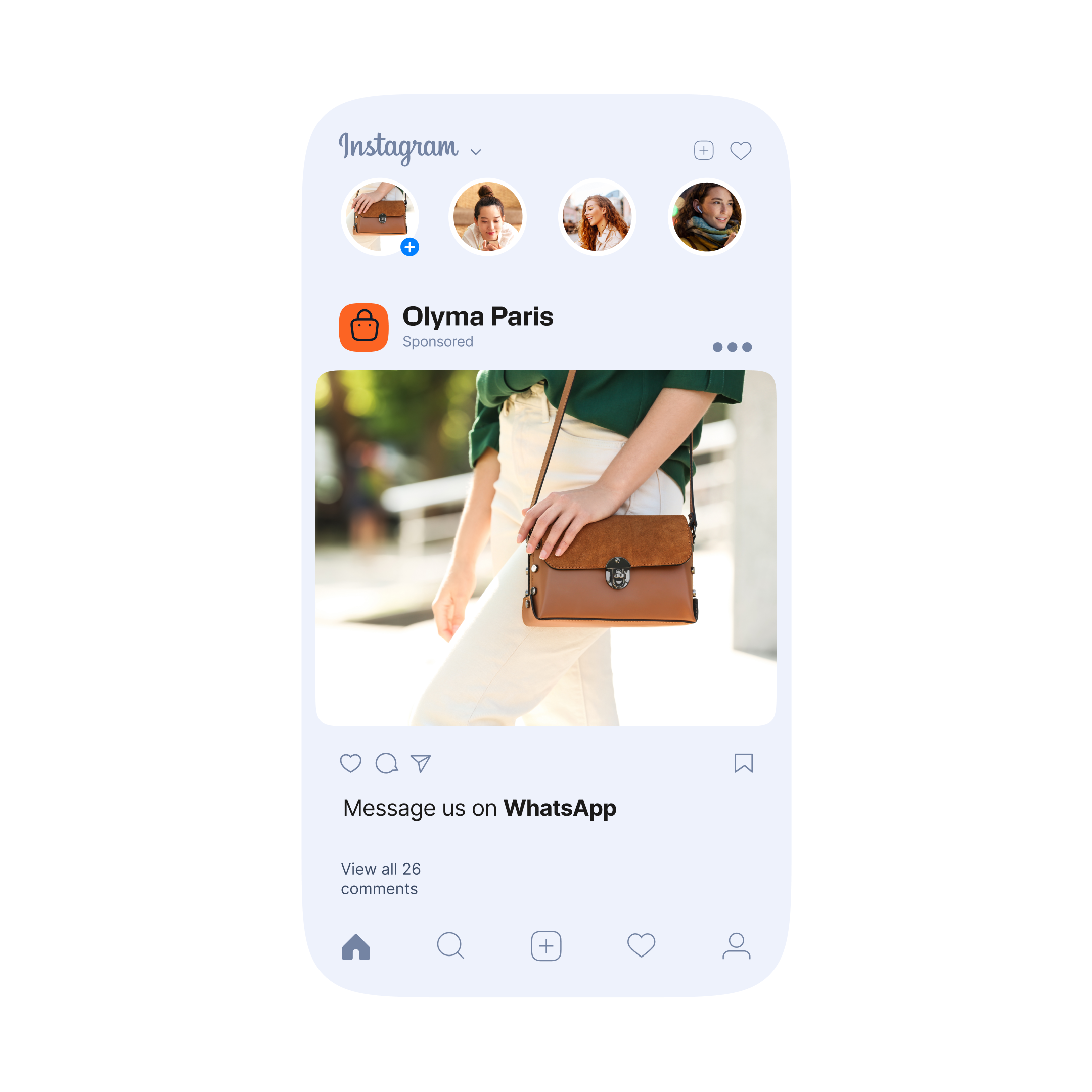
  • A customer sees your Instagram ad for a product that catches their attention.   
  • You included a click-to-WhatsApp button in your ad, so the customer clicks it to ask about your offer.  
  • After two days, the customer has not yet made a purchase.   
A visual showing an Instagram sponsored post from Olyma Paris featuring a person holding a brown leather handbag, with a call-to-action encouraging users to message on WhatsApp.

Consideration    

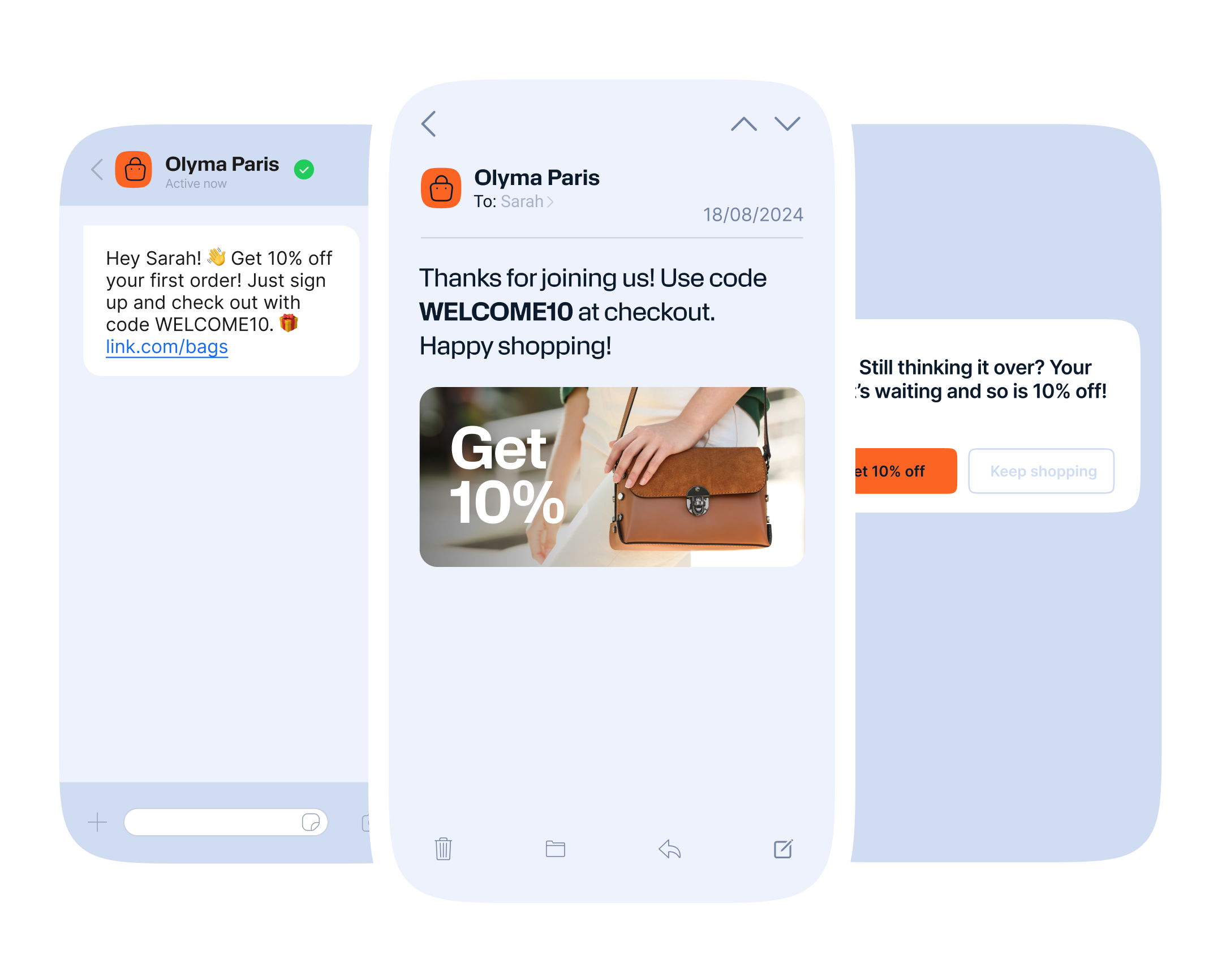
  • You send a WhatsApp message offering them 10% off their first purchase when they register an account and check out.  
  • The customer registers and receives a welcome email with the promo code.  
  • The customer adds items to their cart through your mobile app but doesn’t complete the purchase.  
  • You send a mobile app push notification to remind them of their abandoned items.  
Three screens display promotional messages from "Olyma Paris." The left screen shows a chat message that reads: "Hey Sarah! 👋 Get 10% off your first order! Just sign up and check out with code WELCOME10. 🎁 link.com/bags." The center screen is an email to Sarah dated 18/08/2024 with the message: "Thanks for joining us! Use code WELCOME10 at checkout. Happy shopping!" accompanied by an image of a person holding a stylish brown handbag and text saying "Get 10%." The right screen shows a notification message stating: "Still thinking it over? Your order is waiting and so is 10% off!" with two buttons below labeled "Get 10% off" and "Keep shopping."

Purchase

  • The customer completes the purchase and gets a payment confirmation email.   
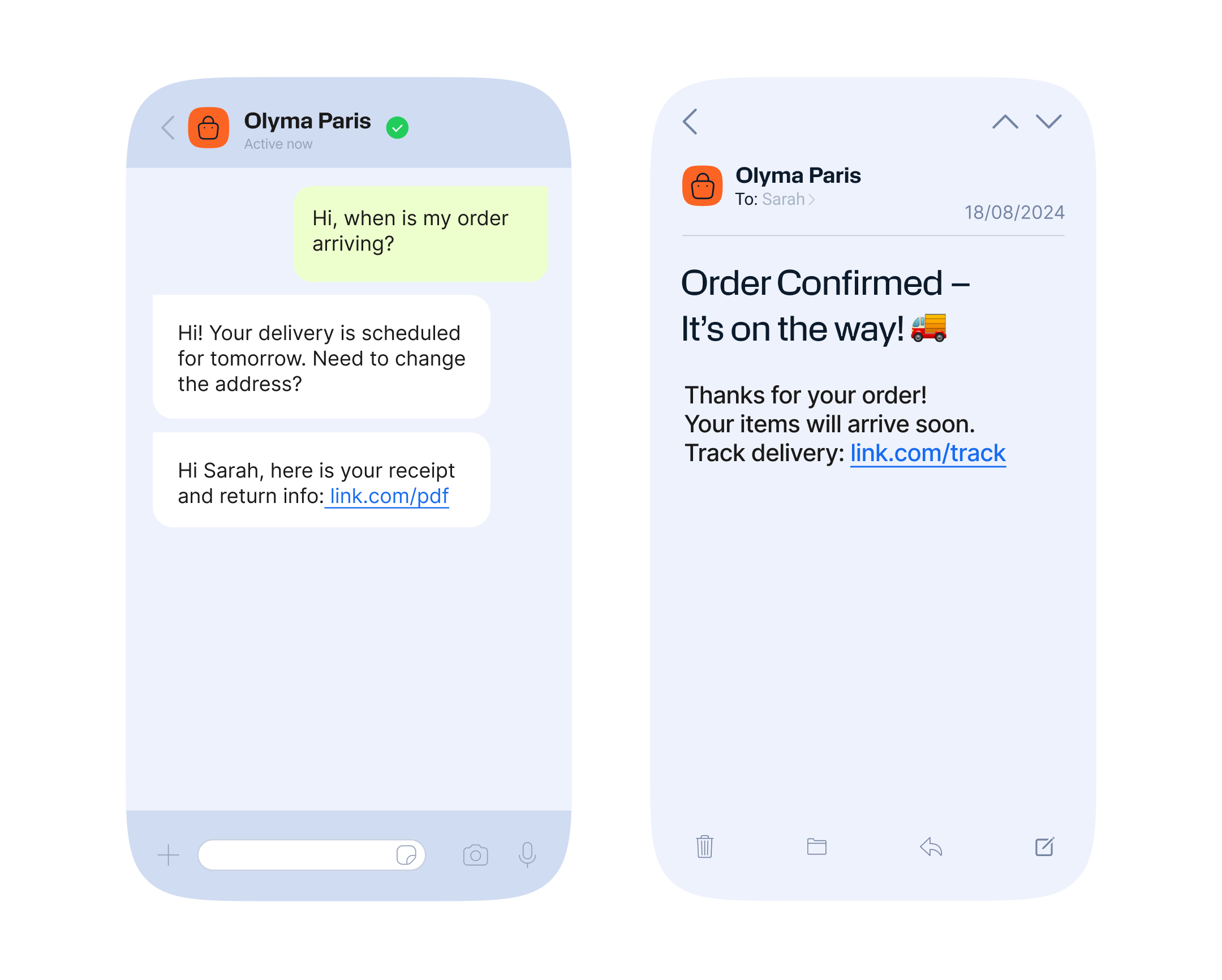
  • After a few days, the customer reaches out to you through WhatsApp, asking when they can expect their delivery.   
  • An Agentic AI agent quickly answers, confirms delivery for tomorrow, and offers to update delivery details.   
  • The next day, the customer gets a WhatsApp message with their receipt and return info.  
Two smartphone screens display messages from "Olyma Paris." The left screen shows a chat conversation where the customer asks, "Hi, when is my order arriving?" Olyma Paris responds, "Hi! Your delivery is scheduled for tomorrow. Need to change the address?" followed by "Hi Sarah, here is your receipt and return info: link.com/pdf." The right screen displays an email dated 18/08/2024 with the subject "Order Confirmed – It’s on the way! 🚚" and the message: "Thanks for your order! Your items will arrive soon. Track delivery: link.com/track."

Post-purchase  

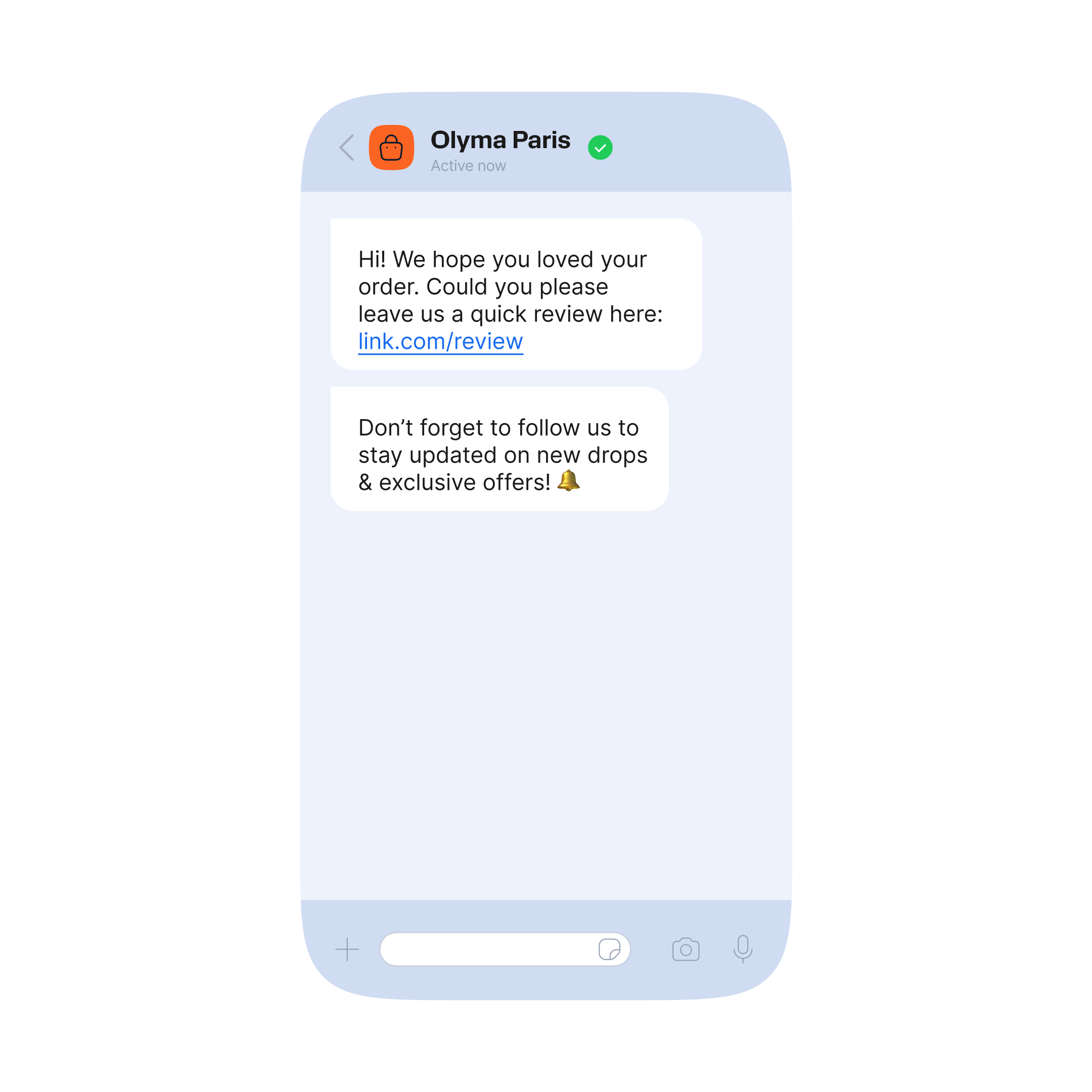
  • After a great experience, retailer asks for a review via WhatsApp. 
  • The customer leaves a review and follows the brand to stay informed about future promotions.  
A smartphone screen shows a chat message from "Olyma Paris" that reads: "Hi! We hope you loved your order. Could you please leave us a quick review here: link.com/review. Don’t forget to follow us to stay updated on new drops & exclusive offers!"

How to create an omnichannel retail strategy  

To meet growing customer expectations, retailers need a smart omnichannel strategy. By using data, preferred channels, and seamless integration, you can boost marketing efforts and offer better brand experiences.  

Segment customers  

Start by using customer data to build detailed customer profiles. Segment audiences by demographics, behavior, location, social media platforms, and purchase habits. For example, if you’re targeting Gen Z, use TikTok and Instagram. Offer deals like loyalty program rewards or influencer promotions that match their shopping habits.  

Discover the right channels  

Know which channels your audience actually uses. Use customer preferences to guide your investments. Frequent shoppers might prefer loyalty apps, while occasional buyers respond better to email discounts or targeted ads on social media.  

Map the journey  

Build journey maps for your top customer segments. Plot each step from awareness to post-purchase and find friction points. For instance, a customer sees an influencer post, clicks the tagged brand, browses your Instagram, and buys through a retargeted ad. A strong omnichannel strategy supports this kind of seamless integration across all touchpoints.  

Communicate across channels  

Use the best channel for each step: social media for awareness, email to nurture, and live chat or WhatsApp for support. Use online tools to improve in-store visits, like helping staff check stock or answering questions on social media.  

Add automation  

Support your strategy with automation tools. Use chatbots to answer FAQs or guide shoppers through purchase steps. Transfer to a live agent with all the conversation details when necessary. Platforms like Answers (chatbot building platform) and Moments (customer engagement solution) make it easy to automate flows and CTAs.  

Test and improve  

Track campaign results by channel; clicks, conversions, satisfaction. Use A/B testing on subject lines, images, and timing to refine your messaging. Optimize regularly to improve ROI and customer engagement.  

Retail tools to power your omnichannel strategy

  • Chatbot builder: Deploy rule-based or AI chatbots to handle customer support and engagement. 
  • Customer data platform & marketing automation tool: Collect and unify customer data, then use it to send personalized, automated messages across channels. 
  • Cloud contact center: Manage customer interactions across channels from a single, integrated platform.  

To make these tools truly omnichannel, they need to be integrated and synced with each other and the channels you choose. This seamless connection ensures a smooth, consistent customer journey. For that, you might need support from CX experts who can help you design and implement the right customer journeys for your business. 

Seamless shopping starts with the right omnichannel retail strategy  

Connect your brand across platforms for an end-to-end shopping experience.  

Conversational AI in retail: Enhance in-store shopping experiences 

Level-up retail shopping experiences, streamline operations, and drive sales growth with Infobip conversational AI tools.  

A chat conversation on a smartphone screen. The message reads: 'Hey Olivia! Our new Spring collection is arriving in stores this Saturday! Take a look and reserve your favorite pieces.' Below is an image of models wearing the collection with a 'View products' link. The customer asks if the floral maxi dress comes in a petite fit, and the response confirms it does, with another 'View products' link.

Create memorable shopping experiences with Infobip conversational AI  

Infobip AI-powered chatbots, virtual assistants, and voice bots can transform in-store shopping experiences and keep your customers coming back for more than just a great product. Infobip’s intuitive platform makes building AI-powered experiences easy, with a drag-and drop interface and seamless integration with all your retail systems. Plus, with the help of AI and CX experts at your side, you can create unique and creative retail journeys that keep customers engaged and loyal.  

A person shopping for clothes in a retail store, with text overlays highlighting features of a Infobip's conversational AI solution for retailers: 'Intuitive platform,' '24/7 AI support,' 'AI & CX experts,' and 'Easy integration.'

Why retail needs conversational AI

Shoppers love the in-store experience, but retailers still need to find ways to digitally connect with customers to stay top of mind and relevant. Here’s the top four ways conversational AI can elevate the shopping experience:  

24/7 support availability

AI helps brands provide round the clock support so customers can always have access to customer service regardless of time or location,.

Automate routine tasks

Free up customer support agents and hand off simple and repetitive tasks to AI agents that can guide customers through query resolution. 

Save time and money

Conversation AI can reduce the need of costly customer service processes and operations and speed up resolution times.

Data driven decisions

AI can help retailers organize and analyze data to help make informed decisions and provide accurate targeting for marketing campaigns.

Enhancing the shopping experience with conversational AI  

Conversational AI use cases for retail

Learn how you can apply AI to enhance use cases, add personalization, and carry customers through their shopping journeys including support and sales. 

Overcoming challenges with AI adoption in retail 

Conversational AI is transforming retail, but its adoption comes with challenges, including data privacy concerns, integration complexities, and user adoption resistance. Here’s how retailers can navigate these obstacles and how Infobip’s AI-driven solutions support a smooth transition. 

Data privacy and security concerns 

Challenge:

Customers and regulators demand strong data privacy protections, especially with AI-driven insights and personalization. 

Solution

  • Adopt strict data governance frameworks to ensure compliance with regulations (e.g., GDPR, CCPA). 
  • Use anonymization and encryption to protect sensitive customer data. 
  • Ensure transparency in AI-driven decisions to build trust with customers. 

Infobip’s AI solutions follow stringent data governance and security protocols, ensuring retailers handle customer data responsibly. With built-in compliance measures, encryption, and AI transparency, Infobip helps retailers protect customer trust while leveraging AI. 

Overcoming integration complexities 

Challenge:

AI tools must work seamlessly with existing POS systems, CRM platforms, and in-store technologies, which can be a complex process.

Solution

  • Opt for AI platforms with flexible APIs that integrate easily with existing retail tech stacks. 
  • Use cloud-based AI solutions for scalable and cost-effective implementation. 
  • Start with modular AI deployments (e.g., chatbots, smart recommendations) and expand as needed. 

Infobip’s AI-powered solutions offer easy API integration, ensuring smooth integration with retail CRMs, POS systems, and messaging platforms like WhatsApp and SMS. With minimal disruption, retailers can integrate AI-powered chatbots into their existing systems. 

Encouraging employee and user adoption  

Challenge:

Employees and customers may resist AI adoption due to fear of complexity, data security concerns, or job displacement. Eliminate any doubts with these tips:

Solution

  • Educate staff to work alongside AI, emphasizing that AI enhances rather than replaces human roles. 
  • Demonstrate quick wins with AI, such as reducing checkout times or improving customer service
  • Make AI interactions seamless for customers by ensuring user-friendly interfaces and natural-language processing. 

Infobip provides ongoing AI optimization and training support, ensuring retail teams understand AI capabilities and how to leverage them effectively. By offering seamless, human-like AI interactions, Infobip helps retailers deliver AI-powered experiences without friction. 

How to select the right AI platform for retail: A checklist 

Choosing the right AI platform for conversational experiences is crucial for enhancing customer engagement, streamlining operations, and driving sales. Use this checklist to ensure you select a platform that meets your retail needs: 

Best practices for AI implementation 

The future of AI in retail 

How might the evolution of AI effect retail shopping journeys? There are 3 trends that can have the biggest impact on conversational AI experiences in retail:  

How Infobip can help transform retail experiences with AI 

Retailers looking to stay competitive in this evolving landscape can leverage Infobip’s expertise in AI-driven customer engagement. Infobip’s solutions offer: 

  • Predictive customer insights for personalized recommendations 
  • Omnichannel AI-powered interactions via chat, voice, and messaging apps
  • Secure and compliant AI that prioritizes data privacy and ethical practices

By integrating Infobip’s AI-powered conversational solutions, retailers can future-proof their business, delivering innovative and seamless shopping experiences that keep customers engaged. 

Learn how to create exceptional conversational experiences for retail

conversational commerce in retail
Posted onJuly 25, 2025.

Conversational commerce in retail.

What is conversational commerce in retail? How can retailers capitalize on it and what are the benefits? Find out this and more!

Tags:
  • Blog.
  • conversational commerce.
  • Conversational experience.
  • Retail.
  • Trends and Insights.
Omnichannel retail strategy header image
Posted onMay 29, 2025.

Omnichannel retail strategy for transformed customer experiences.

With the right omnichannel retail strategy, you can personalize every step of the customer journey and create a smoother path to purchase and loyalty. Explore how to make it happen.

Tags:
  • Blog.
  • Retail.
  • Best Practices.
Retailtainment announcement: "You're in! Secret pop-up with Sabrina Carpenter. More details coming soon."
Posted onMarch 14, 2025.

Retailtainment 101: How to create immersive customer experiences.

Retailtainment helps transform the retail industry from a place of transaction to a hub of experience. Join us as we explore the strategies, examples, and benefits and help you discover how to create an entertainment-rich environment that captivates your customers.

Tags:
  • Retail.
  • Retail.
  • Awareness.
Posted onSeptember 12, 2024.

Alyasra Fashion: Building strong customer relationships through personalization.

Alyasra Fashion is setting new customer satisfaction and convenience standards with its personalized approach. Learn how.

Tags:
  • Blog.
  • Spotlight.
  • eCommerce.
  • eCommerce.
  • Trends and Insights.
Posted onSeptember 11, 2024.

How Carrefour is transforming the shopping experience with conversational retail.

Carrefour is leveraging conversational retail to transform the way we shop. Dive into the new era of customer service and personalized interactions.

Tags:
  • Blog.
  • Spotlight.
  • Conversational experience.
  • Retail.
  • Inspiration.

Ready to transform retail experiences?

Offer customers immersive, personalized, and secure interactions with conversational AI.

Number validation

Validate mobile numbers to optimize message deliverability and ensure cost efficiency.

The pain points:

  • Maintaining a database with invalid or inaccurate phone numbers can hinder marketing efforts, customer service interactions, and overall operational efficiency.
  • Sending SMS or WhatsApp campaigns to invalid numbers results in wasted marketing spend and a lower return on investment.

How number validation helps:

  • Verify the accuracy and validity of phone numbers before sending messages, ensuring successful delivery and maximizing reach.
  • Maintain a clean and accurate database of phone numbers, improving data quality and enabling more effective communication.
  • Reduce wasted marketing spend by avoiding sending messages to invalid or inactive numbers.
Number validation Infobip

The business benefit of number validation:

  • Improve campaign performance: For marketing campaigns, number validation ensures that your messages reach a real and engaged audience, leading to higher open rates, click-through rates, and conversions.
  • Better compliance: Number validation can help businesses comply with data privacy regulations by ensuring that you have accurate and valid consent to communicate with customers.
  • Increase efficiency: Improve operational efficiency by streamlining communication processes and reducing manual effort associated with managing invalid numbers.
  • Cost savings: Reduce costs associated with message delivery failures and wasted marketing spend.

Number validation across industries:

Discover more:

Collect opt-ins

Build a strong and engaged audience by collecting opt-ins for your marketing communications, ensuring compliance and respecting customer preferences.

The pain points:

  • Failing to obtain proper opt-ins can lead to legal issues and fines, especially with regulations like GDPR.
  • Sending marketing messages to uninterested recipients is a waste of time and resources.
  • Sending marketing messages to people who haven’t explicitly given their permission can lead people to block your number and miss out on valuable messages they actually want to receive.

How collecting opt-ins helps:

  • Create a list of engaged subscribers who have explicitly expressed interest in receiving your marketing communications and only send messages to those numbers.
  • Comply with data privacy regulations and avoid legal issues by obtaining proper opt-ins before sending marketing messages.
  • Always provide a clear and easy way to opt-out. This gives customers control over their communication preferences and enhances their experience with your brand.

The business benefit of collecting opt-ins:

  • Enhance brand reputation: Build a positive brand image by demonstrating respect for customer preferences and data privacy.
  • Improve marketing ROI: Increase the effectiveness of your marketing campaigns by targeting an engaged audience that’s more likely to convert.
  • Reduce risk and liability: Minimize the risk of legal issues and fines by complying with data privacy regulations.
  • Sustainable growth: Build a sustainable marketing strategy based on trust, permission, and customer engagement.

Mobile adoption across industries:

Discover more:

Retailtainment 101: How to create immersive customer experiences

Retailtainment helps transform the retail industry from a place of transaction to a hub of experience. Join us as we explore the strategies, examples, and benefits and help you discover how to create an entertainment-rich environment that captivates your customers.

Ana Rukavina Content Marketing Specialist
Skip to table of contents

Consumers, especially Millennials and Gen Z, aren’t just looking to buy. They’re looking to experience. They are trading possessions for memories. To remain relevant, brands must now prioritize creating experiences over simply selling products.

The challenge, then, is how to turn your retail store into an experience. Forget adding another display to your store, you’ll need to think bigger. We’re talking about transforming your physical stores into an adventure. Imagine a cosmetics store where customers don’t just buy makeup, they learn to create personalized looks through interactive digital tutorials and live mini-makeover sessions. Or a bookstore that hosts immersive literary escape rooms.

That is what it means to create a destination that blends the thrill of entertainment with the shopping experience. In other words, retailtainment. And that is precisely what we’ll explore in this blog, from its benefits and use cases, to how you can implement these strategies in your business.

What is retailtainment?

Definition of retailtainment: Retailtainment is a fusion of retail and entertainment that transforms stores into vibrant, engaging destinations. American sociologist George Ritzer coined the term, describing it as “the use of sound, ambiance, emotion, and activity to get customers interested in the merchandise and in the mood to buy.”

Retailtainment is also sometimes called “inspirational retailing” or “entertailing”.

Types of retailtainment campaigns

Retailtainment campaigns are as diverse as the brands that implement them, but they generally fall into several key categories, such as:

Experiential pop-ups

Pop-ups are retail spaces or installations designed to create unique, limited-time experiences. They often focus on a specific theme, product launch, or brand message.

Key features:

  • Short term
  • Highly themed
  • Interactive
  • Tests new concepts

Interactive installations and displays

These campaigns use technology to create interactive experiences, often involving touchscreens, motion sensors, augmented reality (AR), or virtual reality (VR).

Key features:

  • Technology-driven (AR/VR)
  • Tells brand stories
  • Customer participation

In-store events and workshops

Hosting scheduled events that provide entertainment, education, or hands-on, personalized experiences helps build community, foster relationships, and create a sense of belonging.

Key features:

  • Scheduled events with a defined agenda
  • Educational, entertaining, or both
  • Building relationships with customers

Immersive themed environments

Immersive themed environments transform retail stores into a cohesive, multi-sensory experience, engaging sight, sound, smell, touch, and taste.

Key features:

  • Escapism and fantasy
  • Tells brand stories
  • Memorable experiences

Gamification and challenges

Gamification turns shopping into a playful adventure with game-like elements. Points, badges, leaderboards, and challenges encourage participation and competition.

Key features:

  • Game mechanics: points, leaderboards, badges
  • Drives engagement
  • Increases dwell time

Live performances and entertainment

Live performances provide a platform for the brand to connect with new audiences, effectively extending its fan base.

Key features:

  • Performance
  • Social event

Phygital experiences

Phygital experiences integrate digital and physical into one cohesive omnichannel journey.

Key features:

  • Bridges the gap between online and offline
  • Interactive technology
  • Personalization

How does retailtainment drive consumer experience?

How does retailtainment create a superior customer experience that leaves a lasting impression? It boils down to a few key principles:

Creating immersive experiences

Retailtainment activates multiple senses through interactive displays, themed environments, and engaging activities. Your customers can step into a world crafted just for them, a place where every day fades away.

Emotional connection and storytelling

Retailtainment taps into emotions by creating experiences that resonate with customers on a personal level. Storytelling plays a crucial role, weaving narratives into the retail environment to create a sense of connection.

Active participation

Interactive elements like games, virtual reality experiences, and hands-on activities directly engage customers. Active participation can evoke strong emotions, whether it’s the thrill of winning a game, the wonder of exploring a VR world, or the satisfaction of creating something unique.

Social interaction and shared experiences

Retailtainment often fosters social interaction, creating opportunities for customers to connect with each other. Shared experiences, like group workshops or live performances, build a community around your brand.

Surprise

Retailtainment introduces elements of novelty and surprise, breaking the monotony of traditional shopping. The urgency of a limited-time event or the exclusivity of a pop-up creates a sense of ‘I have to be there!’ If you’re not in on the experience, you’re missing out. And nobody wants to be the one scrolling through their feed, watching everyone else have an amazing time. Fear of missing out (FOMO) is a potent driver of participation.

How can retailtainment be tailored to different customer demographics?

When done right, retailtainment can resonate with a wide range of customers. There’s no one-size-fits-all approach, and while many factors play a role, let’s explore how to effectively tailor retailtainment experiences to different generations.

Gen Alpha (2010-2024)

Image of generation alpha

Retailtainment strategies for Gen Alpha:

  • Incorporate augmented reality (AR) and virtual reality (VR) experiences
  • Gamify shopping experiences with interactive displays and challenges
  • Focus on personalized, digital-first experiences through apps or interactive kiosks
  • Use interactive robots or AI assistants

Retailtainment ideas:

  • AR treasure hunts within stores: Use a store app to find hidden virtual objects
  • Virtual try-ons or interactive product demos

Gen Z (1997-2009)

image of generation Z

Retailtainment strategies for Gen Z:

  • Create FOMO with TikTokable moments and experiences
  • Integrate live streaming and social media into the shopping experience
  • Offer interactive workshops and events that align with social values

Retailtainment ideas:

  • Pop-up shops with exclusive, limited-edition merchandise
  • Interactive art installations
  • Events with social media influencers

Millennials (1981-1996)

image of Millennials

Retailtainment strategies for Millennials:

  • Design physical spaces that transport them to a different world or time
  • Offer mobile ordering, in-store navigation, and personalized digital content
  • Create spaces for gathering and interaction, like cafes, lounges, or event spaces

Retailtainment ideas:

  • In-store cafes
  • Interactive workshops

Gen X (1965-1980)

Gen X

Retailtainment strategies for Gen X:

  • Offer high-quality entertainment, such as live music
  • Provide educational workshops and demonstrations

Retailtainment ideas:

  • Live jazz or blues performances
  • Improvement workshops

Baby Boomers (1946-1964)

Baby Boomers

Retailtainment strategies for Baby Boomers:

  • Organize events that encourage social interaction and community building
  • Host lectures, demonstrations, or guided tours related to their interests

Retailtainment ideas:

  • Guided tours with history lectures on your brand
  • Comfortable seating areas for social interaction

While this overview provides valuable examples and strategies for tailoring retailtainment to different age demographics, remember that these are just starting points.

Benefits of retailtainment

By embracing retailtainment, brick-and-mortar stores are investing in their long-term viability, ensuring they remain relevant and engaging for generations to come. Here’s why businesses should prioritize retailtainment in their marketing mix:

Increased foot traffic

Creating engaging experiences will attract customers and keep them lingering longer. More time in your store means more opportunities to connect, showcase products, and, ultimately, make a sale.

Enhanced customer engagement

Retailtainment focuses on getting customers involved. Interactive experiences spark conversations, create memories, and build stronger emotional connections. When customers actively participate, they’re more likely to remember your brand and return for more.

Boosted brand loyalty and advocacy

Happy customers are your best advocates. When you create unique and enjoyable experiences, you’re also building relationships. Those satisfied customers will share your brand on social media, recommend it to a friend, spread the word, and attract new business.

Increased sales and revenue

When discussing numbers, longer dwell times and engaged customers naturally lead to more sales. Experiential elements can also drive impulse purchases and increase average transaction values. It’s a win-win: happy customers and a healthier bottom line.

Competitive advantage

Customers are used to similar messages from different brands. How do you stand out in the crowd? Retailtainment helps you offer unique experiences specific to your brand that competitors can’t replicate.

Improved brand perception

Retailtainment experiences are made for sharing. They generate social media buzz, increase brand visibility, and create positive brand sentiment. And today, social proof is everything.

Data collection and customer insights

Interactive experiences provide a goldmine of data on customer preferences and behaviors. This valuable information can be used to personalize future experiences, refine marketing strategies, and make smarter business decisions.

10 examples of brands leveraging retailtainment

From pop-up shops to immersive installations, retailtainment offers a multitude of avenues for customer engagement. Here are a handful of examples of brands leveraging retailtainment to transform customer journeys:

Mall of the Emirates

The Mall of the Emirates redefines retailtainment by offering an escape from the Dubai heat. Beyond the shopping, dining, and entertainment options, lies Ski Dubai, a truly extraordinary attraction. This mall, located in the desert, houses the world’s largest indoor ski slope and snow park, allowing customers to easily browse luxury brands in one moment and reexperience the thrill of winter sports in another.

Tiffany and Co.

Tiffany & Co. has brought the iconic Breakfast at Tiffany’s dream to life, allowing customers to enter a scene straight from the beloved 1961 film. The Blue Box Cafe, bathed in Tiffany’s signature blue tones and adorned with herringbone marble and amazonite stone, perfectly mirrors the film’s sophisticated ambiance. Here, guests can indulge in a refined New York-inspired breakfast, coffee, and croissant in hand, living out a cherished fantasy just like Audrey Hepburn.

IKEA place

Recognizing that shopping for home goods can be a lengthy affair, IKEA has intelligently integrated elements of play and convenience. Their stores are designed as immersive showrooms, actively encouraging customers to envision their dream spaces while providing practical solutions.

Play areas for children allow parents to browse at ease, while in-store cafes and restaurants provide affordable and family-friendly dining options. Interactive room displays and strategically placed shortcuts throughout the store turn the shopping journey into a treasure hunt.

Alibaba’s “See Now Buy Now” fashion show

Another interesting example of retailtainment was Alibaba’s Singles Day 2018 fashion show. At first glance, it was just a traditional runway event, but it was live-streamed, transforming viewers into immediate consumers. Models showcased the latest fashion pieces, and with a few clicks, the audience could purchase those items in real time.

John Lewis and Kinder

In collaboration with Kinder, John Lewis transformed a section of their flagship Oxford Circus store into a festive, personalized wonderland. The space was transformed into a Christmas scene, complete with themed backdrops and an island of Kinder merchandise. At the heart of the experience was a bespoke personalization machine, allowing customers to witness their chosen name being printed directly onto a Kinder Egg Christmas box.

Nike’s House of Innovation

Customers in Nike’s House of Innovation in New York City can explore interactive try-on zones, where digital displays showcase products in dynamic ways. They can also personalize their footwear in dedicated studios or craft unique pieces that reflect their individual style. The store also features sports-themed challenges and experiences, inviting customers to actively engage with the brand.

LEGO stores

Stepping into a LEGO Store is akin to entering a world of limitless imagination, where colorful bricks and boundless possibilities take center stage. Central to their retailtainment strategy is interactive building stations, where customers can unleash their inner architect and construct their LEGO creations. Their stores incorporate interactive digital displays that bring LEGO sets to life, allowing customers to explore virtual worlds and engage with characters. LEGO’s success lies in its ability to tap into the essence of its brand: creativity, imagination, and play.

Meow Wolf

Meow Wolf discarded the conventional retail model and created elaborate, interactive installations that challenge perceptions and spark curiosity. Each installation is a labyrinth of interconnected rooms, secret passages, and hidden narratives, inviting visitors to explore, discover, and become active participants. Visitors are encouraged to touch, climb, crawl, and interact with the art, blurring the lines between observer and participant.

Topshop

Topshop Oxford Circus recently transformed into a portal to the Upside Down, celebrating the launch of their limited-edition Stranger Things clothing line. The centerpiece of the experience was a recreation of Joyce Byers’ living room, complete with the iconic alphabet wall and Christmas lights, where shoppers could snap photos and channel their inner Eleven. Another highlight was a replica of the Hawkins National Laboratory, where visitors could test their telekinetic powers on a Coke can.

Sephora

Sephora’s in-store Beauty Hub is an interactive learning center that hosts workshops, tutorials, and events led by beauty experts. These sessions provide hands-on experience with new products and techniques. Customers can participate in live demonstrations, receive personalized advice, and connect with fellow beauty enthusiasts. At the same time, digital tools like the Skin Analysis tool and Virtual Artist allow customers to explore products and techniques in a tailored way. These technologies provide instant feedback, personalized recommendations, and virtual try-ons.

Eataly

Eataly is a culinary theme park where customers can explore, learn, and savor the rich traditions of Italian cuisine. In-store cooking demonstrations and classes, led by expert chefs, provide customers with hands-on learning opportunities, allowing them to master the art of Italian cooking. Dining areas are integrated into the marketplace, creating a lively and authentic atmosphere. Customers can enjoy freshly prepared meals at various restaurants and cafes, each specializing in different aspects of Italian cuisine.

What about your retailtainment strategy?

To truly excel at retailtainment, you must understand your specific target audiences. This involves actively listening to customer feedback, analyzing their behaviors, and staying attuned to their evolving preferences. Authenticity is paramount. Copying other brands or implementing generic strategies will likely fall flat. Instead, you should leverage your unique identity and values to create retailtainment experiences that genuinely resonate with your customers.

Start your retailtainment evolution

FAQs

You might be interested in:

conversational commerce in retail
Posted onJuly 25, 2025.

Conversational commerce in retail.

What is conversational commerce in retail? How can retailers capitalize on it and what are the benefits? Find out this and more!

Tags:
  • Blog.
  • conversational commerce.
  • Conversational experience.
  • Retail.
  • Trends and Insights.
A graphic to learn how to calculate abandoned cart rate featuring a flowchart with icons: “Items added to cart,” “Incomplete purchase,” and “Abandoned cart rate %.” Below, there’s a chat message from “Shop-bop” saying, “Hey Julie, your items are waiting for you in your cart! Complete your purchase now for 10% off,” with a “Go to Cart” button.
Posted onJuly 15, 2025.

How to calculate cart abandonment rate .

Learn how to calculate cart abandonment rate and why it’s important for optimizing your eCommerce strategy.

Tags:
  • Retail.
  • Best Practices.
A visual showing a person holding a smartphone. Surrounding the person are three chat bubbles representing different communication channels: an email saying "Thanks for joining us! Here’s 15% off your first order," an SMS message stating "Hey Lisa, your delivery arrives today!," and a WhatsApp notification reading "Just a heads-up: Items in your cart are almost out of stock!"
Posted onJuly 15, 2025.

The complete guide to retail customer engagement.

Win your customers’ hearts! Learn about customer engagement in retail and how to build the ideal customer engagement strategies for your business.

Tags:
  • Blog.
  • Marketing.
  • Retail.
  • Best Practices.
Visual representation of SMS, email, and WhatsApp messages delivered to a shopper, highlighting how retailers can optimize customer touchpoints across channels.
Posted onJuly 8, 2025.

Retail touchpoints: Optimizing the customer journey for elevated experiences.

Unlock ways to optimize your retail touchpoints to offer better customer journeys and drive business results.

Tags:
  • Blog.
  • Moments – Customer Engagement.
  • Retail.
  • Best Practices.
Cart abandonment header image
Posted onJuly 1, 2025.

Cart abandonment: 11 proven strategies for eCommerce success.

Cart abandonment is a major challenge in eCommerce. This blog breaks down why shoppers leave without buying, and more importantly, what you can do about it.

Tags:
  • eCommerce.
  • Best Practices.
Posted onMay 10, 2024.

Shifts in retail: Why generational targeting isn't working.

We surveyed 2,000 retail consumers in the UK to find out how they prefer to communicate with brands. Dive into the findings that challenge traditional retail targeting practices.

Tags:
  • Blog.
  • Conversational experience.
  • Retail.
Posted onMarch 16, 2023.

eCommerce cart abandonment solutions and best practices.

Explore powerful alternatives to boosting abandoned cart recovery rates to improve conversion rates and bottom lines.

Tags:
  • Blog.
  • eCommerce.
  • Retail.
  • Best Practices.