



The benefits of RCS for customer experience
Discover how RCS transforms customer experience with rich media, verified messaging, AI chatbots, and omnichannel orchestration. Learn why enterprise brands choose Infobip AgentOS.

Every list of RCS benefits reads the same way. Rich media. Verified sender. Interactive buttons. Repeat, like a group chat that has said the same three things all week. What is almost always missing is the part a customer experience leader actually came here for: what those features do to the numbers on your Monday dashboard.
That is the gap this piece is built to close. Here are the benefits of RCS for customer experience, told the way a CX director would actually want to hear them: as outcomes, not features. Open rates climbing past 98 percent. Click-through rates running 15 to 30 percent, against SMS’s flat 3 percent. Conversion rates 60 to 70 percent higher than plain text messaging, according to Forrester’s research on RCS for Business.
Those numbers are only half the story. The other half is what happens once RCS stops living alone in a messaging tool and starts living inside a platform built to orchestrate it alongside WhatsApp, SMS, and a dozen other channels, through Infobip’s customer engagement platform within AgentOS. This piece covers both sides: the foundational CX benefits every business should expect from RCS, and the advantages that only show up once RCS becomes part of something bigger.

RCS vs SMS for customer experience
Here is the shift in a single view, before we get into why each row matters.
| Metric | SMS | RCS |
|---|---|---|
| Average open rate | Around 90 percent, no verification | Around 98 percent |
| Average click-through rate | Around 3 percent | 15 to 30 percent |
| Conversion rate | Baseline | 60 to 70 percent higher (Forrester) |
| Verified sender | No, plain number | Yes, logo, name, and badge |
| Rich media in the thread | Link-out only | Carousels, images, video, buttons |
| Read receipts | No | Yes, plus typing indicators |
| Device reach (2026) | Universal | 70 to 85 percent in major markets, topped up with smart fallback |
None of this makes SMS any less essential. Universal reach and delivery with no data connection required are exactly why SMS remains the fallback every RCS strategy leans on. It just means RCS is the richer choice whenever a customer’s device supports it.
For the full breakdown, see our RCS vs SMS comparison, and for more numbers like these, our RCS statistics roundup.
Core CX benefits of RCS messaging
Before we get to what makes Infobip different, here is what RCS delivers no matter who is sending it, no logo required yet. These are the fundamentals worth understanding, because everything else in this piece leans on them.
At a glance
- Branded, verified messaging: a logo, name, and badge on every message, so customers trust it enough to open it
- Rich media and interactive elements: carousels, buttons, and replies that remove steps between intent and action
- Real-time engagement visibility: read receipts and typing indicators instead of a delivery black box
- Native reach with no download: works inside the default messaging app on Android and, since iOS 18, iPhone too
- AI-powered self-service: chatbots that resolve requests inside the thread, day or night
Branded, verified messaging that builds trust
Picture the last unknown number that texted you. Did you open it, or did you let it sit until curiosity won? That hesitation is the exact friction RCS is built to remove. Every RCS message arrives with a verified sender profile, your logo, your brand name, and a verification badge that Google Messages displays automatically. That is the difference between a customer opening your message the moment it lands, or leaving it unread next to three other numbers they do not recognize.
That trust translates directly into engagement. Text-based spoofing and impersonation have become a bigger industry-wide problem in recent years, and a verified sender badge is one of the few things that pushes back against it in a way customers can actually see.
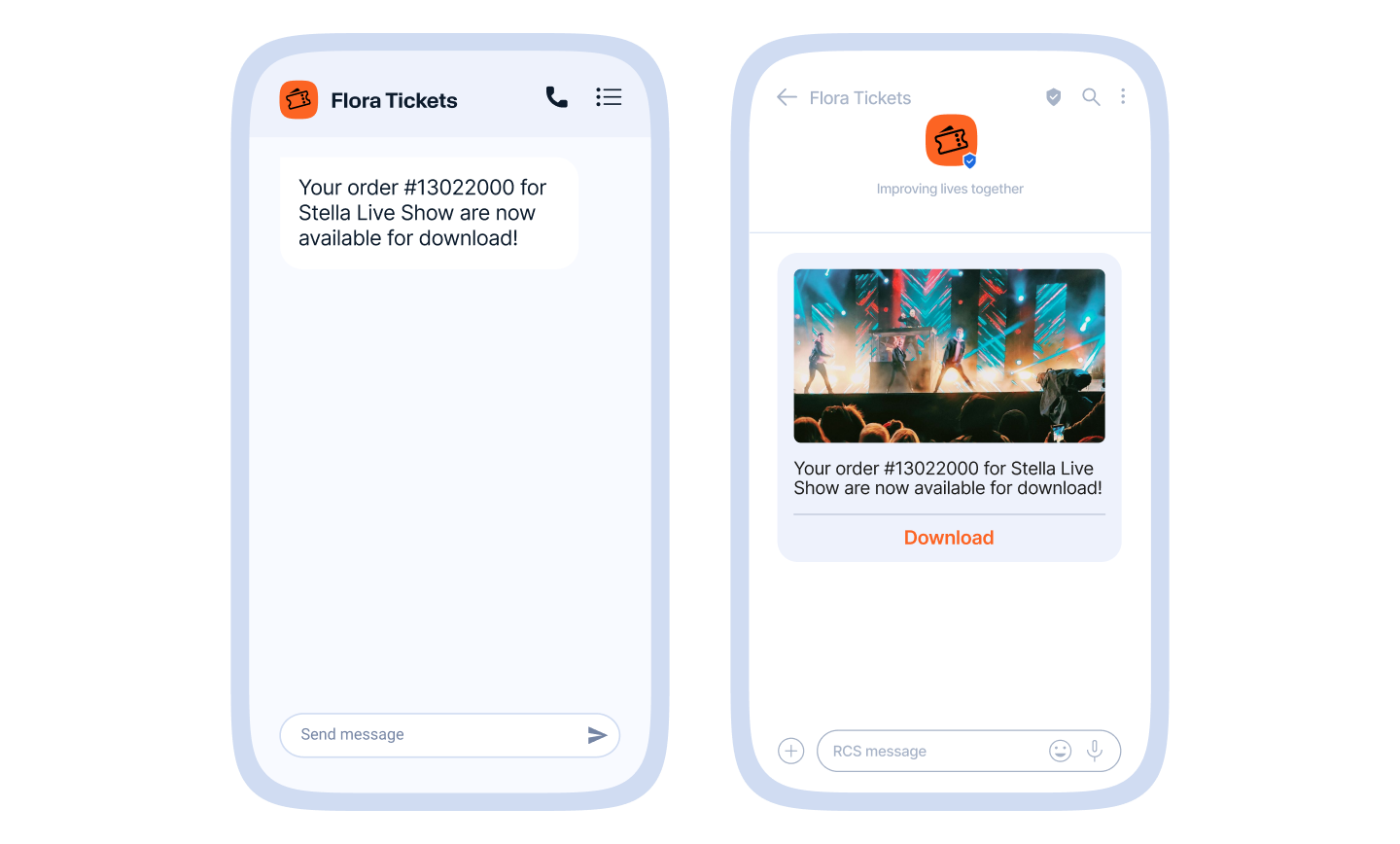
Infobip has been an official Google RCS partner since 2017, which means the verification process, brand registration, and ongoing compliance checks are handled by a team that has been doing this since RCS for Business was still a niche channel most competitors had not heard of.
For more on what that checkmark actually signals, see our piece on RCS checkmarks.
Rich media and interactive elements that reduce friction
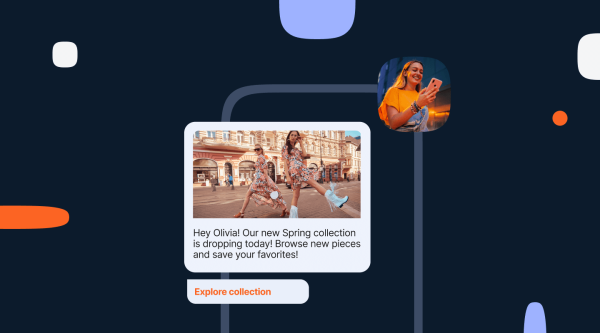
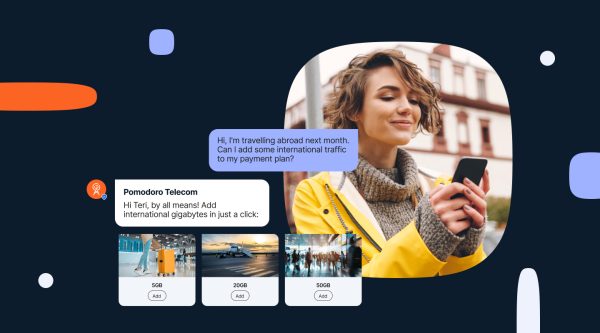
RCS carries richness natively. Product carousels, catalogs, suggested replies, and action buttons live directly inside the message thread, so a customer can browse, book, confirm, or reply without ever leaving the conversation.
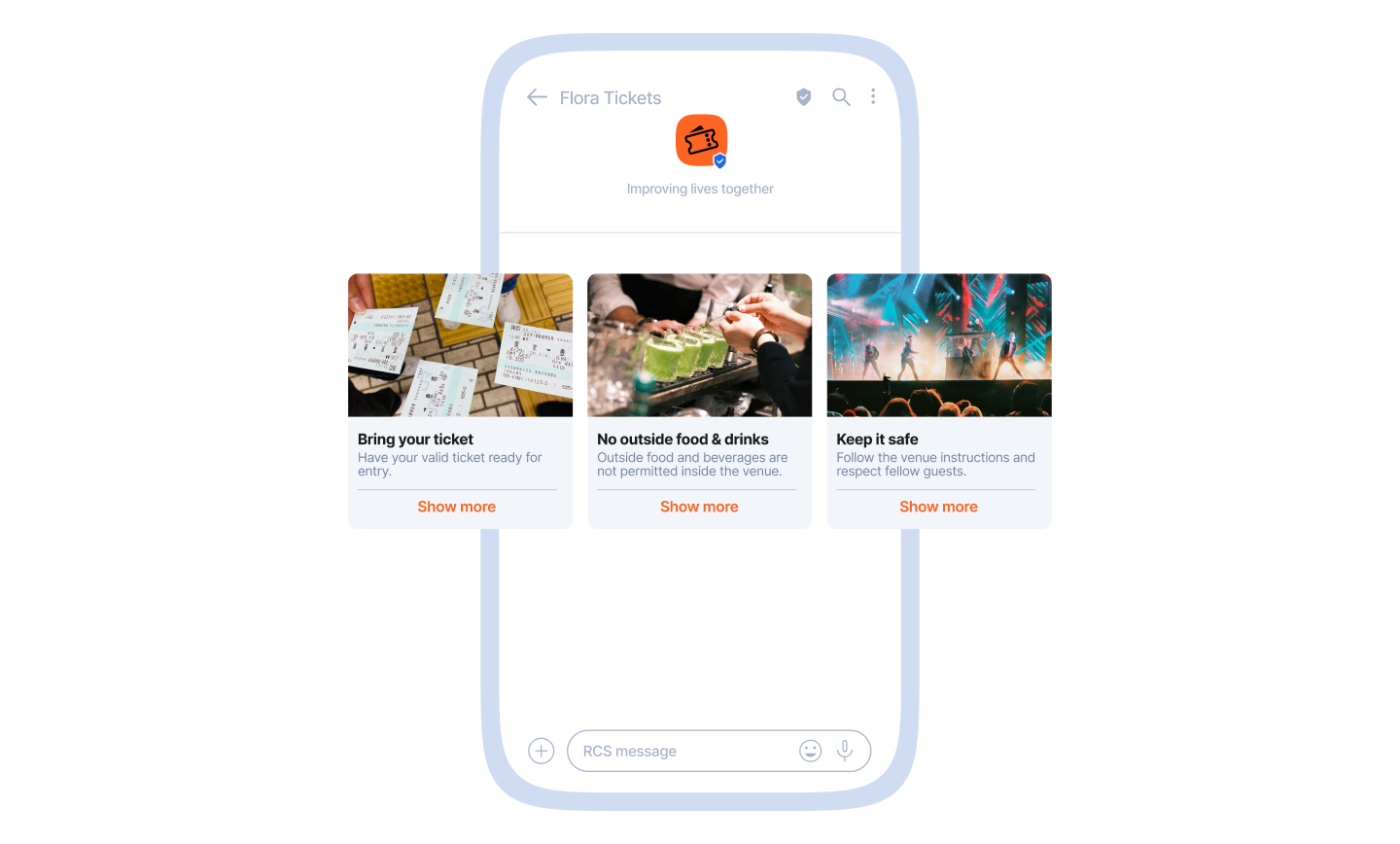
For a CX team, that is not just a marketing win. Fewer steps between a customer wanting something and getting it is the definition of a smoother experience, whether that something is a product, a booking confirmation, or an answer to a question.
Real-time engagement visibility with read receipts and analytics
RCS adds visibility on top: delivery confirmation, read receipts, and typing indicators tell you exactly when a customer saw your message and whether they are responding.
That visibility changes how a CX team can act. Instead of guessing whether a follow-up will land as helpful or repetitive, you know whether the first message was even opened. Campaign optimization stops being a quarterly retrospective and becomes something you can adjust in real time, based on what customers are actually doing.
![Smartphone screenshot of an RCS message from Flora Tickets reading 'Your order #48291 has shipped! Track it here: [link],' shown with double check-mark read receipts.](https://cdn-web.infobip.com/uploads/2026/08/rcs-cx-benefits-design-brief-in-blog-4-e1787833715607.png)
Infobip’s RCS analytics, built into the customer engagement platform, surface this data alongside every other channel a business runs, so a read receipt on an RCS message never sits in a separate dashboard from the rest of the customer journey.
Native messaging experience with no app download required
The best interface is the one a customer already has open. RCS lives inside the default messaging app on a customer’s phone, no download, no login, no separate account to set up. It looks and feels like texting, which is exactly why customers use it without a second thought.
For a long time, that reach stopped at Android’s edge. Apple added RCS support in iOS 18 in late 2024, and that single change closed the biggest gap in enterprise RCS strategy. Combined smartphone coverage across major markets like the US, UK, Germany, and France now sits at an estimated 70 to 85 percent.
The remaining gap is where Infobip’s smart fallback comes in. If a customer’s device does not support RCS, the message automatically cascades to SMS, WhatsApp, or Viber instead, so reach never depends on a single channel working perfectly.
AI-powered chatbots that resolve issues in the message thread
A lot of customer service still runs on hold music. RCS chatbots change that by handling common requests directly inside the conversation: tracking an order, rescheduling an appointment, answering a product question, all without a phone call or a wait time.
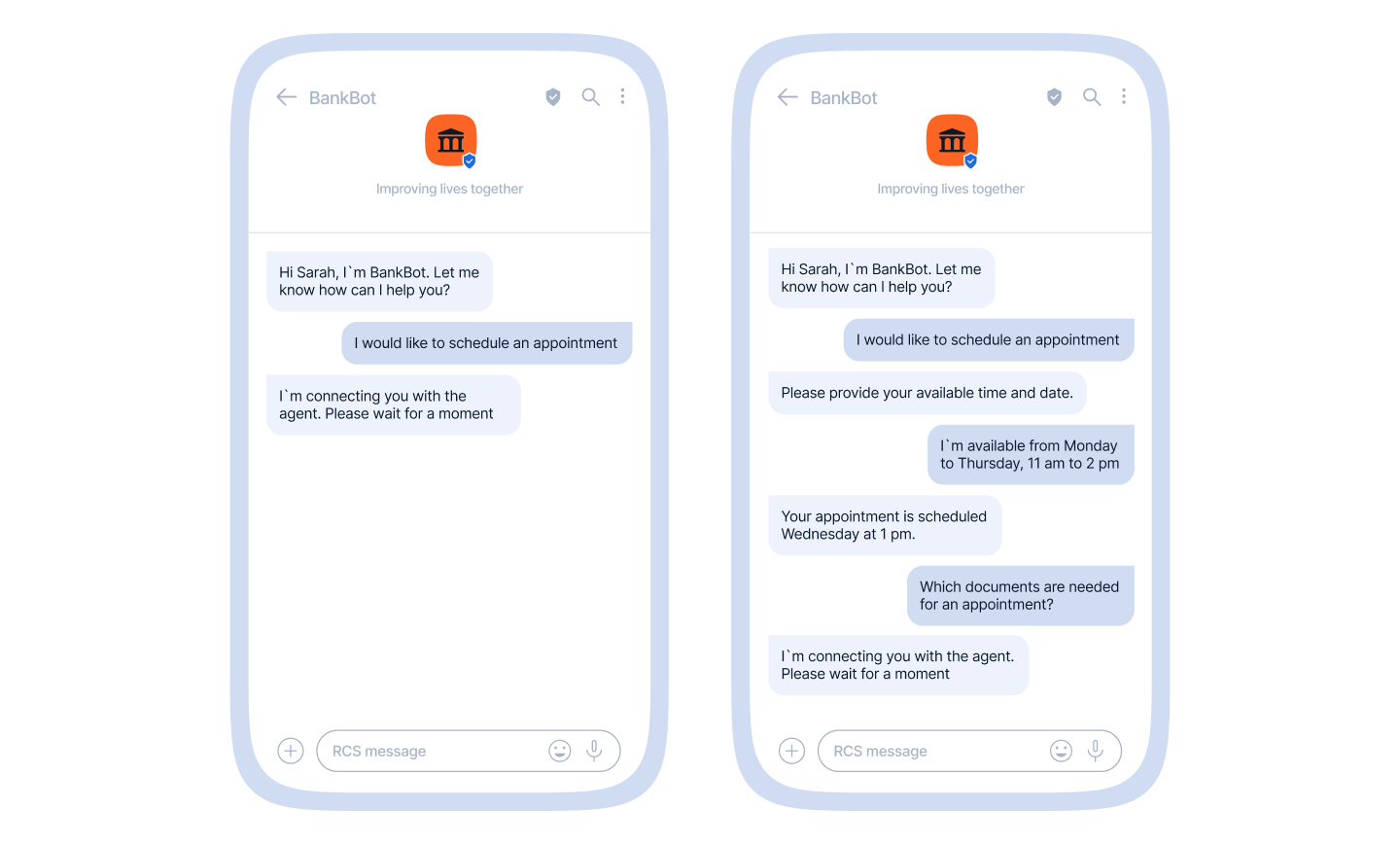
That kind of self-service adds up: fewer calls reaching the contact center, faster resolution for the customer, and a support team that gets to spend its time on the requests that actually need a human. Most of it runs on bots built with Infobip’s AI chatbot builder, and Infobip’s RCS integration with Vertex AI extends that further, powering chatbots that can handle more complex, multi-turn conversations rather than just a scripted decision tree.
CX benefits only an omnichannel RCS platform delivers
Everything above is what RCS does straight out of the box. What follows is what happens once RCS stops being a lone channel and joins a connected customer engagement platform instead, which is where most RCS content quietly stops looking, and where the real CX gains actually start.
Omnichannel journey orchestration with smart fallback
Here is a scenario that plays out constantly and gets almost no coverage anywhere else. A retail brand sends an RCS product carousel to its customer list. Most devices render it perfectly. A handful cannot, so instead of a broken message or a dead end, Infobip’s customer engagement platform automatically sends the same catalog over WhatsApp. If that fails too, an SMS with a deep link goes out as the last resort.
No customer sees a gap. No message gets lost. That kind of journey, built once inside Infobip’s journey orchestration within AgentOS, spans RCS alongside WhatsApp, SMS, and more than a dozen other channels. The result is a simple promise: every customer gets the richest experience their device can handle, and full reach regardless.
Seamless escalation from RCS chatbot to human agent
The single most frustrating phrase in customer service is asking someone to repeat their issue. It happens when a conversation moves from a chatbot to a human agent and all the context gets left behind. Infobip’s Cloud Contact Center, part of AgentOS, is built specifically to prevent that.
When an RCS conversation escalates, the human agent receives the full chat history, the customer’s profile, sentiment signals, and the AI’s recommended next steps, all in one view. The customer never has to start over, which shows up directly in the metrics that matter most to a CX leader: lower average handle time, better first contact resolution, and higher CSAT scores.
RCS conversations powered by unified customer profiles
Most RCS chatbots start every conversation from zero, with no memory of who they are talking to. Infobip’s conversational CDP, built into AgentOS, gives RCS interactions access to a unified customer profile instead: purchase history, channel preferences, past conversations, and behavioral signals.
In practice, that means a returning customer gets greeted by name, sees a message that references their last order, and gets product suggestions that actually fit what they have bought before. Every RCS interaction picks up where the last one left off, instead of starting the relationship over each time.
AI agents that take autonomous actions within RCS
This is where RCS starts looking less like messaging and more like a full customer service channel with its own judgment. Picture a customer messaging about a delayed flight. Within AgentOS, an AI agent can check the booking, find alternative flights, rebook the customer, and send the new boarding pass, all inside the same RCS thread, without a human ever stepping in.
That is a 2026 capability, and one that shows up nowhere else in the current RCS content landscape: multi-step, policy-aware resolution inside a messaging thread, handled by an AI agent that can actually take action instead of just answering questions.
Closed-loop CX measurement across every channel
Read receipts and click-through rates tell you whether someone engaged. They do not tell you whether that engagement made the customer happier, more loyal, or more likely to buy again. Infobip’s Insights and Analytics module, within AgentOS, connects RCS engagement data to the CX metrics that actually get reported to leadership: CSAT, NPS, revenue attribution, and churn correlation.
That closes the loop between a single RCS message and a customer’s overall relationship with your brand, across every channel they use, not just the one message you happened to be measuring.
RCS CX benefits by industry
The core benefits above land differently depending on which industry is running them. A quick tour of four. For more scenarios across every industry, see our RCS use cases and examples.
Enterprise infrastructure behind every RCS CX benefit
Every benefit above only matters if the message actually shows up. That is where infrastructure stops being a footnote and starts being the whole plot.
- 850+ direct carrier connections, so delivery does not rely on third-party APIs
- 43 data centers across 190+ countries
- Backed by a 99.95 percent uptime SLA
- Official Google RCS partner since 2017
- Smart fallback to SMS, WhatsApp, or Viber whenever RCS is not available
- SOC 2 Type II, ISO 27001, and GDPR compliance built in
None of the CX benefits above matter much if the message never arrives, and that reliability is what a CPaaS-only vendor cannot fully replicate.
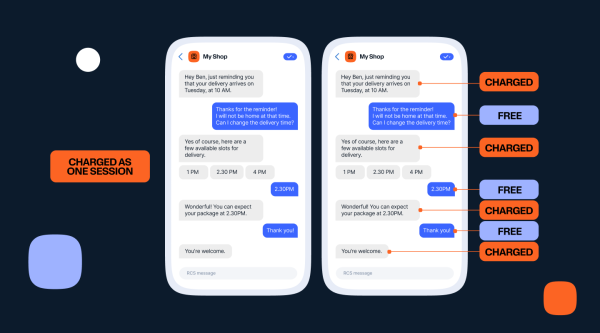
One more shift worth watching: RCS pricing is moving toward conversational billing, where cost follows the conversation rather than the message count. We cover what that means for CX strategy separately.
Frequently asked questions
Verified sender profiles build trust, rich media and interactive elements cut friction, read receipts give real engagement visibility, AI chatbots handle self-service around the clock, and native delivery through the default messaging app removes the download barrier entirely. Infobip’s customer engagement platform within AgentOS builds on all of this by orchestrating RCS alongside 15+ channels, with smart fallback, contact center escalation, and unified customer profiles that personalize every interaction.
RCS delivers 3 to 7 times higher click-through rates than SMS by adding rich carousels, buttons, and media on top of plain text. Verified sender profiles increase trust and cut ignore rates, and read receipts add visibility that plain text does not provide on its own. Within AgentOS, that engagement data flows into unified analytics, so a CX team can optimize the entire customer journey, not just a single message.
Yes. Apple added RCS support in iOS 18 in late 2024, closing the gap that once limited RCS to Android. That single update removed the biggest barrier to enterprise adoption. With Infobip’s smart fallback, any device that still cannot support RCS automatically receives the message through WhatsApp, SMS, or Viber instead.
RCS chatbots resolve common requests, order tracking, appointment changes, FAQ answers, directly inside the message thread, which deflects calls away from the contact center. When a conversation does need a human, Infobip’s Cloud Contact Center receives the full RCS history, cutting average handle time and improving first contact resolution.
RCS messages travel over TLS encryption by default, and verified sender profiles with a visible brand name, logo, and badge combat the spoofing risk that comes with any plain text channel. End-to-end encryption is rolling out through GSMA’s Universal Profile 3.0. Infobip adds enterprise-grade protection on top: SOC 2 Type II, ISO 27001, GDPR compliance, and data residency options across 43 data centers.
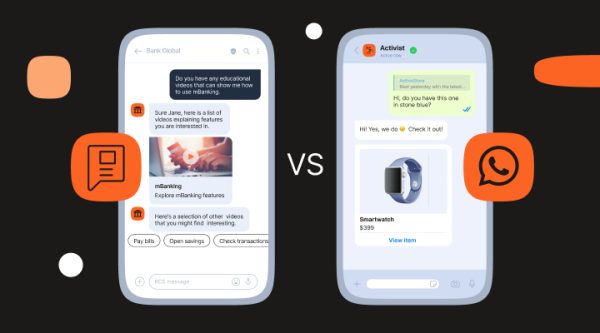
RCS delivers rich messaging through a customer’s native messaging app, no download required. WhatsApp needs the app installed but offers broader global adoption and end-to-end encryption by default. Both matter, which is why Infobip’s customer engagement platform orchestrates RCS and WhatsApp together, alongside SMS, Viber, and more, so customers are reached on whichever channel they actually prefer.
RCS provides native engagement data: delivery confirmation, read receipts, button clicks, and carousel interactions. Forrester’s research found RCS conversion rates run 60 to 70 percent higher than SMS. Within AgentOS, that data connects to broader CX metrics, CSAT, NPS, and revenue attribution, so ROI measurement covers the full customer journey rather than a single campaign.
Absolutely. RCS supports full two-way conversations: customers can send photos of a product issue, use self-service menus, confirm or dispute a transaction, and escalate to a human agent, all inside the same thread. Infobip’s Cloud Contact Center makes that escalation seamless, preserving full conversation context so RCS works as a complete channel for service, sales, and marketing alike.
Retail and e-commerce, banking and financial services, healthcare, telecommunications, and travel all see strong results, generally anywhere high-volume customer messaging meets a need for trust, interactivity, and self-service. The specific use case changes by industry, but the underlying benefit, a faster, richer, more trusted conversation, stays the same.
RCS works best as one channel inside a broader strategy, not as an island. Within Infobip’s AgentOS, RCS integrates into full journey orchestration alongside WhatsApp, SMS, email, voice, and live chat, with consistent context and smart channel selection built in. That ensures every customer gets the richest experience their device supports, with fallback and escalation handled automatically across the entire channel mix.