


Bajaj Markets: 23% increase in leads with RCS for Business 

50%

delivery rate achieved on RCS for Business

Bajaj markets logo white
Share

CHALLENGE

Meeting customer expectations in an evolving digital landscape 

Bajaj Markets is one of India’s leading digital marketplaces, offering financial products across multiple categories, such as loans, cards, insurance, investments, and stock markets, to millions of customers across urban and semi-urban regions.

Bajaj Markets focuses on delivering a secure and personalized financial experience to its customers. However, as customer expectations and digital behavior evolved, the company needed to create interactions to keep them engaged and connected with the brand. The traditional marketing efforts struggled to capture and engage younger audiences, especially during new vehicle launches, prompting the need for a more creative and interactive approach to drive digital engagement.

SMS could no longer keep pace with customers’ demand for enhanced communication experiences. As a result of this Bajaj Markets began facing several limitations: 

  • Lack of rich media: Customers prefer visually rich, interactive content, while plain text messages fail to capture attention. 
  • Limited content capability: The 160-character SMS limit created blockers for the company to send descriptive communication about products and any ongoing offers.

Therefore, Bajaj Markets wanted to go for an advanced messaging solution to resolve these challenges and enhance customer experience. 

SOLUTION

Leveraging RCS to deliver engaging experiences and boost lead generation 

To modernize its customer communications, Bajaj Markets. sought a trusted technological partner capable of scaling with its digital ambitions. After evaluating many technology providers, the company decided to go with Infobip for its reliable global platform and always-on support system.

Understanding the existing business challenges of Bajaj Markets, we suggested adopting RCS for Business as their key communication channel because of its rich media features, real-time engagement capabilities, and growing traction in the Indian market.

The entire onboarding process was smooth, and within just a few days, they were able to get started with RCS.   

Reimagining customer journey with RCS

Once RCS was activated, Bajaj Markets. quickly adopted it as a primary marketing channel to reach both existing and potential customers. The team designed campaigns to promote a range of financial products, from everyday loan offers to festive-season promotions, all featuring interactive, visually rich messages.

Bajaj Markets loan approval process using RCS

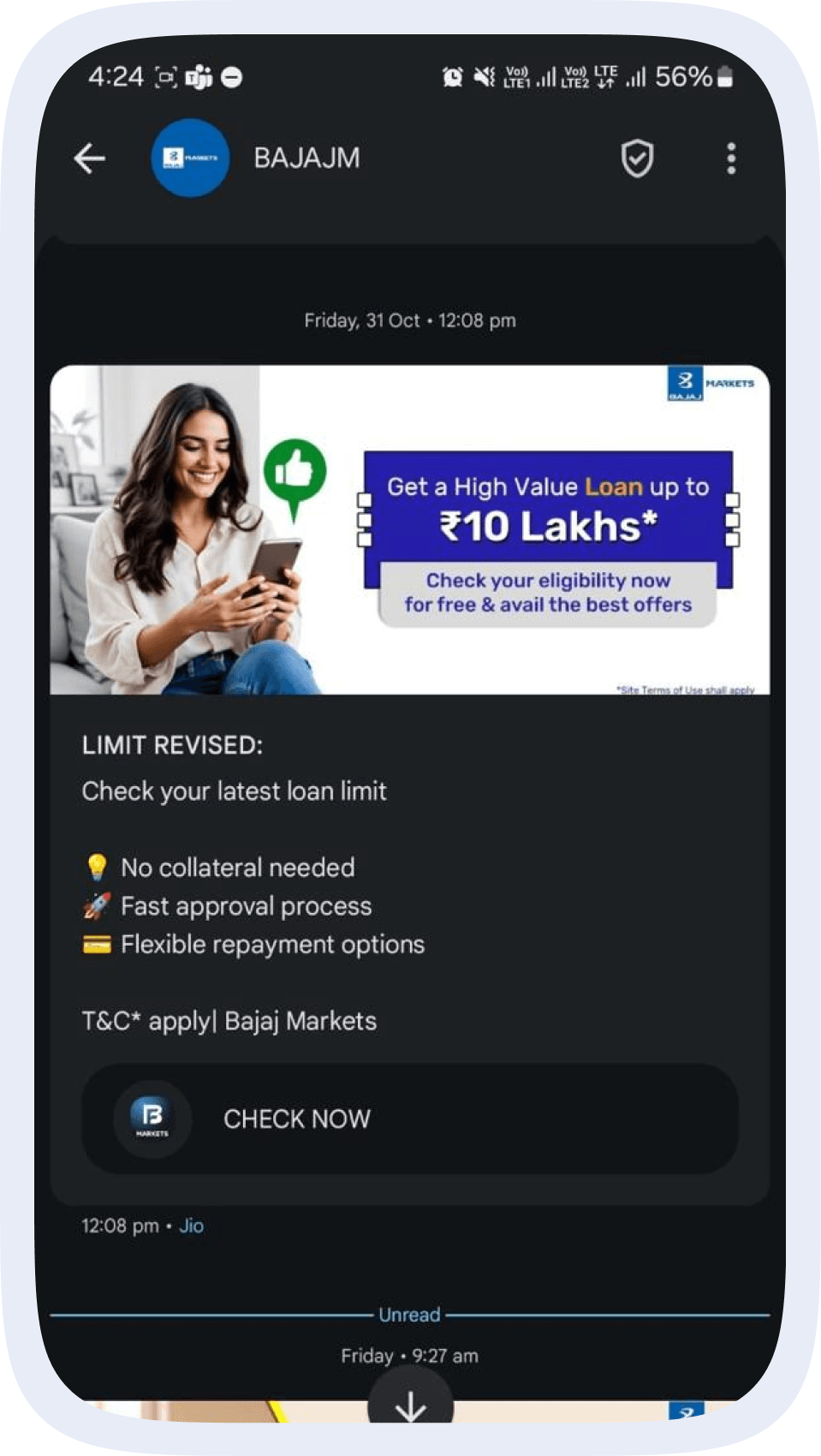
To make their campaigns more engaging, they began sending visually rich RCS messages with call-to-action buttons using our platform.  A typical RCS journey starts with a personalized loan offer message that includes a call-to-action button. When the customer taps it, a simple in-chat form opens, allowing them to share basic details like income or city of residence.

The system then automatically checks loan eligibility and provides tailored product recommendations, all within the same conversation. Alternatively, if the customer already has the Bajaj Markets app installed, they are redirected to the app to complete the loan application.

Once the lead is generated, the call center team contacts the customer for smooth loan disbursal. This journey explains why in the fintech industry, personalization is the key as different customers have different types of financial needs. So, to make the RCS campaigns more relevant for their customers, Bajaj Markets leverages AI and Python to segment users based on behavior, credit profile, and engagement history. They use predictive models to recommend the right product at the right time.

Apart from promoting financial products, the company also used RCS for Business to build financial awareness. Regular campaigns encouraged customers to check their credit score via the Bajaj Markets app and educated them on how maintaining a healthy score can simplify future loan approvals. 

By transforming simple text messages into rich, interactive experiences, Bajaj Markets. created a faster, more engaging, and more personalized way to guide customers from awareness to conversion. As they say in Bajaj Markets, “RCS provides us with an interactive communication facility without any character limit. We can also add our logo, which helps build trust.”

Better engagement and ROI with WebView 

To provide a better user experience and improve lead generation, the Bajaj Markets team implemented the WebView feature of RCS in its campaigns.  WebView is a powerful feature of RCS for Business that allows brands to provide a full web-like experience within the native app. Users can browse product pages, fill out forms, and even make payments without leaving the chat.

The team conducted A/B testing to evaluate the effectiveness of the WebView experience in re-engaging users and improving conversion outcomes. Users’ data was segmented to identify individuals who had previously engaged with their campaigns but did not complete the lead submission process.

Two campaigns were created with identical creative and content but different landing experiences – one on WebView and the other directed to a web browser. It was observed that the campaign providing the WebView experience was more successful in terms of generating more leads and providing a cost advantage.  

RESULT

50% delivery rate achieved on RCS for Business 

Implementing RCS in their messaging mix powered by Infobip, Bajaj Markets noticed a huge difference in their campaign performance and ROI. When compared to the traditional SMS campaigns, RCS campaigns delivered improved results in terms of engagement and lead generation.  The visually rich and interactive nature of RCS messages captured customer attention easily, leading to a higher number of successful loan applications. 

 Here are some of the key results attained: 

  • 50% delivery rate achieved on RCS for Business
  • Delivered a strong uplift in performance
  • Achieved a strong improvement in click-through rate, driving higher engagement
  • 18% to 23% increase in clicks to leads after implementing WebView 

Encouraged by these positive numbers, the Bajaj Markets team looks forward to implementing RCS in new cases across insurance, investment promotions, and more. They’re also exploring integration with WhatsApp and SMS to build a cohesive omnichannel strategy that enhances customer experience across touchpoints. 

Regarding our association, Bajaj Markets has expressed strong satisfaction with the timely support provided by our team. As the team shares,” Working with Infobip has been productive. The team has been proactive, responsive, and genuinely invested in our success.”

COMPANY PROFILE

Bajaj Finserv Direct, a subsidiary of Bajaj Finserv, is one of the fastest growing fintech companies in India. It has two primary arms, Bajaj Markets, a financial marketplace, and Bajaj Technology Services, a tech solutions provider.
Bajaj Markets is a marketplace that offers multiple financial products across all categories such as loans, cards, investments, insurance, pocket insurance, stock market, and value-added services (VAS).

RCS has evolved from a promise into performance

A year after Apple joined the conversation, RCS is delivering real business impact, broader reach, richer experiences, smarter engagement through AI, and measurable outcomes for brands.

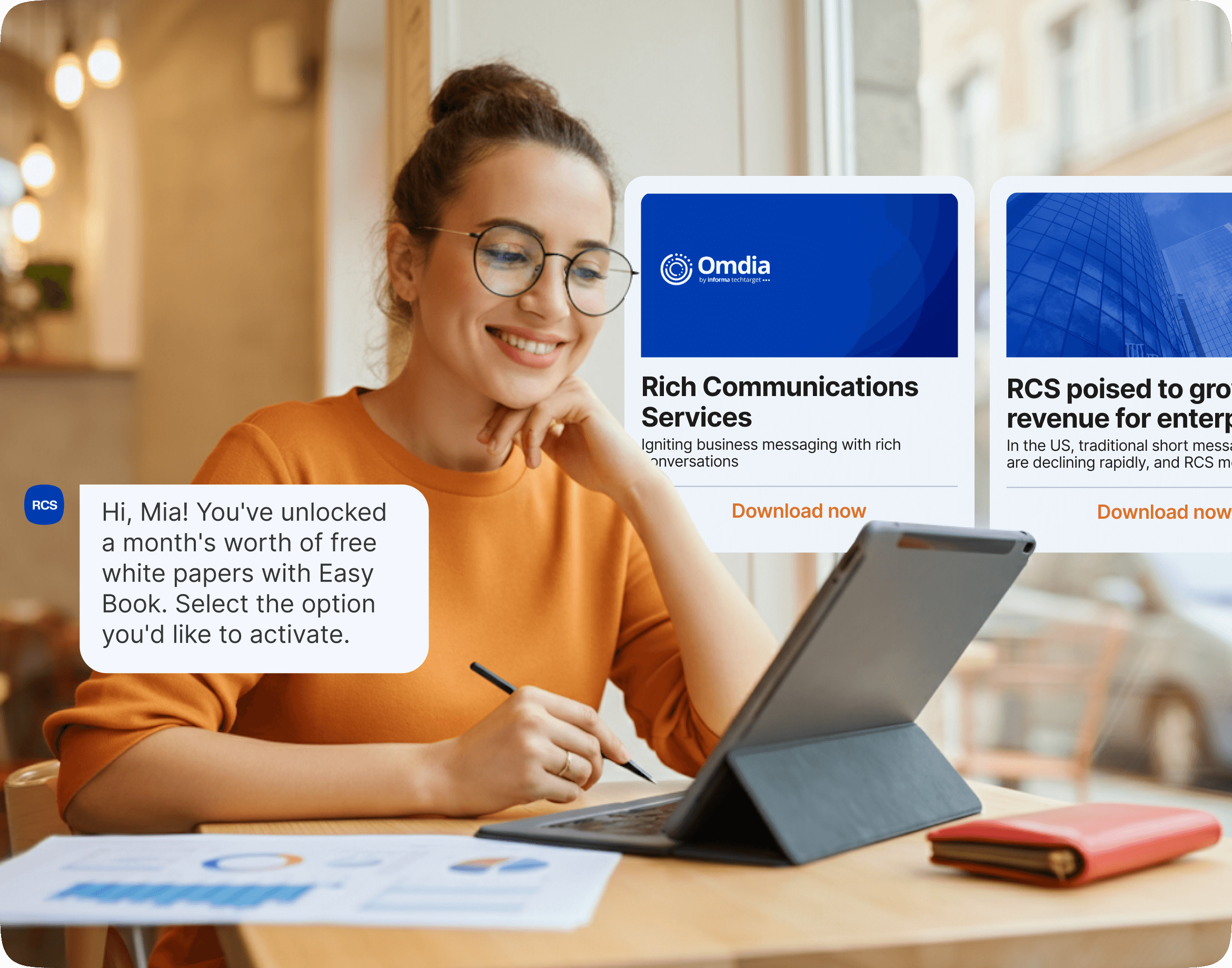
A woman working at a café table on a tablet. A message reads, “Hi, Mia! You’ve unlocked a month’s worth of free white papers with Easy Book. Select the option you’d like to activate.” Beside it are two Omdia cards: “Rich Communications Services—Igniting business messaging with rich conversations” and “RCS poised to grow revenue for enterprise,” each with “Download now.”

RCS enters its high-growth era

Fifteen years after launch, Rich Communication Services (RCS) has become the next evolution of business messaging. Secure, scalable, and creative.
With Apple’s adoption, RCS is now a truly universal channel, merging the reach of telco with the interactivity of chat apps.

In collaboration with Omdia, we created a white paper: RCS: Igniting Business Messaging with Rich Conversations, which deep dives into the latest trends, insights and best practices to use RCS for business messaging. We explore how enterprises are using RCS to enhance marketing, CX, and security with richer, verified conversations that drive measurable results.

Omdia projects that global A2P RCS revenue will soar to US $4.2 billion by 2029, up from just US $317 million in 2024, representing a 68% CAGR.

What’s inside the whitepaper:

RCS is finally universal:

With Apple’s adoption, RCS becomes the first truly global, telco-trusted messaging channel that’s ready to rival OTT apps.

Markets where RCS is growing fastest:

From 340M users in the US to 1.2B+ in Asia-Pacific, adoption is accelerating across every region.

What’s next with AI and security:

See how GenAI and end-to-end encryption are powering smarter, more secure conversations at scale.

Real-life success stories:

Learn how leading brands are driving engagement and conversion with RCS.

Download the whitepaper and explore how RCS delivers secure, verified, and AI-driven engagement backed by real results and forecasts through 2030.

Get your copy of the whitepaper

Download the whitepaper over RCS!

WhatsApp banking: Use cases and examples for banks

WhatsApp banking is transforming how banks and financial institutions engage with customers by enabling real-time support, marketing, and transactional services.

Monika Lončarić Senior Content Marketing Specialist
Skip to table of contents

Imagine enabling your customers to check account balances, pay bills, and verify fraud alerts directly within WhatsApp. This guide provides an overview of essential WhatsApp banking use cases for financial institutions, supported by practical examples and step-by-step instructions for implementation via Infobip’s platform or API. 

What is WhatsApp banking? 

Banking over WhatsApp enables financial institutions to provide support, send marketing messages, and capitalize on cross-sell and upsell opportunities over the popular chat app. From discovery and onboarding to conversions and re-engagement, WhatsApp banking can make automating use cases simpler, allowing banks to offer more convenient and better service to customers. 

Over 60% of banks worldwide are using WhatsApp to automate banking use cases and enhance the customer journey.

WhatsApp banking is most often used over the WhatsApp Business Platform which offers banks easy access to advanced messaging features like: 

  • Cloud APIs
  • Reliable delivery reporting 
  • CRM integration 

What are the benefits for banks and financial institutions that use WhatsApp? 

Real-time support 

Instant support and 24/7 availability are big perks for banking customers who are used to waiting in call queues for banking specialists. Thanks to easy to use chatbots and WhatsApp Flows, customers get real-time support at any time. Plus, seamless handoff to live agents is available when needed, so WhatsApp banking streamlines the entire banking experience.   

Richer banking experiences 

Instant support and 24/7 availability are big perks for banking customers who are used to waiting in call queues for banking specialists. Thanks to easy to use chatbots and WhatsApp Flows, customers get real-time customer service on WhatsApp at any time. Plus, seamless handoff to live agents is available when needed, so WhatsApp banking streamlines the entire banking experience.   

Operational efficiency and cost reductions 

Speed up resolution times and automate self-service cases like FAQs, balance checks, card blocks, appointment booking, and routine updates to deflect calls and reduce handling time. Plus, adding call deflection from voice calls to digital chat can speed up inbound call volumes and help enable customers to use digital channels which helps banks save on call center costs. 

Security and compliance 

WhatsApp offers enterprise-grade security with end-to-end encryption and verified business profiles to protect sensitive financial conversations between banks and their customers. Business-initiated messages require explicit user consent and must use pre-approved templates aligned with WhatsApp and Meta policies.

Infobip helps design policy-aligned workflows that support regional requirements such as PSD2, GDPR, RBI guidelines, and other local regulations.

Higher engagement and ROI 

WhatsApp banking makes connecting with customers easier and more rewarding. Take Angel Broking, for example, they welcomed 39% of their customers through WhatsApp and see a lively 47% monthly engagement rate. Mukuru’s story is just as impressive, with 42% of users going for WhatsApp banking and an outstanding 80% customer satisfaction score. These real-world examples show how WhatsApp’s interactive and convenient messaging helps financial services build stronger relationships, spark more engagement, and see better returns. 

Key use cases for WhatsApp banking

Banks all around the world use WhatsApp to automate important use cases. Here’s a short list of the most popular ones and why banks have started their switch to digital journeys here: 

Customer support 

38% of banks use WhatsApp to automate customer support: 

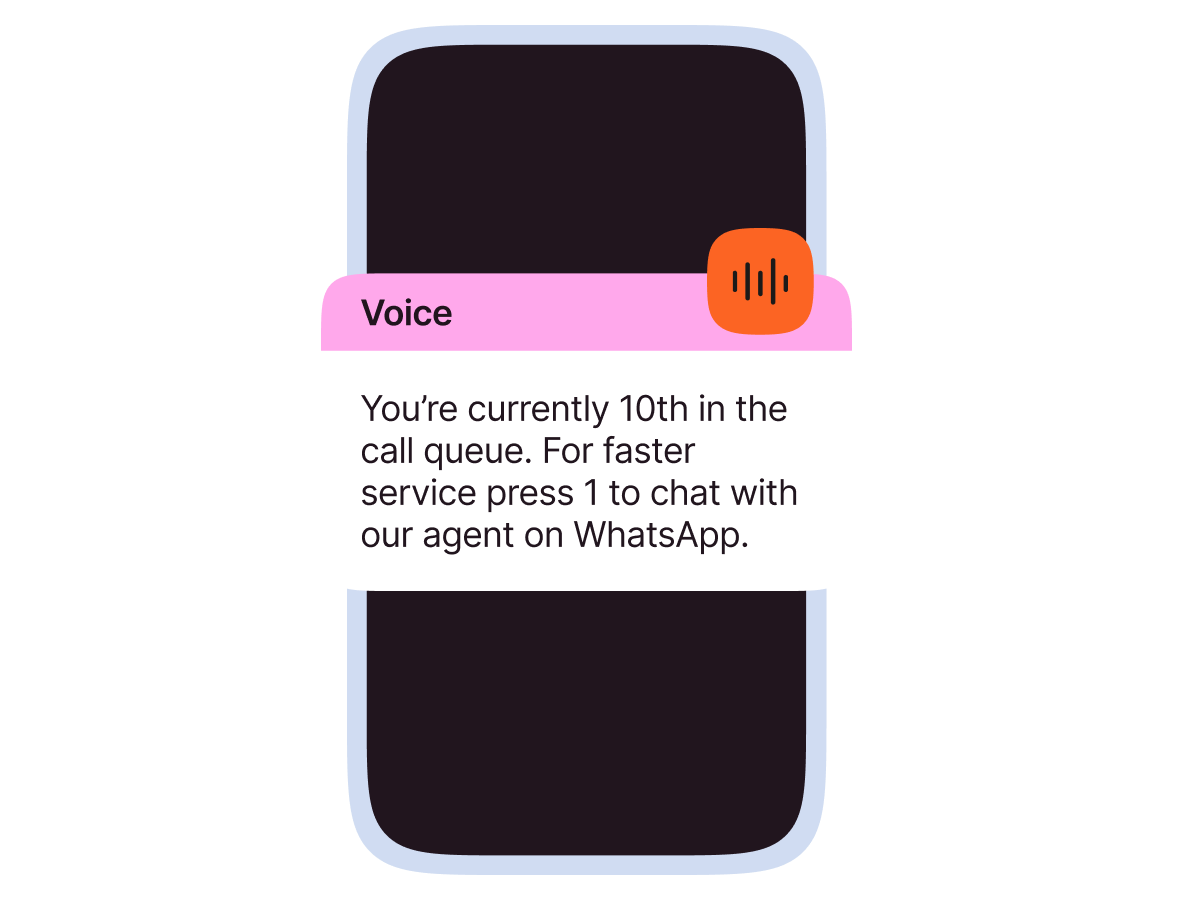
A smartphone screen displays a message in a voice call interface indicating that the caller is currently 10th in the call queue. It advises that for faster service, the caller can press 1 to chat with an agent on WhatsApp.

An example of a call deflection message pushing customers to WhatsApp.

Payment reminders

39% of banks use WhatsApp for payment reminders: 

  • Send due date alerts, payment confirmations, and receipts using utility templates. Business-initiated messages require explicit opt-in and pre-approved templates 
  • Personalize amounts, due dates, and links. Add quick replies for “Pay now,” “View statement,” or “Need help” 
  • Build with Infobip: Orchestrate reminders in customer engagement platform, trigger template sends via API, and track delivery, seen, click, and conversion metrics in analytics 
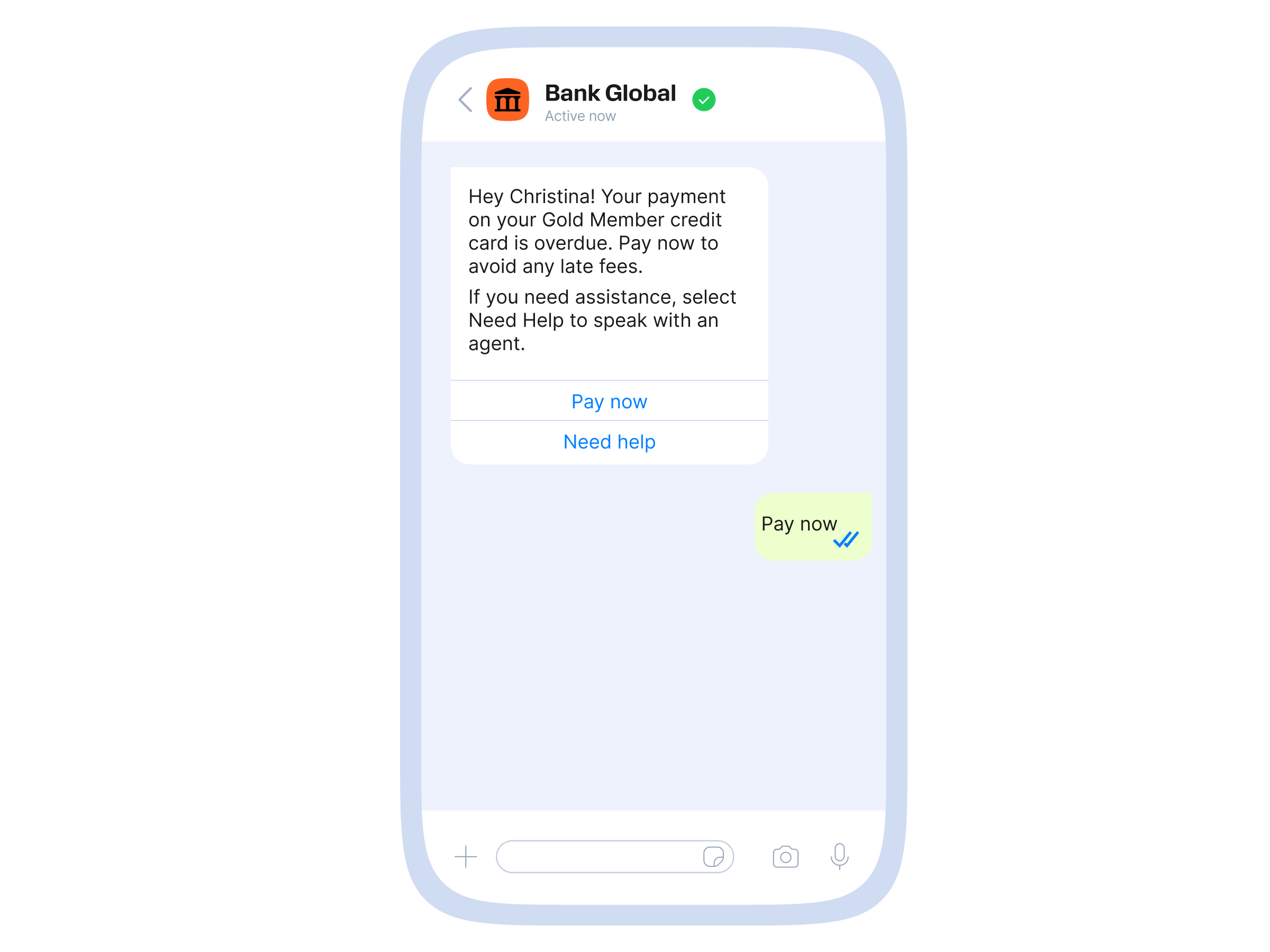
profile Infobip-GPT-4.1-mini Today at 11:15 AM A smartphone screen shows a chat conversation with Bank Global. The message notifies the user that their payment on a Gold Member credit card is overdue and urges them to pay now to avoid late fees. It also offers assistance via an agent if needed. Below the message are two selectable options: "Pay now" and "Need help." The user has replied with "Pay now."

An example of a WhatsApp payment reminder.

Customer onboarding

39% of banks use WhatsApp for onboarding: 

  • Guide onboarding with structured WhatsApp Flows: capture documents, validate identity, and update status in real time  
  • Use utility templates for application updates outside the 24-hour window. Add authentication steps for sensitive actions 
  • Build with Infobip: Chatbot builder and Flows for guided journeys, cloud contact center for agent checks, customer data platform for profile enrichment, customer engagement platform for welcome sequences 

Appointment booking

42% of banks use WhatsApp for branch appointment bookings: 

  • Let customers book branch visits or meetings in chat with date pickers, quick replies, and confirmations. Flows support end-to-end booking experiences in WhatsApp 
  • Send reminders and reschedule options using utility templates when outside the service window  
  • Build with Infobip: Use Flows for scheduling UX, customer engagement platform for reminder logic, and WhatsApp CRM integration to sync calendars and customer preferences

Card transaction notifications

39% of banks use WhatsApp for card transaction notifications: 

  • Deliver instant transaction alerts, spend summaries, and travel notices using utility templates. Add quick actions like “Freeze card” or “Report a problem” 
  • Keep data private with end-to-end encryption and a verified sender for trust  
  • Build with Infobip: Trigger notifications via API, add secure decision branches in Flows, escalate to agents in cloud contact center to an agent when needed 

Product and services promotions

37% of banks use WhatsApp to promote products and services: 

  • Run opt-in marketing campaigns for new accounts, credit cards, loans, and wealth services with rich media, catalogs, and interactive buttons. Marketing templates require consent and pre-approval
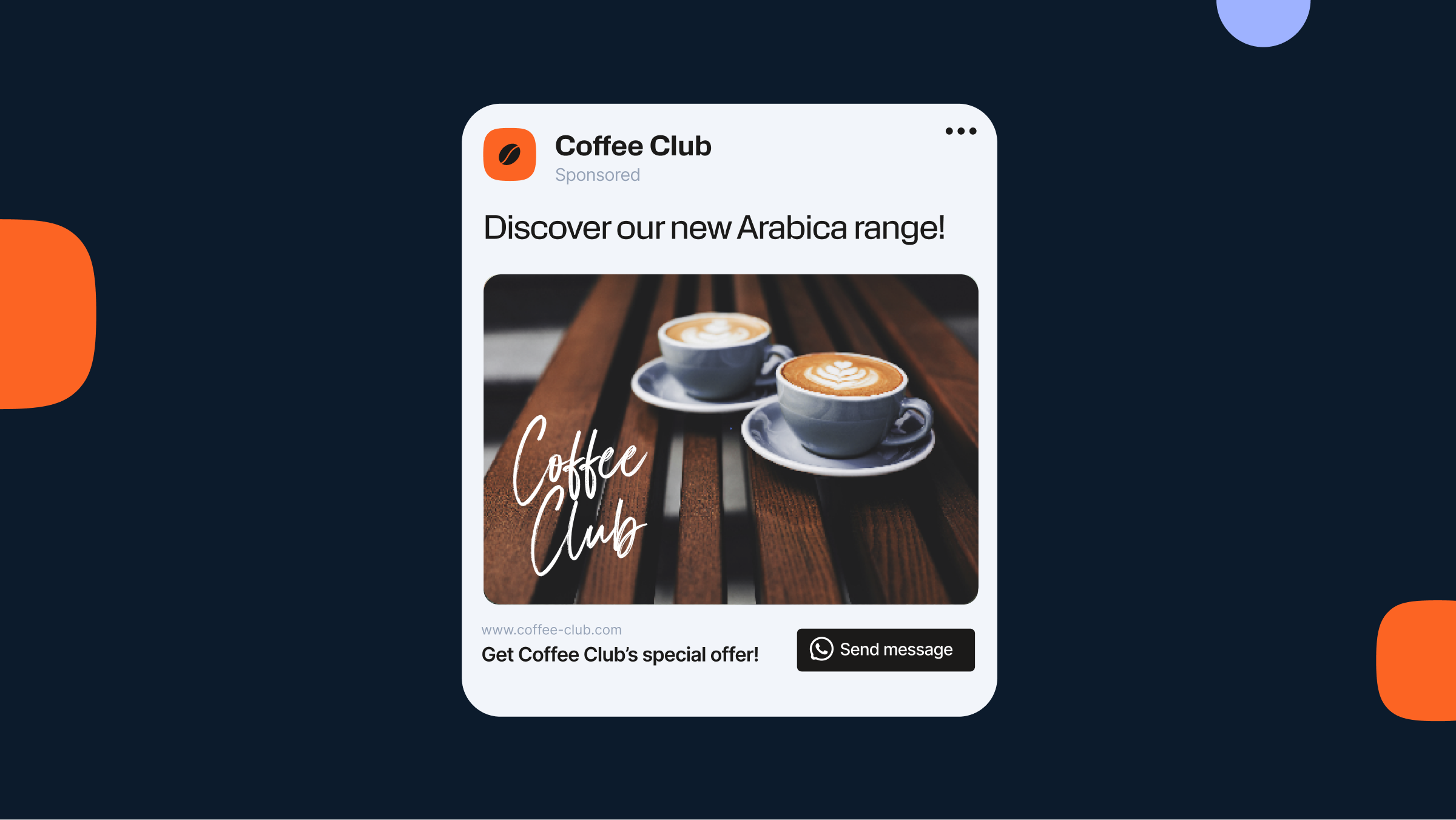
  • Use Click to WhatsApp ads to acquire and re-engage customers. Once the user starts interacting with you via click to WhatsApp ads, a special entry point rules apply. All templated messages sent within 72-hour time window are free of charge.
  • Build with Infobip: Customer engagement platform for segmentation and A/B tests, analytics for CTR and conversion, and unified reporting across ads and messaging 
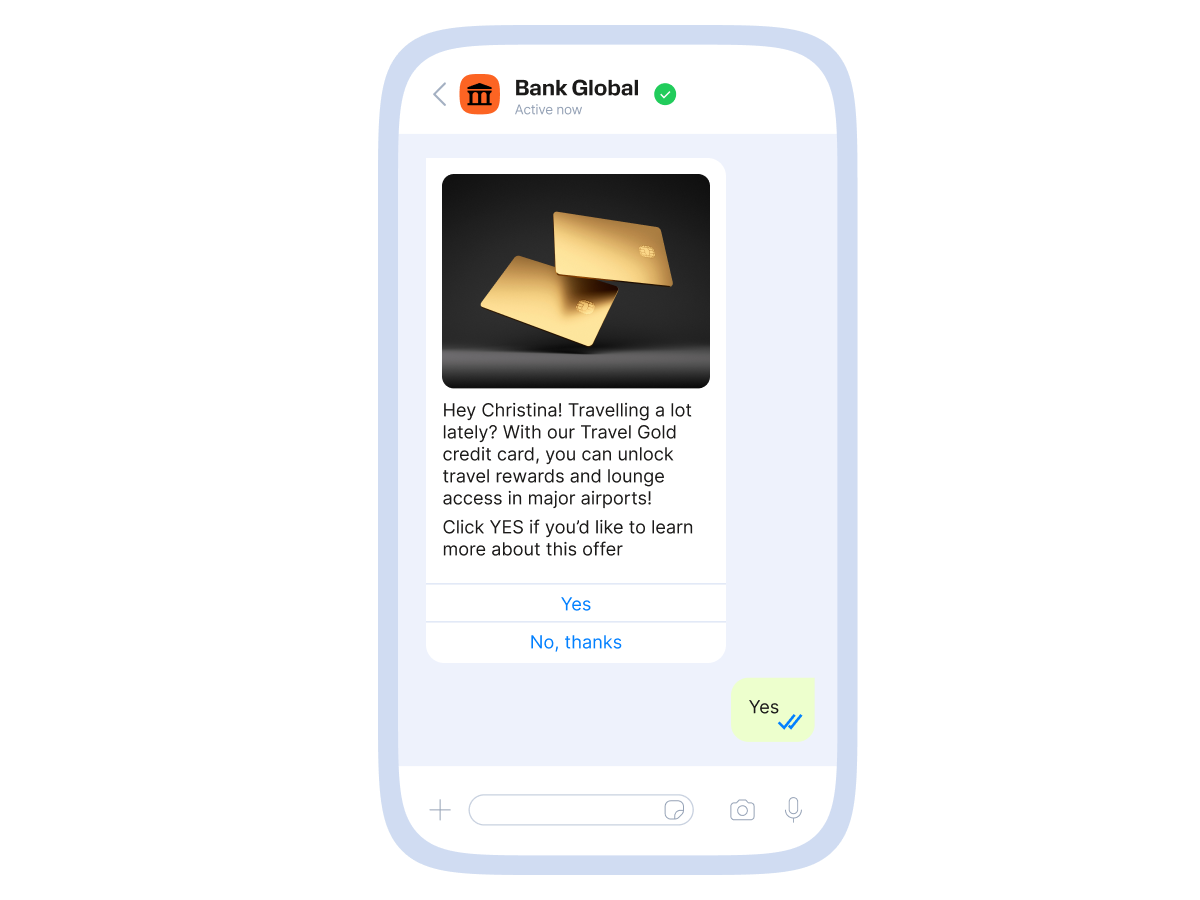
A smartphone screen shows a chat with Bank Global promoting their Travel Gold credit card, highlighting travel rewards and lounge access at major airports. The message invites the user to click "Yes" or "No, thanks" to learn more about the offer. The user has responded "Yes." The message also includes an image of two gold credit cards.

An example of a promotional message over WhatsApp.

Suspicious transaction alerts

32% of banks use WhatsApp to alert of suspicious activity:

  • Notify customers of unusual activity in real time. Collect confirmations in-chat and trigger protective actions like card freeze or password reset  
  • Use authentication templates to add OTP or step-up verification for risky actions
  • Build with Infobip: Automate alert flows, route high-risk cases to agents, and maintain compliant, encrypted messaging end to end
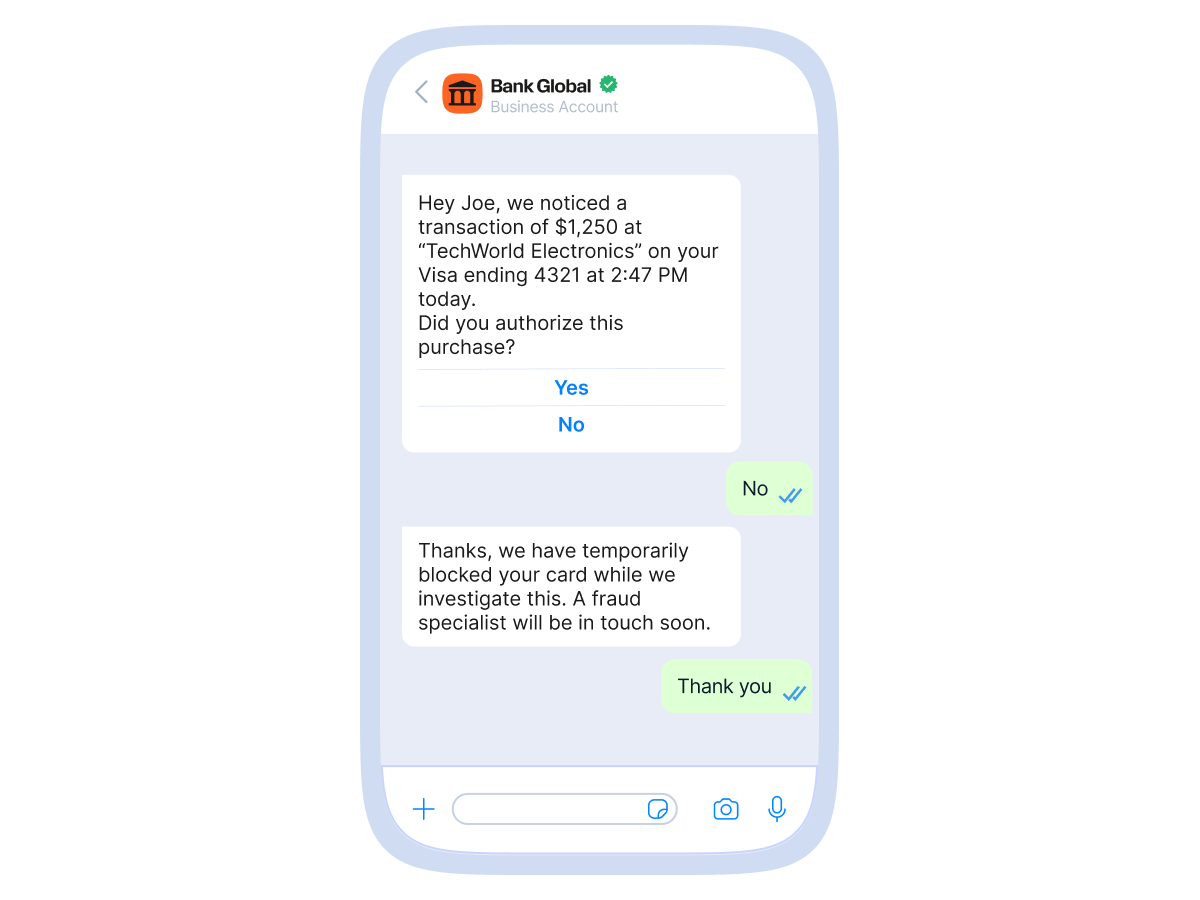
A smartphone screen showing a WhatsApp chat conversation with Bank Global. The bank alerts Joe of a $1,250 transaction at “TechWorld Electronics” on his Visa card ending in 4321 and asks if he authorized the purchase. Joe replies "No." The bank responds that the card has been temporarily blocked for investigation and that a fraud specialist will contact him soon. Joe replies with "Thank you."

An example of a bank notifying a customer of suspicious transactions over WhatsApp.

Self-service contact info updates

40% of banks use WhatsApp to enable customers to update profiles:

  • Let customers update email, phone, address, and communication preferences in chat. Confirm changes with OTP and log updates to CRM  
  • Provide clear confirmation messages and audit history using utility templates  
  • Build with Infobip: A chatbot solution and Flows for guided updates, customer data platform for profile management, API integrations to core banking for real-time sync

One-time passwords (OTPs)

46% of banks use WhatsApp to deliver OTPs

  • Send OTPs for login, payments, and sensitive changes using authentication templates. WhatsApp offers secure delivery with verified sender and end-to-end encryption
  • Combine OTP with session-based checks or biometrics depending on your risk model 
  • Build with Infobip: OTP via WhatsApp API, template governance, analytics to monitor delivery and completion rates, and omnichannel fallback if needed

Implementation steps for banks

Step 1: Define goals and get set up

Choose priority use cases, KPIs, and markets. Align teams on compliance, data, and CX goals. 

Create your WhatsApp Business account with Infobip. We are an official WhatsApp Business Solution Provider and Meta partner, so we can properly guide your onboarding and approvals.

Step 2: Verify your business and secure approvals

Complete Meta Business Verification, set your display name, and configure a verified WhatsApp sender. 

Establish opt-in flows and template governance. Business-initiated messages require explicit consent and pre-approved templates across marketing, utility, and authentication categories.

Step 3: Integrate your stack

Connect core systems via API or Infobip apps:

Sync CRM and core banking systems to personalize messages and enforce data policies and enable analytics to track delivery, reads, clicks, and conversions in one place.

Step 4: Design compliant flows and templates

Build WhatsApp Flows for guided tasks like onboarding, appointment booking, and self-service updates. Create template sets for each message type. Use: 

  • Utility templates for statements, receipts, and payment reminders. 
  • Marketing templates for product offers and campaigns. 
  • Customer engagement platform for journeys, campaigns, and reminders. 
  • Authentication templates for OTP and step-up verification
  • Add entry points to boost opt-ins: QR codes, wa.me links, website buttons, and Click to WhatsApp ads.

Step 5: Launch, measure, and optimize 

Pilot with a limited audience. Validate consent capture, latency, and handoff to agents. 

Track KPIs per use case: containment rate, CSAT, cost per contact, payment completion, response time, and template approval success. 

Scale with A/B tests on copy and flows. Add language variants and omnichannel failover where needed.

Banks using WhatsApp to digitalize the customer journey

FAQs about WhatsApp banking

Digitize the banking experience with WhatsApp

Keep reading:

Get the latest insights and tips to elevate your business

By subscribing, you consent to receive email marketing communications from INFOBIP. You have the right to withdraw your consent at any time using the unsubscribe link provided in all INFOBIP’s email communications. For more information please read our Privacy Notice

Ibancar: Driving digital credit journeys from application to approval with conversational messaging

60%

of leads progress through the sales funnel without human intervention

~3,000

monthly service requests resolved automatically

ibancar logo white
Share

CHALLENGE

Rapid growth put pressure on fragmented communication

Ibancar is a Spain-based fintech that’s been redefining access to credit. The entire process is fast, fully digital, and designed for flexibility, especially for those with limited or irregular credit histories. 

The market quickly embraced the mission to make credit more inclusive. With over €50 million in loans issued and 25,000 customers served, demand skyrocketed. But with success came operational strain. 

Each month, more than 40,000 leads flowed into Ibancar’s system. Their customer service team struggled to keep up, spending valuable time handling repetitive questions, searching for documents, and managing communications spread across multiple, disconnected channels. 

Without a unified customer engagement strategy, agents struggled to keep up:

  • Manual processes slowed response times 
  • Fragmented data made it challenging to optimize performance 
  • Overall customer experience suffered 


In a competitive lending space, where processing speed is key, these gaps risked lost opportunities and rising costs. 

Ibancar needed a scalable solution that could automate repetitive tasks, improve visibility, and free up teams to focus on complex cases without compromising on service quality. 

SOLUTION

A single platform for automation, personalization, and outreach

During their search for a communications partner, Ibancar was drawn to Infobip’s strong reputation. Once the conversation began, they were equally impressed by the professionalism and responsiveness shown in addressing their needs.

Ibancar chose to partner with us to unify and automate customer communication. After launching a WhatsApp chatbot, they expanded their CX strategy with a broader range of Infobip’s solutions.  

The company adopted: 

  • Answers: Our chatbot-building platform for automating support 
  • Conversations: A cloud contact centre for live agent handovers 
  • People CDP: Infobip’s customer data platform bringing all customer information into one central portal for a unified view of the customer journey
  • WhatsApp Business, SMS, and RCS Business Messaging for outreach, reminders, and real-time engagement 

At the heart of the solution is Ibancar’s support chatbot, which is available 24/7 via WhatsApp. From their website, customers have easy access to open a WhatsApp chat for support throughout the entire loan journey:  

  • Checking eligibility  
  • Collecting documents 
  • Confirming payouts 
  • Providing ongoing account support  

When human input is needed, customers are routed to agents through our cloud contact center, Conversations. And with the data being gathered through our customer data platform, agents have a line of sight of the full interaction history across all channels, giving context and ensuring a seamless customer experience. 

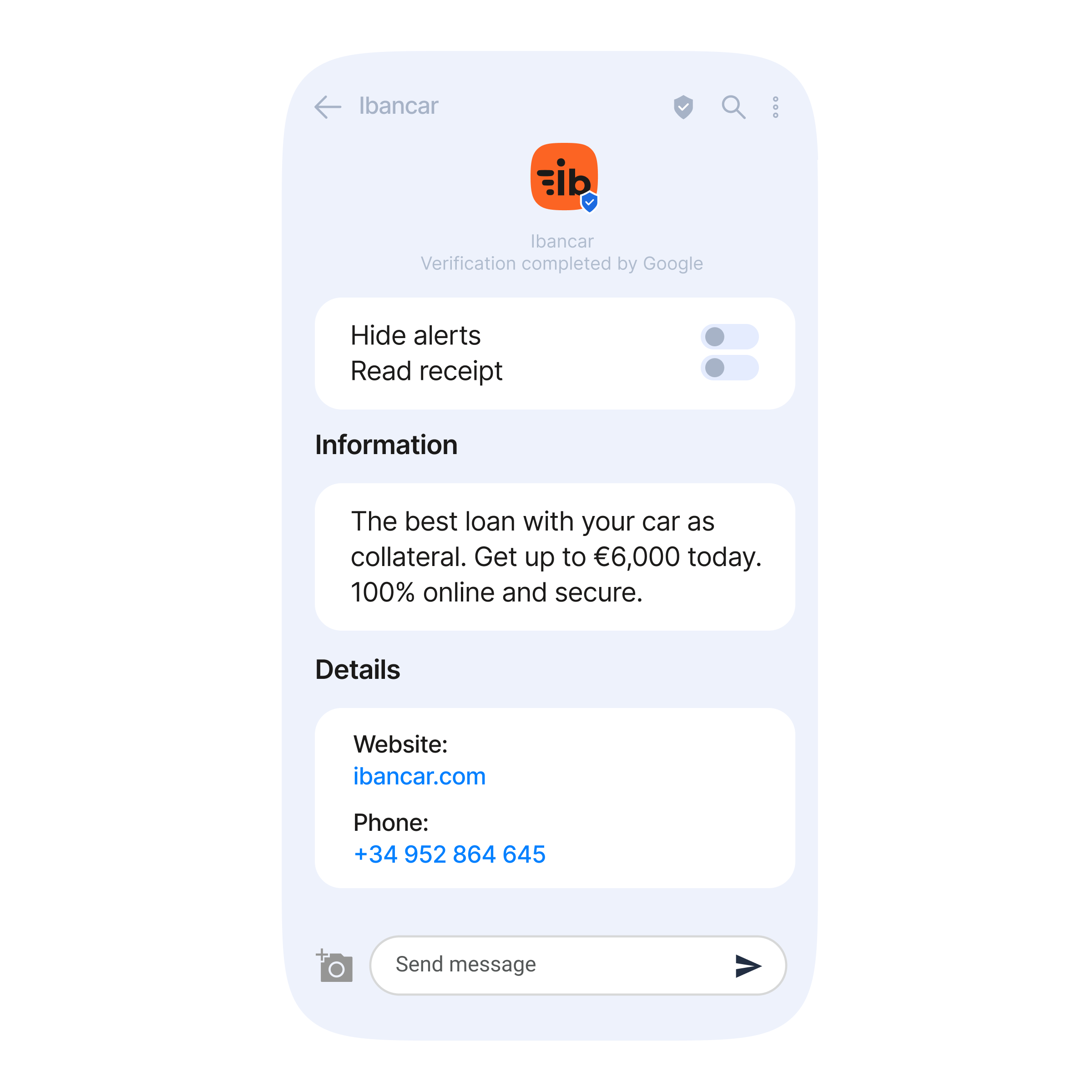
A smartphone screen shows a verified message from Ibancar. The message contains options to hide alerts and read receipts, both toggled off. Under "Information," it states: "The best loan with your car as collateral. Get up to €6,000 today. 100% online and secure." Under "Details," it provides a website link "ibancar.com" and a phone number "+34 952 864 645."
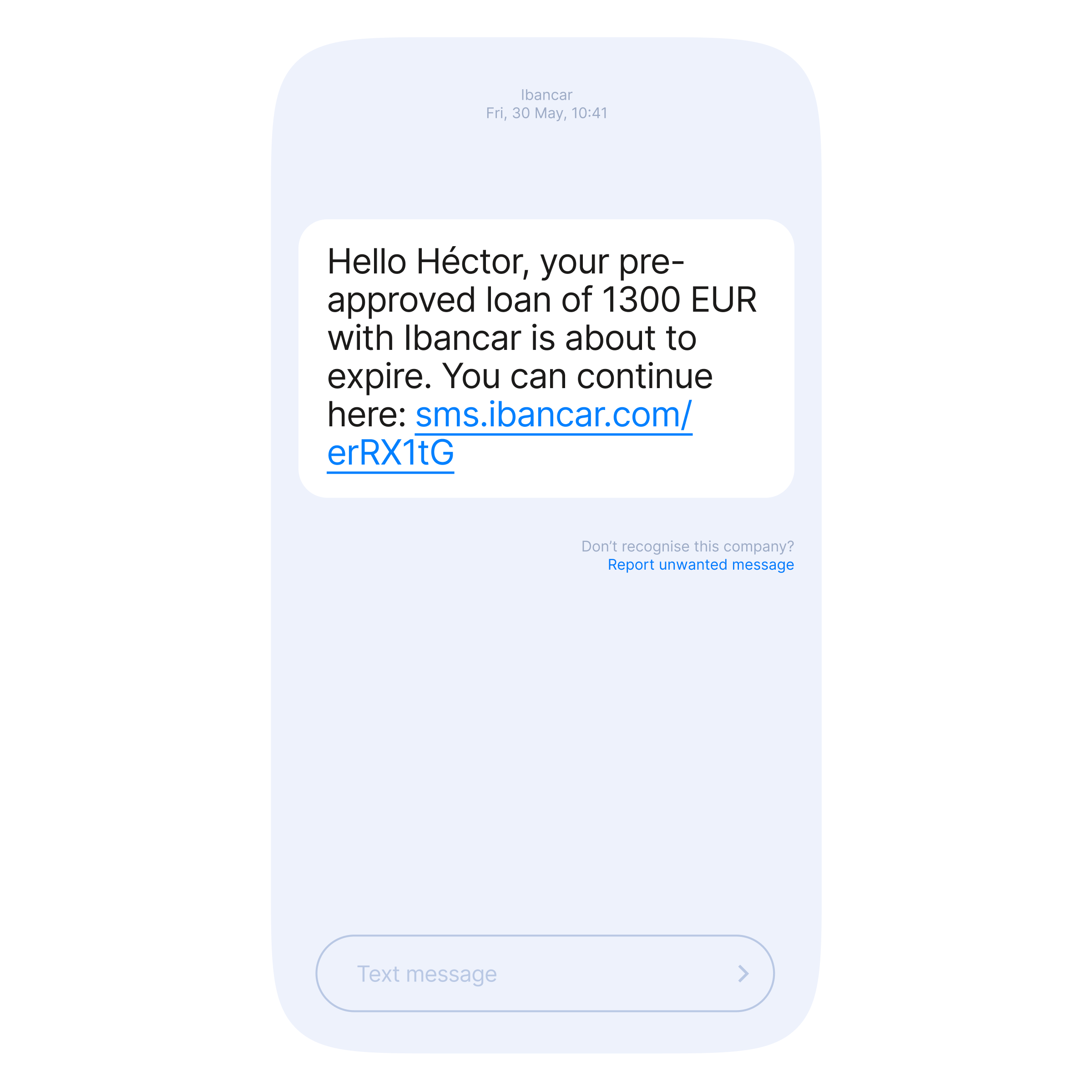
A smartphone screen displays a text message from Ibancar dated Fri, 30 May, 10:41. The message reads: "Hello Héctor, your pre-approved loan of 1300 EUR with Ibancar is about to expire. You can continue here:" followed by a clickable link "sms.ibancar.com/erRX1tG." Below the message, there is an option to report unwanted messages.

RCS, with SMS as failover channel, also play an integral role in the customer journey to ensure no marketing or transactional messages get lost. These channels notify customers when loans are approved, prompt document uploads, send payment reminders, and power remarketing and verification flows, ensuring key messages are delivered on the customer’s preferred channel. 

Our CX consultants worked closely with the Ibancar team to map journeys, train staff, and optimize the experience. With advanced analytics and journey tracking, the operations team can monitor drop-off points, channel performance, and customer satisfaction in real time. 

RESULT

Scalable growth, lean operations, and faster service

Since partnering with Infobip, Ibancar has optimized support, improved visibility, and streamlined thousands of monthly interactions, without needing to scale its customer service team simultaneously. 

Around 3,000 service requests are resolved automatically on a monthly basis, while 60% of valid leads move through the funnel without agent intervention, totaling over 40,000 monthly interactions.

The scalability of our solutions is also reflected in how Ibancar has grown its team. While the overall workforce expanded by 30–40% in recent years, the customer service team saw only a slight increase, highlighting the efficiency gains made possible through automation.


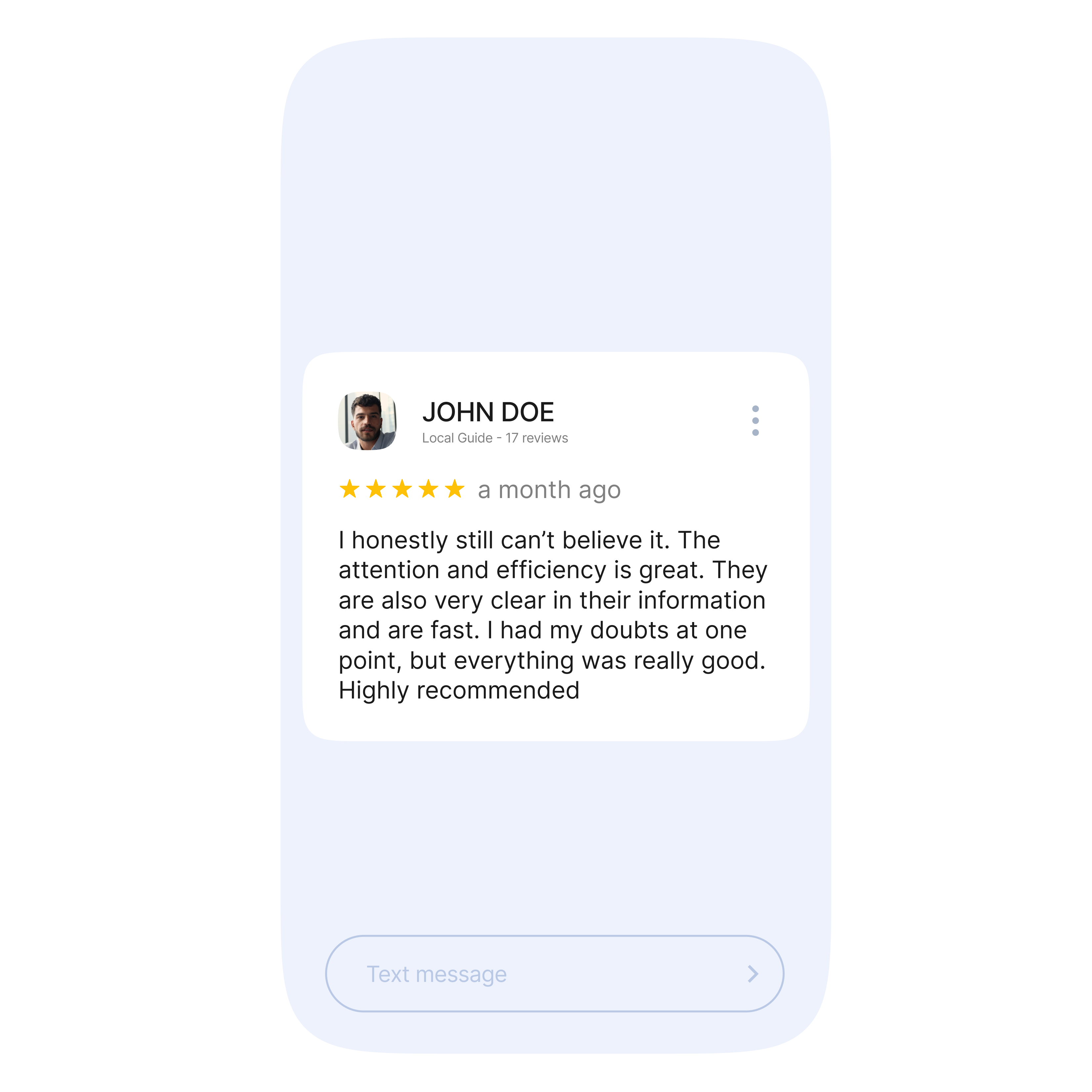
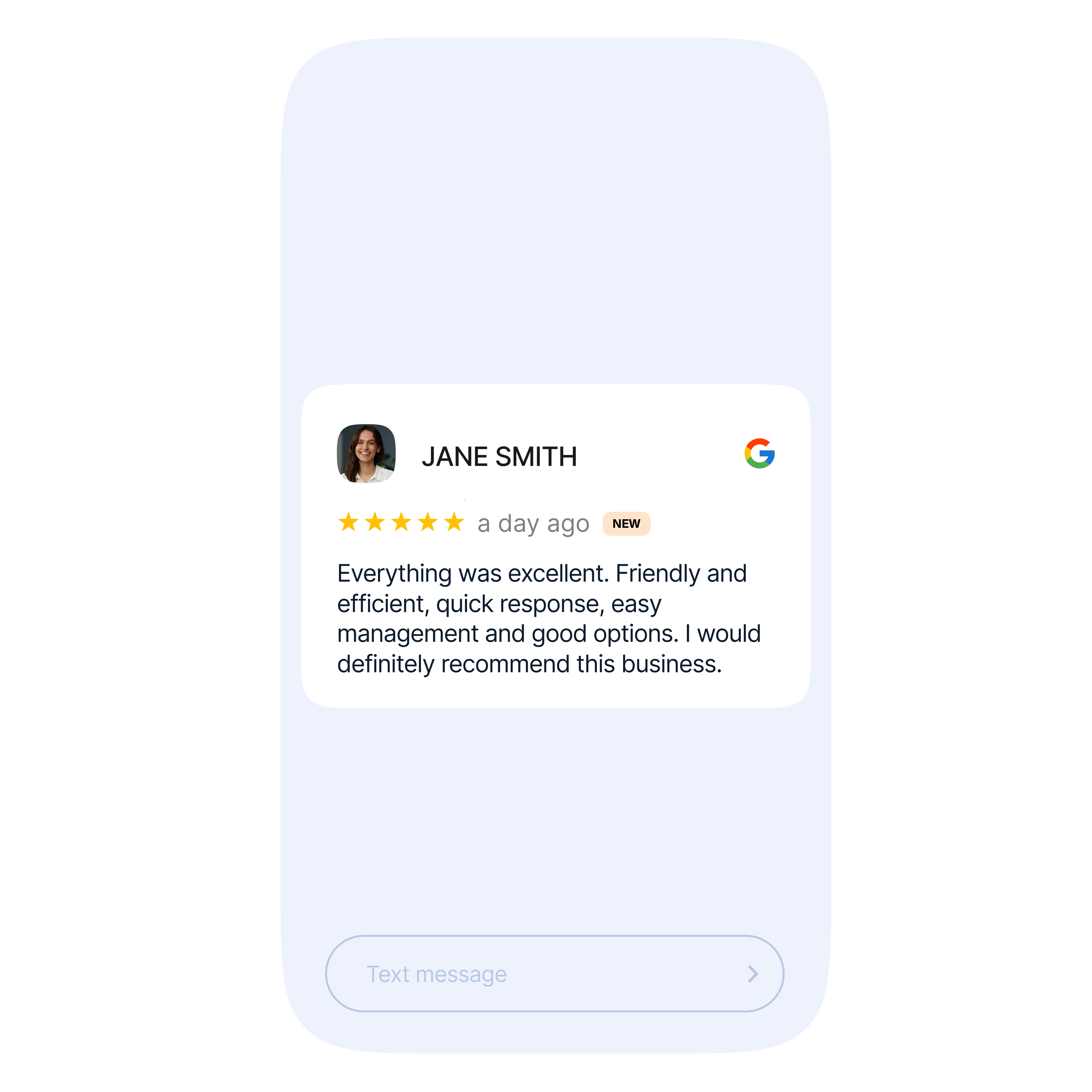
The impact extends to customer experience, too. People can apply for loans, manage their accounts, and receive updates anytime, without waiting on hold or being restricted to business hours. Feedback has been overwhelmingly positive in online reviews.

A smartphone screen displays a Google review by John Doe, a Local Guide with 17 reviews. The review, posted a month ago, gives five stars and reads: "I honestly still can’t believe it. The attention and efficiency is great. They are also very clear in their information and are fast. I had my doubts at one point, but everything was really good. Highly recommended."
A smartphone screen displays a Google review by Jane Smith, posted a day ago. The review gives five stars and reads: "Everything was excellent. Friendly and efficient, quick response, easy management and good options. I would definitely recommend this business."

Our conversational communication platform has paved the way for Ibancar’s international expansion – the same workflows are already live in Mexico, with further automation on the way.

At present, they are planning an email migration to Infobip’s Email API platform. By implementing a seamless, omnichannel customer journey, Ibancar has a solid foundation for sustainable growth, with even greater opportunities in the pipeline. 

Our objective was clear: to offer a simple, agile, and seamless credit experience without giving up scalability. Infobip has enabled us to achieve this with an integrated and automated omnichannel solution, which has helped us strengthen the solid foundations of our sustained growth.

Marcelo Teplitzky

Head of Product & Growth at Ibancar

Click here for more information about Ibancar. 

COMPANY PROFILE

Ibancar is a Spain-based fintech that’s been redefining access to credit since 2017. Focused on people often overlooked by traditional banks, the company offers loans of up to €8,000 against a vehicle, without asking customers to lose ownership, hand over keys, or visit a branch.  

Angel One: Redefining customer experience with a conversational omnichannel strategy

10%

increase in message delivery rate with RCS

35%

open rate with WhatsApp Flows

Angel One logo
Share

CHALLENGE

Engaging with customers in real-time through multiple channels to support their decision-making journey

Angel One is one of India’s largest retail broking houses in terms of active clients on the National Stock Exchange of India (NSE). As a digital-first company, Angel One provides a digital platform for users to invest in the stock market. To further support customers on their investment journey, the company aimed to enhance its communication strategy by leveraging digital channels for real-time, personalized engagement.

We were always a digital-first company, encouraging users to download the app and trade by themselves. Even today, the majority of users trade via our app.

Prateek Kabra, Angel One

Prateek Kabra

Head – Traffic & Engagement, Angel One

Being a digital-first company, Angel One wanted to upgrade its existing communication system to resolve some key challenges:

  • Low reachability: Traditional channels such as email and SMS were not enough to reach their customer base, which was growing exponentially.
  • Lack of real-time interactions: Customers who dropped off during the onboarding process could not be followed up in real-time.
  • Absence of two-way communication: Instant resolution of queries became difficult, resulting in poor customer experience.


To address these challenges, Angel One needed a digital communication solution that could:


  • Make the onboarding and trading experience seamless for customers.
  • Enhance their customer acquisition and remarketing strategies.

Without digitalization, we were unable to access most of our users since the users were growing in the last 3-4 years. So, it’s very important to reach them through channels such as WhatsApp, RCS, and other communication mediums. Because with the help of offline communication and SMS, the reachability was inadequate.

Prateek Kabra, Angel One

Prateek Kabra

Head – Traffic & Engagement, Angel One

SOLUTION

Attaining higher engagement and reach with a strategic omnichannel approach

Angle One was looking for a communications technology provider with experience in the financial services industry. After evaluating our platform capabilities in terms of flexibility, user-friendliness, and security, the company decided to partner with us to digitalize its communication process and enhance its customers’ journey. 

We helped the company implement a robust omnichannel communication strategy by integrating RCS and WhatsApp on our customer engagement platform, Moments.

Our team helped them design a flow journey on RCS and WhatsApp on Moments. Given its extensive reach, WhatsApp was a natural choice, while the growing traction of RCS in India made it an ideal channel for maximizing engagement.

The company used both channels to assist in onboarding, proactive communication, and driving higher conversion. Managing and securing data was also a key concern for Angel One, so we helped them localize their customer data by integrating with Moments. In this way, we ensured that the data remained within the country.

RCS: A game changer for Angel One

Angel One leverages RCS to streamline customer engagement. Here are some of the use cases:

  • Keeping new customers informed.
  • During onboarding, customers are provided with access to online and downloadable content, such as quick guides on trading and research picks, to help them in their investment journey.
  • Preventing customer loss.
  • If a customer drops off during onboarding, follow-up messages are sent to RCS through our Moments platform to motivate them to complete the process.
  • Providing transactional assistance.
  • In case of payment failure or difficulty in adding funds during the trading process, real-time assistance is provided through the RCS messaging.


Angel One also uses RCS to nurture inactive users, promote new product features, and suggest investment opportunities such as news regarding any upcoming IPO. The conversational nature of RCS enables a two-way dialogue, allowing customers to ask questions and receive immediate answers, all within the same interface. Using Moments, the company could automate most of its communication seamlessly.

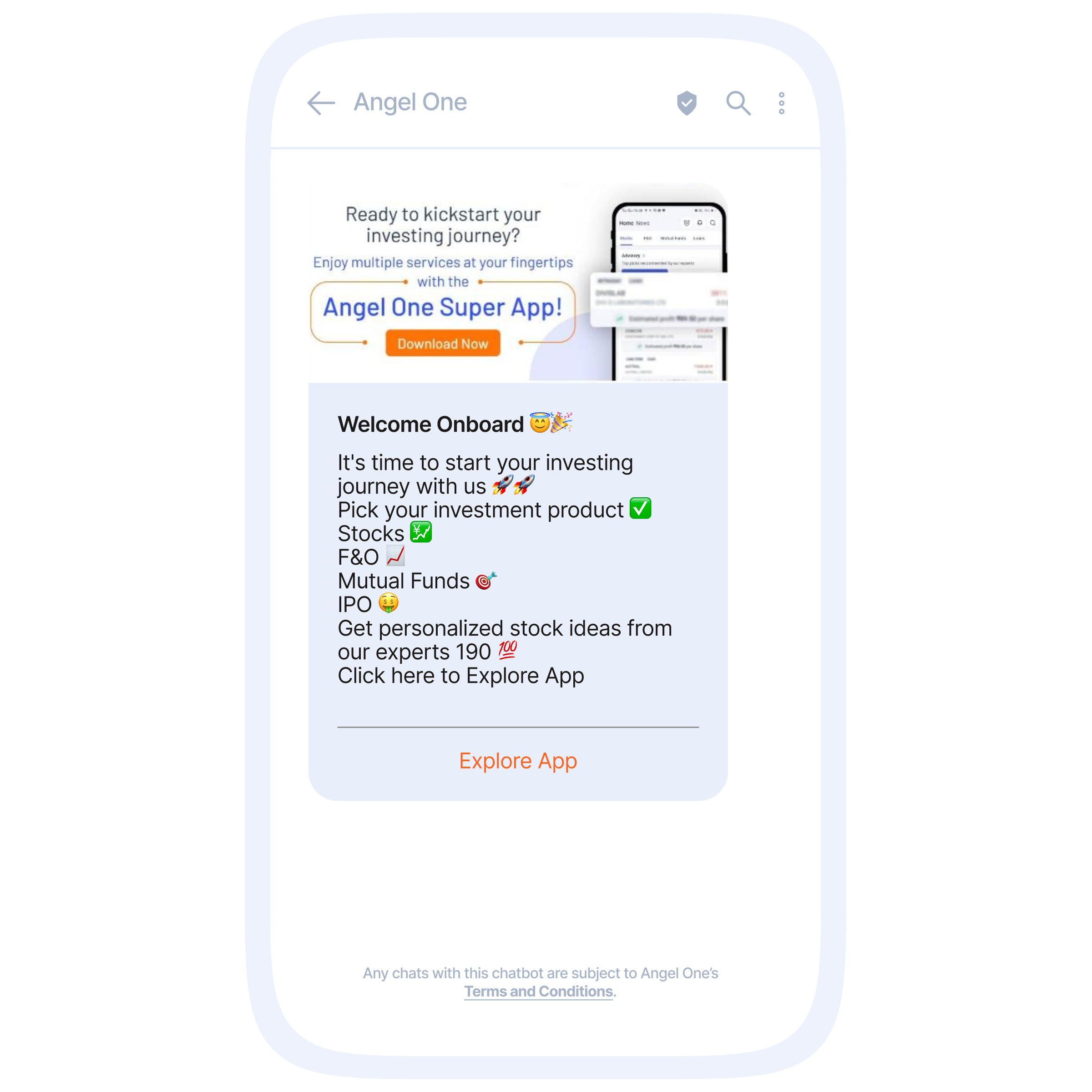
A smartphone screen displays a message from "Angel One" promoting their investing app. The message reads: "Ready to kickstart your investing journey? Enjoy multiple services at your fingertips with the Angel One Super App! Download Now." Below, there is a welcome message that says: "Welcome Onboard. It's time to start your investing journey with us. Pick your investment product: Stocks, F&O, Mutual Funds, IPO. Get personalized stock ideas from our experts. Click here to Explore App." There is an orange button labeled "Explore App."

Prateek adds, “We are doing most of our campaigns via Moments. The unique capabilities of Moments have helped us attain better campaign performance. We can split the audience so that we can do AB testing in a single flow. Apart from that, we can do the real-time campaigns, and personalization can be done easily using Moments.

Enhancing customer experience with WhatsApp

Angel One primarily uses WhatsApp to assist customers with onboarding. When customers sign up on the Angel One platform with their mobile number, an automated welcome message with rich media content is sent to guide them through onboarding.

“Primarily, we use WhatsApp to send out communication to our customers who have opened an account with us. When we say open an account, they have a client code generated, which we carry forward in all communications,” said Prateek Kabra.

To educate customers and help them in their investment journey, Angel One shared various online and downloadable assets via WhatsApp, such as instructions on adding funds, performing transactions, and more. Customers are also provided with personalized stock trading advice with quick action buttons.

We helped Angel One set up WhatsApp Flows to automate the customer journey and provide quick, real-time assistance. The company also implemented WhatsApp Flows for some of its campaigns, such as IPO applications for existing customers, where they can easily apply for any IPO via WhatsApp. With our AI agent, setting up WhatsApp Flows has been a seamless process.

Infobip’s AI Agent will be a game changer – it allows us to build WhatsApp Flows in minutes, heavily supporting our technical teams. The fact that Infobip’s platform components work so well together makes it easier for us to experiment, optimize, and quickly deploy new use cases. This level of cohesion and flexibility is exactly what we need to keep innovating in such a fast-paced digital environment.

Prateek Kabra, Angel One

Prateek Kabra

Head – Traffic & Engagement, Angel One

Maximizing reach with omnichannel communication

Angel One has been using WhatsApp and RCS as a holistic combination for omnichannel success. While WhatsApp was used as a primary channel, RCS acted as a failover for many use cases, such as onboarding, nurturing, and more. The main idea behind using both communication channels was to ensure no message goes unnoticed.

One thing that we are doing is the failover. So, that is the major part we are doing in the RCS. The flows are already defined in the Infobip Moments platform. If a WhatsApp message is not delivered, we send them an RCS message as a failover.

Prateek Kabra, Angel One

Prateek Kabra

Head – Traffic & Engagement, Angel One

RESULT

10% increase in message delivery rate with RCS messaging

By adopting an omnichannel communication strategy, Angel One was able to increase its reach and create a better customer experience. RCS proved to be a very effective channel for driving higher engagement due to its real-time communication capabilities and rich media features.

Customers are now getting better communication in the form of images and carousels, which attract their attention and lead to improved click rates. This channel is also interactive, which helped us launch a carousel campaign offering various services for our clients to choose from, based on their interests.

Prateek Kabra, Angel One

Prateek Kabra

Head – Traffic & Engagement, Angel One

Some impactful results using RCS include:

  • 10% higher message delivery rate: Delivery rates improved from 35% to 45% after switching to RCS, showing a significant uplift in message reach.
  • 5% click-through rate (CTR): Using personalized RCS messages with rich media helped Angel One achieve a 5% CTR, prompting users to engage with links and sign up for the application.

Prateek added, “A better response may be in terms of CTR on personalized campaigns because that drives users’ attention, and they are intrigued enough to open your message. We did see a better engagement rate there.”


WhatsApp, one of the key channels and part of the omnichannel communication strategy, has helped Angel One enhance its customers’ onboarding journey. Advanced WhatsApp features such as WhatsApp Flows have proved very effective in driving higher engagement.


Some impactful results using WhatsApp include:

  • 35% open rate with WhatsApp Flows
  • 90% of users engaged with Flows
  • Over 50% of users progressed through Flows


Attaining exceptional results through a well-defined omnichannel strategy, Angel One looks forward to leveraging new features of channels such as RCS and WhatsApp as part of its innovation process.

Infobip has been very supportive and has helped us solve our queries quickly. They have always helped us explore new features & use them to achieve our metrics.

Prateek Kabra, Angel One

Prateek Kabra

Head – Traffic & Engagement, Angel One

Disclaimer: This is only for informational purposes. Investments in the securities market are subject to market risks. Read all the related documents carefully before investing.

COMPANY PROFILE

Established in 1996, Angel One Limited is a financial services company headquartered in Mumbai, India. The company provides broking and advisory services, margin funding, and financial products. Regarding active clients, it is now one of the largest listed retail broking houses in India.

Mukuru: Faster customer service and reduced costs with WhatsApp Business Platform

30x

increase in active digital wallet customers

92%

read rates in WhatsApp campaigns

mukuru logo
Share

CHALLENGE

Enhancing financial services accessibility and maintaining meaningful customer interactions

Mukuru, a leading financial services provider serving over 17 million users across over 70 countries in Africa, Europe, and Asia, faced the challenge of transitioning from cash reliance to digital wallet adoption across Africa. Serving the emerging African market and migrant workers, Mukuru needed to make its services more accessible over channels that customers prefer, while maintaining meaningful interactions.

Previously, customers accessed services through the Mukuru mobile site, app, and USSD. However, with a high volume of money transfers, Mukuru sought to optimize communication channels, enhance the customer journey, and reduce costs by providing an additional channel with better functionality than USSD.

SOLUTION

Connecting with customers and driving digital adoption with WhatsApp Business chatbot

Mukuru identified WhatsApp as the ideal channel for customer transactions and communication, given its popularity in Africa and global reach. They developed a WhatsApp chatbot to facilitate faster money transfers without assistance from a live agent.

To use WhatsApp with Mukuru, customers start a WhatsApp chat with the company to sign up for the service. Once the chatbot responds, customers receive menu options from which they can choose what they want to do next, including:

  • automatically creating a Mukuru account
  • selecting from 10 language options
  • transferring money across borders
  • managing their digital stores of value (Mukuru Wallet or Mukuru Card)
  • ordering groceries
  • buying airtime or electricity
  • paying for DSTV

Before sending WhatsApp notifications, Mukuru secured customer opt-ins through three methods: directing users to opt in via their Facebook page, offering the option to select WhatsApp during sign-up, or collecting consent during customer service calls. This process was streamlined with full support from our team during onboarding, technical implementation, chatbot logic development, and WhatsApp template registration.

Additionally, integration with the contact center allows customers to chat with an agent when needed, enhancing support.

In parallel, Mukuru implemented Infobip’s customer engagement solution, Moments. They launched a campaign in Zimbabwe that played a key role in encouraging customers to move from relying on cash to adopting digital wallets.

Understanding customer touchpoints and preferred channels is crucial, and moving the needle on cost-to-acquire with an integrated platform is powerful. Africa’s emerging consumer market offers vast potential beyond money transfer, expanding into a full ecosystem of financial services. The differentiator lies not just in pricing but in delivering messages through the right channel at the right time, continuously curating better experiences for our customers.

Sandy Rheeder

Chief Information Officer, Mukuru

RESULT

Over 30x increase in active customers and 92% read rates with WhatsApp, halving drop-off rates and cutting costs by 15%

Integrating WhatsApp and Infobip’s Moments has yielded impressive results for Mukuru. The shift from cash reliance to digital wallet adoption has been remarkable, with active customers increasing from just 4,000 in December to 129,000 by March. This allowed Mukuru to engage in meaningful two-way conversations with customers and reconnect with those who were previously disengaged. The effectiveness of this approach is highlighted by the success of WhatsApp campaigns, which consistently achieve read rates above 92%.

Moreover, the implementation of WhatsApp Flows has significantly enhanced the customer journey by reducing the process from 17 steps to just 2, halving the drop-off rate in Botswana. This streamlined experience has improved product usability and customer sentiment, providing an app-like feel with interactive elements. Mukuru’s strategic use of a multichannel approach, with a focus on WhatsApp, has not only optimized communication but also reduced costs, saving 15% on reverse billed USSD costs and 5% on transactional SMS costs.

These results underscore Mukuru’s commitment to leveraging technology to enhance customer satisfaction and operational efficiency, setting a strong foundation for future growth in the financial services sector.

Mukuru’s future goals include deepening their collaboration with Infobip to advance their AI strategy, focusing on delivering quick, accurate responses to common customer questions like “What is this?” or “How much does it cost?”

This kind of automation not only boosts operational efficiency but also empowers customers and supports financial inclusion, such as guiding someone through sending money to a family member in Nigeria via conversational AI.

However, implementing AI in banking is complex due to strict regulations and the need for absolute trust. That’s why Mukuru is taking an incremental, roadmap-driven approach and is confident that, with Infobip’s expertise, they can navigate these challenges while staying aligned with their core systems and delivering real value to their customers.

Previously, our communication was one-sided, sending messages and hoping for a response. Now, with two-way engagement, we’re having real conversations, reconnecting with customers we hadn’t engaged with in a while. The impact is clear: our WhatsApp campaigns through Moments consistently achieve read rates above 92%. Collaborating with Infobip’s CX team, we’re excited to track click-throughs and further enhance our engagement strategies.

Jennifer Stevens

Head of Product: Customer Domain, Mukuru

COMPANY PROFILE

Mukuru is a leading Next Gen Financial Services Platform that offers affordable and reliable financial services to an emerging customer base of over 10 million across Africa, Asia, and Europe. With over 100 million transactions to date, the core of Mukuru was built to provide international money transfers and since then have developed a set of services to address the broader financial needs of its customers. The company now operates in over 50 countries and across over 300 remittance corridors. Mukuru has been named one of the FXC Intelligence Top 100 Cross-Border Payments Companies in 2022. Mukuru is listed as one of the top eight global, independently owned businesses in the remittances space.

Wema Bank: Leading Nigeria’s digital banking revolution 

Discover how Wema Bank is driving Nigeria’s digital banking revolution with ALAT, AI-powered personalization, and seamless customer engagement – shaping the future of finance. 

Marthinus Jansen Van Vuuren Content Marketing Expert
Skip to table of contents

Nigeria’s Wema Bank has been evolving for over 80 years, growing from a cooperative bank into a leader in digital banking. With technology at its core, it’s enhancing customer experience and driving financial inclusion. The bank has remained at the forefront of innovation. Central to this innovation is ALAT, its pioneering digital banking platform, which has reshaped Nigeria’s financial landscape. 

We spoke with Ajibade Laolu-Adewale, Chief Partnership and Ecosystems Officer at Wema Bank, whose leadership in digital transformation has positioned him as a key industry figure. His impact led to his appointment as Chairman of the Committee of e-Business Heads in Nigeria, where he now collaborates with leaders from all Nigerian banks to advance digital banking initiatives. 

In our conversation, he shared how innovation is redefining banking in Africa, strengthening Wema Bank’s leadership, and accelerating change across the industry. 

Providing instant customer service is key to retaining customers. And that is what digital transformation enables us to do, as a financial service provider.

Ajibade Laolu-Adewale

Ajibade Laolu-Adewale

Chief Partnership and Ecosystems Officer at Wema Bank

A digital-first approach 

Wema Bank saw the future of banking early. At its 70th anniversary, the bank launched its digital transformation strategy, resulting in ALAT, a fully digital banking platform. Today, the app has over 8 million active users, setting the benchmark for financial technology innovation in Nigeria. 

“We built ALAT to simplify banking and bring financial services closer to people. The success of Nigerian fintech today owes a lot to ALAT’s use case in validating digital transformation strategies,” says Ajibade. 

With ALAT, opening an account, activating a debit card, and managing transactions takes just minutes – all from a mobile device. Seamless KYC verification and automated onboarding make banking effortless, helping individuals and businesses easily access financial services. 

Tailoring banking for a diverse market 

Unlike traditional banking, which often needs multiple branch visits for account setup and transaction approvals, Wema Bank streamlined its customer experience through digital engagement. Customers can now control their banking preferences remotely, including managing cards and transactions while traveling. 

For Wema Bank, customer segments are not about demographics – they are about tech affinity. Some customers embrace digital banking, while others prefer traditional methods. Maintaining a hybrid approach, Wema Bank ensures that financial services stay inclusive, accessible, and tailored to every customer’s needs. 

The power of personalization and AI 

Wema Bank’s innovation goes beyond digital banking – it’s about understanding customers at every stage of their journey. Ajibade firmly believes in Customer Lifecycle Management (CLM), leveraging AI-driven personalization to deliver tailored support. The result? More intuitive, seamless, and customer-centric banking. 

We know when a customer downloads our app, even if they don’t complete registration. Our systems intelligently follow up via email, calls, or messages, ensuring they are guided through onboarding. Technology is the driving force behind this personalized engagement.

Ajibade Laolu-Adewale

Ajibade Laolu-Adewale

Chief Partnership and Ecosystems Officer at Wema Bank

But AI isn’t just about acquiring new customers – it’s about keeping them engaged. Wema Bank uses AI-powered insights to reactivate dormant accounts, enhance retention strategies, and anticipate customer needs. This approach ensures timely financial solutions and improved user experience. 

Infobip: Enabling seamless communication 

Wema Bank’s digital transformation strategy is strengthened by its partnership with Infobip. While they currently use Infobip for SMS notifications, their vision is bigger – expanding our partnership to include real-time customer engagement through digital channels like WhatsApp

While SMS still has a role to play in time -sensitive notifications like one-time passwords (OTPs), Adewale believes WhatsApp’s instant, interactive capabilities make it the preferred choice for banking interactions. At the time of writing, Wema Bank is exploring more avenues to expand their digital banking offerings including with WhatsApp, as they recognize the demand and potential that comes with the channel. 

Infobip’s global reach ensures seamless message delivery, regardless of customer location. Their integration with Meta allows us to tap into AI-driven messaging solutions that improve banking efficiency and customer service.

Ajibade Laolu-Adewale

Ajibade Laolu-Adewale

Chief Partnership and Ecosystems Officer at Wema Bank

As a key industry thought leader, Adewale envisions Infobip’s impact reaching far beyond Wema Bank – empowering African financial institutions with secure, scalable digital banking solutions that drive innovation and financial inclusion. 

The future of Wema Bank and digital banking in Africa 

Wema Bank is on a mission to build Africa’s most intelligent and engaging bank, powered by AI and automation. As financial services shift to digital, the bank remains focused on enhancing convenience, security, and customer experience – every step of the way. 

“The future is now. Customers expect instant services, and banks that deliver will lead the industry. Through innovation and strategic partnerships, Wema Bank is redefining banking in Nigeria and beyond,” Ajibade concludes. 

Wema Bank is not just keeping up with digital transformation – it’s playing a key role in shaping the future of banking in Africa. Thanks to its commitment to technology, financial inclusion, and customer-centricity, it continues to drive innovation in the industry. 

Stay ahead in digital banking

Creating smarter, more intuitive financial journeys.

EastWest Bank: Leading the future of digital banking with omnichannel engagement 

Discover how EastWest Bank is accelerating digital transformation in the Philippines’ banking sector using an omnichannel communication strategy powered by conversational AI.

Abhijeet Guha Senior Content Marketing Specialist
Skip to table of contents

The adoption of digitization in the Philippines’ banking sector has been slow compared to the rest of the Asia-Pacific region. According to a McKinsey report, Banks in the Philippines spend less than 10% of their revenue on IT compared to an APAC average of 15%.   

This situation, however, is changing rapidly with institutions like EastWest Bank, a leading commercial bank in the Philippines, which has been a forerunner in digital transformation. 

We spoke to Efren Dela Cruz, Head of Innovation Center for Excellence at EastWest Bank to learn about their digital transformation journey and how it has helped them stay ahead in this competitive arena.  

Key trends shaping the future of banking  

Customers’ expectations and behavior are not the same as they used to be a few years back. Today’s customers have much higher expectations, such as hyper-personalized interactions, automated assistance, and proactive services from their banks.  

In our latest Messaging Trends Report 2025, we have analyzed 530 billion mobile channel interactions that took place on our platform and noticed that banks and financial institutions are making significant progress in leveraging AI to improve customer experience and efficiency of their workflows. 

According to Efren Dela Cruz when it comes to digitalization, the following trends play an important role in the banking industry:  

The emergence of Conversational AI 

With the use of AI-powered chatbots and digital assistants, banks have been able to help customers conduct regular banking activities, such as transferring money, accessing bank statements, or even paying bills. Conversational AI has been one of the key drivers for banks’ move towards digital transformation.  

Machine Learning 

Implementing machine learning (ML) technology allows banks and financial institutions to deliver personalized banking solutions leveraging customer data. Machine learning is considered an important element in improving the overall banking process by predicting customer behavior.  

AI automation

AI automation supports the shift from traditional to digital banking. By leveraging automation, banks can improve operational processes, increase agents’ productivity, and minimize human errors.  

Banks that integrate these technologies into their front-end and back-end operations can eliminate outdated physical processes, streamline operations, and stay ahead of the competitive curve.  

EastWest Bank is currently invested in all three in varying degrees. Harmonizing all three into a seamless and cogent front-to-back customer journey is a challenge that it is currently taking on.

Efren Dela Cruz

Head of Innovation Center for Excellence at EastWest Bank

From uniformity to nimbleness: The evolving digital strategy 

The journey of EastWest Bank began with an enterprise approach, where the goal was to bring all services under a single universal banking portfolio. This approach allowed the bank to maintain uniformity, consistency, and continuity across its business lines.

However, speeding up their processes was seen as a crucial element, just like modern fintech companies, so it moved ahead to shift from a universal setup to a more decentralized model.  

Accomplishing its short-term goals, the bank is now on the path to transitioning to a hybrid model, where it enjoys the dual advantage of control and uniformity under an enterprise approach along with the agility and flexibility of controlled autonomy. 

Implementing a successful omnichannel communication strategy: 

As the communication process has evolved from multichannel to omnichannel, most banks are adopting omnichannel banking. Unlike multichannel banking, omnichannel banking is an integrated approach where all touchpoints are combined and can interact seamlessly with each other. 

In our Messaging Trends Report, we have observed that the number of businesses using more than two channels has increased from 15% in 2024 to over 25% in 2025. Notably, in the finance industry, the popular channel combination is SMS paired with either Viber or WhatsApp, accounting for 37% of usage. 

According to Efren Dela Cruz, implementing omnichannel communication and automation is often challenging due to the difficulty of integrating disparate systems.

Banks need to approach multiple solution providers because no vendors offer complete solutions. However, the real challenge comes in seamless integration and interaction between channels, further complicating development and execution.  

As seen, even developing a standalone solution usually takes 12-24 months to develop, test, and implement, so enterprise omnichannel service will demand more time and monetary investment. 

Leveraging technology to stand tall in the competitive market 

EastWest Bank is taking a modular approach in using different technologies to build a competitive digital advantage.

Efren Dela Cruz

Head of Innovation Center for Excellence at EastWest Bank

Today, traditional banks face huge competition from fintech companies that are adopting the latest technologies to create better customer experience. For traditional banks, adopting the same has become a lifeline so that they don’t become obsolete.  

When it comes to adopting the latest technologies, there are already too many available, so attempting to master everything is not feasible. EastWest Bank has taken a modular approach here, focusing on areas where it already has some expertise.

They wanted to build a digital edge by upgrading the technology they already use. Conversational AI is one such area where the bank has an advantage over its competitors.  

Infobip x EastWest Bank: A partnership making an impact 

Our partnership with EastWest Bank has been a key driver in transforming the bank’s customer experience strategy. Using our omnichannel customer engagement solution the bank integrated multiple touchpoints such as SMS, Voice, Email, and Viber for Business to create a holistic customer experience.  

SMS and Voice are the key channels for authenticating user’s transactions seamlessly whereas email serves as an important communication medium to send timely notifications.

Additionally, recognizing Viber’s effectiveness in the Philippines, the bank leveraged it on our platform for new product promotion and drive customer acquisition.  

Infobip is a pioneer in direct customer touchpoint capability. Initially via SMS, and now expanded to email and social messaging.  These are, in fact, the first and most essential legs of customer interaction. We intend to continue to take full advantage of their competencies under our modular approach.

Efren Dela Cruz

Head of Innovation Center for Excellence at EastWest Bank

This collaboration reflects a broader shift in the banking sector. Omnichannel banking is no longer a trend, it’s a standard. It’s transforming how financial institutions connect with customers by enabling meaningful, personalized interactions at every stage of the journey.

As a global leader in omnichannel communication, we’ve supported banks and financial service providers in implementing intelligent automation and streamlining customer engagement. Whether you’re aiming to improve retention, acquisition, or operational efficiency, our platform enables you to do more—faster and smarter.

We’d love to hear how you’re planning to evolve your business’s communication strategy.

Ready to transform your customer’s banking experience?

Number validation

Validate mobile numbers to optimize message deliverability and ensure cost efficiency.

The pain points:

  • Maintaining a database with invalid or inaccurate phone numbers can hinder marketing efforts, customer service interactions, and overall operational efficiency.
  • Sending SMS or WhatsApp campaigns to invalid numbers results in wasted marketing spend and a lower return on investment.

How number validation helps:

  • Verify the accuracy and validity of phone numbers before sending messages, ensuring successful delivery and maximizing reach.
  • Maintain a clean and accurate database of phone numbers, improving data quality and enabling more effective communication.
  • Reduce wasted marketing spend by avoiding sending messages to invalid or inactive numbers.
Number validation Infobip

The business benefit of number validation:

  • Improve campaign performance: For marketing campaigns, number validation ensures that your messages reach a real and engaged audience, leading to higher open rates, click-through rates, and conversions.
  • Better compliance: Number validation can help businesses comply with data privacy regulations by ensuring that you have accurate and valid consent to communicate with customers.
  • Increase efficiency: Improve operational efficiency by streamlining communication processes and reducing manual effort associated with managing invalid numbers.
  • Cost savings: Reduce costs associated with message delivery failures and wasted marketing spend.

Number validation across industries:

Discover more:

Payment reminders

Remind customers about upcoming loan or credit card payments.

The pain points:

  • Traditional payment methods can be inconvenient, requiring customers to visit a physical branch, mail a check, or navigate complex online portals.
  • Life gets busy, and it’s easy to forget about upcoming payment deadlines. Missed payments can lead to late fees, penalties, and even damage to credit score.

How payment reminders help:

  • Send automated payment reminders to customers well in advance of due dates, ensuring they have ample time to make payments.
  • Provide clear and concise information about the payment amount, due date, and available payment methods.
  • Tailor payment reminders to individual customer preferences, offering the choice of communication channel and reminder frequency.
  • Promote convenient payment options, such as online payments, mobile wallets, or automated recurring payment.

The business benefit of payment reminders:

  • Reduce late payments: Minimize late payments and associated fees, improving cash flow and reducing bad debt..
  • Improve customer satisfaction: Enhance customer satisfaction by providing timely and helpful payment reminders, reducing stress and improving their financial management experience. Happy customers are more likely to stay loyal to your business.
  • Increase efficiency: Automate payment reminder processes, reducing manual effort and freeing up staff for other tasks.

Payment reminders across industries:

Discover more: