
GSMA: How developer collaboration is driving innovation in the telecom industry

We caught up with Peter Jarich, Head of GSMA Intelligence to get his take on how developer collaboration can drive innovation in the telecom industry by making network features widely available.

Skip to table of contents

The Shift developer conference was held in beautiful Zadar in Croatia in September. The event is an opportunity for software developers and IT professionals to come together to learn about new technologies and processes, extend their networks, and have a bit of fun at the same time.

What has this got to do with telcos you might ask? Rather a lot it turns out.

With the development of Network APIs, telcos are increasingly relying on developers to engage with them to tap into the many features that they are making available.

We caught up with Peter Jarich, Head of GSMA Intelligence at GSMA to find out his take on the why and how of this exciting collaboration.

The GSM Association (GSMA) is a non-profit trade association that represents the interests of mobile network operators and organizations across the mobile ecosystem and adjacent industries. The GSMA’s vision is to unlock the full power of connectivity so that people, industry and society thrive.

The changing relationship between telcos and the development community

Telcos have always understood the benefits of working with developers so they could leverage the capabilities of the telco’s network.

However, for devs the value proposition didn’t always add up. Sure, a single telco may have millions of end customers, but they are still only a subset of the total market. Any development work done to incorporate a feature from a particular telco had to be replicated multiple times because every other telco had a unique API.  

This made life for the developer extremely complex as they attempted to scale their applications across different networks.

This is where Network APIs that are standardized across multiple telco networks become invaluable. CAMARA is an open-source initiative led by the Linux Foundation and GSMA, which aims to make Network APIs more standardized, innovative, and accessible to developers worldwide. So instead of integrating a separate API for every Telco, devs can work with a single unified standard.

What CAMARA does is enable devs to build once and then use many times across telco networks.  

As Peter points out – “Scale is what drives the business”.

When we talk about Network APIs we are talking about the ability to easily tap into network capabilities to (for example) find out someone’s location, someone’s identity, to deliver quality on command, in order to ultimately accomplish an end goal.

Peter Jarich, Head of GSMA Intelligence

Peter Jarich

Head of GSMA Intelligence

  • How developers can use Network APIs to enrich their own applications
  • Number verification: Verifying phone numbers is easy with Network APIs. You can match a phone number with an IP address in seconds, reducing fake accounts and boosting security with features like OTP replacements.
  • Device location: Want to send users offers when they’re near certain stores? Network APIs can fetch user locations and set up geofencing, allowing you to deliver timely, location-based notifications. 
  • SIM swap detection: Concerned about fraud? Network APIs can help you track SIM swaps, alerting you when a number has changed cards—a common tactic in fraud attacks. 
  • Know Your Customer (KYC): For industries needing secure verification, Network APIs simplify KYC processes. You can quickly verify user identities and even auto-fill data for a better user experience. 

And what about the challenges?

Peter concedes that opening up their networks does raise some challenges for telcos, but that the benefits make it worthwhile and it is necessary to ensure the long-term success of the industry.

Of course, whilst operators need to collaborate with other operators to ensure the interoperability of their networks, they remain competitors at the same time. Striking this balance isn’t new and telcos recognize that collaborating on initiatives like CAMARA is key to helping the wider industry flourish.

Another challenge is deciding what is the best way to go to market – whether that be directly, through channel partners, or by working with a cloud communication provider. Spending too much time on this decision may delay getting return on investment, and risk falling behind the competition. What Peter recommends is an agile approach where telcos move quickly and try multiple approaches to see what works best for them.

The GSMA’s role in the responsible adoption of AI by telcos

With AI making such a huge impact on the telco industry and its customers, we asked what role the GSMA was playing in helping its members to incorporate AI effectively and make informed decisions about the best way to use the wealth of data that they collect.   

Peter makes the point that network operators have historically not been particularly agile when it comes to the adoption of new technology, like AI, but the reason for this is that there is so much resting on them if they get it wrong. Risk to their customers privacy and to their brand if there is a data breach or the AI makes a mistake.

The GSMA recognized early on that there was a gap in proven best practice advice for telcos when it came to AI adoption. With so many unknowns, they undertook a project to publish an Ethical AI Playbook to help set its members on the right path when beginning their AI journey.  It serves to educate telcos, helps them to reduce risk, and introduces benchmarking capabilities so that telcos can measure their AI maturity against other members, and work towards making ethics a core part of industry business practices.

Responsible AI and ethics are something that need to be included in any conversation about ROI.

Peter Jarich, Head of GSMA Intelligence

Peter Jarich

Head of GSMA Intelligence

How developers can help to shape the future of communications

The benefit of industry events like the Shift conference and MWC Barcelona is that they provide the telco industry with a platform to educate developers about new network capabilities that they can leverage when building their own applications.


Peter uses the example of the adoption of RCS, which Infobip has been a key part of, and the success that has been had by commercial developers in incorporating the now ubiquitous channel to take advantage of its rich media capability.

Peter makes the point that while people often think of developers as the cool folk in hoodies working in isolation on the next world-altering technology, the vast majority of developers in the commercial sector are writing code to satisfy a use case in the most efficient, cost effective, and elegant way possible. Basically, they just want to achieve a goal, and network APIs are a key tool to help them do just that.

With telcos working on exposing their key network functionality and developers bringing these features to life in the aps and solutions that they build – the result is a collaboration that benefits society as a whole.

Further reading:

A close-up digital banner showcasing two circular profile pictures side by side over a diagonal orange gradient background on the right, with a dark purple background on the left. Beneath the left picture, a white label displays "Lívia Magalhães, E-commerce & CRM Channel Manager, Danone," and beneath the right picture, a similar label shows "Marcela Rocha, Multichannel Engagement Manager, Danone." Below the labels are the Infobip and Danone logos centered at the bottom.
Posted onNovember 12, 2025.

Danone: Promoting well-being and strategic growth in Brazil.

Discover how Danone, a global leader in nutrition, uses artificial intelligence and an omnichannel strategy to build human connections, boost eCommerce, and promote consumer health in Brazil. 

Tags:
  • Blog.
  • Spotlight.
  • Trends and Insights.
Portrait of Jonathan Melton, Product Manager at Text-Em-All, displayed on a graphic background with orange and dark purple diagonal shapes. The image includes the Infobip and Text-Em-All logos at the bottom.
Posted onNovember 3, 2025.

Text-Em-All: Where technology speaks human.

See how Text-Em-All keeps empathy at the heart of communication using Infobip Voice to make every message feel human, personal, and truly heard.

Tags:
  • Blog.
  • Spotlight.
  • Conversational experience.
  • Voice.
  • Trends and Insights.
Blog header image showcasing Joe Hix, VP of technology at Amsive and Infobip and Amsive logos
Posted onSeptember 12, 2025.

Amsive: Helping brands meet customers where they are – and where they're going .

See how full-service agency Amsive helps regulated brands turn strategy into action with smarter messaging, better engagement, and ROI that actually makes an impact. 

Tags:
  • Blog.
  • Spotlight.
  • Marketing.
  • Best Practices.
COMEX spotlight header showcasing David Aguilera, CRM at COMEX
Posted onSeptember 10, 2025.

COMEX: Right channel, right time, perfect home.

From WhatsApp to RCS, discover how COMEX turns communication into personalized experiences that not only inform but paint every interaction with value.

Tags:
  • Blog.
  • Spotlight.
  • Conversational experience.
  • Retail.
  • Best Practices.
Header image featuring Infobip and Samsung logos. In the middle is a photo of Arturo Rodríguez, Manager of Process Innovation at Samsung Electronics México, with his name and title displayed below.
Posted onAugust 19, 2025.

Samsung Electronics México: Why every message should earn its place.

From SMS to WhatsApp and RCS, see how Samsung Electronics México delivers secure, personalized, and value-driven interactions that build trust and loyalty.

Tags:
  • Blog.
  • Spotlight.
  • eCommerce.
  • Trends and Insights.
Header image featuring Infobip and Netcore branding and a photo of Sankalp Bajpai, Senior Vice President for Partnership Alliances at Netcore. The blog is about how Netcore is creating smarter customer journeys at scale
Posted onAugust 18, 2025.

Netcore: Creating smarter customer journeys at scale.

Discover how Netcore and Infobip are transforming fragmented customer data into smarter, AI-powered journeys at scale. Learn how our partnership helps retailers deliver secure, personalized, real-time engagement across channels.

Tags:
  • Blog.
  • Spotlight.
  • eCommerce.
  • Trends and Insights.

Get the latest insights and tips to elevate your business

By subscribing, you consent to receive email marketing communications from INFOBIP. You have the right to withdraw your consent at any time using the unsubscribe link provided in all INFOBIP’s email communications. For more information please read our Privacy Notice

Artificially inflated traffic (AIT): Causes and solutions

Artificially inflated traffic (AIT) drives fake OTP requests, high-risk patterns, and lost revenue. Learn how to detect and prevent this growing SMS fraud. 

Goran Valjak Senior Telecom Business Executive
Skip to table of contents

When it became public that Twitter (now X) was losing over $60 million annually because bot accounts were pumping A2P SMS traffic, it quickly drew attention. This bombshell highlighted a type of fraud with immense consequences for the entire mobile and messaging ecosystem – artificially inflated traffic (AIT).  

Studies indicate that AIT accounts for 5% up to a staggering 40% of all international A2P SMS traffic, with the proportion varying by region. This widespread fraudulent activity led to significant financial losses, costing businesses an estimated US$1.6 billion for businesses in 2023 alone.  

What is AIT and why is it a problem?  

Artificially inflated traffic (also known as SMS pumping fraud) is a type of SMS fraud that increases the number of requests for SMS one-time PINs sent from businesses. By using bots, fraudsters generate fake one-time PIN requests to generate unnecessary costs and benefit financially.  

This fake traffic results in fake accounts, distorted conversion rates, and clear red flags that point to potential fraudulent activity. 

Effects of AIT on telcos 

AIT is fairly simple, but the impact is much wider: it has a huge damaging effect on the overall trust in the digital and mobile ecosystem, affecting reputations of telcos and businesses alike, not to mention the security aspect. 

It raises the question whether A2P two-factor authentication can be trusted and could consequently compromise the value of A2P SMS as a business messaging channel.  

For years, telcos have considered A2P SMS a dependable source of revenue, largely due to the delivery of SMS-based one-time PINs. AIT fraud may push businesses to consider other authentication methods that aren’t always available to all users, while A2P SMS remains widely accessible and easy to use for 2FA. Removing it could leave accounts unprotected, which should never be an option. 

Ironically, despite the costs of AIT, some players in the ecosystem can benefit from it. While most enterprises are victims, a few use it to inflate user numbers and show growth. To fight these threats, telcos, communication providers, and enterprises must work together to protect customers, secure sending messages, and win back trust. 

How does AIT work?  

AIT is typically initiated by fraudsters who use automated software programs to send out large numbers of PIN requests to generate revenue from businesses. These high-risk requests are difficult for businesses to distinguish from genuine user activity. 

Various parties in the messaging system might be tempted to use AIT:

  • Businesses: Brands could misuse AIT to mispresent their customer base, as it could be an indicator of customer base growth.   
  • Communication providers: CPaaS providers could misuse AIT to inflate the number of OTPs which could directly or indirectly bring them more revenue.   
  • Mobile network operators: MNOs could misuse AIT to inflate the number of OTPs which could directly or indirectly bring them more revenue.   
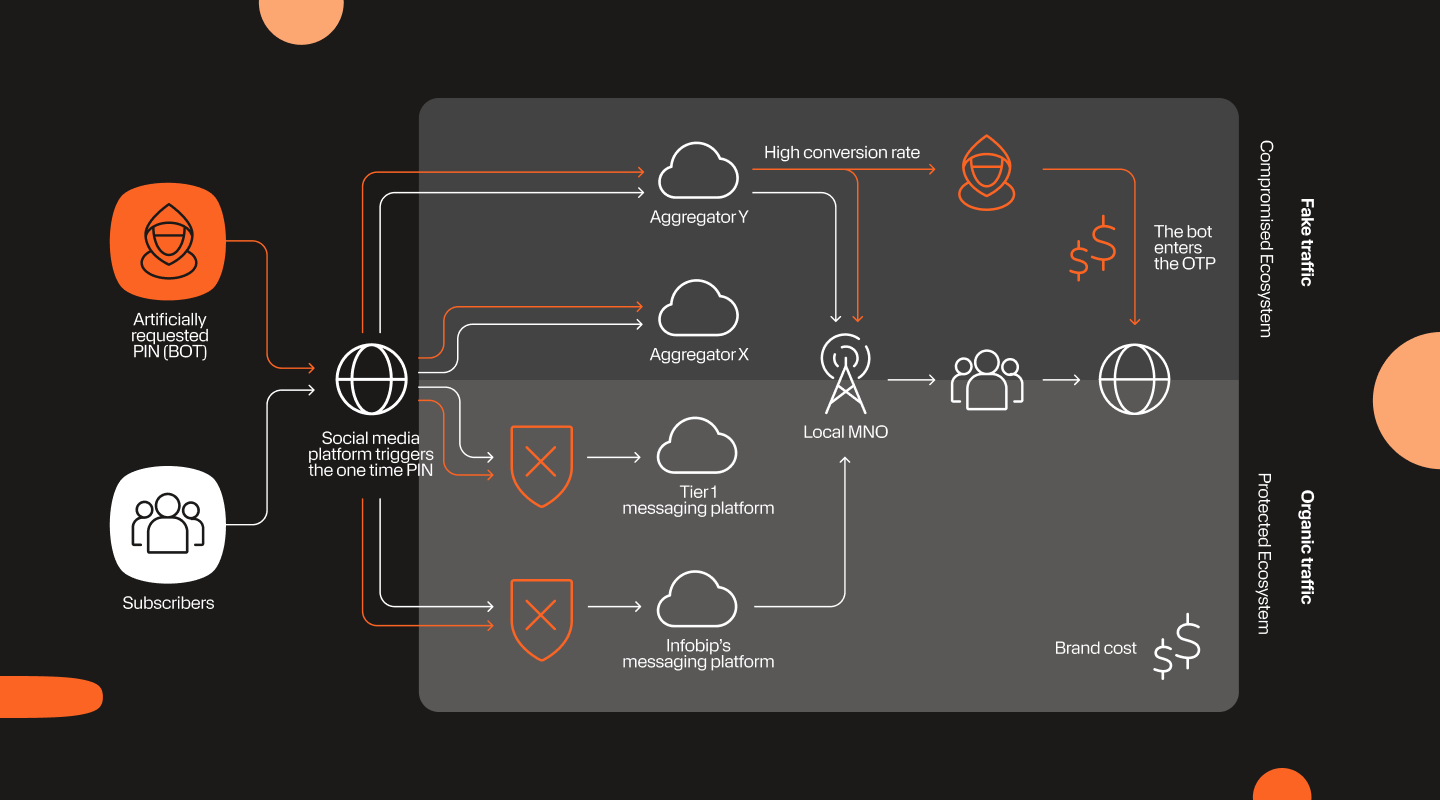
Diagram illustrating the flow of artificially requested PINs (bot) and subscribers through social media platforms triggering one-time PINs (OTP). Fake traffic enters a compromised ecosystem via aggregators Y and X, with aggregator Y having a high conversion rate. This traffic goes through the local MNO to subscribers and back to the internet, where a bot enters the OTP, leading to financial loss. Organic traffic flows through protected ecosystems via Tier 1 messaging platforms and Infobip’s messaging platform to the local MNO, reaching subscribers without interception. Brand costs are indicated at the bottom right. The right side of the diagram contrasts fake traffic (compromised ecosystem) from organic traffic (protected ecosystem). Icons represent bots, subscribers, social media, clouds for aggregators and messaging platforms, a shield for protection, and monetary symbols for costs.
Diagram illustrating the flow of artificially requested PINs and subscriber traffic through social media and messaging platforms, highlighting the differences between compromised and protected ecosystems.

Why do businesses and telcos fall into the trap of AIT?  

We can identify two sources for artificially generated traffic; both businesses and telcos can contribute to AIT. 

The first source is businesses seeking the cheapest rates, which often leads them to partner with lower-tier SMS aggregators

Businesses assume cheaper routes will save money, but low-cost aggregators often can’t break even after paying for the businesses’ traffic usage. To compensate, some generate artificial traffic, keeping the profit for themselves instead of sending it to the telco. 

When businesses choose low‑cost aggregators instead of reputable providers or direct telco connections, bots may be used to trigger fake OTP requests and inflate message volumes. 

In the second scenario, when telcos set high A2P SMS revenue targets, they may partner, intentionally or not, with aggregators that pump artificial traffic, increasing telco revenue but inflating business bills. 

Common messaging use cases for artificially inflated traffic 

The messaging use cases most often targeted by AIT are time-sensitive, user-initiated interactions, especially one-time passwords (OTPs). These include scenarios where a user receives an authentication code or a security alert that prompts them to take action, for example verifying an account or responding to suspicious activity. 

Why 2FA and OTPs are the main use case for AIT? Businesses generally use OTP to onboard new users, login users and reset passwords. With high SMS rates in some markets, bad actors can easily exploit these flows by automating OTP requests with bots, generating large volumes of fake traffic that result in significant financial loss. 

How to manage AIT?  

Some may see AIT as a revenue stream, but it harms the industry and raises trust and compliance concerns. To reduce the risk of AIT, telcos, communication providers and businesses should implement a comprehensive fraud prevention strategy. This includes monitoring suspicious activity, implementing authentication protocols, using advanced analytics to detect anomalies in traffic patterns, and new features for recognizing AIT.  

They should ensure that their systems are regularly updated with the latest security patches to protect against any potential vulnerabilities.  

What can businesses do to protect the ecosystem?  

As mentioned earlier the responsibility lies with all three organizations, including businesses. As a business it is important to responsibly choose the communication provider to help fight AIT. While cost is always a factor in choosing a communication provider or aggregator, it shouldn’t be the only one. What should businesses pay attention to? 

  • Cost: Higher messaging costs can indicate official routes are being used and reflect the expenses of direct connections. 
  • Validity of connections: Confirmation letters and references from telco providers improve the credibility of aggregators and communication providers. 
  • Conversion rate: Conversion rates offer transparency into how many messages are successfully delivered and matched to platform activity. 
  • Direct connections: The number of direct connections to telco operators reduces the risk of grey routes and limits the chances of fraud entering the communication channel. 
  • Testing: Businesses should test the connection firsthand before signing up with a provider. 

What can telco operators do to protect the ecosystem?  

Telcos or mobile network operators are one of the key stakeholders in the messaging ecosystem. Given their central role, telcos must take specific measures to keep the ecosystem secure, including: 

  • Realistic goal setting: When setting A2P SMS traffic goals or KPIs telcos must look at their organic growth and set achievable targets. 
  • Responsible partnering: Like businesses, telcos should choose communication partners carefully, prioritizing security and guidance, not just revenue. 

What can aggregators and communication providers do?  

Aggregators and communication providers can strengthen security by enforcing a zero-tolerance policy on AIT and offering guidance and tools to monitor and protect the messaging system. 

Recently, Infobip has been recognized as the number one provider among Established Leaders in the Artificially Inflated Traffic (AIT) Fraud Prevention market by Juniper Research.  

Infobip was ranked as the leading company because it offers a comprehensive solution to AIT fraud detection and prevention strategies, including its Infobip Signals solution, which detects AIT by monitoring phone number behavior, ranges, and types.  

Helping set Infobip aside from others in the market is its use of AI and machine learning (ML) algorithms to detect and block OTP traffic, ensuring automated protection for enterprises.   

Infobip has a comprehensive solution to combat AIT fraud, with a significant messaging client base to inform future AIT detection and prevention strategies. Infobip’s growth into markets in North America and Western Europe is critical when considering the high levels of AIT fraud in these regions, therefore making them key regions for AIT prevention solutions. Infobip offers several AIT prevention solutions, with Juniper Research highlighting the ‘Infobip Signals’ solution as a crucial tool in blocking AIT fraud, with differing levels of aggression depending on the enterprise’s needs. 

Georgia Allen

Research Analyst at Juniper Research 

Best practices for preventing AIT 

AIT can be difficult to detect and prevent, but there are some best practices and solutions that can help reduce the risk.  

1. Implementing firewalls 

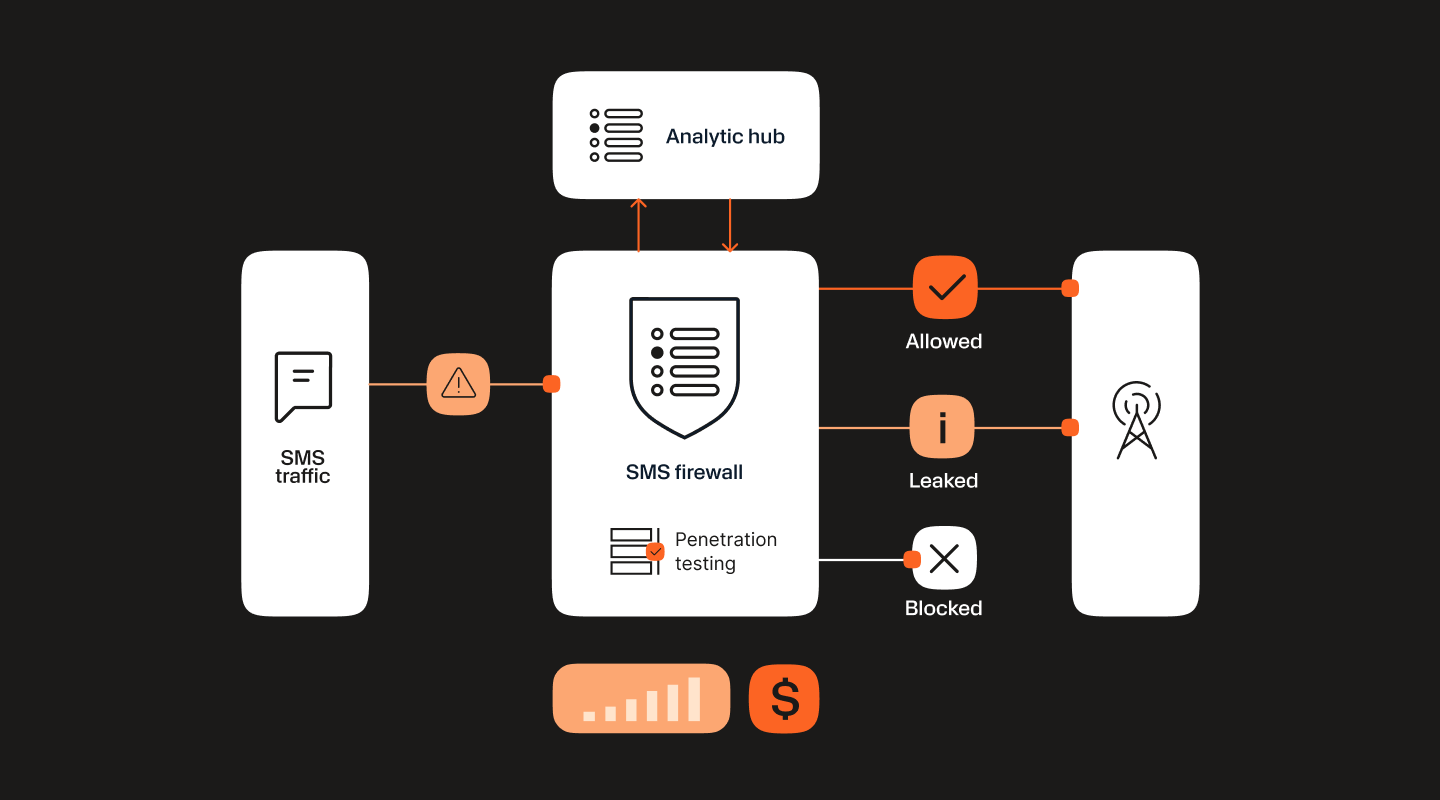
SMS firewalls can detect and block suspicious SMS traffic patterns, such as large volumes of messages sent from and to the same destination. This prevents fraudsters from inflating traffic with fake messages, keeping businesses safe. Additionally, firewalls can be used to detect and block messages containing malicious content, such as spam or phishing links.  

Diagram illustrating an SMS firewall system. SMS traffic enters from the left and is processed by the SMS firewall, which is linked to an analytic hub. After analysis, the SMS firewall classifies the traffic into three categories: Allowed (marked with a checkmark), Leaked (marked with an information icon), and Blocked (marked with an X). Allowed and Leaked traffic proceeds to a cell tower icon on the right, representing delivery. Penetration testing is indicated as part of the SMS firewall process, and icons for signal strength and cost are shown at the bottom. The overall flow represents monitoring and filtering of SMS traffic for security and performance.
Diagram showing the flow of SMS traffic through an SMS firewall.

2. Setting rate limits  

Rate limits are used to stop fraudulent behavior and prevent attackers from targeting applications. Limiting the number of messages sent to certain numbers or prefixes helps prevent fraud, especially in financial services where attackers may target sensitive data. Rate limits should be monitored using AI and machine learning so they can adjust dynamically in real time, making it harder for fraudsters to bypass. 

3. Detecting bots  

The prevention of bots from sending artificially generated traffic or requesting OTPs is important to protect the ecosystem. Tools like BotD or CAPTCHAs can help identify and block bots by adding small steps for users, such as verifying an email before signing up for 2FA. These minor steps frustrate automated scripts while keeping the process easy for real users. 

4. Delays between verification attempts 

Adding increasing delays between authentication retries helps slow down rapid requests. This prevents a single number from receiving too many messages at once and makes it easier to spot bot activity. Best practices include setting a maximum number of attempts and using back-off algorithms to space out each retry. 

5. Monitoring OTP conversion rates 

Tracking how often one-time codes (OTPs) are successfully used is key to protecting your system. Monitoring these conversion rates and setting alerts for unusual activity helps ensure OTPs are used correctly and flags potential fraud. 

6. Detecting fraud with Infobip Signals for businesses  

To protect businesses from AIT, consider using Infobip Signals. The solution is as simple as plug and play and requires no development effort.  

Here’s how Infobip Signals helps you:

  1. Proactive fraud detection: Continuous monitoring of message traffic using advanced volumetric and rate-based analytics enables early identification and prevention of suspicious or fraudulent activity. 
  2. Intelligent threat mitigation: Intelligence-led techniques such as analyzing risk profiles, contact ratios, and behavioral patterns protect from threats and reduces the risk of attacks.  
  3. Real-time automated protection: Machine learning and advanced algorithms detect and block AIT instantly, ensuring communications remain secure and customers’ trust is maintained. 
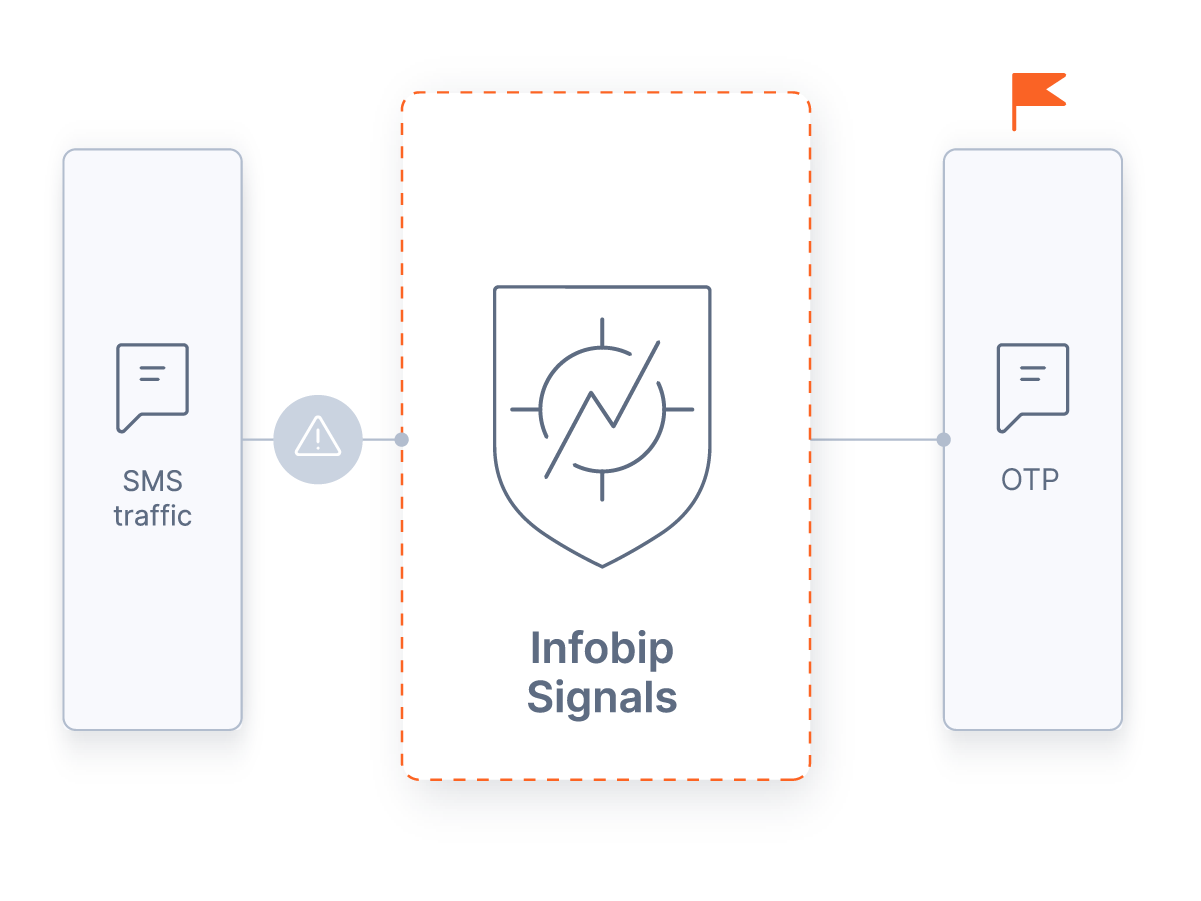
A visual showing Infobip Signals will check for patterns and flag numbers that are potentially fraudulent.
Infobip Signals will check for patterns and flag numbers that are potentially fraudulent.

At Next, we are committed to protecting our customers from fraud while continuing to provide the rich, responsive, and reliable communication that they expect from us. To benefit from the latest anti-fraud technology, we partnered with Infobip to empower us to be proactive in keeping both our customers and infrastructure safe from new and emerging threats. Their AI and machine-learning powered solution Infobip Signals, helped block approximately 175,000 artificial messages per month, enabling us to maintain the reliability and security of our SMS messaging by mitigating the risk of fraudulent activity. This means that our customers always receive updates on time, and we can continue to deliver the personalized promotional messaging that they expect.  

Raz Razaq

Domain Manager, Customer Contact Experience Technology, Next

Creating a safer messaging ecosystem together

Building a secure and trustworthy messaging ecosystem requires everyone to work together and adopt effective measures against AIT. If left unchecked, AIT can damage credibility and push businesses away from SMS, the channel with a 98% delivery rate

Businesses must understand the risks of choosing low-cost routes, telcos need to align their revenue expectations with real market growth, and aggregators must avoid compromising their reputation for short-term gains. Only through shared responsibility can the industry protect its users and restore confidence in A2P messaging. 

At Infobip, we work directly with telcos and businesses to secure the ecosystem. Our 800+ direct carrier connections and our advanced firewall solutions help you limit fraud and ensure no third parties benefit from artificial traffic. 

Take control of artificially inflated traffic and protect your users with advanced AI detection

Get the latest insights and tips to elevate your business

By subscribing, you consent to receive email marketing communications from INFOBIP. You have the right to withdraw your consent at any time using the unsubscribe link provided in all INFOBIP’s email communications. For more information please read our Privacy Notice

10 ways MVNOs improve customer service in telecom

MVNOs can now turn every customer interaction into an advantage. Infobip provides the tools to deliver fast, personalized, and consistent support across all channels. Explore how they’re bridging two worlds, from hold music to real-time connection. 

Sandra Posavac Content Marketing Specialist
Skip to table of contents

Imagine two versions of the same telecom company. In one world, customer frustration brews inside endless phone calls, long hold times, and disjointed channels. Agents toggle between systems while customers repeat their issues for the third time, reflecting poor customer service in telecom. 

In the other world, the same Mobile Virtual Network Operators (MVNOs) uses automation, artificial intelligence (AI), and customer data to deliver real-time support across every channel. Queries resolve quickly, and customer satisfaction scores climb. 

Both exist in today’s telecom industry. The difference lies in how each company chooses to transform its customer service. Some MVNOs struggle, while others thrive. Let’s explore two realities of customer service in telecom and the path to building the one your customers prefer. 

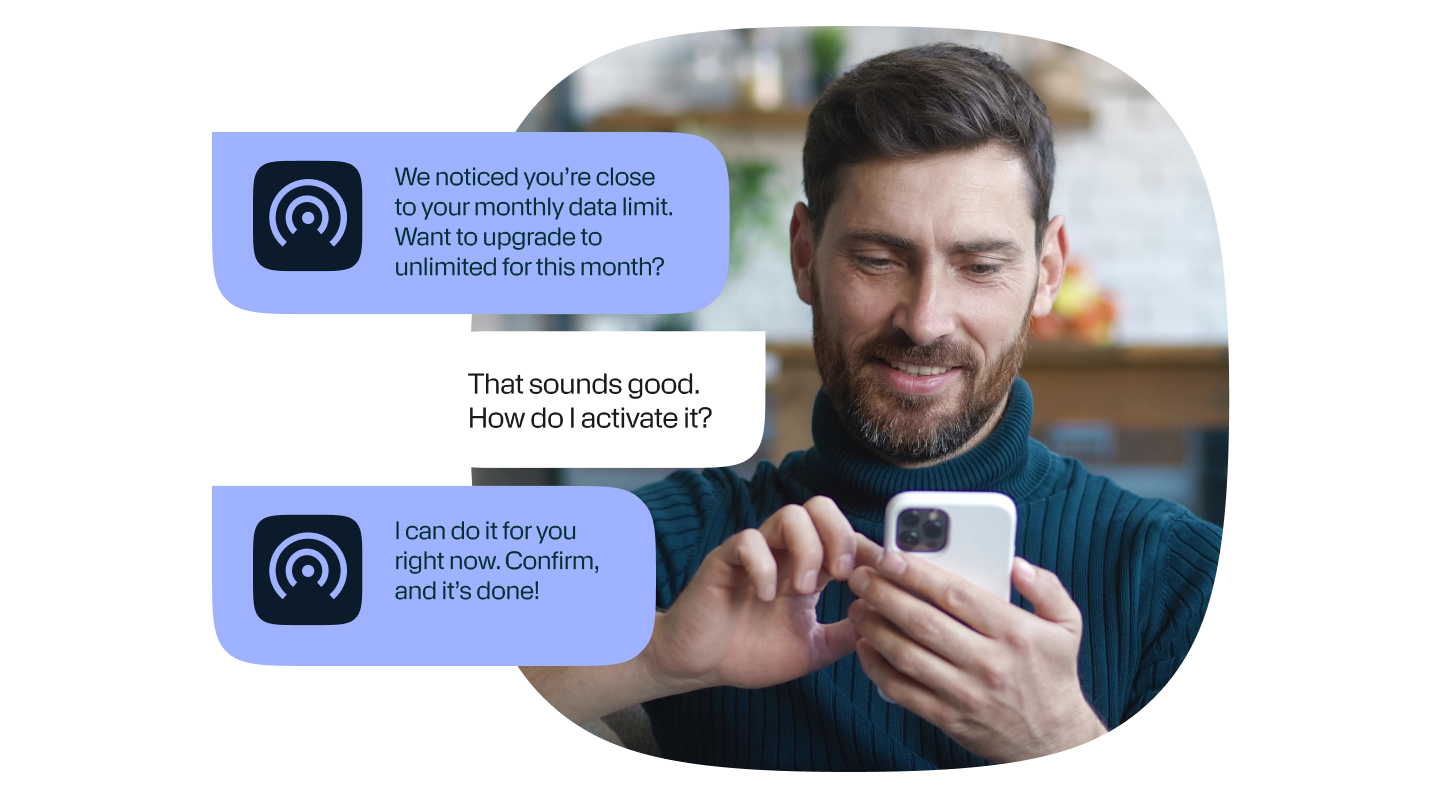
A man is interacting with a brand on the smartphone. Text message bubbles overlay the image: the first blue bubble says, "We noticed you’re close to your monthly data limit. Want to upgrade to unlimited for this month?" The white reply bubble says, "That sounds good. How do I activate it?" The second blue bubble says, "I can do it for you right now. Confirm, and it’s done!"

The shift driving telecom customer service

MVNOs and other telecommunication companies are no longer competing on coverage or cost alone. MVNO market is expected to grow from 73.47 billion USD in 2024 to 132.02 billion USD by 2032. This means it will expand at an average rate of 7.6% per year, thanks to new technologies, remote work, and data-heavy lifestyles. While connectivity has become a commodity, excellent customer care in telecom is now what sets companies apart. 

  • 80% of global telco consumers say service quality determines whether they’ll do business with a company. 
  • Reducing customer support wait times can improve customer satisfaction by up to 30%. 

In short, price gets you attention, but service earns loyalty. 

The modern telecom customer expects convenience, personalization, and real-time assistance. If your customer care strategy still relies on outdated systems, the multiverse is moving on without you. 

10 strategies MVNOs use to improve customer service in telecom

Here are practical ways MVNOs can improve customer service and how Infobip partners with them to make each one real:

1. From waiting on hold to helping in real time

Customers no longer tolerate long wait times. They expect quick, easy answers the moment they reach out. 

Legacy system: Customers call, navigate a complex IVR system, wait, and repeat their details. Agents scramble between systems, increasing the risk of errors. The result is frustration, abandoned calls, and lower customer satisfaction scores. 

New world: AI-powered self-service and chatbots handle simple requests instantly; balance checks, SIM cards activations, plan changes. Complex customer issues are routed to human agents with full context, which reduces time to resolution. MVNOs can also offer video calling as a personal, face-to-face option for customers who need more guidance. 

Why it works: Real-time responses increase customer satisfaction, reduce frustration, and allow telecom companies to allocate human resources to where they make the biggest impact and that are high-value interactions. 

With call deflection you move phone calls to digital channels, where chatbots handle simple issues instantly. When an agent takes over, AI-generated summaries provide full context so they can focus on resolving the customer’s problem faster and with a more personal touch.

2. From generic service to personalized care 

People don’t want to feel like just another ticket. Personalized support makes every interaction feel seen and valued. 

Legacy system: Scripts and standard responses treat every customer the same. 

New world: With insights into purchase history, customer behaviors, and service preferences, MVNO agents can offer tailored solutions and recommendations, such as a better data plan or a relevant bundle. 

Why it works: Personalization humanizes telecom customer service, creating stronger bonds and improving customer satisfaction scores. Customers feel valued rather than processed, which directly improves retention and customer relationships. 

Customer data platform and customer engagement solution help MVNOs deliver personalized add-ons, like data boosts, roaming packs, or streaming bundles, at the right time and through the customer’s preferred channel.

CUSTOMER STORY

How Virgin Mobile used RCS to improve customer experience

Virgin Mobile (now Virgin Media O2) increased phone upgrades and engagement using rich, interactive RCS messages through our platform. The RCS message gave customers the option to connect directly with a customer service assistant for real-time support and guidance. 

By sending personalized, visually rich campaigns through customers’ native messaging inboxes, the brand achieved a 93% delivery rate and a 60% seen rate. 

3. From fragmented tools to one connected platform 

When agents have to jump between systems, service slows down. A single, connected view of the customer changes everything. 

Legacy system: Agents toggle between multiple systems like CRM, billing, chat apps, losing context and increasing chances of errors. 

New world: A single, data driven platform centralizes all communication channels and customer data. Agents see conversation history, account details, and previous resolutions immediately. 

Why it works: Centralizing customer data improves response times, reduces repeat information requests, and increases service quality. It also empowers teams to handle more interactions without increasing staffing costs, making operations more cost effective. 

Our cloud contact center gives agents one workspace for all channels and customer data, with native integrations and open APIs to your CRM or BSS. AI creates quick summaries of calls and chats, so when an agent takes over, they immediately know the full context, avoiding repeated questions and saving time.

4. From phone-only to omnichannel engagement 

Support shouldn’t stop at phone calls. Customers want to message, chat, or text and pick up right where they left off. 

Legacy system: Customer support relies solely on phone calls, with rigid operating hours. 

New world: Customers interact through their preferred channels like WhatsApp, SMS, social media, or web chat, with smooth transitions between channels. Based on our Messaging Trends Report 2025, 80% of brands claim to have an omnichannel strategy. 

Why it works: Omnichannel service reduces friction, improves customer satisfaction, and ensures consistent experiences across touchpoints, turning customer care into a competitive differentiator for MVNOs. 

As a global MVNO partner, Infobip provides a wide portfolio of channels through a single platform. One SLA, one vendor, unified routing.

A smartphone screen showing a chat conversation with "MyTelco." The user asks, "How much internet data do I have left?" MyTelco replies, "You have 256MB remaining until the end of the month. Do you want to activate 2GB additionally for 5$?" The user responds, "Yes." MyTelco then says, "Great, now you have 2.3GB of Internet data left. Is there anything else I can do for you?"

5. From static scripts to conversational AI 

Nobody likes robotic responses. Conversational AI makes every interaction feel more natural and a lot more helpful. 

Legacy system: Agents follow rigid scripts that don’t reflect real-life customer needs. 

New world: AI-powered conversational platforms interpret intent, tone, and context to adapt responses automatically. Bots handle common questions, and escalate complex requests to humans with full context, eliminating repetition and frustration. 

Why it works: Conversational AI increases efficiency, reduces customer frustration, and ensures 24/7 availability, delivering a consistent, high-quality telecom service. 

Chatbot building platform delivers advanced NLP capabilities, multilingual support, sentiment detection, and smart handoffs to cloud contact center. AI-powered assistant drafts replies, surfaces knowledge, and keeps responses consistent with your brand.

6.  From scattered data to informed business decisions 

MVNOs have tons of data, but the real win comes when they use it to make smarter, faster decisions that improve service. 

Legacy system: Telecom companies collect vast amounts of data that often goes unused. 

New world: MVNOs apply data analytics and AI to identify patterns in usage, service issues, and churn risk. These data-driven insights help predict problems before they happen, such as detecting network congestion or identifying customers likely to leave. 

Why it works: Turning raw data into real-time insights allows MVNOs to anticipate customer needs, improve service quality, and proactively reduce customer frustration.  

By centralizing data in a customer data platform within CXOP, MVNOs gain a single source of truth that converts raw signals into insights and next-best actions. Performance dashboards then connect CSAT, time to resolution, and conversions to quantify service-driven revenue.

CUSTOMER STORY

How ComparTfon used data for better customer support

Using WhatsApp Business along with our customer engagement solution and cloud contact center, ComparTfon offered customers real-time guidance throughout their online shopping journey. Agents could see where each customer was in the purchase process, use data-driven insights to respond quickly to questions, and proactively prevent issues. 

7. From “call back later” to instant verification

Verification shouldn’t take days. Customers expect it to happen instantly, securely, and in the same conversation. 

Legacy system: Customers upload documents, wait days for validation, and call multiple times for updates. 

New world: Documents like IDs and SIM registrations are processed in seconds. Customers can complete verification within the same session, reducing friction. 

Why it works: Automation speeds up processes while enhancing security and accuracy. Quick verification builds trust, reduces phone calls, and improves the overall customer experience. 

Infobip enables secure document capture on channels like WhatsApp and web, provides one-time passwords and two-factor authentication for step-up verification, and delivers real-time status notifications. Integrations with your KYC and vendor systems keep flows compliant and smooth.

8. From reactive problem-solving to predictive care 

Great service is about spotting problems early and preventing them before they start. 

Legacy system: Agents wait for complaints to arrive. 

New world: Predictive analytics and AI forecast potential issues, like network congestion, plan overages, or recurring billing errors, before they affect the customer. Agents can reach out proactively, providing solutions before frustration escalates. 

Why it works: Predictive care transforms customer service from reactive to proactive. By reducing incidents of dissatisfaction, MVNOs improve customer satisfaction scores and strengthen brand loyalty. 

Use our customer engagement solution to trigger proactive notifications (usage caps, roaming offers, payment reminders) on preferred channels. Combine with AI to prioritize high-impact outreach in real time.

9. From one-size-fits-all to community-driven innovation 

The best ideas often come from the people using your service. Listening turns feedback into real growth opportunities. 

Legacy system: Products and services are designed in isolation from the customer. 

New world: MVNOs engage customers as co-creators. Feedback loops, surveys, and interaction data inform product development. This approach allows the creation of tailored bundles for niche audiences or specific demographics. 

Why it works: By understanding usage patterns and preferences, telecom companies innovate with relevance. Customers feel heard, and businesses identify cross-sell opportunities while improving service quality and satisfaction. 

Run NPS or CSAT surveys over channels like SMS, WhatsApp or email, manage loyalty program messaging, and localize flows. Feed insights back into customer data platform to refine segments and journeys that improve customer experience.

10. From doing enough to continuous experimentation

In telecom industry, standing still means falling behind. The most successful MVNOs test, learn, and improve every single day. 

Legacy system: Telecom service is considered complete once it’s functional. 

New world: MVNOs constantly test emerging technologies like AI, chatbots, augmented reality troubleshooting, or advanced analytics, dedicating resources to innovation while balancing daily operations. 

Why it works: Continuous experimentation ensures the company stays ahead of industry trends, delivers superior service delivery, and enhances customer experience. It’s how telecom customer service evolves from a cost center into a cost effective growth driver. 

No-code builders, sandboxes, and A/B testing in our customer engagement solution and chatbot building platform let you ship improvements weekly. Global reach, security, compliance, and fraud prevention give you a safe base to innovate at speed.

The Infobip advantage: Supporting MVNOs in driving growth through CX 

MVNOs have the agility to set a new standard for telecom customer experiences: 

  • Deliver consistent, real-time customer interactions 
  • Reduce churn while increasing customer lifetime value 
  • Transform contact centers into intelligent engagement hubs that drive loyalty and efficiency 
  • Turn the entire customer journey into a scalable profit center by monetizing every interaction through personalized upsells, cross-sells, and value-added services 

Infobip is the strategic partner behind that transformation. Our CXOP platform integrates automation, AI, and human expertise in one scalable solution for telecommunication companies.  

Beyond resolving issues faster and delivering personalized care at scale, MVNOs use our platform to expand their product offerings, co-create tailored CX solutions, and generate new CPaaS revenue streams through direct sales or marketplaces. This approach turns every customer touchpoint into an opportunity for sustainable business growth and increased profitability. 

Grow your MVNO business through better customer service 

Your customers expect more – we help you deliver it. 

Read more:

Get the latest insights and tips to elevate your business

By subscribing, you consent to receive email marketing communications from INFOBIP. You have the right to withdraw your consent at any time using the unsubscribe link provided in all INFOBIP’s email communications. For more information please read our Privacy Notice

From fail to fix: Telco to techco CX lessons for 2025 

Explore how My Telco, a fictional telecom operator, navigates its biggest customer experience stumbles; from chaotic support to missed upsell opportunities. Drawing lessons applicable to real-world telco operators, this blog shows how to turn these failures into long-term competitive advantages, guiding the journey from everyday telco operations to a full techco transformation.   

Sandra Posavac Content Marketing Specialist
Skip to table of contents

Traditional telcos pushing to transform into techcos face a completely different playing field. Network operations and connectivity are just the starting point, what comes next defines the journey. Customers expect their telecom operator to act less like a utility and more like modern tech companies: data-driven, real-time, and truly customer centric. 

A techco isn’t defined only by 5G, cloud, or AI. It’s a business model shift where networking infrastructure, digital channels, and customer service come together in a single ecosystem designed to deliver excellent telco customer experiences at every touchpoint.

For telcos still relying on old playbooks, the gap between expectation and delivery keeps widening, and telco operations need to be optimized for long-term success, including operating models and capital expenditure planning. 

Prefer listening to podcasts? Hit play and listen to the AI-generated audio version of this blog for quick CX lessons on the telco-to-techco journey.

A day at My Telco: Where it all goes wrong (but not for too long)

Meet My Telco, a fictional provider navigating the rocky road from telco to techco. On paper, My Telco has everything: infrastructure, reach, loyal subscribers. But in practice, cracks are everywhere.  

Their call centers are overwhelmed, campaigns miss the mark, billing confuses more than it clarifies, and field visits waste opportunities for growth. Each failure is a reminder that being a telco isn’t enough anymore; the future belongs to techcos. 

But what does that future look like? In a true techco: 

  • Customers don’t wait, on hold, they get instant answers from AI-powered assistants, with a human-in-the-loop always available when needed. 
  • Bills aren’t puzzles; they’re crystal clear, interactive, and resolved in real time.  
  • Marketing isn’t a spam blast; it’s a personalized conversation that feels almost human.  
  • A technician’s visit isn’t just about fixing a router; it’s a chance to unlock new digital services and strengthen loyalty.  

That’s the techco promise: every interaction is an opportunity to improve customers’ experiences. 

To see how these challenges play out in real life, let’s follow the key players at My Telco as they navigate day-to-day customer experience obstacles:

  • Mark, Head of Customer Experience – worried about long queues and rising churn. 
  • Lina, Marketing Director – struggles with ineffective campaigns. 
  • Julia, CTO – sees missed revenue opportunities. 
  • Natalie, Customer Service Manager – faces frustrated agents and customers. 
  • Alex, Operations Manager for Equipment and Logistics – overwhelmed by equipment returns and long store queues, leading to frustrated existing customers. 

Each one faces a CX “fail” that telecom operators everywhere will recognize.  

1. The call that never ends: From broken support to 360° assistance

The fail: 

Natalie, My Telco’s Customer Service Manager, is drowning in complaints. Customers are stuck in endless IVR loops, waiting 30+ minutes to reach an agent. Support channels don’t communicate in real-time, as web chat has no record of what happened on the phone line. Agents themselves feel powerless, lacking tools to resolve queries quickly.  

This type of failure is especially painful for providers where internet connectivity outages flood support lines. 

The fallout: 

  • Rising customer complaints (with public brand shaming on social media) 
  • High churn 
  • Overworked agents and internal chaos 

The fix – CX rescue: 

  • Omnichannel cloud contact center solution: Connects multiple channels, for example SMS, WhatsApp, in-app chat, and Voice, in a single interface, enabling a connected and consistent experience across all touchpoints.  
  • 360° customer view: Complete overview of customer data across all touchpoints for faster, smarter customer service. Agents also benefit from AI Assistant support, with instant summaries of past interactions and suggested replies. This shortens resolution time for customers while making agents more confident and comfortable in their roles, helping to reduce turnover. 
  • Agentic AI escalation: Agentic AI refers to AI systems that detect urgency, frustration, and intent for priority routing using generative AI. These systems can proactively take actions, such as prioritizing tickets, suggesting next steps, or drafting responses, while autonomously orchestrating workflows and collaborating with human support to deliver faster, more human-like customer experiences. 
  • Proactive follow-ups via customer engagement solution: Send timely updates or order status to keep customers engaged. E.g. “Ticket created: 135068. Stay in the loop while we handle it. “ 

Takeaway: Don’t let disconnected support define your brand. Customers judge telecom operators by the speed and clarity of problem resolution, and now, when switching takes only a few clicks, operators are especially wary of losing customers. By unifying channels and carrying context across interactions, telcos reduce churn but also turn customer service into a competitive advantage. Prioritizing friction-free escalation, proactive updates, and AI-driven routing ensures that customer frustration doesn’t escalate into lost loyalty. 

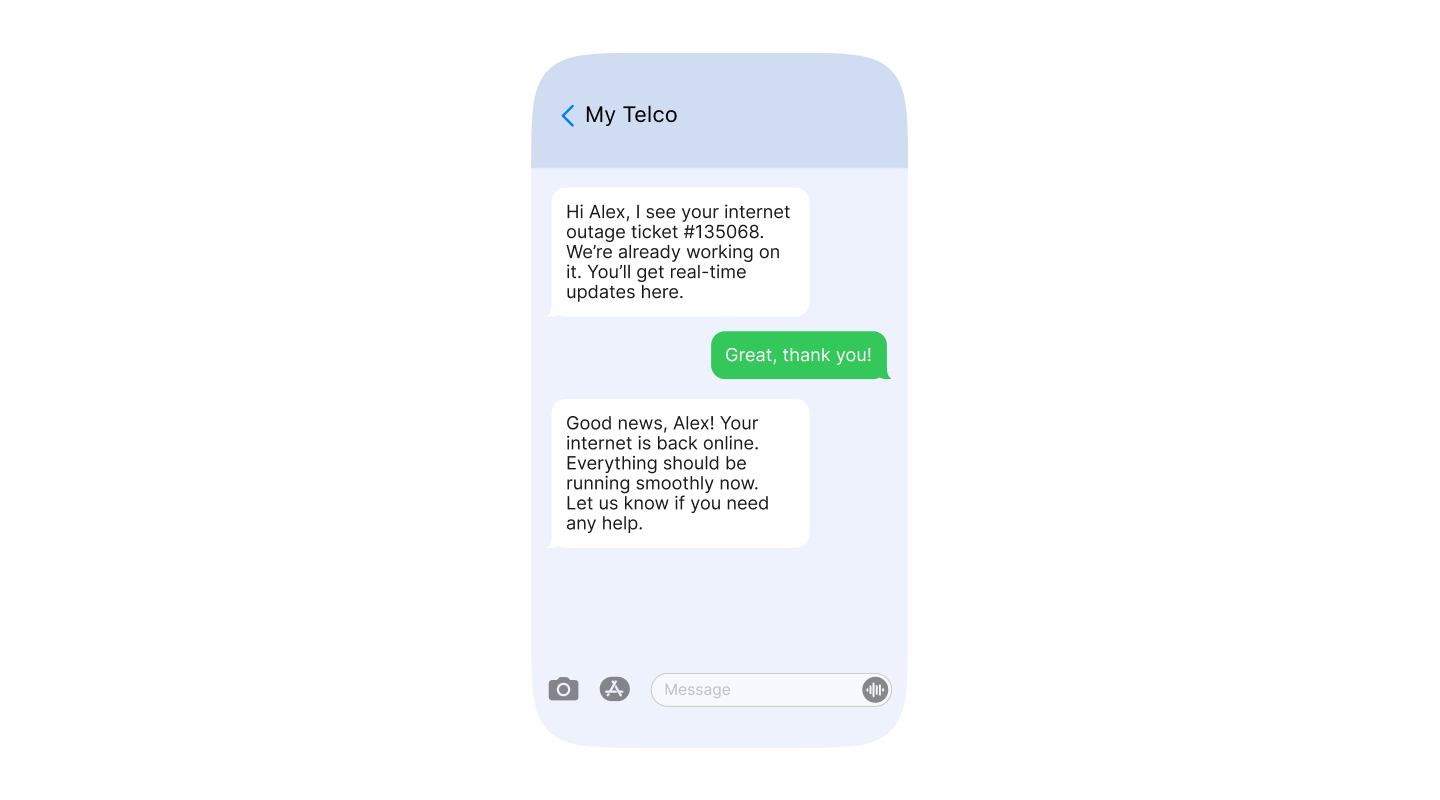
A smartphone screen shows a text conversation between "My Telco" and a customer named Alex. The first message from My Telco says, "Hi Alex, I see your internet outage ticket #135068. We’re already working on it. You’ll get real-time updates here." Alex replies, "Great, thank you!" My Telco responds with, "Good news, Alex! Your internet is back online. Everything should be running smoothly now. Let us know if you need any help."

2. Promo gone wrong: From untargeted mass messaging to smart personalization 

The fail: 

Lina, Marketing Director at My Telco, is excited about a new promo campaign. She blasts the entire subscriber base with a generic, untargeted offer. Customers feel spammed, not understood. 

This failure is especially common where operators rely heavily on promotions to drive average revenue per users (ARPU) but lack the personalization engines of larger operators. 

The fallout: 

  • Thousands of opt-outs shrink Lina’s future reach 
  • Missed upsell opportunities lead to lower campaign ROI 
  • Declining engagement damages brand trust 
  • Trigger-based personalization: Offers delivered based on user behavior 
  • Omnichannel delivery: Coordinated SMS, email, WhatsApp, push notifications 
  • Analytics-driven optimization: Next-best-offer insights tailored per customer 
     

Takeaway: Mass marketing without personalization is a quick path to opt-outs. Customers expect offers that are timely, relevant, and delivered through their preferred channel. By switching from generic campaigns to omnichannel, behavior-triggered journeys, telecom operators can maximize campaign ROI. Enriching messages with formats like RCS or carousels builds trust, drives customer engagement, and strengthens the brand’s value. 

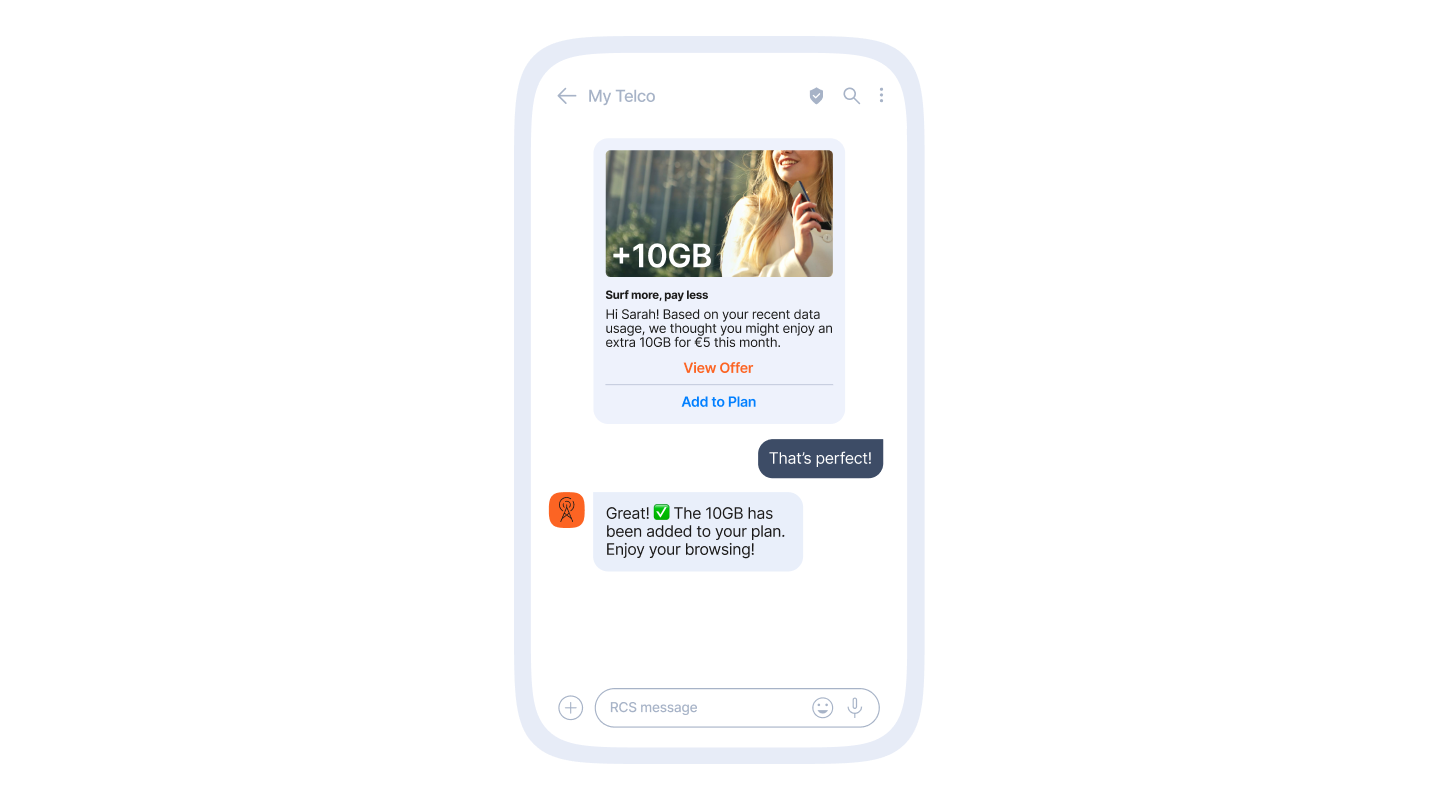
A smartphone screen displays an RCS message conversation with "My Telco." The first message offers a data plan upgrade: "+10GB Surf more, pay less. Hi Sarah! Based on your recent data usage, we thought you might enjoy an extra 10GB for €5 this month." with options to "View Offer" in orange and "Add to Plan" in blue. The user taps "Add to Plan" and replies, "That's perfect!" My Telco responds with, "Great! ✅ The 10GB has been added to your plan. Enjoy your browsing!"

Note: Conversational experience orchestration platforms (CXOP), like Infobip, together with a Customer Data Platform (CDP), help you connect channels, segment audiences, automate campaign flows, and deliver behavior-based offers in real time, making every message feel personal, not promotional. 

3. Billing blackout: AI chatbots simplify customer portals 

The fail: 

Mark, Head of CX, is struggling with billing complaints. Customers find their invoices confusing, and the self-service app nearly impossible to navigate. Support lines are clogged with people asking about charges or failed payments.  

The fallout: 

  • App abandonment and low digital adoption 
  • Higher operational costs from repetitive billing queries 
  • Customer frustration that drives churn 

The fix – AI chatbots: 

  • Instant billing assistance: PDF bills, explanations, and queries resolved immediately 
  • Smooth escalation: Agents handle complex issues without customers repeating themselves 
  • Omnichannel coverage: Available across web, app, WhatsApp, and other channels 

Takeaway: Clarity and speed in billing can make or break customer trust. Confusing invoices and slow support lead to app abandonment and unnecessary call center overload. With AI-powered chatbots and conversational interfaces, telecom operators can automate repetitive billing queries, provide instant transparency, and ensure smooth escalation when needed. The result: fewer billing issues, lower operational costs, and stronger confidence in the brand’s reliability. 

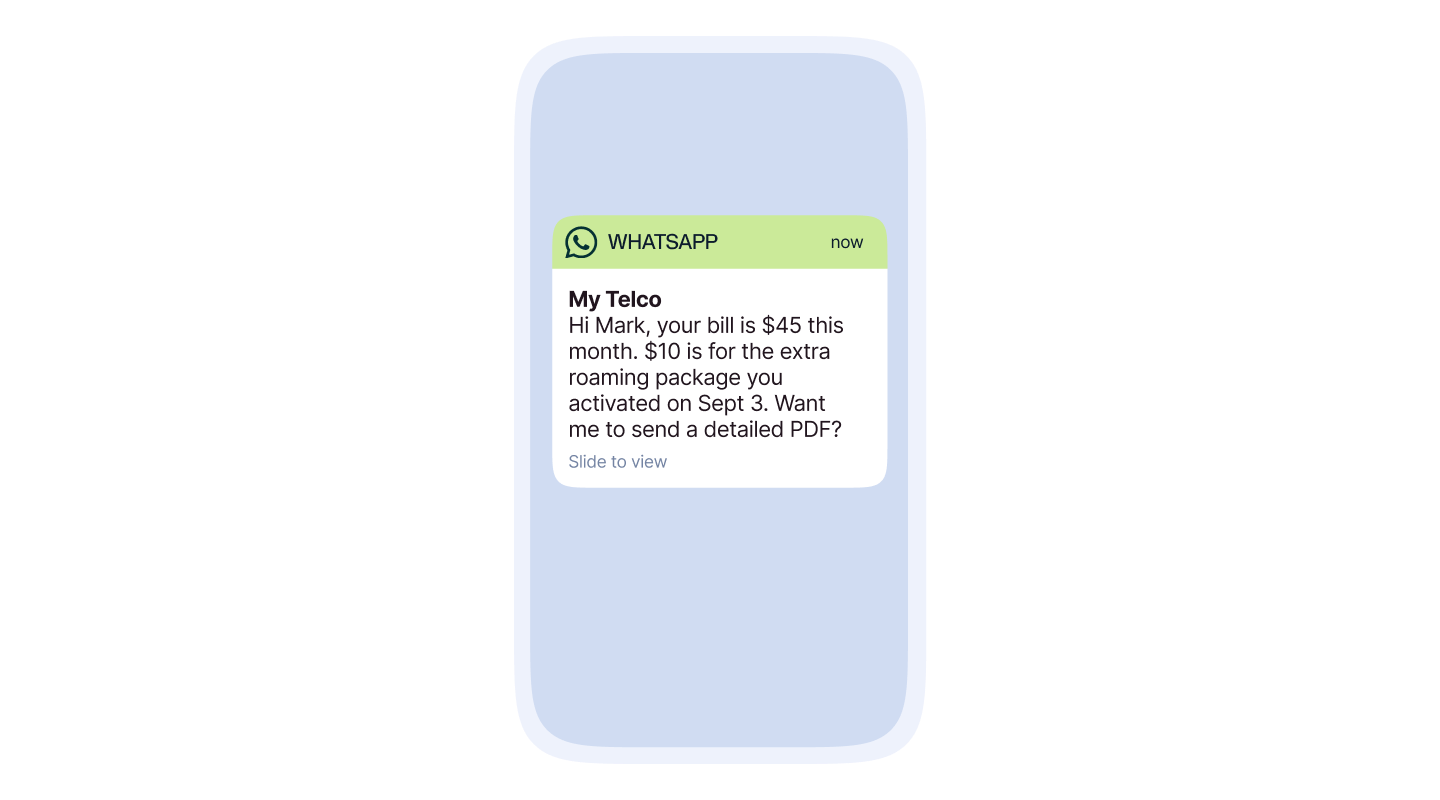
A smartphone screen displays a WhatsApp message from "My Telco" that reads: "Hi Mark, your bill is $45 this month. $10 is for the extra roaming package you activated on Sept 3. Want me to send a detailed PDF?"

Note: The global AI in telecommunication market was valued at USD 2.7 billion in 2024 and it is projected to grow at a CAGR of approximately 32.6% between 2025 and 2034, reaching roughly 45 billion USD.

4. The missed opportunity at the doorstep: Field service monetization 

The fail:

Julia, CTO at My Telco, sees the gaps: technicians visit homes to fix issues or install equipment, but the opportunity ends there. Manual processes delay activations, upsell chances slip away, and back-office teams miss out on collecting valuable household data.

The fallout: 

  • Lost revenue from missed upsell/cross-sell moments 
  • Delayed activations frustrate customers 
  • Field teams feel like cost centers, not growth drivers 
  • AI-powered conversational tools integrated into OSS/BSS systems, turning technicians into customer-centric brand ambassadors 
  • On-the-spot activation of digital services via RCS, WhatsApp, Viber, or Apple Messages 
  • Context-aware offers triggered during visits at peak trust moments 
  • Real-time eligibility checks ensure smooth onboarding without paperwork 

Takeaway: Field service shouldn’t stop at problem-solving, it should open new revenue streams. Technician visits are high-trust moments, yet most telecom operators fail to monetize them. By equipping field teams with AI-driven tools for instant activations, upsells, and contextual offers, operators can boost ARPU and cut repeat visits. Every on-site interaction becomes a growth opportunity. 

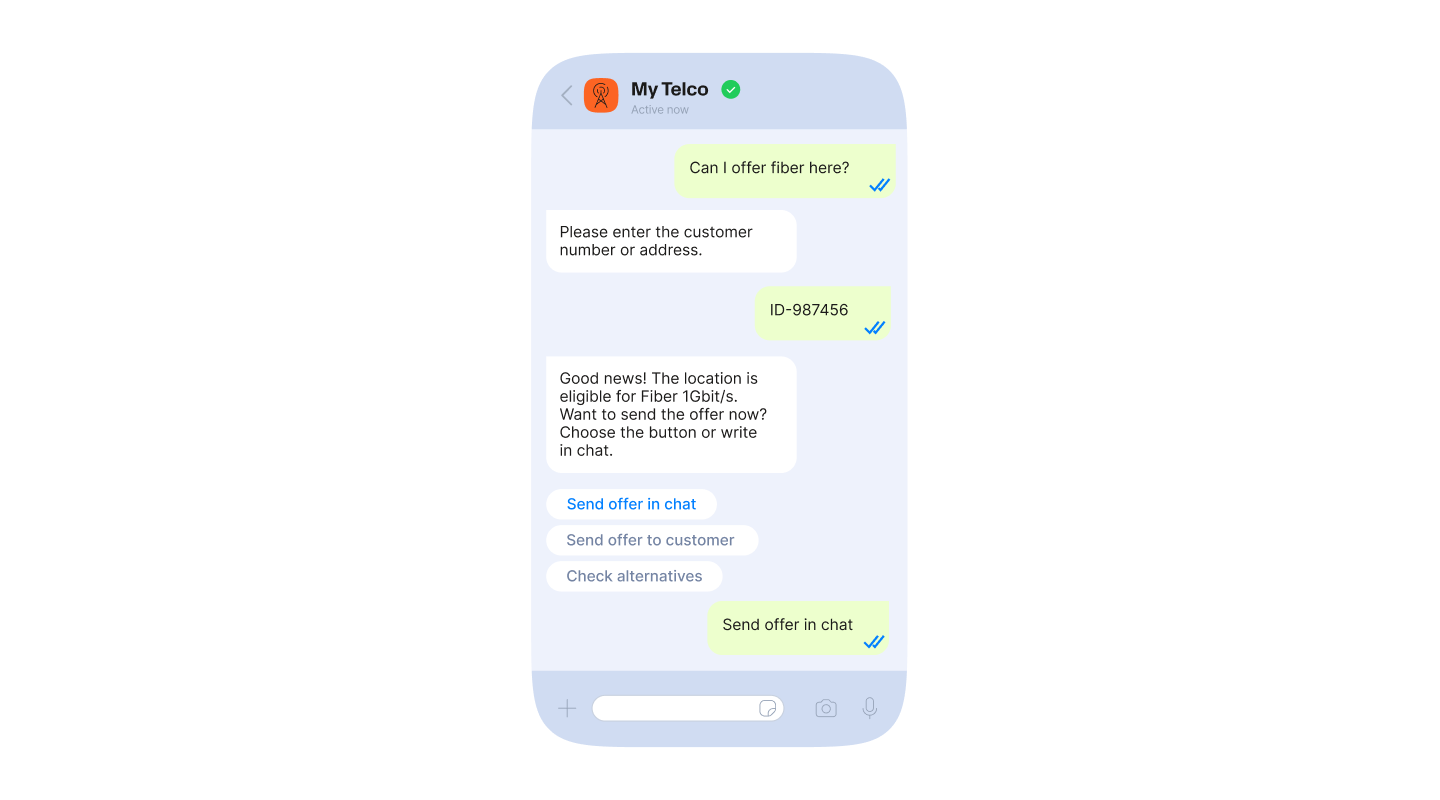
A smartphone screen shows a chat conversation with My Telco AI-powered chat. The technician asks, "Can I offer fiber here?" and is prompted to enter the customer number or address. The technician replies with "ID-987456." My Telco responds, "Good news! The location is eligible for Fiber 1Gbit/s. Want to send the offer now? Choose the button or write in chat," followed by three options: "Send offer in chat," "Send offer to customer," and "Check alternatives." The technician selects "Send offer in chat."

5. The equipment queue crisis: AI-powered returns and upgrades 

The fail: 

Alex, Operations Manager for Equipment and Logistics at My Telco, is overwhelmed by long queues and stressed store staff. Customers returning equipment or seeking upgrades face lengthy waits, causing frustration and lost sales. Prospective customers balk at the delays and often abandon their upgrade plans altogether. Manual handling of returns and provisioning adds complexity, slows the process, and overburdens physical stores. 

The fallout: 

  • Crowded stores with stressed employees and unhappy customers 
  • Lost revenue from dropped upgrade opportunities 
  • Increased operational costs from inefficient manual processes 
  • Damage to brand reputation due to poor in-store experiences 

The fix – AI-powered self-service for equipment returns and provisioning: 

  • AI chatbots integrated into digital channels (web chat, mobile app) guide customers through equipment returns and upgrade provisioning remotely. Customers can scan equipment barcodes or input ID numbers, allowing the chatbot to verify and process returns instantly. They also provide clear instructions, including return drop-off options and addresses, reducing confusion and follow-up calls. 
  • Voice AI assistants handle similar tasks via phone or voice-enabled devices, offering hands-free support and answering customer queries in real time. Routine tasks are automated, so live agents only need to review exceptions and finalize approvals. 

Takeaway: Physical stores shouldn’t be bottlenecks in the customer journey. By using AI-driven digital self-service for equipment returns and upgrade provisioning, telecom operators can reduce queue times, improve customer satisfaction, and recover lost revenue opportunities. Automating routine processes empowers agents to focus on complex cases while delivering frictionless experiences that improve brand loyalty and operational efficiency. 

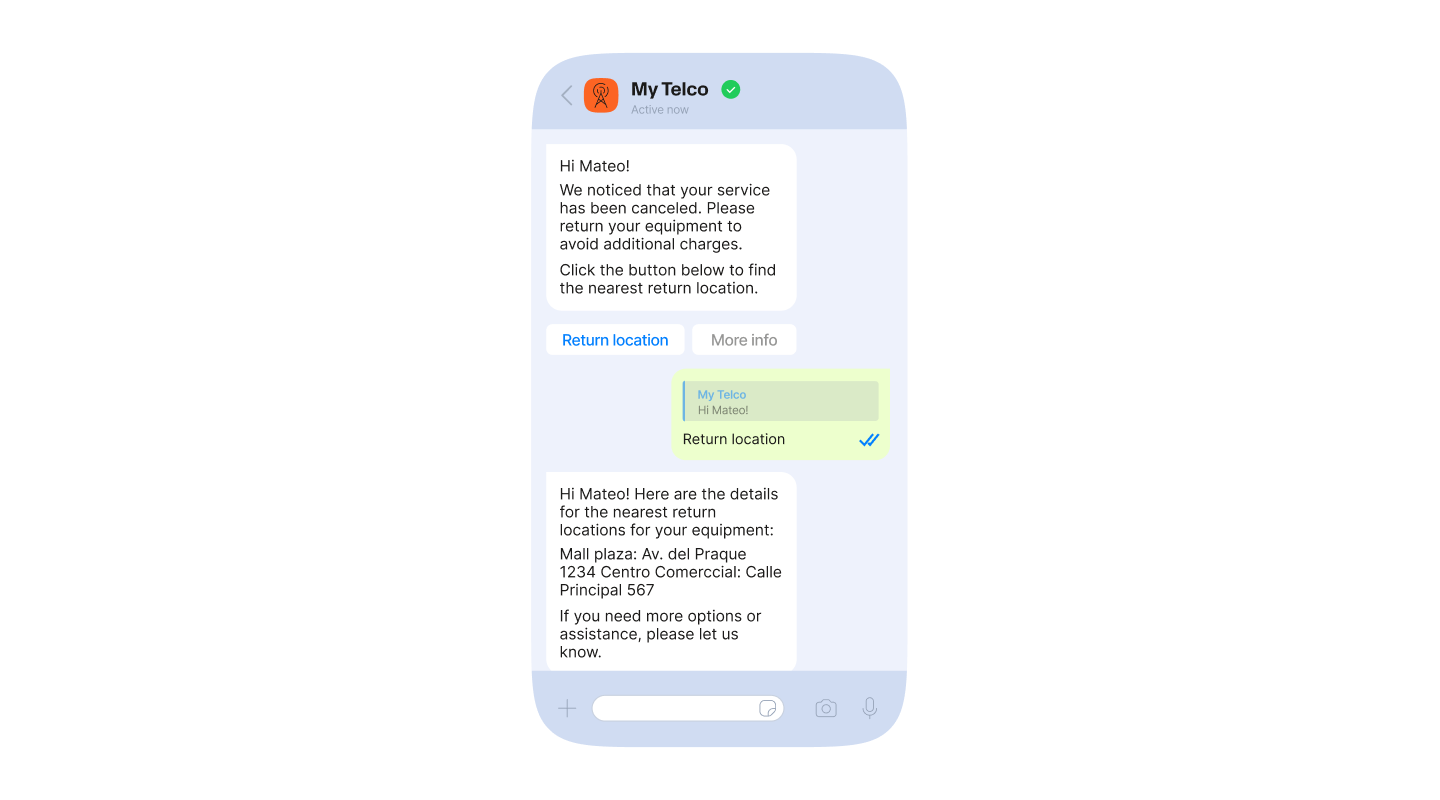
A smartphone screen shows a chat conversation with "My Telco." The messages read: "My Telco: Hi Mateo! We noticed that your service has been canceled. Please return your equipment to avoid additional charges. Click the button below to find the nearest return location." Buttons below say: "Return location" and "More info." Mateo taps: "Return location." My Telco responds: "Hi Mateo! Here are the details for the nearest return locations for your equipment: Mall plaza: Av. del Praque 1234, Centro Comercial: Calle Principal 567. If you need more options or assistance, please let us know."

What My Telco could learn from real-world techco leaders 

Real-world examples show how telcos that embrace a techco mindset are already fixing CX failures and setting new industry benchmarks.

Three global leaders, Deutsche Telekom, Hrvatski Telekom, and Jazz demonstrate how the right mix of channels, automation, and conversational experiences can turn pain points into growth opportunities. 

1. Deutsche Telekom: Richer engagement with RCS 

Telekom Deutschland wanted to move beyond SMS campaigns and deliver something more engaging. They rolled out an omnichannel campaign centered around RCS Business Messaging for a Spotify Premium promotion. 

The campaign featured branded RCS messages with rich media carousels, CTA buttons, and Telekom Deutschland colors and logos. To guide customers from awareness to conversion, Moments automated the engagement flows and sent messages at the optimal times, while agents used Conversations to access real-time interaction insights and assist customers directly from the RCS messages.  

Results:

  • 2x higher engagement vs SMS  
  • 26% higher open rate  
  • 120% higher conversion 

Lesson for My Telco: In 2025, it’s not about replacing SMS, but raising the bar. Customers expect rich, branded, and interactive experiences. By combining RCS with omnichannel orchestration, telecom operators can increase their digital transformation, turning simple messages into full customer journeys that build trust, boost loyalty, and drive conversions far beyond what standalone campaigns can achieve.  

Pro tip: Using a platform like Infobip MaaP, MNOs can manage and scale RCS campaigns more efficiently, gaining better control over traffic, onboarding, and analytics, while creating engaging, interactive experiences for customers. 

2. Hrvatski Telekom: AI chatbots for smarter support and collections 

Hrvatski Telekom faced repetitive queries and ineffective debt collection. Customers ignored voice reminders, while business clients clogged support lines. 

AI-powered WhatsApp chatbots handled payment and troubleshooting queries instantly, providing faster resolutions for customers. At the same time, automated Viber and SMS messages improved collection rates and streamlined communications, reducing the load on live agents. 

Results:

  • 62% of users paid their bills after receiving a Viber message  
  • 38% of customers paid their bills after receiving automated SMS reminders  
  • 20% revenue increase through upgraded packages 

Lesson for My Telco: Automation reduces costs while improving satisfaction. Offloading repetitive tasks to chatbots allows agents to focus on complex issues, delivering excellent customer experiences. 

3. Jazz: Improved customer service with WhatsApp Business 

Jazz, serving 59 million subscribers, wanted to digitalize their customer care by introducing a quick self-service channel that could reduce high call volumes and service center visits. Previously, customers had to wait up to 24 hours to receive tax certificates or duplicate bills, resulting in slow support and inefficiency. 

Using WhatsApp Business Platform, Jazz launched an automated self-service channel where customers simply send “Hi” on WhatsApp to start interacting with menu options for balance checks, billing details, package information, tax certificates, top-ups, and bill payments.  

Results:

  • 32% reduction in tax certificate call costs 
  • Over 250,000 customers used the WhatsApp self-service channel 
  • 71,000 calls saved in three months 

Lesson for My Telco: Offering self-service via chat apps reduces operational costs, speeds up response times, and improves customer satisfaction. By meeting customers where they already communicate, telecom operators can offload routine tasks from agents, freeing them to handle complex issues while strengthening loyalty and boosting efficiency. 

The techco challenge: How advanced is your CX? 

Customer expectations keep advancing. What felt “good enough” yesterday is unacceptable today. Tomorrow’s winners will be companies that treat every customer interaction as an opportunity to create loyalty, not lose it. 

Our CX Maturity report shows the average telco brand uses a mix of classic and digital channels and automates use cases across support, marketing, and sales. Yet many still struggle with technical issues and overloaded call centers, likely because most telcos have only partially integrated tools and tech constraints. 

Here’s the best part: you don’t have to guess where you stand. CX Maturity Assessment shows exactly how advanced your customer experience is. The results reveal your current “maturity score” and, more importantly, give actionable steps to improve your telco-to-techco transformation. 

Improve your telco operations with smarter CX 

13 strategies for Internet Service Providers to improve customer experience in 2025

Discover 13 proven customer support strategies for Internet Service Providers to improve response times, manage customer interactions, and boost loyalty.

Ana Rukavina Content Marketing Specialist
Skip to table of contents

One day, approximately 15 years ago, we all turned in our pagers and flip phones for the ultimate all-in-one gadget: the smartphone.

With the power of the internet in the palm of our hands, our landline and cable TV bills are fading away, and the focus is placed on wireless interactions.

But even today, customers still rely on their Internet Service Provider (ISP) for fixed services such as home internet, cable TV, and phone calls. And with the rise of remote work, online learning, and streaming, customers expect these connections to be reliable, fast, and easy to manage.

Still, Internet Service Providers need more than just great connectivity. They need a customer experience strategy that focuses on seamless communication and customer service, high-quality interactions, and modern digital tools that help them meet customers where they are.

This guide highlights how ISPs can digitize their customer journey, implement smarter customer support strategies, and unlock new revenue opportunities, all while keeping loyal customers happy.

The growing demand for high-speed connectivity

The European Union aims for every household to have high-speed internet coverage by 2025 and gigabit connectivity by 2030. In the United States, rural broadband initiatives continue to address underserved areas where households still lack access to reliable fixed services. While, in Latin American and Caribbean households, residential fixed broadband should increase to 56.7% by the end of 2025.

For Internet Service Providers, upgrading networks and investing in infrastructure is just the start. The real challenge is pairing this with a strong customer communication management approach and a customer portal that allows subscribers to control their service plan, pay bills, and request support without waiting for a phone call.

Key challenges ISPs face today

In addition to meeting underserved markets, telecom providers need to face the current and potential threats being brought on by other technologies, providers, and events that are out of their control, including:

Cord-cutting and OTT competition

Since 2012, U.S. pay-TV providers have lost around 25 million subscribers, and the number is growing. Today, roughly 8 in 10 U.S. households still have cable, but by 2030 that number is expected to fall to just 55%.

Streaming giants like Netflix, Disney+, and Spotify are the clear winners here, capturing audiences with flexible, on-demand content. The message for Internet Service Providers is clear: legacy TV bundles are no longer enough to keep customers loyal. To stay competitive, ISPs must diversify their offerings with streaming partnerships, higher-speed internet packages, and innovative add-ons that deliver value beyond cable.

Customer experience gaps

Customers no longer tolerate six-hour appointment windows, opaque billing processes, or waiting days for service activation.

Common frustrations include:

  • Missed or vague technician appointments that disrupt customers’ schedules
  • Billing errors and unclear charges flood customer service teams with complaints
  • Complicated self-installation processes that often force customers to call support
  • Slow response times when problems do arise, creating negative brand perception

These pain points result in churn. When switching providers is easy, ISPs that don’t modernize their customer interaction approach will quickly lose customers, no matter how good their product or service might be.

Economic pressure

ISPs are also facing economic pressure that affects both their operations and their customers’ wallets. Inflation, rising energy costs, and increased competition are squeezing margins. Meanwhile, households are becoming more selective about the services they pay for.

To stay profitable, Internet Service Providers must find ways to:

  • Operate more efficiently through automation and managing customer interactions digitally
  • Reduce contact center load by shifting routine inquiries to self-service customer portal
  • Increase ARPU strategically through value-added services and upsells rather than price hikes
  • Invest wisely in infrastructure projects that future-proof networks without overextending budgets

13 strategies to future-proof your ISP business

Here’s how Internet Service Providers can deliver better experiences, grow revenue, and reduce churn, all while running leaner operations.

1. Digitize the entire customer journey

Build journeys that start and finish on digital channels. Let customers scan QR codes on ads to check service plan availability, configure packages, and book installation appointments directly in chat. This creates a measurable, seamless offline-to-online experience and improves lead conversion rates.

And this doesn’t have to compete with your mobile app. Digital channels and apps can work together. Use chat to start the journey (quick checks, lead capture, appointment scheduling) and guide customers to your app for ongoing account management, billing, and plan upgrades. This creates a cohesive experience rather than a fragmented one.

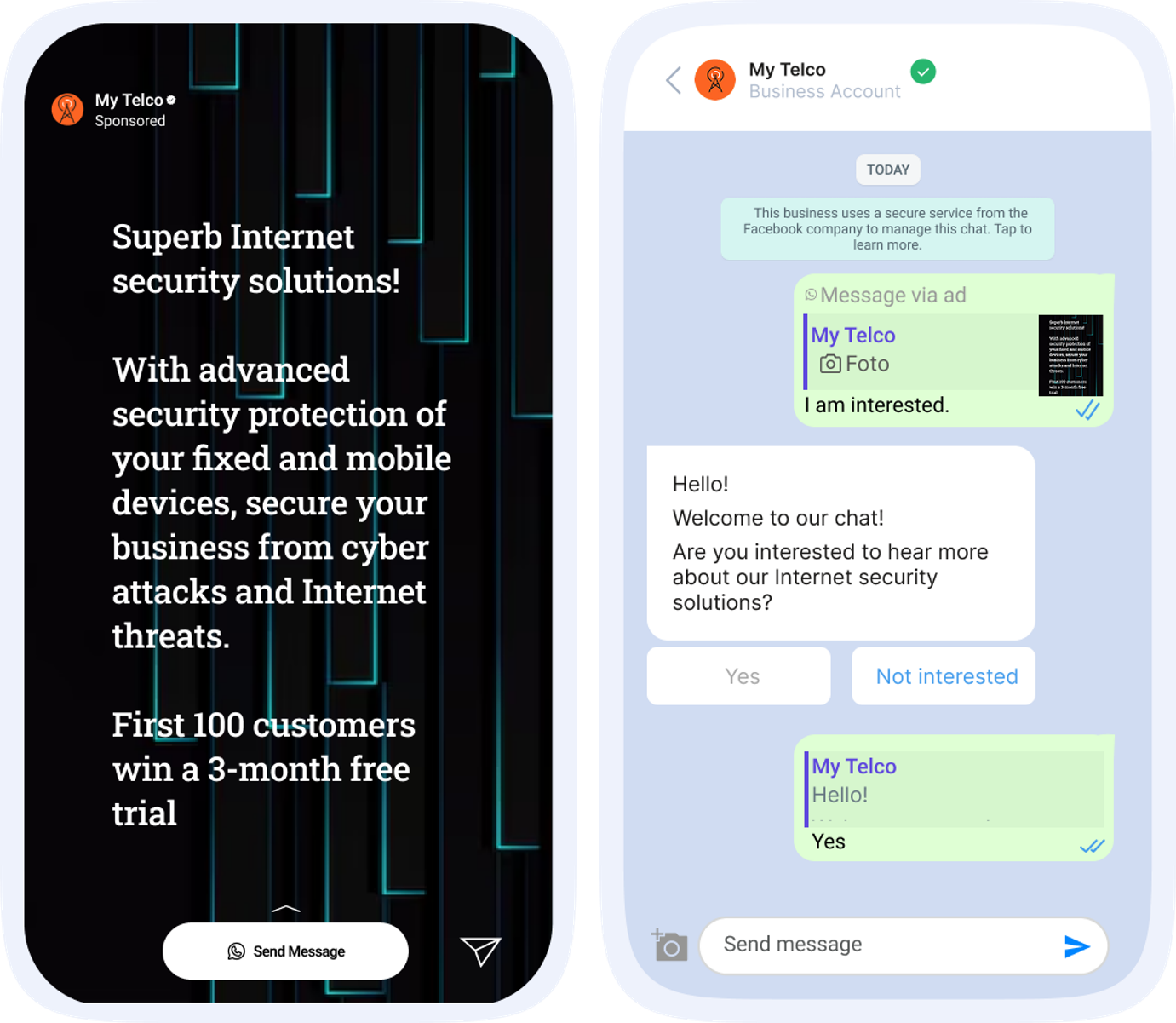
Two side-by-side smartphone screens. The first shows a dark Instagram story ad with vertical green lines and text: "Superb Internet security solutions! With advanced security protection of your fixed and mobile devices, secure your business from cyber attacks and Internet threats. First 100 customers win a 3-month free trial." A "Send Message" button is visible. The second screen shows a WhatsApp chat where the user writes "I am interested" and the bot replies, "Hello! Welcome to our chat! Are you interested to hear more about our Internet security solutions?" with buttons "Yes" and "Not interested." The user taps "Yes."

2. Use smart chatbots for self-service

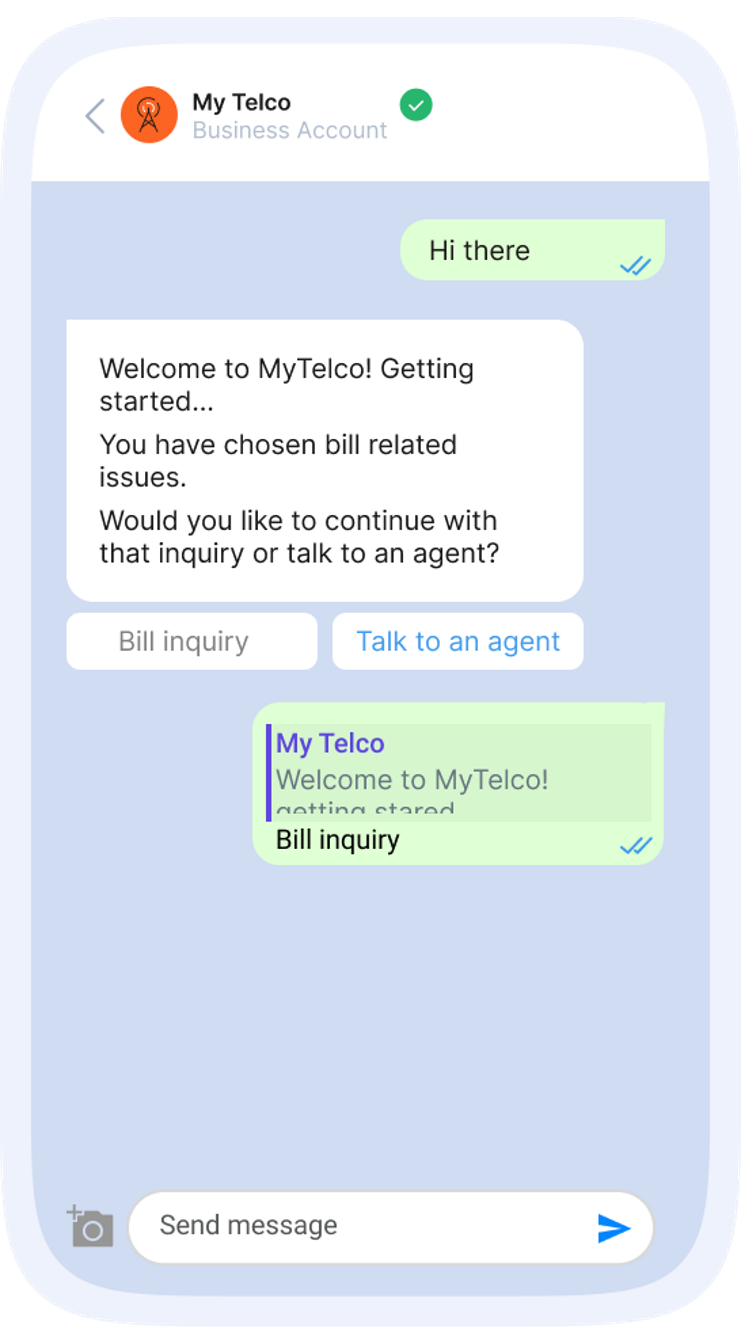
Deploy chatbots on WhatsApp, Messenger, Viber, and RCS to offer 24/7 support. Combine automation with human escalation (if needed) so customers can resolve billing questions, schedule visits, or report issues without calling a contact center. This reduces phone calls, improves response times, and allows customer support teams to focus on complex cases.

A smartphone screen shows a WhatsApp chat with My Telco business account. The user sends "Hi there." The bot replies, "Welcome to MyTelco! Getting started... You have chosen bill related issues. Would you like to continue with that inquiry or talk to an agent?" Two reply buttons appear: "Bill inquiry" and "Talk to an agent." The user selects "Bill inquiry."

3. Improve technician scheduling

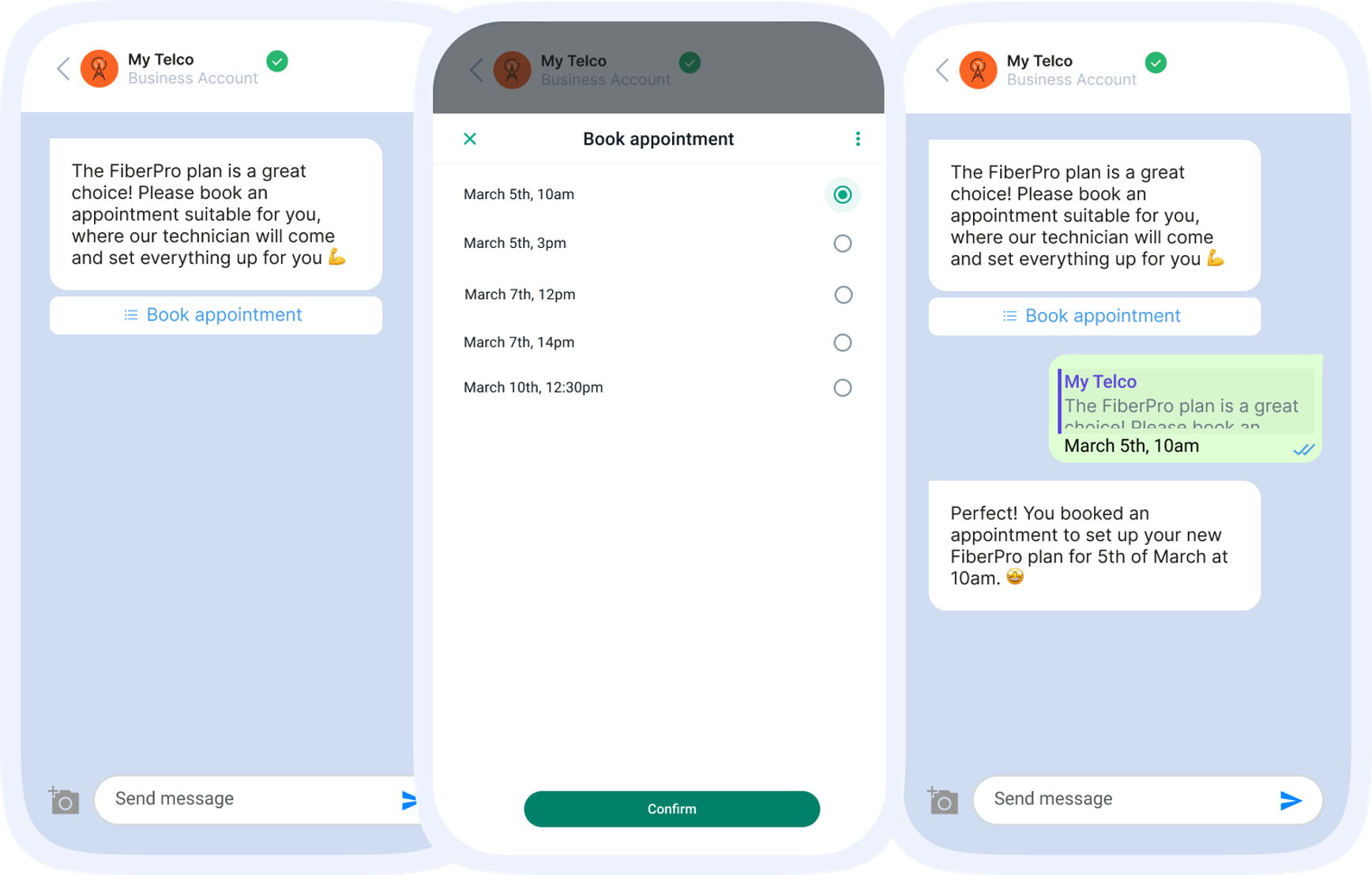
Enable one-click technician booking, send reminders, and allow rescheduling via chat. Field staff can upsell add-ons on-site, increasing ARPU per visit while reducing missed appointments and delivering high-quality service that customers notice.

Three mobile phone screens showing a customer booking a service appointment through Infobip RCS Business Messaging, branded as My Telco Business Account. First screen: chat message says 'The FiberPro plan is a great choice! Please book an appointment suitable for you, where our technician will come and set everything up for you 💪' with a 'Book appointment' button and a send message input. Second screen: 'Book appointment' selection with dates and times: March 5th, 10am (selected), March 5th, 3pm, March 7th, 12pm, March 7th, 14pm, March 10th, 12:30pm, and a confirm button. Third screen: chat history repeats the plan offer and booking info, confirms appointment for March 5th, 10am; message says 'Perfect! You booked an appointment to set up your new FiberPro plan for 5th of March at 10am. 😁'.

4. Support installations with video

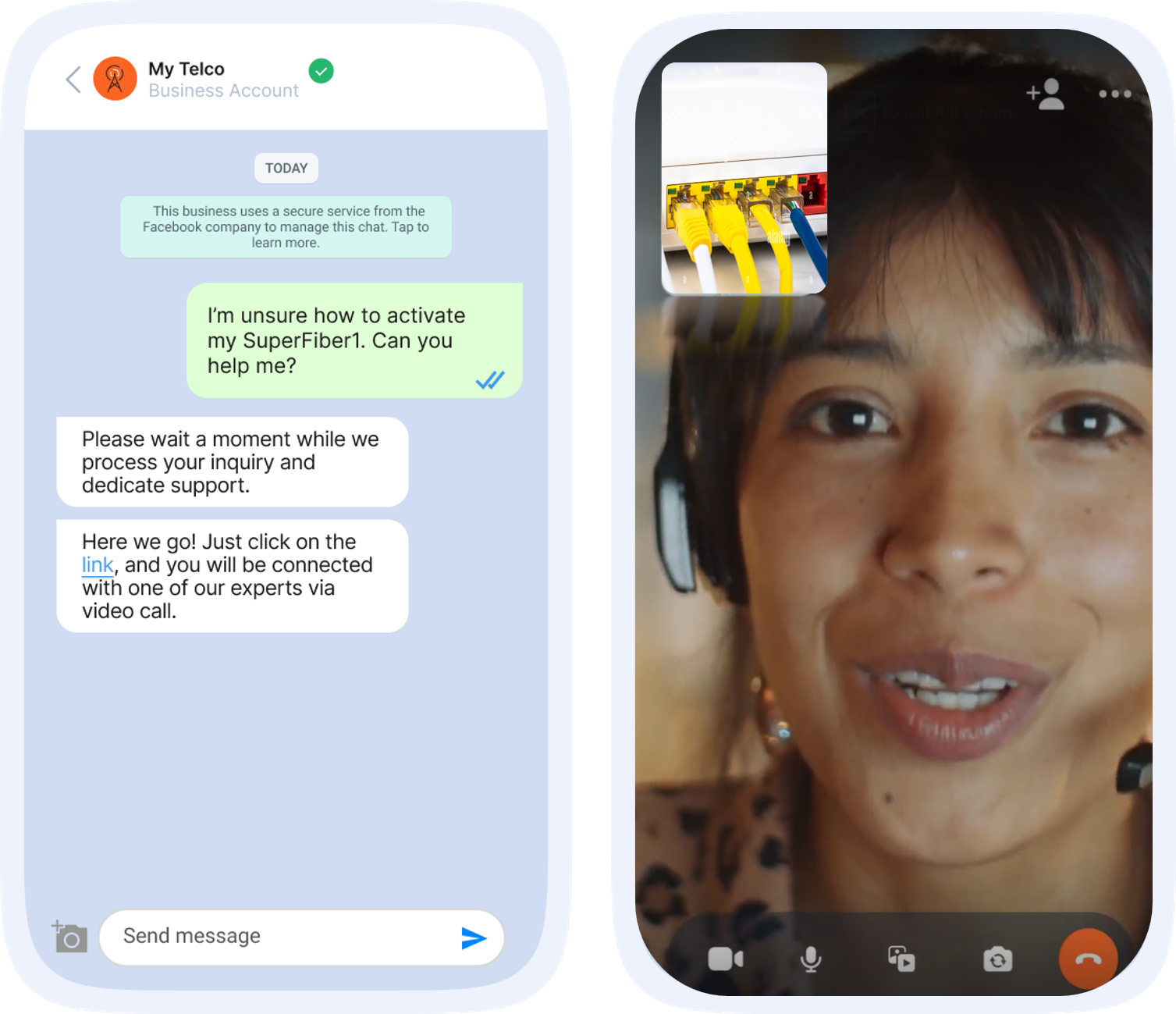
Offer real-time video support to guide customers through self-install steps. This minimizes home visits, reduces service desk load, speeds up activation, and reduces calls to your support team.

Two smartphone screens. Left screen shows WhatsApp chat: user writes, "I’m unsure how to activate my SuperFiber1. Can you help me?" My Telco replies: "Please wait a moment while we process your inquiry and dedicate support. Here we go! Just click on the link, and you will be connected with one of our experts via video call." Right screen shows an ongoing video call: a support agent wearing a headset speaks, with a small picture-in-picture showing a modem with connected cables.

5. Proactively communicate outages

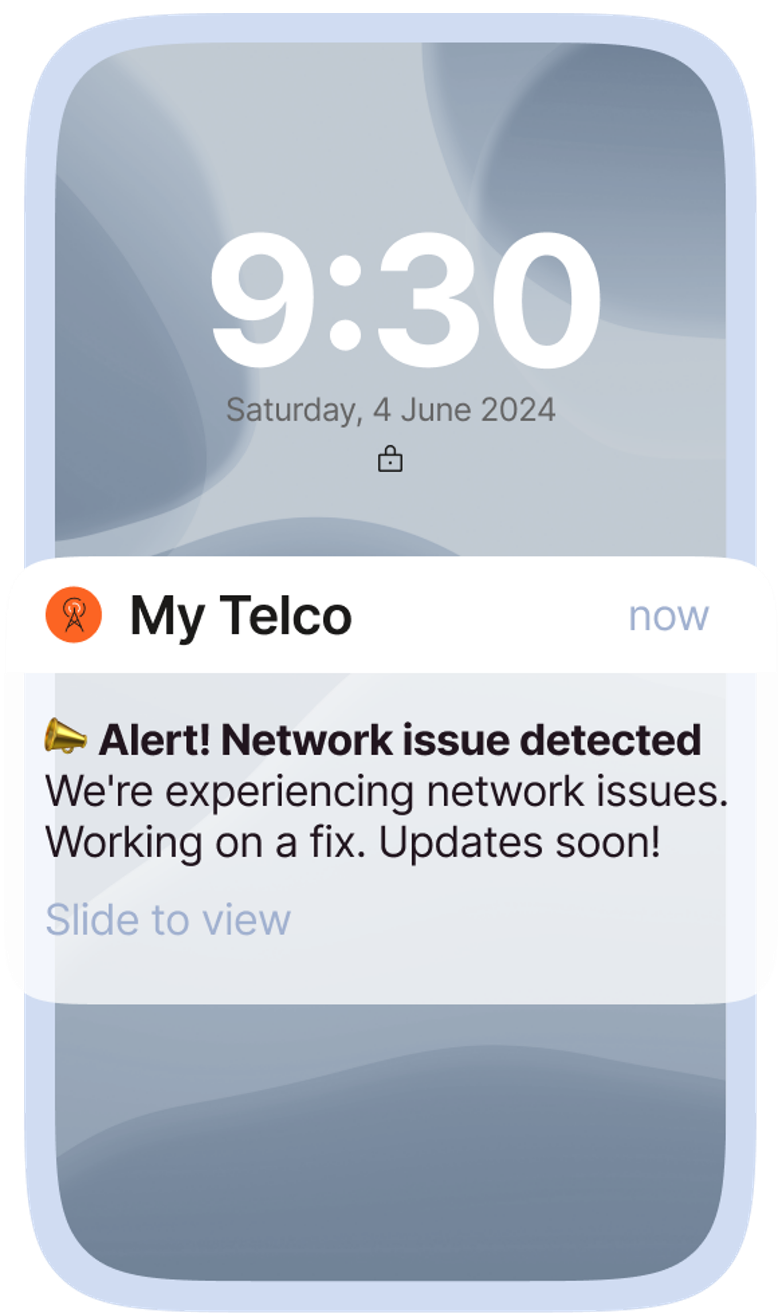
Use messaging channels to send real-time alerts about service issues or planned maintenance. Transparency builds trust and helps deflect inbound complaint calls.

A smartphone lock screen notification from My Telco reads: "📣 Alert! Network issue detected. We're experiencing network issues. Working on a fix. Updates soon!" Timestamp: Saturday, 4 June 2024, 9:30.

6. Automate billing and usage notifications

Send automated updates for invoices, balances, and data usage. Follow up with conversational debt collection reminders and secure payment links over chat. Customers feel in control, and billing-related calls drop significantly.

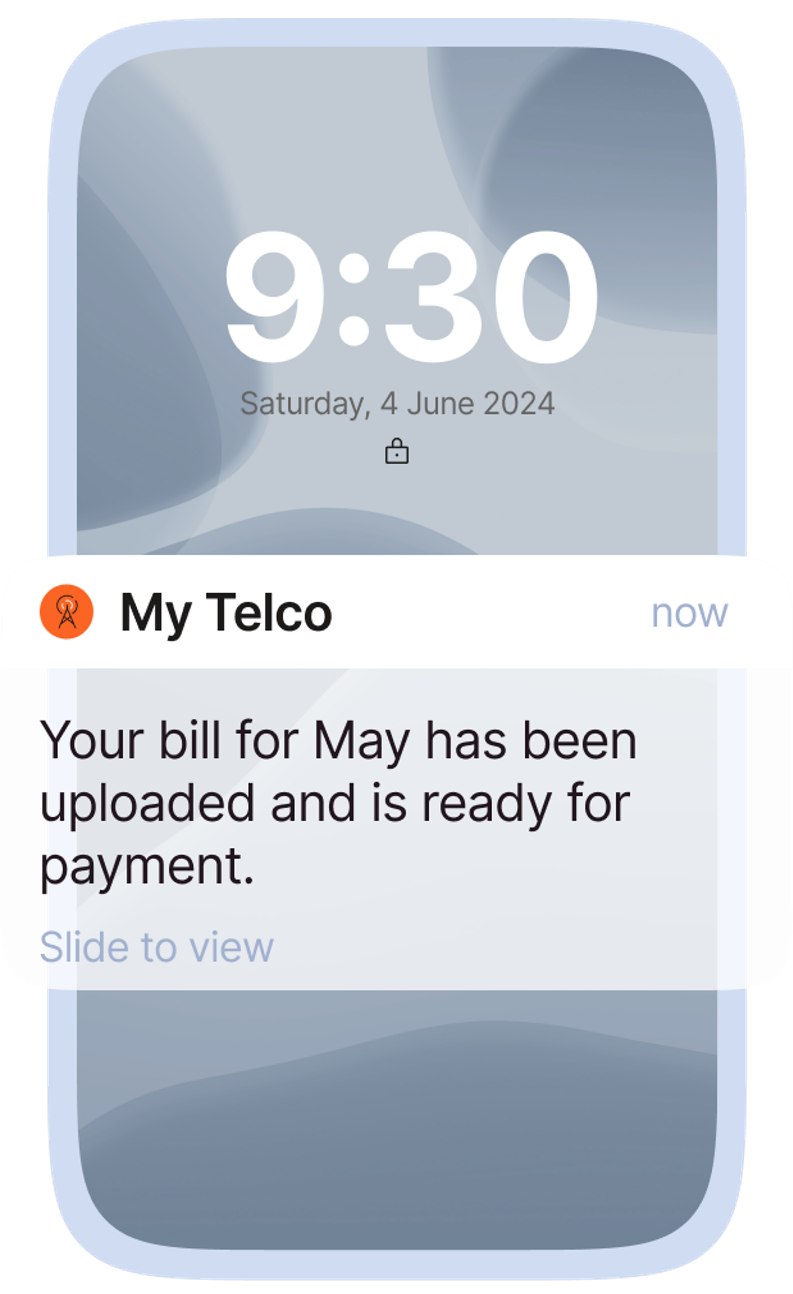
A smartphone lock screen notification from My Telco reads: "Your bill for May has been uploaded and is ready for payment." Timestamp: Saturday, 4 June 2024, 9:30.

7. Use AI for smarter CX and operations

For ISPs, using AI means helping customers: predicting issues before they happen, routing requests to the right agent, and giving clear, instant answers to common questions.

Practical AI use cases for ISPs include:

  • Predicting outages or network slowdowns so you can warn customers early
  • Suggesting the best-fit service plan or upgrade based on real usage data
  • Automating appointment scheduling and follow-ups to reduce no-shows
  • Spotting churn signals and triggering personalized save offers

8. Personalize upsell and retention campaigns

Leverage customer data to offer plan upgrades, streaming bundles, or loyalty rewards. Trigger contextual retention offers before contract expiry to prevent churn.

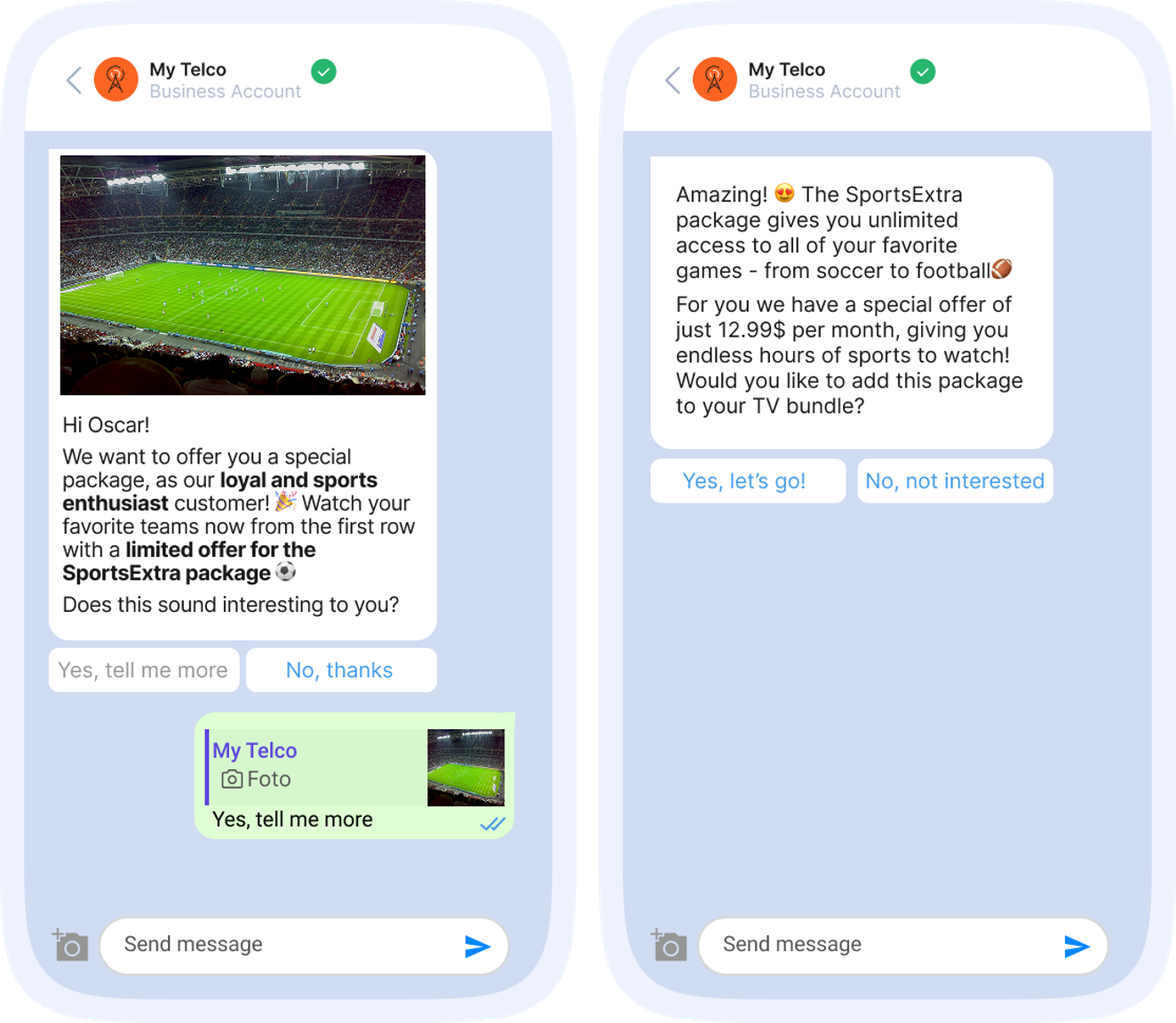
Two smartphone screens show a personalized WhatsApp marketing conversation. The first screen displays a stadium image and a message: "Hi Oscar! We want to offer you a special package, as our loyal and sports enthusiast customer! 🎉 Watch your favorite teams now from the first row with a limited offer for the SportsExtra package ⚽ Does this sound interesting to you?" Buttons: "Yes, tell me more" and "No, thanks." The user taps "Yes, tell me more." The second screen continues: "Amazing! 😍 The SportsExtra package gives you unlimited access to all of your favorite games - from soccer to football🏈 For you we have a special offer of just 12.99$/month, giving you endless hours of sports to watch! Would you like to add this package to your TV bundle?" Buttons: "Yes, let's go!" and "No, not interested."

Telekom Deutschland: Elevating customer engagement with RCS Business Messaging

Customers were sent an eye-catching RCS message straight into their default messaging app via Moments. Unexpected questions were directed to the right human agent via Conversations.

On the backend, Conversations also gave Telekom Deutschland agents a clear view of any customer’s interaction with a message. This helped the agents fast-track any conversation to conversion. .

  • 2x

    better performance than previous SMS-based campaign .

Virgin Mobile (now Virgin Media O2): Increased engagement and phone upgrades through rich, interactive RCS messages

Virgin wanted to start creating more engaging campaigns, while retaining the great reach and reliability that SMS campaigns delivered. They saw a good opportunity for a test case: an upcoming offer on some of the latest Samsung phones.

Together, with Virgin Mobile’s marketing team, our Professional Services planned out an RCS campaign that would bring the offer to life. 

Customers who were identified for a handset upgrade were sent rich marketing messages featuring image-rich carousels of the new device. The campaign approach, including which customers should be targeted and their respective journeys, was executed via our customer engagement solution, Moments. .

  • 93%

    delivery rate .
  • 60%

    seen rate .

9. Collect feedback and act on it

Send CSAT or NPS surveys after key interactions. Use sentiment analysis to spot dissatisfaction early and take action before customers switch providers.

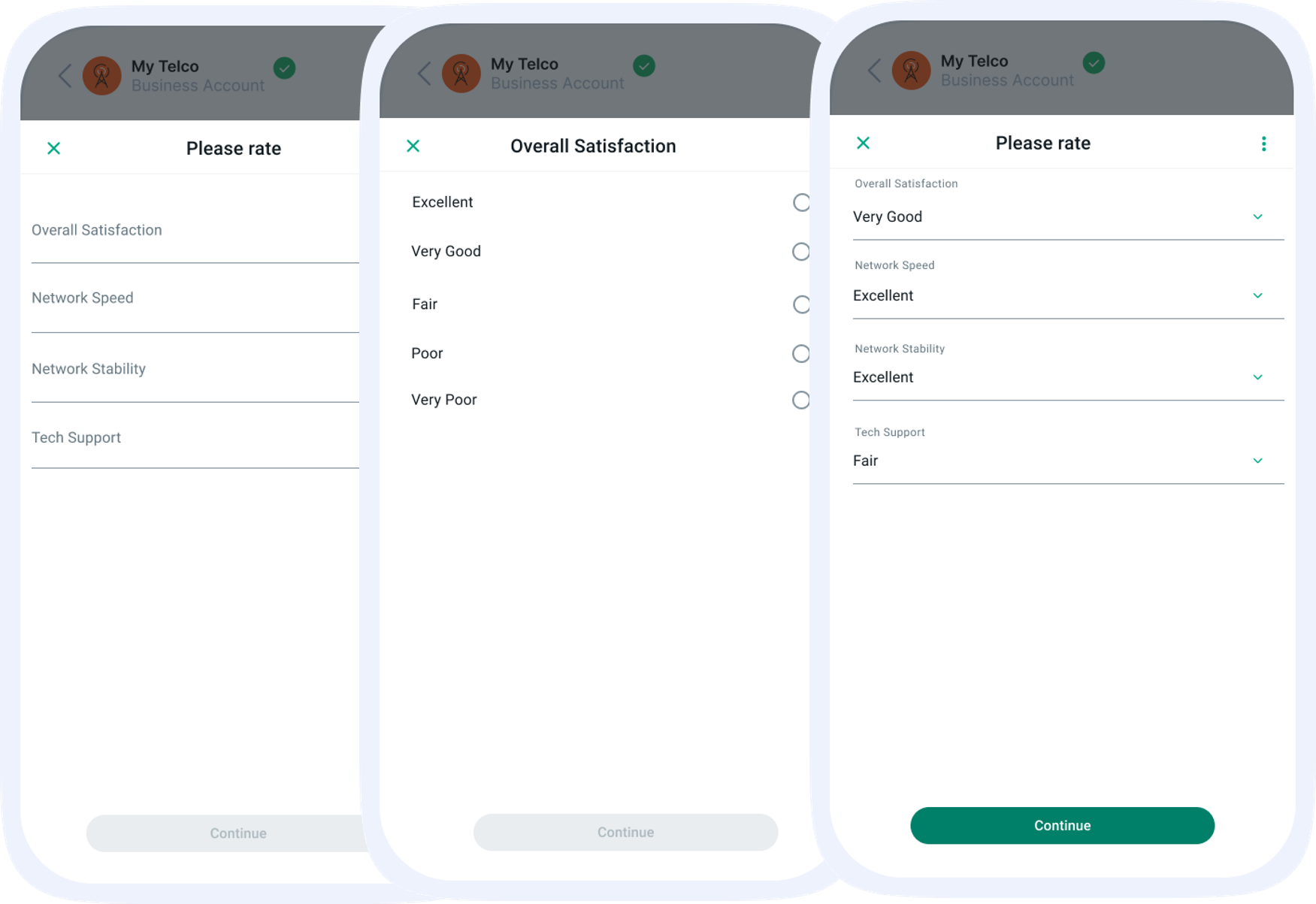
Three smartphone screens show a customer feedback form within WhatsApp. First screen: "Please rate" with fields: Overall Satisfaction, Network Speed, Network Stability, Tech Support. Second screen: user selects "Excellent" for Overall Satisfaction from options Excellent, Very Good, Fair, Poor, Very Poor. Third screen: completed ratings: Overall Satisfaction – Very Good, Network Speed – Excellent, Network Stability – Excellent, Tech Support – Fair, with a green "Continue" button enabled.

10. Make security and compliance a CX differentiator

Customer trust is one of the most valuable assets an Internet Service Provider can build. As more touchpoints move online, so does the responsibility to protect sensitive data.

ISPs can strengthen trust by:

  • Investing in advanced cybersecurity and fraud detection systems
  • Ensuring regulatory compliance with GDPR, CCPA, and other data privacy laws
  • Using AI-powered anomaly detection to catch unusual activity before it escalates

11. Simplify equipment returns

Digitize the process of returning modems, routers, or set-top boxes. Automated reminders and easy instructions speed up account closure and improve asset tracking.

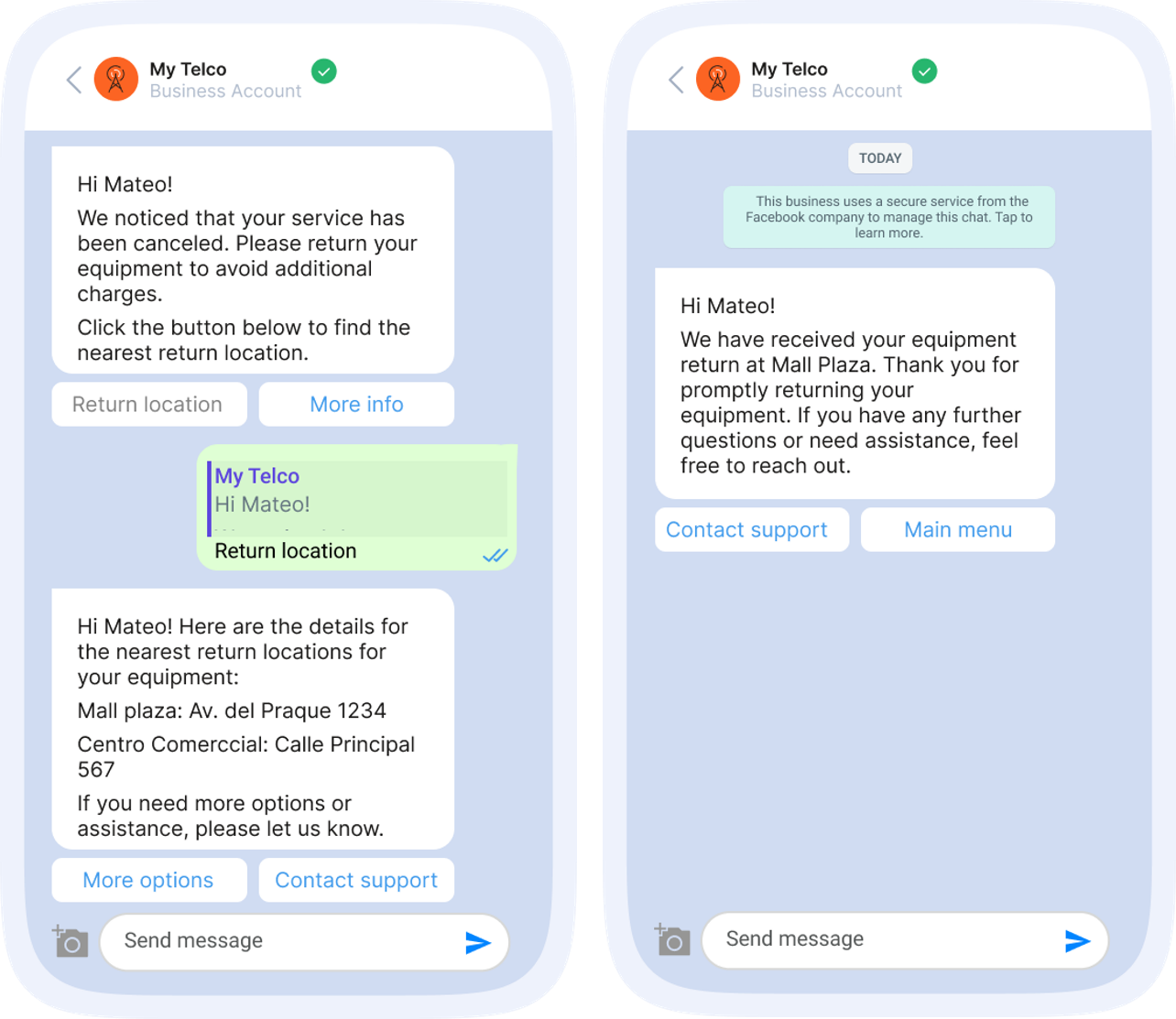
Two smartphone screens show equipment return coordination via WhatsApp. First screen: My Telco writes, "Hi Mateo! We noticed that your service has been canceled. Please return your equipment to avoid additional charges. Click the button below to find the nearest return location." Buttons: "Return location" and "More info." The user taps "Return location." My Telco replies with nearest return addresses: "Mall Plaza: Av. del Praque 1234, Centro Comercial: Calle Principal 567," and offers "More options" and "Contact support." Second screen: My Telco confirms, "Hi Mateo! We have received your equipment return at Mall Plaza. Thank you for promptly returning your equipment. If you have further questions or need assistance, feel free to reach out." Buttons: "Contact support" and "Main menu."

12. Embrace partnerships and new services

The future of ISP growth lies in offering more than connectivity. Bundle security software, cloud storage, or streaming subscriptions to add value. Partnerships with leading tech players help you stay competitive and attract new audiences.

13. Explore IoT and smart-home opportunities

Connected devices give Internet Service Providers an entirely new way to add value. From smart thermostats and security cameras to connected appliances, customers want their homes to work seamlessly and they need reliable, high-speed internet to make it happen. This not only deepens customer relationships but also opens up new revenue streams and positions ISPs as trusted technology partners in the connected-home era.

Building the connected future

Transforming the ISP customer experience doesn’t have to mean overhauling everything at once. The most successful providers start by digitizing key journeys, automating support where it matters most, and using data to personalize interactions. All areas where Infobip can help.

With Infobip, you get a partner who understands both telco infrastructure and customer engagement:

  • 800+ direct operator connections
  • 3,500+ employees across 75+ offices
  • Operations in 190+ countries

Our omnichannel platform brings together messaging, chatbots, automation, and analytics in one place, so you can provide proactive, personalized, and secure experiences across every channel your customers use.

Start creating connected experiences your customers will love

Keep reading:

Get the latest insights and tips to elevate your business

By subscribing, you consent to receive email marketing communications from INFOBIP. You have the right to withdraw your consent at any time using the unsubscribe link provided in all INFOBIP’s email communications. For more information please read our Privacy Notice

The rising threat of SIM swap fraud and how to protect your business

Learn about the dangers of SIM swapping fraud, and what can be done to prevent it from causing serious financial loss.

Razan Saleh Group Content Marketing Manager
Skip to table of contents

SIM swap fraud has exploded from a telecom concern into a universal threat impacting all industries. Recent cyberattacks on major retailers like M&S and Harrods show that any business handling customer data is now at risk. In just the first half of 2024, SIM swap incidents in the UK surged by over 1,000%, with £5.35 million in financial losses attributed to SIM swap fraud between 2023 and 2024.

The fallout goes beyond financial damage. Communications fraud now threatens brand reputation, disrupts supply chains, and erodes customer trust. As cyber threats evolve, businesses must shift their focus from simply maintaining service to actively safeguarding sensitive data, especially as regulatory scrutiny and potential fines intensify.

No business, regardless of size or sector, can afford to treat communications security as optional. Advanced, layered security and firewall are now essential for protecting customer data, maintaining trust, and safeguarding business operations.

What is SIM swap fraud?

At its core, SIM swap fraud is a form of account takeover fraud and Cybercrime where scammers exploit the process of swapping SIM cards to access a victim’s personal and financial information. They gain unauthorized control over the victim’s phone number, which enables them to take over social media or bank accounts.

In short, here’s how it works:

  • Cybercriminals legally or illegally get access to your data (including mobile phone number) and contact mobile network operators (MNOs) pretending to be you.
  • They deceive the MNOs into activating a new SIM card with your phone number.
  • Once the new SIM card is activated, fraudsters can access every one-time-pin (OTP) and two-factor authentication (2FA) message sent to that number, effectively gaining access to all your accounts that use your phone number for verification.

This lets them receive all calls and SMS messages sent to the original number, including OTPs and 2FA codes used by banks, retailers, and online services for two factor authentication.

Armed with access to these codes, fraudsters can reset passwords, drain bank accounts, make unauthorized purchases, and steal sensitive business data.

Social engineering is at the heart of most SIM swap attacks, with fraudsters exploiting personal data from breaches or phishing, and sometimes even recruiting insiders within telecom operators (BioCatch/Financial Times, May 2023).

Why is SIM swap fraud on the rise?

SIM swap fraud thrives due to our growing dependence on phone numbers for security key accounts, oversharing personal information online, and gaps in telecom security practices.

When personal details are easily accessible through social media or data breaches, scammers can impersonate victims and convince mobile operators to transfer their number to a new SIM card, often bypassing weak verification steps.

This enables attackers to gain control of sensitive accounts protected by two-factor authentication, putting both individuals and businesses at risk.

Several other trends are fueling the dramatic spike in SIM swap fraud:

  • Widespread reliance on SMS and OTPs for verifying digital identity means a single compromised phone number can unlock multiple accounts.
  • Massive data breaches across industries have put personal information needed to pull off a SIM swap within easy reach of attackers.
  • AI and automation make it easier than ever for fraudsters to launch convincing phishing attacks and social engineering campaigns at scale.

The result? SIM swap fraud is now a top risk not just for telecoms but also for retailers, eCommerce providers, banks, fintech, and consumers worldwide. In the U.S., the FBI estimates average losses of $10,000 per victim (IC3 Report). As more businesses move to mobile, this risk will only grow.

Impact of SIM swap on Retail & eCommerce and how to prevent it

Trust and revenue at stake

SIM swap attacks are increasingly targeting retailers and eCommerce platforms. These attacks can result in unauthorized purchases, emptied loyalty accounts, lost revenue, data breach, and customer access.

These incidents don’t just mean financial losses, they can also trigger operational disruptions and long-term reputational damage. When high-profile breaches make headlines, brands risk losing the very trust they’ve built with their customers.

How can businesses protect themselves and their customers?

Effective SIM swap fraud prevention in retail and eCommerce starts with layered security:

  • Integrate SIM swap detection from network APIs into fraud prevention workflows. If a SIM swap is detected, require extra identity verification—such as biometric authentication—before allowing sensitive actions like high-value purchases or password changes.
  • Combine telco data with behavioral analytics to flag suspicious login attempts, location changes, or account updates.
  • Educate customers at critical touchpoints (like checkout and profile updates) about the risks of SIM swap attacks and best practices for digital identity protection.

Impact of SIM swap on telecom operators and how to prevent it?

Telecom operators occupy a unique position as both frequent targets and frontline defenders against SIM swap fraud. If attackers slip past weak verification processes, telcos can face regulatory fines, customer churn, operational costs, and severe reputational harm. The responsibility to detect and prevent SIM swaps is greater than ever.

Best-in-class telecom security now includes:

  • AI-driven analytics to monitor for abnormal SIM swap patterns—such as mass porting events or sudden changes in user location.
  • Stricter internal controls: Limiting and rotating employee access to SIM management systems, and enforcing multi-factor authentication for staff.
  • Active customer confirmation: Requiring direct digital approval from customers before processing any SIM changes, closing a key social engineering loophole.

Impact of SIM swap on banks & financial services and how to prevent it

For banks, fintechs, and financial service providers, SIM swap fraud can swiftly undermine SMS-based two-factor authentication, opening the door to direct financial theft, regulatory breaches, and customer attrition.

The speed and scale of SIM swap-enabled attacks make robust fraud prevention critical in financial services.

Leading financial institutions are adopting a multi-layered approach:

  • Adopt out-of-band authentication methods such as secure banking apps, push notifications, or voice biometrics instead of relying solely on SMS OTPs.
  • Monitor recent SIM activity: Flag accounts with recently swapped SIMs and require additional verification for high-risk transactions.
  • Establish real-time data sharing with telcos via network APIs, so that suspicious activity can be detected and stopped before funds are lost.

How to detect and prevent SIM swap fraud?

To detect SIM swap fraud, businesses can check for changes to a mobile user’s phone number (MSISDN) and International Mobile Subscriber Identity (IMSI) number.

An IMSI number is unique to each SIM card and is used to identify every mobile phone subscriber on a UMTS or GSM network. The IMSI remains unchanged even when a mobile (MSISDN) number is ported to a different SIM card.

Our Mobile identity solution can assist enterprises in mitigating SIM swapping by recent changes in the MSISDN – IMSI combination on the side of the mobile operator.

For example, when a bank sends OTP codes for user verification, it may also carry out a SIM swap check. This will ensure the bank isn’t sending a verification code to a fraudster who has acquired a new SIM card with the same mobile number as the account they are attempting to hack.

In other words, it can provide information on which phone number is currently assigned to a particular SIM card. Most commonly, business trigger a SIM swap check right before a high-risk action, such as a large transaction or password reset, to ensure the request is coming from the legitimate user. If a SIM swap is detected, businesses can require additional verification before allowing the action to be taken.

RCS message from a bank asking the customer to answer a security question to verify identity, illustrating a SIM swap scam attempt.
Example of a fraudulent bank message blocking a payment after receiving a security answer, highlighting SIM swap scam tactics through RCS messaging.
Scam bank message confirming a fake transaction and attaching a receipt PDF, demonstrating how SIM swap fraudsters trick users into downloading malicious files.

Strengthening fraud prevention with RCS and Network APIs

Combining Rich Communication Services (RCS) with Network APIs gives telcos and enterprises a smarter, more secure way to deliver trusted and high-impact messaging.

APIs for SIM swap detection, Silent Number Verification, Know Your Customer (KYC) checks, and device location enable businesses to build fraud protection and identity assurance directly into the messaging flow, without adding friction for users.

Delivered through RCS with verified sender profiles, these interactions feel seamless to customers while giving businesses more control and security than traditional SMS or OTT apps.

As demand for secure, high-engagement channels grows, Network APIs become a new source of value. By offering them alongside RCS as a managed service, operators can position themselves as trusted technology partners while generating new revenue through API consumption.
Infobip’s role in securing the ecosystem from SIM swap fraud

Working with businesses across industries, we can confidently say that effective SIM swap fraud prevention is never about one tool or one policy. It’s about layering the right technologies, processes, and ongoing education.

As attackers evolve their tactics, businesses must adapt, updating their strategies to protect their customers, their brand, and their bottom line.

Here’s how we help businesses stay protected:

  • Real-time network intelligence: Our SIM Swap Detection API instantly alerts you to SIM changes, so you can pause suspicious activity and require extra verification before fraud occurs.
  • Modern network firewalls: Anam Protect detects and blocks unauthorized SIM swaps and suspicious port-outs at the network edge.
  • Stronger mobile identity verification: Silent verification, device-binding, and biometrics reduce dependence on vulnerable SMS codes.
  • RCS fraud prevention: Verified RCS business messaging, complete with brand logos and sender checkmarks, ensures secure and trusted customer communication.
  • AI and behavioral analytics: We flag unusual behaviors, such as device swapping or rapid transaction patterns, allowing for fast, targeted intervention.

What sets our approach apart is a commitment to ongoing vigilance, customer education, and close collaboration with industry partners. Fraud tactics never stand still, neither do we.

Every business is a target, but you can take action!

SIM swapping fraud is not just a telecom issue or a banking risk. It is a serious threat that can lead to significant financial loss and reputational damage. However, by taking proactive measures, both individual mobile users and businesses can significantly reduce the risk and consequences.

Ultimately, staying ahead of attackers requires continuous effort, collaboration, and adaptation. Businesses that prioritize security at every level, the right technology, process, and people are best positioned to safeguard their customers, protect their reputation, and thrive in today’s mobile-first world.

Ready to safeguard your customers and brand from SIM swap and digital identity fraud?

 Contact Infobip today to learn how we can help.

How Infobip MaaP helps MNOs manage and monetize RCS for business messaging

Razan Saleh Group Content Marketing Manager
Skip to table of contents

Each year, a growing share of A2P messaging traffic shifts to OTT (Over-the-Top) messaging apps, costing Mobile Network Operators (MNOs) significant revenue. While RCS presents a promising alternative to reclaim and grow that traffic with richer capabilities, the path to success has proven complex for many MNOs.

As a native messaging alternative to OTT apps like WhatsApp and Apple Messages for Business, RCS Business Messaging is quickly becoming the go-to channel for brands seeking richer, more personalized customer interactions.

Despite growing enterprise demand and market readiness, RCS adoption remains low among MNOs, mainly due to operational and strategic hurdles. The good news? There’s now a better way forward.

Read on to learn more about Infobip’s Messaging-as-a-Platform (MaaP) solution and how it can help MNOs manage and monetize RCS for Business Messaging more effectively.

Current challenges holding MNOs back from adopting RCS

While Google has been expanding its RCS footprint globally, MNOs are still struggling with the day-to-day realities of running and scaling RCS for Business effectively.

Here are the common challenges operators face:

  • Complex, manual agent management – Onboarding, approving, and monitoring RCS senders is complex.
  • Limited control over traffic – Most RCS traffic bypasses the operator network, offering no insight or monetization.
  • No scalable monetization model – Without visibility or billing infrastructure, A2P traffic moves to OTT platforms.
  • Fragmented market coverage – Without interconnectivity between carriers, brands can’t reach entire national audiences.
  • Resource constraints – Many operators lack dedicated teams to manage RCS operations internally.

These pain points are real, and they’re limiting revenue and relevance. The timing couldn’t be better for a smarter solution. Enterprises are ready, customers are using RCS-capable devices, and Google is prioritizing RCS rollout across mature and emerging markets.

The market is ready and so is Infobip MaaP

Infobip’s Messaging-as-a-Platform (MaaP) was built for this moment. It empowers MNOs to step back into the center of the RCS value chain with full control, visibility, and monetization opportunities.

What is Infobip MaaP?

Infobip MaaP (Messaging-as-a-Platform) is an all-in-one solution that helps operators efficiently manage, monetize, and scale their RCS for Business more effectively. Whether you’re just starting with RCS or looking to optimize existing workflows, MaaP gives you the flexibility and control you’ve been missing.

Infobip’s MaaP solution integrates with the Google Jibe RCS platform and gives MNOs full control over their RCS ecosystem, making it easier to accelerate RCS adoption, protect A2P messaging revenue, and provide enterprises with a seamless RCS for Business experience

Benefits of using Infobip MaaP

Infobip MaaP isn’t just a management console, it’s a comprehensive platform designed to help operators accelerate RCS adoption, retain A2P traffic, and monetize their networks effectively. Here’s how we do it:

1. Streamlined RCS agent management

Onboard, approve, reject, or suspend enterprise RCS senders from a single, intuitive interface. This reduces spam risk and accelerates enterprise go-lives.

Benefits:

  • Faster time-to-market for enterprise brands
  • Reduced operational overhead
  • Improved quality control of RCS traffic

 2. Advanced traffic control and security

Spam detection, content filtering, throughput throttling, and real-time analytics keep your RCS network secure and efficient.

Benefits:

  • Protects the RCS channel from abuse and fraud
  • Optimizes network performance for business messaging
  • Enables differentiated pricing models

 3. Global RCS coverage via interconnectivity

Seamlessly connect with other carriers to deliver RCS messages nationwide, regardless of the recipient’s operator.

Benefits:

  • Increases RCS adoption among enterprises
  • Improves competitiveness vs OTTs
  • Unlocks new monetization opportunities

4. Managed service offering

Don’t have an RCS operations team? Infobip can run it for you, from sender approvals to ongoing monitoring.

Benefits:

  • Minimal resource investment
  • Rapid deployment
  • Reliable, expert-led executing

5. Real-time analytics and actionable insights

Understand traffic patterns, sender behavior, and engagement levels with deep visibility into your RCS ecosystem.

Benefits:

  • Better monetization through insights
  • Network and campaign optimization
  • Increased transparency

6. Flexible commercial models

Choose from exclusive or non-exclusive partnerships, revenue-share options, and pay-as-you-grow pricing.

Benefits:

  • Aligns with your business strategy
  • Reduces entry barriers
  • Enables sustainable, long-term growth

Choosing the right MaaP solution

With deep roots in operator infrastructure and CPaaS innovation, we bring a unique perspective to the RCS space. Our MaaP offering is built specifically for the needs of modern operators:

  • Managed service: Great for early-stage adopters without dedicated RCS for business teams
  • Global RCS delivery: Interconnectivity ensures B2B clients get full coverage
  • Real-time insights: Gain transparency into who’s sending what, and how it performs
  • Faster onboarding: Rapid enablement of enterprise RCS traffic
  • Commercial flexibility: Choose from exclusive or non-exclusive business models
  • Compliance built-in: Stay ahead of local regulations with tools and workflows designed to meet telco and data protection requirements

From smarter agent management to full A2P traffic control and monetization, you’re no longer stuck on the sidelines. Let’s put your network back at the heart of enterprise messaging.

Ready to reclaim business messaging with Infobip MaaP?

Infobip’s MaaP gives your MNO the tools to own your RCS strategy end-to-end.

WhatsApp for telcos: How to transform CX and boost retention

Razan Saleh Group Content Marketing Manager
Skip to table of contents

Telcos play an important role in our daily lives, with us relying on them for connection, entertainment, and information.

But how connected do customers feel to their providers? According to Infobip research, not very:

  • 63% of customers say they have switched from their main provider 
  • 53% made the switch due to poor customer service 
  • 40% of customers stay with their telco provider anywhere between one to five years  

In an era when customer expectations are higher than ever, telcos are embracing new ways to enhance engagement and streamline communication. And with the accelerated adoption of digital channels comes the need for always-on communication.

WhatsApp has emerged as a key channel for telecom operators looking to deliver seamless, real-time interactions across every stage of the customer journey. From onboarding to support and retention, WhatsApp is redefining how telcos connect with their customers.

The growing adoption of WhatsApp in telecom

While call centers still play a role in the telco customer support ecosystem, we can see a shift to more digital channels. The growing adoption of WhatsApp by telcos is driven by the demand for instant, convenient, and personalized communication.

According to our 2024 Telco Messaging Trends report:

65%

have already integrated WhatsApp into their customer service strategy.

385%

increase in WhatsApp support interactions

6x

increase in WhatsApp marketing interactions

There is no doubt that telcos have been one of the first industries to recognize the benefit of using the channels that their customers trust and use every day.

By going digital and being available on WhatsApp, telcos can offer conversational experiences in marketing, sales and support on a single chat app that their customers use regularly.

With WhatsApp, telcos can:

  • Reduce churn by providing instant, 24/7 support
  • Streamline operations, reduce costs and improve customer satisfaction
  • Drive revenue by providing a richer range of services such as WhatsApp for upselling and cross-selling

Benefits of using WhatsApp for telcos

With WhatsApp, telcos can transform customer engagement, reduce friction, and create meaningful, conversational experiences throughout the customer journey.

Faster, more efficient customer service

Customers expect instant responses, and WhatsApp enables telcos to provide 24/7 automated support through AI-powered chatbots while seamlessly handing off complex issues to live agents. This reduces wait times, improves resolution speed, and enhances overall customer satisfaction.

Higher engagement and retention

With WhatsApp’s high open rates, telcos can send real-time notifications for billing, promotions, and loyalty rewards, keeping customers engaged and informed. Personalized recommendations and interactive product catalogs make it easy to upsell and cross-sell, increasing customer lifetime value (CLV).

Cost savings on customer support

Shifting customer interactions from voice calls to WhatsApp reduces call center strain by automating high-volume queries with chatbots and enabling agents to handle multiple conversations at once. This lowers operational costs while maintaining fast, high-quality customer support.

Enhanced customer experience

WhatsApp simplifies key interactions, from onboarding and service activation to troubleshooting and self-service account management, eliminating common customer frustrations. By offering a seamless digital journey, telcos can improve retention and ensure customers stay connected with minimal effort.

Personalization

Personalization is one of the biggest advantages WhatsApp offers telcos, helping them deliver tailored customer experiences that drive engagement, satisfaction, and retention.

By leveraging customer data and AI-driven insights, telcos can create one-to-one interactions, leading to personalized offers that convert.

Secure and reliable communication

With end-to-end encryption and verified business accounts, WhatsApp provides a secure, trusted channel for customer interactions.

By easily integrating with a customer data platform and a customer engagement solution, telcos can track engagement, personalize communication, and maintain compliance with industry regulations.

With these benefits in mind, let’s explore how telcos can leverage WhatsApp across the entire customer journey. Starting from acquisition to support and all the way to retention.

WhatsApp for telcos use cases

WhatsApp offers marketing, sales, and support use cases that make it a great channel for telcos to add to their communication mix.

Let’s have a quick look at how WhatsApp can be used across the telco customer journey.

Real-world success stories: How WhatsApp transforms telco CX

Why Infobip is the ideal WhatsApp provider for telcos?

Choosing Infobip as your WhatsApp provider will help you create customizable end-to-end customer journeys. Our goal is to empower telcos to connect with a vast audience of over 2 billion WhatsApp users across 180 countries, ensuring seamless and scalable communication.

Our platform offers the flexibility to integrate WhatsApp directly into your existing system via API or by using it through our omnichannel conversational solutions:

  • Answers, our chatbot building platform which helps you build AI-powered chatbots
  • Conversations, our cloud contact center to help you provide the best service
  • Moments, our customer engagement solution to maximize your engagement with personalized messages
  • People CDP, our customer data platform to help you collect, store, and activate your customer data

Whether you need to automate customer journeys, streamline support with AI-powered chatbots, or equip agents with a centralized communication hub, Infobip provides the tools and expertise to transform your WhatsApp strategy into a powerful customer experience advantage.

Ready to transform your telco’s CX?

Talk to our experts today to discover how WhatsApp can transform your telco business.

eSIM vs Standard SIM: Which is better?

What is an eSIM, how is it different than a standard SIM, and what are the pros and cons? Learn this and much more.

Razan Saleh Group Content Marketing Manager
Skip to table of contents

We’re all familiar with the term SIM card, which connects your phone to a mobile network operator (MNO) so you can access wireless service and have a unique phone number.

eSIM is revolutionizing the telecoms industry, offering a more flexible and convenient way to access mobile services, driven by Apple’s release of eSIM-only iPhone models in the US.

But how does eSIM compare to a physical SIM? Let’s find out.

Here, we will explore the benefits of an eSIM, how it differs from a standard SIM, and which devices and networks support it.

What is a physical SIM card?

Before we dive into the intricacies of eSIMs, let’s take a step back and revisit the familiar physical SIM card.

A physical SIM card, or Subscriber Identity Module, is a small, removable smart card you insert into your mobile device. It’s essentially your key to accessing a mobile network.

This little chip holds crucial information that identifies you as a subscriber to your chosen network operator, allowing you to make calls, send texts, and browse the Internet.

Over the years, physical SIM cards have evolved in size, from the credit card-sized giants of the early days to the mini, micro, and, ultimately, the nano-SIM cards commonly used in today’s smartphones.

To get a physical SIM card, you typically visit a mobile network operator’s store or order one online. Once you have the card, you need to activate it with your chosen network provider, which links your device to their services.

esim vs standard sim

What is eSIM?

An eSIM, or embedded SIM card, is a digital SIM built directly into your device’s hardware. Unlike traditional SIM cards that need to be physically inserted, an eSIM is a tiny chip inside your phone that functions similarly to the NFC chip used in payment systems like Apple Pay and Google Pay.

The information available on an eSIM card is rewritable and backed by the GSMA, which means you can choose to switch operators with just a quick phone call.

Linking devices with eSIMs to a mobile account and adding them to any data plan takes a few minutes.

And the rise of eSIM is undeniable:

  • Valued at approximately USD 8.07 billion in 2022, it’s projected to reach USD 17.5 billion by 2030.
  • By 2030, a staggering 6.7 billion smartphone connections – that’s 76% of the total – will be through eSIMs.

How are physical SIM cards and eSIMs similar?

While eSIMs represent a significant advancement in SIM technology, it’s easy to forget that both physical SIM cards and eSIMs share the same fundamental purpose: connecting your device to a mobile network.

Despite the differences in their physical form, these two technologies have more in common than you might think:

  • Network connectivity: This is the core function of both types of SIM. They enable your device to connect to a cellular network, giving you access to calling, texting, and mobile data.  
  • Device compatibility: Both physical SIMs and eSIMs are implemented in a wide range of devices, from smartphones and tablets to smartwatches and IoT devices.
  • Subscriber identification: Both store crucial information that identifies your phone and your connection details, including your chosen network and tariff plan.  
  • Dual SIM functionality: Devices that support dual SIM functionality allow you to use both physical SIM and eSIM technology simultaneously. This allows for greater flexibility in managing different numbers from multiple carriers without switching phones.
  • SIM at the core: Both technologies rely on a SIM module to function. One is a physical card, while the other is an embedded, almost virtual version.

What’s the difference between an eSIM and a standard SIM?

While we’ve already touched on some key differences, let’s explore what sets eSIMs apart from standard SIMs.

Size

  • Standard SIM: A physical card that needs to be inserted into a physical SIM slot. It has evolved in size over the years (mini, micro, nano) but still requires a physical presence.  
  • eSIM: A digital SIM embedded within the device’s hardware, eliminating the need for a physical card or SIM tray. It’s significantly smaller than even the nano-SIM.

Network flexibility

  • Standard SIM: Most SIM cards are locked to a single network, making it impossible for you to change them on your own without assistance from the carrier.
  • eSIM: Offers the flexibility to switch carriers remotely without intervention from the carrier.

Activation and management

  • Standard SIM: Typically requires carrier intervention for activation and deactivation.
  • eSIM: Users can activate, deactivate, and manage profiles directly from their devices.  

Advantages of eSIM

Beyond the core differences, eSIMs unlock a host of benefits:

Convenience

You can download and install eSIM profiles anytime, anywhere, with a network connection, without the need to visit a store or wait for a physical SIM card.  

Cost savings

eSIMs are cheaper to produce than traditional SIM cards due to their smaller size and reduced material requirements.  

According to the Consumer eSIM White Paper, the average cost of a plastic card is $2.50, including the card, packaging, and delivery. In contrast, an eSIM costs between $0.20 and $0.50. This means operators can reduce SIM-related expenses by up to 80% by switching to eSIMs. A mobile operator with 1 million subscribers and approximately 50% gross additions annually could save $1 million annually by transitioning to 100% eSIM provisioning.

Security

eSIMs cannot be physically lost or stolen, as they are embedded in the device.  

Flexibility

eSIM also allows dual SIM cards in one phone, allowing you to link your personal and work numbers to the same device. You can also purchase a local SIM card when traveling abroad and want to cut back on outrageously high data costs.

This opens up new revenue opportunities for mobile operators as their customers scale up their plans by adding new devices that require data.

Device compatibility

While yet to be universal, eSIM compatibility is increasing across various devices, including smartphones, tablets, laptops, and wearables.  

Streamlined management

IT teams can quickly and easily provision and deploy new devices with eSIM by providing a streamlined user experience for managing cellular connectivity.

Enhanced customer experience

Device bundling becomes much easier with eSIM, allowing customers to conveniently add new devices to their plans without visiting a store or waiting for a physical SIM card to be mailed.

eSIM use cases

Welcome to the city message

As soon as a user arrives in a specific location—whether a city center, a popular tourist spot, or even a shopping mall—businesses can trigger a welcome message with relevant information.

This message could include:

  • Greetings and a warm welcome to the city
  • Information about local events, attractions, and points of interest
  • Special offers and discounts from nearby businesses
  • An option to temporarily change their mobile plan to one that’s better suited for travelers, with increased data or local calling benefits
esim vs standard sim use case welcome to the city message

Roaming tips

Traveling internationally often involves navigating unfamiliar mobile networks and data roaming charges. eSIM can simplify this process, but users may still need guidance on how to manage their roaming settings effectively.

Instead of relying on lengthy text instructions or FAQs, businesses can send video instructions and provide a more engaging and user-friendly way to guide customers.

Short video tutorials can be sent to users:

  • Explaining how to switch to a local eSIM profile when traveling
  • Demonstrating how to manage data usage and avoid excessive roaming charges
  • Showcasing the benefits of using eSIM for international travel
esim vs standard sim use cases roaming tips

eSIM transfer alert

When users transfer their eSIM profile to a new device, it often signifies that they’ve upgraded or replaced their old phone. This presents a unique opportunity for businesses to engage with both the original owner and the new device user.

  • For the original owner: A message could be sent offering a discount, or incentive, if they’re selling their old device and the buyer activates a new plan with the same operator.
  • For the new user: A welcome message could be sent to the new device owner, offering them special deals on mobile plans or other services.
esim vs standard sim use cases esim transfer alert

Device and network support for eSIM

eSIM is supported by some of the biggest MNOs around the world. It is often activated on your phone by scanning a QR code provided to you when you buy the plan directly from the operator. Some eSIM-compatible carriers also have apps that allow users to purchase plans and customize pricing.

Although most modern flagships now support eSIMs, not all phones are compatible with them. Some of the devices compatible with eSIM include:

Smartphones

  • Apple iPhone models (from iPhone XR and XS onwards)
  • Samsung Galaxy S series (from S20 onwards)
  • Google Pixel phones (from Pixel 2 onwards)
  • Many other Android devices from various manufacturers

Tablets

  • Apple iPads (selected models)
  • Samsung Galaxy Tab series (selected models)
  • Microsoft Surface Pro X

Laptops

  • Apple MacBooks with Apple silicon (M1 and M2 chips)
  • Microsoft Surface Laptop series (selected models)
  • Lenovo ThinkPad series (selected models)

Wearables

  • Apple Watch Series 3 and newer
  • Samsung Galaxy Watch series (selected models)
  • Various smartwatches with cellular connectivity

eSIMs will also be great for tablets and laptops, where frictionless connectivity will be the standard. According to Vodafone, eSIMs will enable more connected devices simply because they don’t take up as much space within a device. As a result, this allows fitness trackers, smart watches, or even glasses to have stand-alone 4G or 5G connectivity in a way they weren’t able to before.

Driving eSIM adoption

The adoption of eSIM will depend on a collaborative effort of consumers, businesses, and technology providers.

  • By 2030, all new smartphones will support eSIM, and other linked technologies will probably do the same.

Telco operators are also responsible for ensuring their networks can handle the technology and offer a positive customer experience to businesses and consumers who want to adopt it. Updating your customer support systems and investing in a chatbot building platform that will automate communication and provide enhanced eSIM management capabilities can achieve that. This, in turn, will simplify the adoption of eSIM technology for customers and drive new use cases across the telco industry.

Businesses across various industries can also contribute to eSIM adoption by embracing eSIM in their own operations. This could involve switching company devices to eSIM, offering eSIM-compatible products or services, and promoting the benefits of eSIM to their customers.

Widespread adoption of eSIM not only reduces expenses or improves customer experience but also presents significant growth opportunities for both MNOs and Mobile Virtual Network Operators (MVNOs) by simplifying operations and opening new revenue streams.

  • MNOs – eSIM streamlines customer acquisition by enabling instant, remote activations without physical SIM cards, making it easier to attract and onboard new customers.
  • MVNOs – eSIM allows them to maintain their position in the roaming market. International travelers can seamlessly switch to local data plans using their existing eSIM profiles, reducing reliance on non-telco eSIM providers. This allows MNOs to enhance the customer experience and future-proof their business.

To fully realize the potential of eSIM, businesses can partner with platforms like Infobip to leverage the expertise and solutions, accelerate eSIM implementation, and maximize its benefits.

Our platform is designed to help businesses navigate and maximize eSIM potential by offering:

  • Effortless eSIM management: Enable efficient onboarding of eSIM devices and effortlessly manage connectivity profiles.
  • Global eSIM connectivity: Access a vast network of carrier partners to ensure seamless connectivity across different regions and countries.
  • Omnichannel communication capabilities: Our platform can deliver personalized messages, targeted campaigns, and engaging content to enhance customer interactions.
  • Expert support and guidance: Our expert teams provide dedicated support and advice to help you implement and optimize your eSIM strategy.

Reimagine the telco CX with conversational AI

Continue reading

Telekom Deutschland: Elevating customer engagement with RCS Business Messaging

2x

better performance than previous SMS-based campaign

Challenge:

Create dynamic cross sell campaigns to increase conversion rates

Telekom Deutschland, the operating subsidiary of Deutsche Telekom in Germany, wanted to spread the word about a Spotify Premium free trial offer to its subscribers. 

Traditionally, the telco provider had used SMS to communicate all of its subscriber offers (knowing that there is no better way to get people’s attention than the messaging inbox). But for such an exciting offer, they wanted a messaging campaign that was colorful and engaging enough to capture customers’ imaginations and convert them.

Telekom Deutschland knew that 50% of its subscribers’ phones were able to receive RCS messages — an upgrade to text messages with features such as images, video, carousels, and interactive buttons. 

Importantly, RCS (short for Rich Communication Services) messages can also be branded with a company’s colors and logo.  

Telekom Deutschland came to Infobip for help creating an end-to-end customer engagement journey. They wanted to send RCS messages to the phones that accepted it, and SMS messages to the phones that didn’t.

Solution:

Implementing an omnichannel campaign built around RCS richness

Telekom Deutschland and Infobip kicked off the collaboration by brainstorming innovative marketing ideas that would get subscribers to sit up and take notice of the Spotify Premium offer.

The campaign featured RCS messages with:

  • Rich media carousels
  • Suggested CTA buttons
  • Telekom Deutschland and Spotify’s colors and logos

To take customers from awareness all the way to conversion, our customer experience experts helped Telekom Deutschland create an end-to-end customer engagement journey using:

  • Moments: our omnichannel customer engagement solution, which helped setup the flows, automate the campaign, and send messages at the right times.
  • Conversations: our digital-first contact center which allowed customers to effortlessly contact a human agent from the RCS message to know more and activate their Spotify premium membership

The campaign ran like clockwork. Customers were sent an eye-catching RCS message straight into their default messaging app via Moments. Unexpected questions were directed to the right human agent via Conversations.

On the backend, Conversations also gave Telekom Deutschland agents a clear view of any customer’s interaction with a message. This helped the agents fast-track any conversation to conversion.

The team at Infobip understood the campaign objectives, so pairing this with their unrivaled technology expertise meant we could use RCS Business Messaging to communicate with customers the same way we would interact with friends.

Thomas Welzel

Senior Proposition Manager Messaging, Deutsche Telekom

Result:

RCS delivers twice the engagement of SMS

The first campaign launched in August 2021. The results were clear — the RCS messages performed 2X better than the SMS messages in terms of engagement and conversions.

Open rates were sky high. Branding RCS messages with Telekom Deutschland’s name and logo boosted customers’ trust and confidence. 

The second campaign began in October. Real-time analytics via our platform enabled Telekom Deutschland to make quick campaign tweaks to the campaign in Moments, resulting in even better performance:

  • 26% higher open rate
  • 66% higher engagement
  • 120% higher conversion

Following the successful rollout, Telekom Deutschland began looking to drive a wider adoption of RCS in Germany. Fast forward to 2024, and a crucial decision by Apple to support RCS messaging on its phones is set to turbocharge the use of RCS Business Messaging generally. Businesses will be able to reach a large majority of the population with rich and engaging RCS messages.

The ability to brand messages on RCS with the name and logo, along with access to customer support boosted their customer’s trust and confidence. Encouraging them to become a Spotify user.

It was great to work alongside Infobip right from the implementation process to ensure the creation of a rich media marketing campaign that would engage customers and convert them into audio streamers.

Thomas Welzel

Senior Proposition Manager Messaging, Deutsche Telekom

Company Profile

Deutsche Telekom AG

Deutsche Telekom AG is one of the world’s leading integrated telecommunications companies. It provides broadband, mobile communications, internet, and IPTV products and services to hundreds of millions of consumers. It also delivers information and communication technology solutions to businesses